
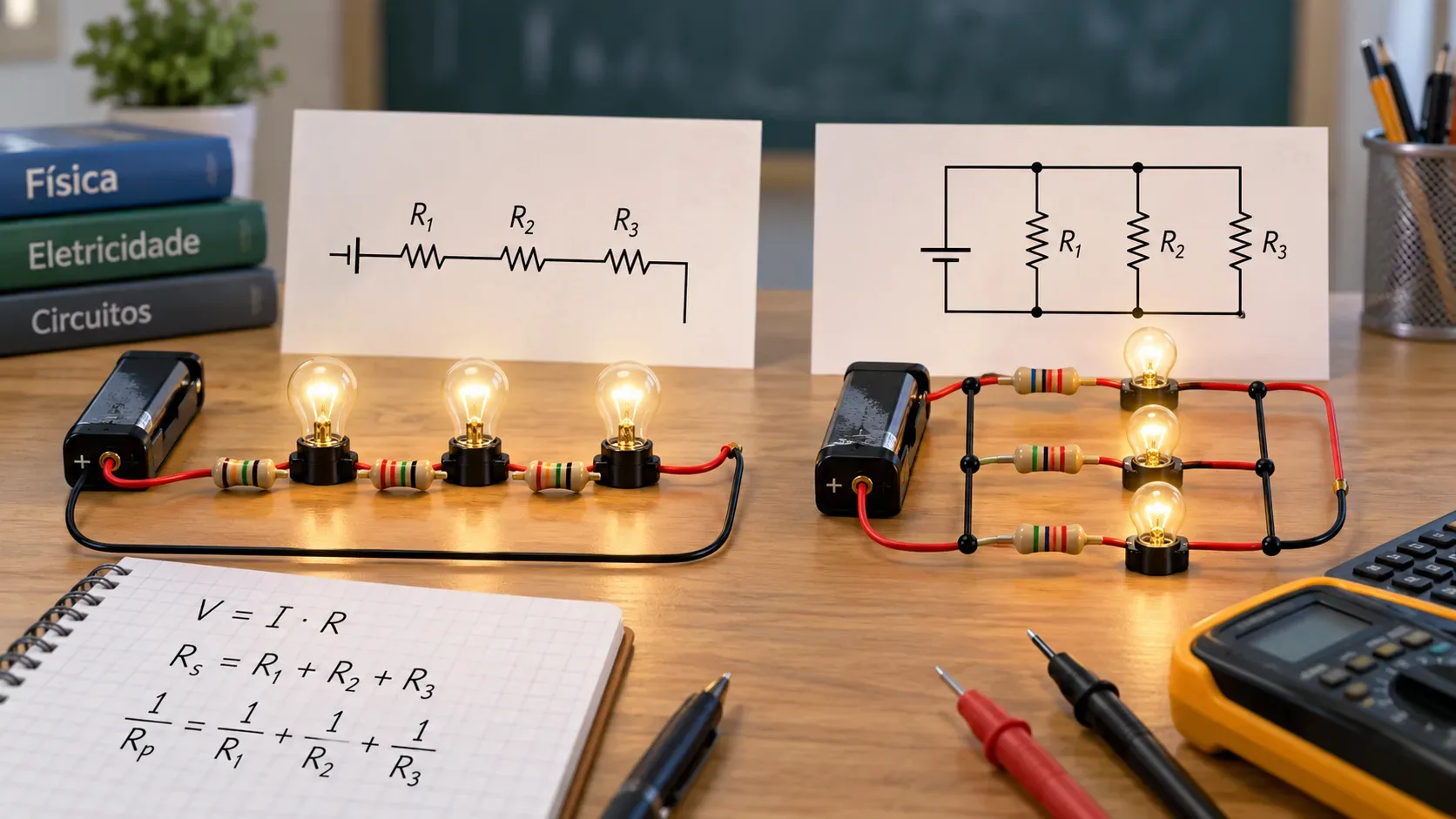
In simple resistor circuits, the key is not memorizing isolated formulas but recognizing how the components are connected. In series, the same current passes through every resistor. In parallel, all branches connected to the same two nodes have the same voltage. From these two ideas and Ohm's law, V = I R, most basic circuit exercises can be solved systematically.
The examples below use an ideal 6 V direct current source and resistors as teaching models. They are intended for study and appropriate low voltage setups; they should not be used as instructions for working on household mains electricity.
The rules that change between series and parallel
| Connection | Quantity that stays the same | Quantity that splits | Equivalent resistance |
|---|---|---|---|
| Series | Current through all resistors | Total voltage splits into voltage drops | Req = R1 + R2 + ... + Rn |
| Parallel | Voltage across all branches | Total current splits among the branches | 1/Req = 1/R1 + 1/R2 + ... + 1/Rn |
The OpenStax Physics circuit summary notes that current is the same through resistors in series, while voltage is the same across parallel branches. The equivalent resistance formulas are also listed in the chapter's key equations.
How to identify the connection before calculating
When it is series
Two or more components are in series when current has a single path and passes through them one after another, with no node offering an alternative route between those components. If one resistor ends exactly where the next begins and there is no branch at that point, that section is a strong candidate for a series connection.
When it is parallel
Two or more components are in parallel when each one is connected to the same pair of nodes. Their input terminals share one node and their output terminals share another. Because the potential difference between those two nodes is unique, the voltage across each branch is the same.
In mixed circuits, the best strategy is to identify small groups that are clearly in series or parallel, replace them with equivalent resistances, and repeat the process. The examples below use pure series and pure parallel cases so the rules stay distinct.
A five step calculation method
- Draw or read the topology. Mark the nodes and check whether there is one path or several branches.
- Calculate equivalent resistance. Add resistances in series. In parallel, add the reciprocals of the resistances and then take the reciprocal of that result.
- Calculate total current. Apply Ohm's law to the equivalent circuit: Itotal = Vsource/Req.
- Return to the original circuit. In series, use the same current through each resistor to calculate voltage drops. In parallel, use the same voltage across each branch to calculate branch currents.
- Check the result. In series, the sum of the voltage drops must equal the source voltage. In parallel, the sum of branch currents must equal the total current.
Worked example 1: three resistors in series
Consider an ideal 6 V source and three series resistors: R1 = 100 Ω, R2 = 200 Ω, and R3 = 300 Ω.
1. Equivalent resistance
Req = 100 + 200 + 300 = 600 Ω.
2. Circuit current
I = V/R = 6/600 = 0.01 A = 10 mA. Because this is a series circuit, all three resistors carry the same 10 mA.
3. Voltage drop across each resistor
| Resistor | Resistance | Current | Voltage drop |
|---|---|---|---|
| R1 | 100 Ω | 10 mA | 1 V |
| R2 | 200 Ω | 10 mA | 2 V |
| R3 | 300 Ω | 10 mA | 3 V |
The check closes correctly: 1 V + 2 V + 3 V = 6 V. Notice that voltage does not split equally because the resistances are different. The largest resistor has the largest voltage drop.
Worked example 2: three resistors in parallel
Now use the same ideal 6 V source with R1 = 60 Ω, R2 = 120 Ω, and R3 = 120 Ω connected in parallel.
1. Equivalent resistance
1/Req = 1/60 + 1/120 + 1/120 = 1/30. Therefore, Req = 30 Ω.
This value makes sense because in parallel the equivalent resistance must be lower than the smallest individual resistance, which is 60 Ω here.
2. Voltage and current in each branch
Because all three branches are in parallel, each resistor has the same 6 V across it.
| Branch | Resistance | Voltage | Current |
|---|---|---|---|
| R1 | 60 Ω | 6 V | 0.10 A |
| R2 | 120 Ω | 6 V | 0.05 A |
| R3 | 120 Ω | 6 V | 0.05 A |
The total current is 0.10 + 0.05 + 0.05 = 0.20 A. The same result appears from the equivalent circuit: Itotal = 6/30 = 0.20 A.
Common mistakes and how to avoid them
- Adding parallel resistances as if they were in series. In parallel, work with reciprocals. With only two resistors, Req = (R1R2)/(R1 + R2) is an equivalent shortcut.
- Assuming current is equal in parallel branches. Voltage is the quantity that is equal in parallel. Currents are equal only when branch resistances are also equal.
- Splitting voltage equally in series. Voltage divides equally only when resistances are equal. In general, Vi = I Ri.
- Forgetting unit conversions. 10 mA = 0.010 A and 1 kΩ = 1000 Ω. Mixing milli, kilo, and base units is a common source of errors.
- Skipping a physical sanity check. In parallel, Req must be lower than the smallest resistor in the group. In series, Req must be greater than each positive individual resistance.
Quick checklist for solving exercises
- First identify whether there is one path or branches between the same two nodes.
- Calculate Req before finding total current.
- Use the same current in series and the same voltage in parallel.
- Check the sum of voltages in series and the sum of currents in parallel.
- Verify units and order of magnitude before finishing.
With this method, the formulas stop competing with each other: each one is used at the stage defined by the circuit topology.