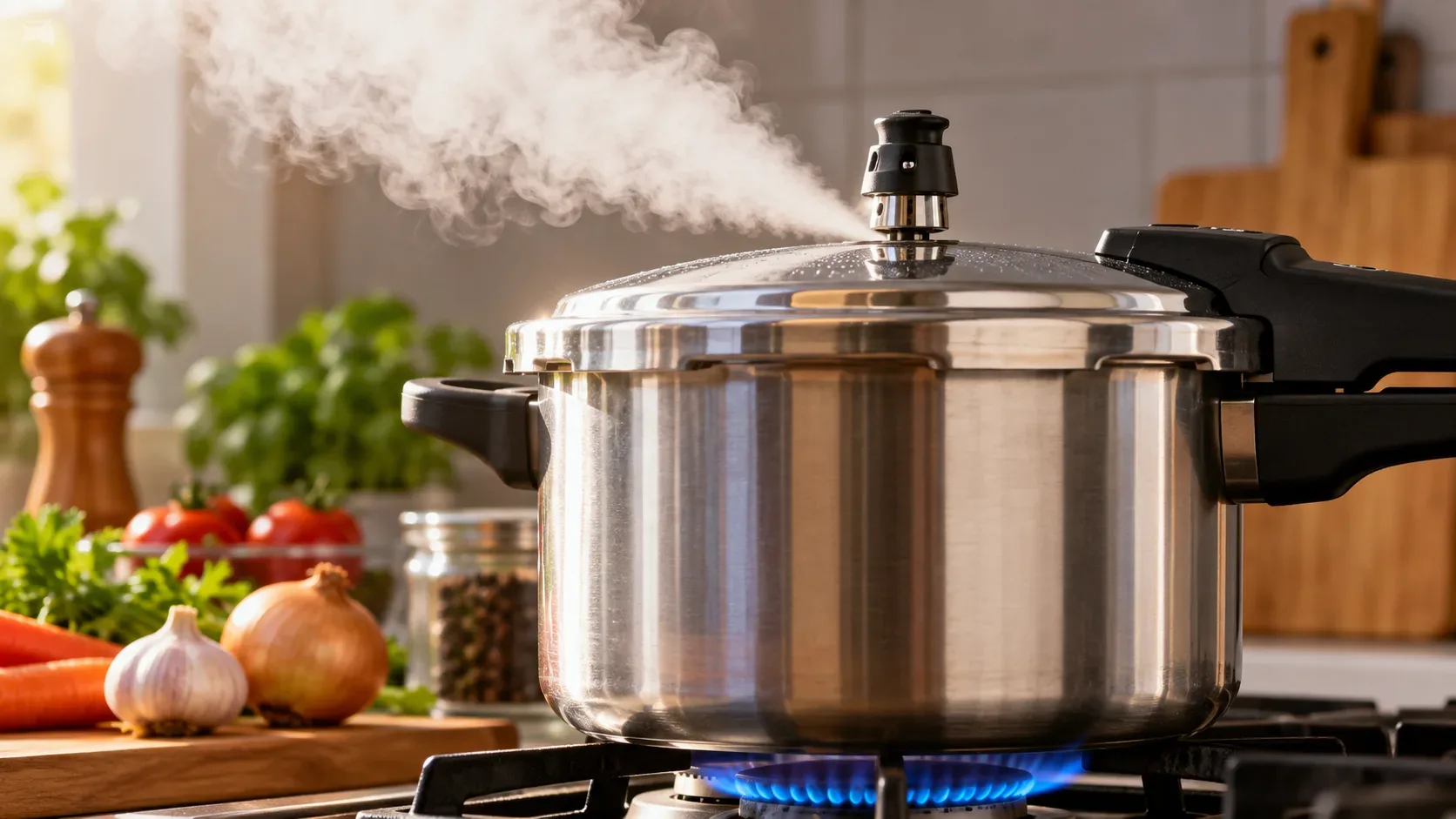
A pressure cooker cooks food faster because it allows water to remain liquid and steam to stay in equilibrium at a higher temperature than an open pot can reach. At sea level, water boils at about 100 °C (212 °F) when its vapor pressure equals atmospheric pressure. Inside a sealed cooker, steam accumulates, internal pressure rises, and the boiling point increases. In a stovetop pressure cooker operating near 15 psi gauge pressure, the temperature can reach about 121 °C (250 °F). It is this higher cooking temperature — not a supposed mechanical “force” of pressure crushing the food — that speeds up many cooking processes.
What does it mean for water to “boil”?
Boiling is not simply reaching one fixed temperature. It occurs when the vapor pressure of water equals the pressure acting on the liquid. In an open pot at sea level, that external pressure is about one atmosphere, or 101 kPa, and the corresponding saturation temperature is about 100 °C.
If the external pressure increases, water molecules must reach a higher temperature before the vapor pressure is high enough for stable bubbles to form throughout the liquid. This pressure–saturation-temperature relationship is a thermodynamic property of water, tabulated in references such as the NIST water-property tables based on the IAPWS formulation.
From an open pot to a pressure cooker: from 100 °C to about 121 °C
A pressure cooker has a sealed lid and a valve or regulator system. As the liquid heats, some of it becomes steam. Because that steam cannot escape freely, internal pressure rises until the control system reaches its operating range. The valve then regulates pressure by releasing steam when necessary.
| Approximate condition | Pressure | Boiling/saturation temperature |
|---|---|---|
| Open pot at sea level | ~101 kPa absolute (1 atm) | ~100 °C / 212 °F |
| Stovetop pressure cooker near 15 psi gauge | ~205 kPa absolute (about 2 atm) | ~121 °C / 250 °F |
Penn State Extension uses this same example: at 15 pounds of pressure, the temperature inside can reach 250 °F. A Presto pressure-cooker manual likewise gives 250 °F (121 °C) at 15 pounds of pressure. In practical pressure-cooker usage, “15 psi” here is pressure above atmospheric pressure; adding the atmosphere brings the absolute pressure close to twice ambient pressure at sea level.
Why do roughly 20 extra degrees make such a difference in cooking time?
Food does not respond to the clock; it responds to temperature and heat transfer. Raising the cooking environment from roughly 100 °C to near 121 °C increases the rate of many temperature-dependent transformations. Proteins denature, collagen in tougher cuts converts to gelatin more quickly, starches hydrate and gelatinize, and vegetable structures soften in less time.
The cooker is still a moist environment rich in water and steam. Pressure's essential role is to let that moist environment operate above the normal boiling point. A more accurate explanation is therefore: pressure raises the possible cooking temperature; the higher temperature speeds cooking.
A numerical example: pressure does not make heating require less energy
To see the scale of the effect, consider 1 kg of water initially at 20 °C. Using an approximate specific heat capacity of 4.18 kJ/(kg·°C), and for the moment ignoring the mass of the cooker and food as well as heat losses:
- Heating from 20 °C to 100 °C: Q ≈ 1 × 4.18 × 80 = 334 kJ.
- Heating from 20 °C to 121 °C: Q ≈ 1 × 4.18 × 101 = 422 kJ.
In this idealized example, reaching 121 °C requires about 88 kJ more than reaching 100 °C. If the full output of a 1 kW heater went into that water with no losses, the minimum times would be about 5.6 minutes to 100 °C and 7.0 minutes to 121 °C — roughly 1.5 extra minutes to reach the higher temperature.
Real kitchen heat-up times are longer because the cooker and food must also be heated and some energy is lost to the surroundings. The important point is that the advantage does not come from using less energy to reach the working temperature. It appears after the cooker is pressurized, because food cooks at a higher temperature and can complete culinary transformations in less time. For foods that would otherwise need a long simmer, that faster cooking phase can outweigh the pressurization time.
Pressure alone does not “push heat” into food
A common explanation says a pressure cooker is faster because pressure “forces” heat or water into food. That is misleading. Heat still moves by conduction, convection, and steam condensation on cooler surfaces. Pressure matters mainly because it changes the equilibrium condition between liquid water and vapor, allowing temperatures above 100 °C without all the water simply boiling away from the vessel.
This also explains why there is no benefit in continuously turning up the burner after a stovetop cooker has reached its regulated pressure. The regulator releases steam to limit pressure; excessive energy tends to increase steam loss rather than let the temperature rise without limit. The correct procedure depends on the cooker design and should follow the manufacturer's manual.
What about electric pressure cookers and altitude?
Not every pressure cooker operates at the same maximum pressure. Electric models may use ranges different from stovetop cookers, and their automatic controls may cycle power to maintain pressure. As a result, two appliances can produce different cooking times for the same recipe.
Altitude matters too. At higher elevations, atmospheric pressure is lower, so water boils at a lower temperature in an open pot. In a pressure cooker, the relationship between absolute pressure and temperature still applies, but the exact operating temperature depends on local atmospheric pressure and on how the appliance regulates pressure. Manuals may recommend time adjustments at high altitude.
The physics in one sentence
A pressure cooker cooks faster because it traps steam, raises internal pressure and therefore raises water's boiling temperature; food then cooks in a hotter, moist environment, accelerating processes that would be slower near 100 °C.