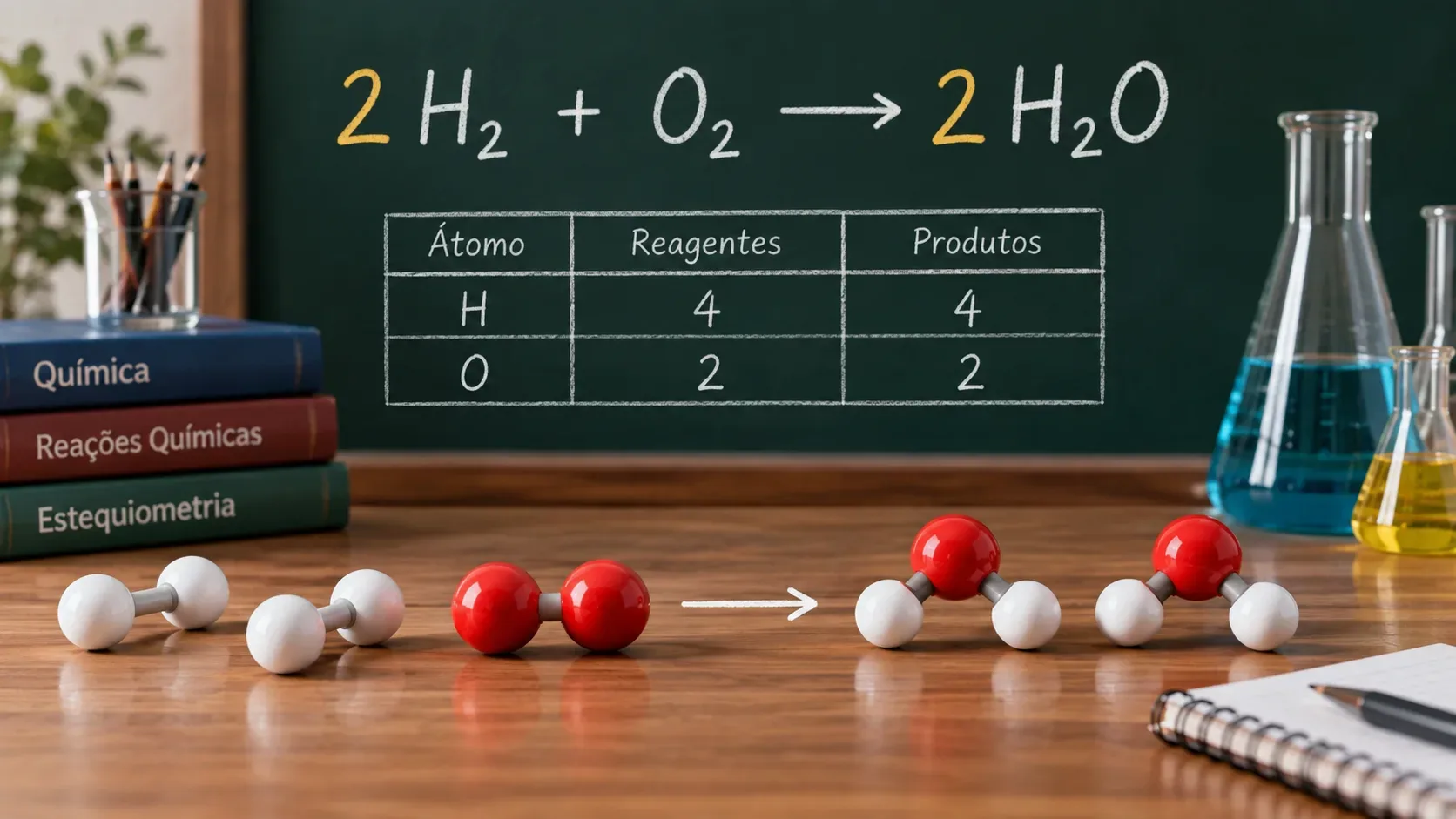
Balancing a chemical equation means adjusting the numbers placed before formulas so that the number of atoms of each element is the same in the reactants and products. The central rule is simple: change coefficients, never the subscripts in a formula. Changing a subscript changes the identity or composition of a substance, while changing a coefficient only changes how many units of that substance participate in the reaction.
This procedure expresses conservation of matter. In a balanced equation, atoms do not appear or disappear: they are rearranged. The balancing section of OpenStax Chemistry: Atoms First 2e uses the atom count on each side of the arrow as the test for balance.
Coefficients and subscripts are not the same thing
Consider H₂O. The number 2 is a subscript: it tells us that each unit of water contains two hydrogen atoms for every oxygen atom. If the formula were changed to H₂O₂, the substance would represent hydrogen peroxide, not water. Subscripts are therefore part of the chemical formula and should not be changed to force an equation to balance.
In 2 H₂O, however, the 2 before the formula is a stoichiometric coefficient. It indicates two units of H₂O. The total count becomes 4 H atoms and 2 O atoms because the coefficient multiplies every atom in the formula.
| Notation | Meaning | Can it change? |
|---|---|---|
| H₂O | The subscript 2 belongs to the formula and means two H atoms per unit | No |
| 2 H₂O | The coefficient 2 indicates two units of water | Yes |
A practical five-step method
- Write the formulas correctly for the reactants and products. Balancing is not a way to repair incorrect chemical formulas.
- Count the atoms of each element on both sides of the arrow. When a coefficient is present, multiply each element's subscript by that coefficient.
- Choose an element to adjust. In simple exercises, it is often efficient to start with an element that appears in only one formula on each side.
- Change coefficients only and recount after every adjustment. A change can balance one element while unbalancing another.
- Check every element and, at the end, reduce the coefficients to the smallest possible whole-number ratio.
There is no universal inspection order that solves every equation. The goal is to choose adjustments that minimize rework. Hydrogen and oxygen often appear in several species, so in many reactions it is useful to leave them until later. OpenStax also shows cases in which fractions can be used as an intermediate step, provided the final form is converted to integer coefficients.
Example 1: forming water
Initial equation: H₂ + O₂ → H₂O.
| Element | Reactants | Products |
|---|---|---|
| H | 2 | 2 |
| O | 2 | 1 |
Place 2 before H₂O: H₂ + O₂ → 2 H₂O. Oxygen is now correct, but the product side has 4 H atoms. Place 2 before H₂: 2 H₂ + O₂ → 2 H₂O.
| Element | Reactants | Products |
|---|---|---|
| H | 4 | 4 |
| O | 2 | 2 |
The equation is balanced, and H₂, O₂, and H₂O kept exactly the same formulas.
Example 2: ammonia synthesis
Initial equation: N₂ + H₂ → NH₃. Nitrogen appears as N₂ on the left and as one N in each NH₃ on the right. Place 2 before ammonia: N₂ + H₂ → 2 NH₃. The products now contain 6 H atoms, so 3 H₂ molecules are required.
N₂ + 3 H₂ → 2 NH₃
| Element | Reactants | Products |
|---|---|---|
| N | 2 | 2 |
| H | 6 | 6 |
The coefficients 1, 3, and 2 are already the smallest whole-number ratio. A coefficient of 1 is normally omitted.
Example 3: aluminum reacting with oxygen
Initial equation: Al + O₂ → Al₂O₃. Oxygen appears in groups of 2 in the reactants and 3 in the products. The least common multiple of 2 and 3 is 6. To obtain 6 O atoms, use 3 O₂ and 2 Al₂O₃:
Al + 3 O₂ → 2 Al₂O₃
The product now contains 4 Al atoms, so adjust the reactant:
4 Al + 3 O₂ → 2 Al₂O₃
| Element | Reactants | Products |
|---|---|---|
| Al | 4 | 4 |
| O | 6 | 6 |
This example shows why common multiples help when the same element appears with different subscripts on the two sides.
Example 4: ethane combustion and an intermediate fraction
Consider C₂H₆ + O₂ → CO₂ + H₂O. First balance carbon with 2 CO₂ and hydrogen with 3 H₂O:
C₂H₆ + O₂ → 2 CO₂ + 3 H₂O
The products contain 7 O atoms in total. To obtain them from O₂, the coefficient 7/2 can be used temporarily:
C₂H₆ + 7/2 O₂ → 2 CO₂ + 3 H₂O
The atom count is balanced, but the conventional final form uses whole numbers. Multiply every coefficient by 2:
2 C₂H₆ + 7 O₂ → 4 CO₂ + 6 H₂O
| Element | Reactants | Products |
|---|---|---|
| C | 4 | 4 |
| H | 12 | 12 |
| O | 14 | 14 |
This procedure also appears in the ethane combustion example from OpenStax.
How to check the count without getting lost
Make a small atom table and update it after every coefficient change. A coefficient multiplies the entire formula. In 3 Ca(OH)₂, for example, there are 3 Ca, 6 O, and 6 H atoms. The subscript 2 outside the parentheses multiplies O and H inside the OH group, while the coefficient 3 multiplies the entire Ca(OH)₂ unit.
It also helps to separate balancing from interpreting the reaction. Physical states, charges, and formulas must be correct before counting begins. In ionic equations, in addition to atoms, the total charge on each side must also be compatible.
Common mistakes and how to correct them
| Mistake | Why it is wrong | How to correct it |
|---|---|---|
| Changing H₂O to H₂O₂ to get more oxygen | It changes the substance being represented | Keep H₂O and adjust a coefficient before the formula |
| Counting only subscripts and ignoring coefficients | It undercounts the total number of atoms | Multiply each subscript by its corresponding coefficient |
| Stopping when only one element matches | Another element may have been unbalanced | Recount every element at the end |
| Using 2, 6, and 4 when 1, 3, and 2 already work | The equation is not in the smallest whole-number ratio | Divide all coefficients by their greatest common divisor |
Two worked exercises for practice
1. Neutralization: HCl + Ca(OH)₂ → CaCl₂ + H₂O
Calcium already has 1 atom on each side. Because CaCl₂ has 2 Cl atoms, place 2 before HCl. The reactants now contain 4 H atoms in total, so place 2 before H₂O.
2 HCl + Ca(OH)₂ → CaCl₂ + 2 H₂O
Final count: Ca = 1, Cl = 2, O = 2, and H = 4 on both sides.
2. Decomposition: KClO₃ → KCl + O₂
Oxygen appears in groups of 3 on the left and 2 on the right. Use the least common multiple, 6: place 2 before KClO₃ and 3 before O₂. This creates 2 K and 2 Cl atoms in the reactants, so place 2 before KCl.
2 KClO₃ → 2 KCl + 3 O₂
Final count: K = 2, Cl = 2, and O = 6 on both sides.
Quick checklist
- Were the reactant and product formulas preserved?
- Were only coefficients changed?
- Does every element have the same number of atoms on both sides?
- Were parentheses and subscripts included in the count?
- Are the final coefficients whole numbers in the smallest possible ratio?
If every answer is yes, the balancing is complete. The goal is not to memorize a fixed sequence, but to apply conservation of atoms through organized counting and controlled adjustments.