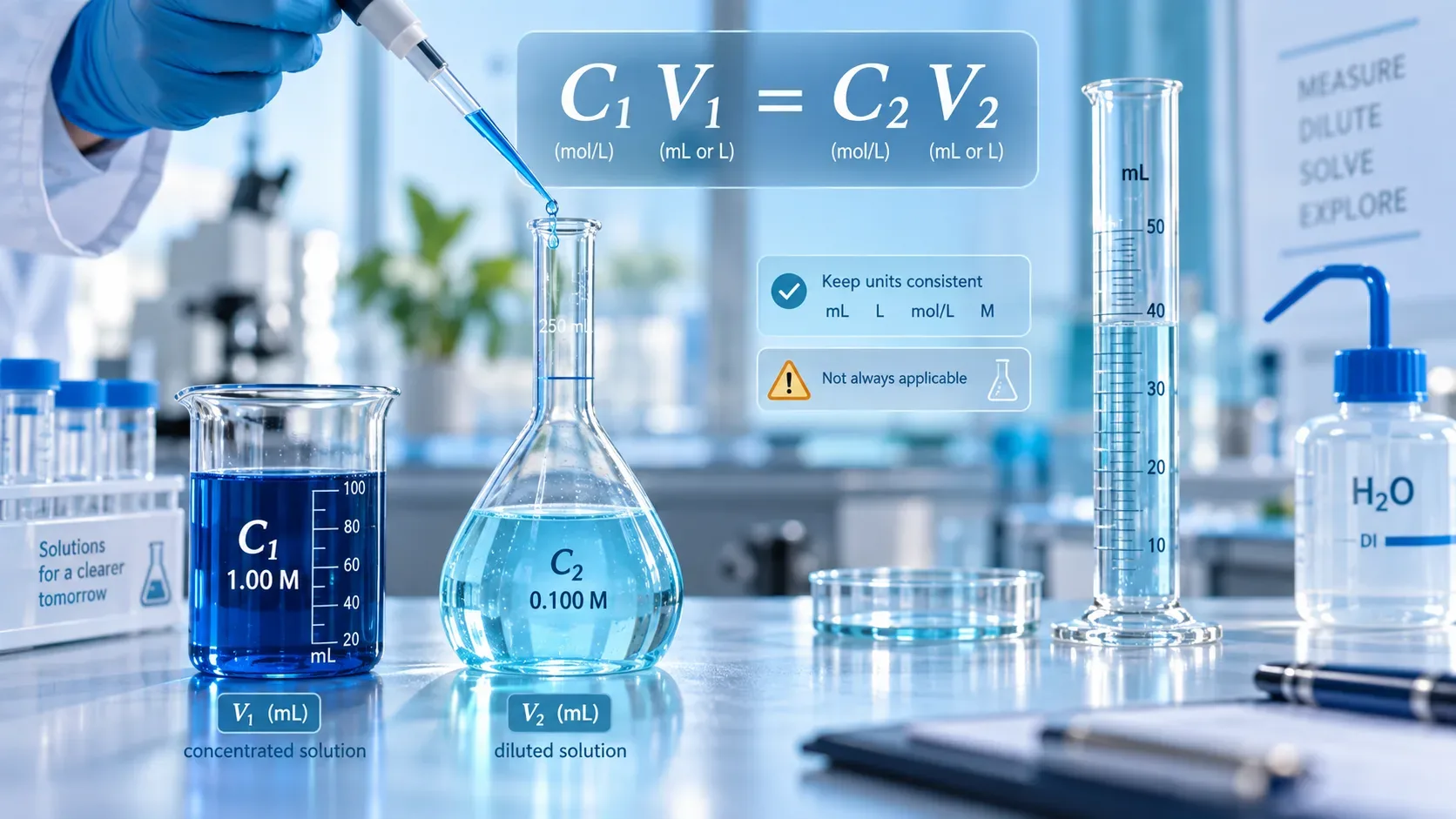
C1V1 = C2V2 is not a formula to memorize without context. It is a compact way to express a simple idea: in a true dilution, the amount of the solute of interest is the same before and after solvent is added. The concentration drops because the final volume increases, not because the solute disappears.
This interpretation prevents two very common mistakes: using incompatible volume units and applying the relationship to situations in which a reaction, loss, gain, or change in concentration basis has occurred. The equation works well when the problem genuinely describes conservation of solute and when concentration and volume are defined on compatible bases.
1. What C1V1 = C2V2 really means
For amount-of-substance concentration, IUPAC defines concentration as the amount of a species divided by the volume of the mixture. For molarity, this is written as C = n/V; rearranging gives n = C×V. If an aliquot is only diluted and the number of moles of solute does not change, then n1 = n2 and therefore C1V1 = C2V2. This is the same derivation presented in introductory chemistry texts such as OpenStax Chemistry 2e. The definition of amount concentration can be checked in the IUPAC Gold Book.
The subscripts 1 and 2 usually mean “before” and “after,” but the key is to keep each concentration paired with the volume of the same solution. In a stock-solution dilution problem, C1 and V1 normally describe the concentrated solution used; C2 and V2 describe the final solution.
2. Before calculating: identify the four quantities
- C1: concentration of the starting solution.
- V1: volume of the starting solution actually transferred.
- C2: desired or resulting concentration after dilution.
- V2: total final volume of the diluted solution.
The most deceptive quantity is V2: it is the final solution volume, not the volume of water or other solvent added. In volumetric preparation, the aliquot is transferred and solvent is added until the final-volume mark is reached.
3. The dimensional check that prevents most mistakes
Before substituting numbers, check whether both sides can represent the same amount of solute. For molarity, C×V represents amount of substance when volume is in liters. In exercises, milliliters can also be used for both volumes because the same volume unit appears on both sides and cancels when the unknown is isolated. What does not work is mixing mL on one side with L on the other without converting.
| Situation | What to do |
|---|---|
| C1 in mol/L and C2 in mol/L; V1 and V2 in mL | You may calculate directly because the volume units match. |
| C1 in mol/L and C2 in mol/L; V1 in mL and V2 in L | Convert one volume so both use the same unit. |
| C1 in g/L and C2 in mg/mL | Convert the concentrations to the same basis before applying the relationship. |
| Concentration in % w/w and volume in mL | Do not force C×V: the basis is mass. Use a mass balance with compatible masses. |
A quick check is to ask: “If I multiply concentration by volume, do I obtain the same conserved type of quantity in both states?” If the answer is no, the formula must be adapted or replaced.
4. Three step-by-step examples
Example 1 — find the final concentration
A 2.00 mol/L solution occupies 25.0 mL and is diluted to 100.0 mL. What is the final concentration?
C1V1 = C2V2
(2.00 mol/L)(25.0 mL) = C2(100.0 mL)
C2 = 0.500 mol/L.
The result is consistent: the volume became four times larger and the concentration dropped to one quarter.
Example 2 — find how much stock solution to use
You want to prepare 250 mL of a 0.200 mol/L solution from a 5.00 mol/L stock.
(5.00 mol/L)V1 = (0.200 mol/L)(250 mL)
V1 = 10.0 mL.
In practice, measure 10.0 mL of the stock solution and add solvent until the final volume is 250 mL. The procedure does not have to be interpreted as “add exactly 240 mL of water.” The instruction to dilute to a final volume is also emphasized in dilution material from Chemistry LibreTexts.
Example 3 — fix the units before calculating
A 35.0 mL aliquot of a 0.750 mol/L solution is diluted to 0.200 L. First put the volumes in the same unit: 0.200 L = 200 mL.
(0.750 mol/L)(35.0 mL) = C2(200 mL)
C2 = 0.13125 mol/L ≈ 0.131 mol/L.
If 0.200 L were inserted directly next to 35.0 mL, the numerical answer would be wrong by a factor of one thousand. The problem would be the units, not the algebra.
5. Final volume is not solvent volume
In a laboratory dilution, V2 describes the total volume after preparation. In a volumetric flask, for example, the usual sequence is to transfer V1 of the stock solution and add solvent up to the V2 mark. This is different from measuring “V2 − V1” of solvent in advance and assuming volumes always add exactly.
In elementary exercises, V2 − V1 may be used as an approximation for solvent added when the problem explicitly treats the system that way. For analytical preparation, however, the correct operational instruction is to reach the final volume.
6. When not to use C1V1 = C2V2
| If this happens... | Why the simple formula fails | A better approach |
|---|---|---|
| The solute reacts during mixing | The amount of the original chemical species is not the same before and after. | Do stoichiometry and, if needed, chemical-equilibrium calculations before finding the final concentration. |
| There is precipitation, decomposition, adsorption, or transfer loss | Part of the solute leaves the phase or container being considered. | Use a material balance that includes the loss or new phase. |
| Two solutions that already contain the same solute are mixed | There are two solute contributions, not one aliquot diluted by pure solvent. | Add the amounts: C1V1 + C2V2 = CfVf, with compatible units and no reaction. |
| The preparation starts from a solid | There is no C1V1 term for an initial solution. | Find the amount from the solid, for example n = m/M, then use C = n/V. |
| Concentration is on a basis not compatible with volume, such as % w/w | Multiplying by volume does not directly recover solute mass. | Use masses and the correct fraction or percentage definition. |
| The goal is to predict pH, ionic species, or equilibrium after dilution | C1V1 = C2V2 may give the analytical concentration, but it does not solve the subsequent chemical transformations. | Use dilution only as the first step, then apply the appropriate equilibrium model. |
The central rule is simple: the equation requires the amount of the relevant solute to be conserved. The derivation of the dilution relationship itself depends on this. If the process changes that amount, the equality no longer represents the system.
7. Mixtures, solids, and serial dilutions
Mixing two solutions of the same solute
If A and B contain the same solute and no reaction occurs, calculate the amount contributed by each solution. For volume-based concentrations, a useful form is CAVA + CBVB = CfVf. The final volume must be the actual or defined volume of the system, and the units must be compatible.
Preparing a solution from a solid
When the starting point is a mass of solute, the reasoning changes. Convert mass to amount of substance when necessary, then determine concentration from the final volume. C1V1 = C2V2 does not create an “initial concentration” that does not exist.
Serial dilutions
In a dilution series, the relationship can be applied at each step. The dilution factor for one step is V2/V1, equivalent to C1/C2 when solute is conserved. Across successive steps, the factors multiply. This is useful for checking whether the final concentration makes sense without repeating all the algebra.
8. Five-step checklist before accepting the answer
- Is it really a dilution? Does the same solute remain, with no relevant reaction or loss?
- Are the pairs correct? C1 with V1 and C2 with V2.
- Is V2 the final volume? Do not confuse it with solvent volume added.
- Do the units match? Convert volumes and concentrations to compatible bases.
- Is the result physically plausible? When solvent is added, concentration should decrease and final volume should be greater than the initial aliquot.
9. How to use the formula without memorizing it
Instead of starting with C1V1 = C2V2, start with a sentence: “the amount of solute before equals the amount of solute after.” Then write that amount using the appropriate concentration definition. For molarity, n = C×V, which is why the equation appears. This route also shows immediately when it does not apply.
When a problem involves only solvent addition, final volume, and concentration, the formula is a fast and reliable tool. When there is a reaction, two sources of solute, a different concentration basis, or material loss, go back to the material balance before choosing the equation.
References: IUPAC Gold Book — amount concentration; OpenStax Chemistry 2e — Molarity and dilution; Chemistry LibreTexts — Dilutions and Concentrations.