Ice floats because, when water freezes, it occupies more volume without gaining mass. The microscopic cause is the way H2O molecules organize into an open crystal lattice stabilized by hydrogen bonds. Because density is the ratio of mass to volume, the increase in volume lowers the solid's density. Ordinary ice is therefore less dense than liquid water and is supported by it.
Start with the relationship between mass, volume, and density
The central idea fits into one simple relationship: density = mass / volume. Imagine a quantity of water containing a fixed number of molecules. When it freezes, essentially the same molecules remain, and therefore so does the same mass. What changes is the space occupied by that collection.
In liquid water, molecules can continuously rearrange and, on average, pack closer together. In ice, they are locked into a more widely spaced architecture. For the same mass, the solid occupies a larger volume, so its density is lower. Reference data from OpenStax put the density of ice at 0 °C at about 917 kg/m³, while liquid water near 0 °C is close to 1,000 kg/m³.
Why water molecules attract one another
A water molecule is polar. Oxygen pulls the electrons in the O–H bonds more strongly and carries a partial negative charge, while the hydrogens carry partial positive charges. This allows the hydrogen of one molecule to be attracted to the oxygen of another: this intermolecular interaction is a hydrogen bond.
It should not be confused with the covalent O–H bond within the molecule itself. A hydrogen bond is weaker and can form, break, and reorganize rapidly in liquid water. Khan Academy likewise highlights water's polarity and its ability to form hydrogen bonds as the origin of several of its unusual properties.
If liquid water also has hydrogen bonds, why is it denser?
Because the network in the liquid is not rigid. Molecules have enough thermal energy to change orientation, break some hydrogen bonds, and form others. This mobility allows more compact configurations: molecules can temporarily occupy spaces that remain open in the crystal.
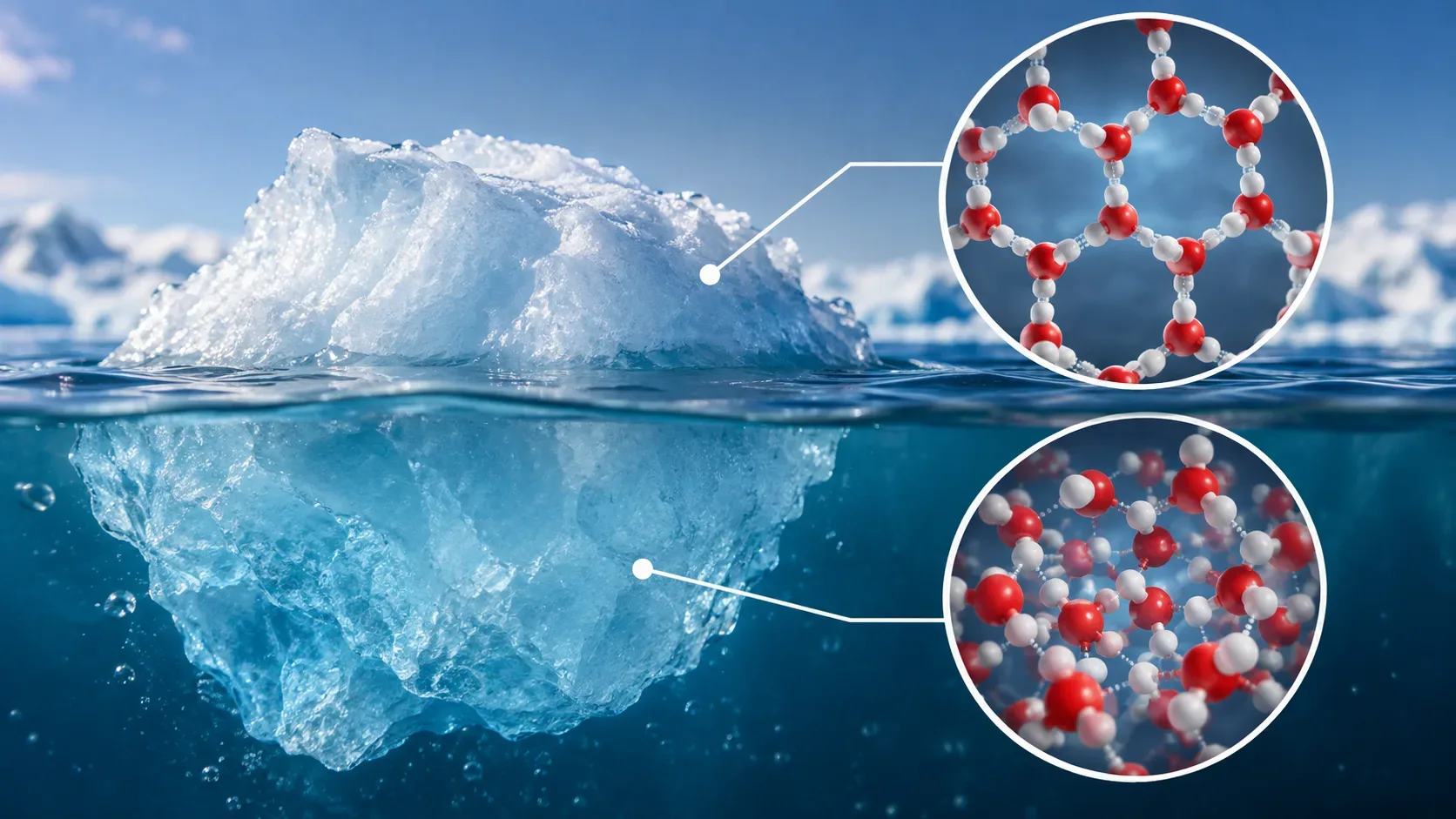
When water freezes at atmospheric pressure, molecular motion decreases and the organization favored by hydrogen bonds becomes much more regular. In ordinary ice (the hexagonal form known as ice Ih), each molecule sits in an approximately tetrahedral neighborhood connected to others through a network that leaves relatively open cavities. It is this geometry, not the presence of “trapped air,” that explains ice's intrinsically low density.
What changes on freezing: a more open network
| Aspect | Liquid water | Ordinary ice |
|---|---|---|
| Hydrogen bonds | Continuously form and break | Organize a more stable crystal network |
| Molecular arrangement | Disordered and flexible | Ordered, with an open geometry |
| Volume for the same mass | Smaller | Larger |
| Density | Higher near the freezing point | Lower |
| Result in liquid water | Forms the supporting fluid | Floats |
During the transition to the solid, volume increases by roughly 9%. The NOAA uses this expansion to explain why the crystal structure lowers density and makes ice float. A visual comparison between an open hexagonal network and a more compact liquid is a useful representation of the mechanism, as long as we remember that real molecules are arranged in three dimensions.
The anomaly starts before freezing: the role of 4 °C
Water departs from the more common behavior of liquids before it turns into ice. When cooled from higher temperatures, it initially contracts and becomes denser. Its density reaches a maximum at about 4 °C. Below that temperature, the tendency to form more open local arrangements associated with hydrogen bonding becomes dominant, and water starts to expand as it cools.
The USGS shows this change in density with temperature, and OpenStax also records the maximum near 4 °C. Once crystallization occurs, the open structure becomes much more persistent, producing the sharp density difference between liquid water and ice.
Thought experiment: the same number of molecules in two containers
Imagine two transparent containers holding exactly the same number of H2O molecules.
- In the first, the molecules are liquid. They move and reorganize, occupying a relatively compact volume.
- In the second, the same molecules are frozen. The hydrogen-bond network keeps larger average separations and leaves more empty space in the structure.
- Because the number of molecules is the same, the mass is the same.
- Because ice occupies more volume, its mass per unit volume is lower: its density is lower.
This thought experiment avoids a common mistake: individual molecules do not “swell.” What expands is the collective arrangement between them.
Why lower density makes ice rise
An object immersed in a fluid experiences a buoyant force equal to the weight of the fluid it displaces. Because ice is less dense than liquid water, it does not need to be fully submerged to displace a mass of water equal to its own mass. It rises until it reaches equilibrium, with part of its volume above the surface and most of it below.
This is the same reason an iceberg shows only a fraction of its volume above water. The exact proportion depends on the densities of the ice and the surrounding water; in fresh water near 0 °C, the density difference means that approximately nine-tenths of the ice remains submerged.
Why most materials do not behave this way
In many materials, reduced thermal motion during solidification lets particles settle closer together. The solid then becomes more compact and denser than the liquid. Water is an important exception because its hydrogen bonds are directional: in ice, they favor an open geometry that outweighs the simple tendency toward tighter packing.
That is why saying only that “molecules move less when they cool” is not enough to predict density. We must also consider how intermolecular forces organize molecules in the solid.
Three common misconceptions
- “Ice floats because it contains air bubbles.” Bubbles can lower the density of a particular sample even further, but they are not required: pure ice is already less dense than liquid water.
- “Hydrogen bonds exist only in ice.” They also exist in the liquid; the difference is that the liquid network is dynamic and continuously rearranges.
- “A water molecule gets larger when it freezes.” No. Molecular size does not explain the expansion. The increase in volume comes from the average spacing imposed by the crystal structure.
Why this property matters beyond a glass of ice water
In freshwater lakes, the densest water near 4 °C tends to sink, while colder water remains closer to the surface and can freeze. Because ice floats, it forms a surface layer that reduces heat exchange with the air and helps preserve liquid water below. This behavior has major ecological importance in cold regions.
The same expansion also explains why freezing water in confined spaces can create large stresses. In both cases, the underlying mechanism is the same: hydrogen bonds favor a more open network in ice; mass remains essentially unchanged, volume increases, and density decreases.
Sources for further reading
- OpenStax Biology 2e — Water: polarity, hydrogen bonding, and the lower density of ice.
- OpenStax University Physics — Fluids, Density, and Pressure: density values and the maximum near 4 °C.
- Khan Academy — Hydrogen bonds in water: molecular explanation of hydrogen bonding.
- USGS — Water Density: relationship among temperature, density, and ice flotation.