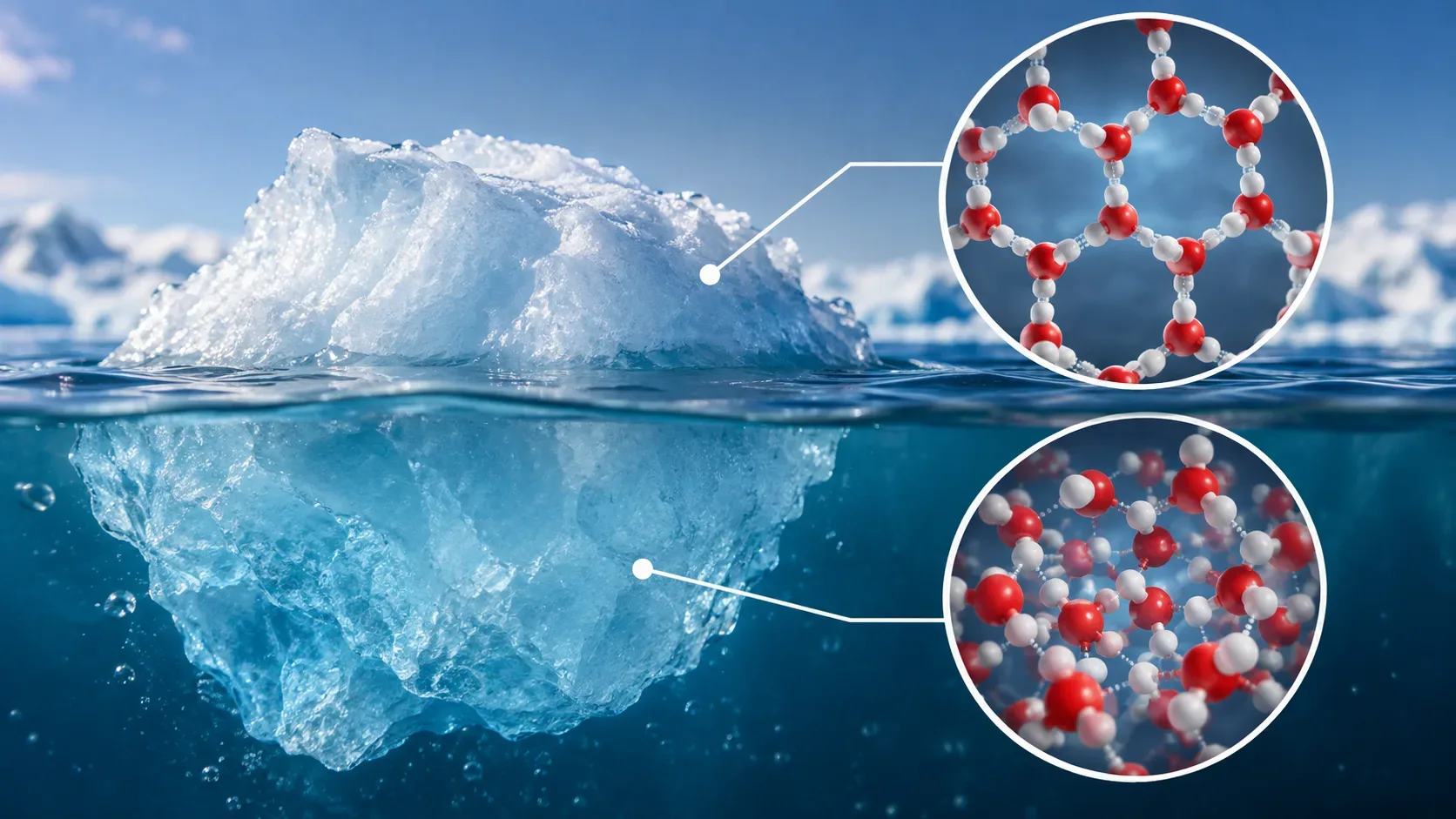
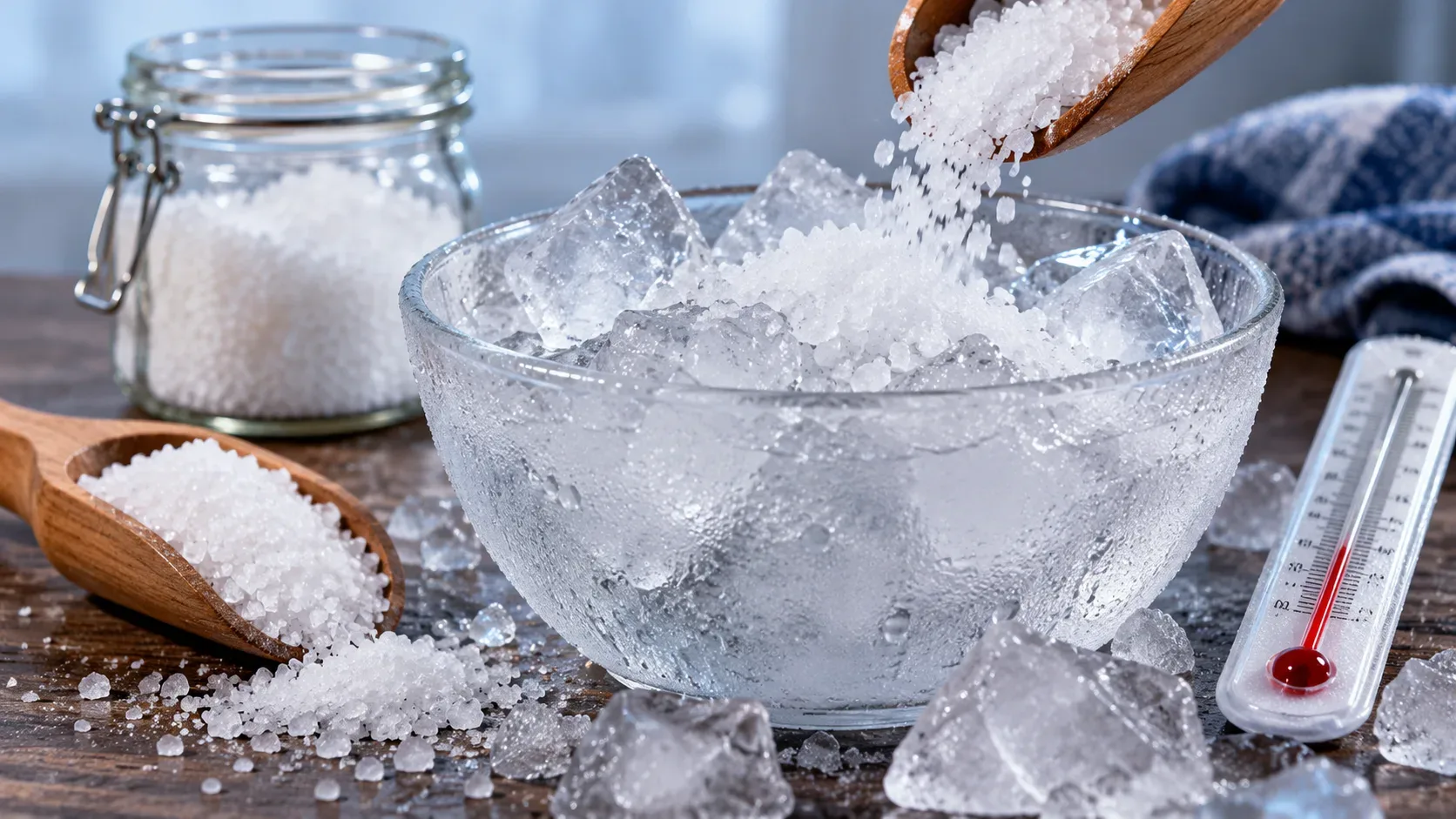
Salt does not “heat” ice to make it melt. It changes the equilibrium between liquid water and ice. When sodium chloride comes into contact with the thin layer of water present on ice, it dissolves and forms brine. That solution freezes at a lower temperature than pure water. As a result, some ice can keep melting even after the mixture has dropped below 0 °C. Because melting consumes energy, the process draws heat from the mixture itself and from its surroundings, causing the temperature to fall.
A simple measurement to observe the effect
You can visualize the phenomenon with two insulated cups or similar containers. Put similar amounts of crushed ice in both. Add a few spoonfuls of salt to one and mix; leave the other as a control. Use thermometers capable of measuring negative temperatures and record the initial temperature and then the values after 1, 3, and 5 minutes.
- In the cup without salt, an ice-water mixture tends to remain near 0 °C while both phases coexist and there is sufficient heat exchange with the surroundings.
- In the cup with salt, more liquid water usually appears and the temperature can fall below 0 °C.
- The exact value depends on how much salt is used, ice crystal size, mixing, initial temperature, insulation, and heat entering from the surroundings.
Avoid holding very cold containers for long periods or touching the mixture directly with bare skin: an ice-salt mixture can reach temperatures capable of causing cold injury.
What salt changes about the freezing point
Pure water at 1 atm has a normal freezing point of 0 °C. In a solution, dissolved particles make it harder for water molecules to enter the ordered structure of ice. In thermodynamic terms, the solute lowers the chemical potential of liquid water, so equality between the liquid and solid phases is reached only at a lower temperature.
This effect is a colligative property: in an ideal, dilute approximation, its magnitude depends mainly on the number of dissolved particles rather than on the chemical identity of each particle. The phenomenon is called freezing-point depression.
The standard classroom relation is ΔTf = i × Kf × m. For water, Kf = 1.86 °C·kg·mol−1. The quantity m is molality, in moles of solute per kilogram of solvent; i is the van't Hoff factor, representing how many effective particles the solute produces in solution. OpenStax gives these values and presents de-icing with salts as a direct application of this colligative property.
Example: 5.84 g of NaCl in 100 g of water
Consider an idealized example in which 5.84 g of sodium chloride are dissolved in 100 g of water. The molar mass of NaCl is approximately 58.44 g/mol, so 5.84 g corresponds to about 0.100 mol.
| Step | Approximate calculation | Result |
|---|---|---|
| Amount of NaCl | 5.84 g ÷ 58.44 g/mol | 0.100 mol |
| Molality | 0.100 mol ÷ 0.100 kg of water | 1.00 mol/kg |
| Ideal NaCl factor | NaCl → Na+ + Cl− | i ≈ 2 |
| Ideal depression | 2 × 1.86 × 1.00 | ΔTf ≈ 3.72 °C |
| Predicted point | 0 − 3.72 | ≈ −3.7 °C |
The ideal model therefore predicts that a 1.00 m NaCl solution would begin to freeze at about −3.7 °C. OpenStax itself shows why this is only an approximation: for a 1.0 m NaCl solution, the text reports an observed depression of about 3.4 °C rather than 3.7 °C. Ion-ion interactions mean the ions do not behave as two completely independent particles, especially as concentration rises.
Why an ice-salt mixture can go below 0 °C
Two coupled processes are involved. First, the salt dissolves in the liquid water at the surface of the ice and lowers the temperature at which that liquid phase can freeze. Second, because the brine can remain liquid below 0 °C, more ice melts as the system moves toward a new equilibrium.
Melting ice requires energy. In a reasonably insulated container, part of that energy comes from the ice + brine system itself, so its temperature falls. The American Chemical Society explains this balance in classroom terms: after salt is added, the saltwater does not refreeze as quickly as the ice melts, so the energy consumed by melting is no longer balanced by an equal amount of energy released by freezing.
This resolves an apparent contradiction: the ice melts while the mixture gets colder. “Melting” does not necessarily mean “getting warmer”; it means that the solid phase is being converted into liquid, and that conversion can consume heat.
Why the simple formula is not an exact prediction for a cup of ice and salt
The equation ΔTf = iKfm is very useful for solutions that are sufficiently dilute and close to ideal behavior. A cup containing ice, salt crystals, and concentrated brine is a more complicated system.
- The concentration changes continuously: as ice melts, more liquid water enters the brine.
- Not all salt has to be dissolved: solid NaCl crystals can coexist with the solution.
- The van't Hoff factor is not exactly 2: ions interact, and non-ideal behavior becomes more important in concentrated solutions.
- There is heat exchange with the surroundings: the cup, spoon, thermometer, air, and countertop can supply or remove energy.
- Several phases may coexist: ice, liquid solution, and solid salt are not equivalent to a single dilute solution of fixed composition.
For that reason, the −3.7 °C calculation should be read as an example of the colligative-property model, not as a universal prediction for “any ice mixed with salt.”
What the experiment actually demonstrates
The salt + ice experiment connects three ideas that are often taught separately: phase equilibrium, colligative properties, and energy balance. Salt lowers the freezing temperature of liquid water; this allows more ice to melt below 0 °C; and melting consumes energy, cooling the mixture.
The same basic logic underlies the use of salts to help melt ice on surfaces and the ice-salt bath used in demonstrations and preparations that need temperatures below 0 °C. Practical effectiveness, however, depends on concentration, outside temperature, salt type, and heat transfer.
Sources and further reading
- OpenStax Chemistry 2e — Colligative Properties: freezing-point depression, the Kf value for water, the van't Hoff factor, and a NaCl example.
- American Chemical Society — Why does salt make ice colder?: a classroom explanation of the balance among melting, freezing, and cooling of the mixture.