
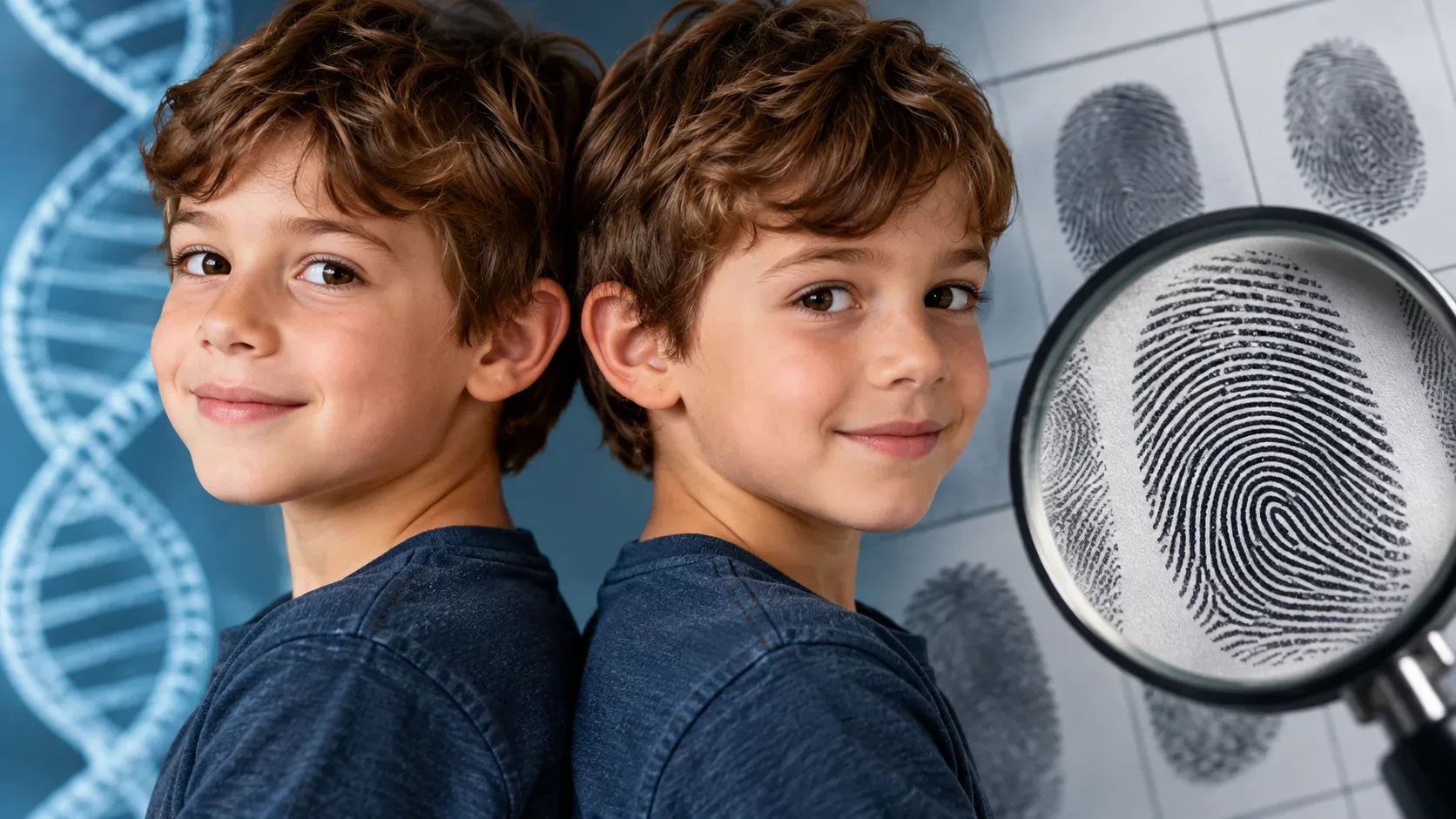
No. Identical, or monozygotic, twins do not have identical fingerprints. They may share broad characteristics — such as a higher chance of having the same pattern type on corresponding fingers — but the friction ridges and, especially, the fine features used in forensic comparison are not reproduced as perfect copies.
The reason is a useful example of why “having the same DNA” does not mean every detail of the body is determined in exactly the same way. Genes contribute to the formation of the hands, fingers and overall ridge pattern. At the same time, fingerprints organize during fetal development through processes that depend on shape, growth, timing and local skin conditions. Small differences in that process can change where a ridge ends, bifurcates or meets another ridge.
What “identical twins” means genetically
Monozygotic twins arise from the same zygote and therefore begin development with extremely similar genomes. This helps explain why they often look alike and why many traits are more strongly correlated in identical twins than in ordinary siblings or dizygotic twins.
But a very similar genome does not work like an engineering blueprint specifying the exact position of every ridge on a fingertip. Genes regulate developmental programs, cell signaling, limb growth and skin properties. The final result also depends on how those programs unfold in space and time.
How a fingerprint forms before birth
Fingerprints are part of the dermatoglyphics, the ridge patterns on fingertips, palms and soles. Developmental studies show that these ridges are established during gestation. One study on the prenatal environment notes that fingerprint configuration is set before the 20th week and links fingertip ridge counts to the growth and regression of fetal volar pads. See the study on PubMed.
More recent research has described the mechanism in greater detail. A 2023 Cell study identified a patterning system involving signals such as WNT, EDAR and BMP. Ridges emerge in waves from initiation sites, and those waves meet according to finger anatomy and the local signaling environment. This combination helps generate arches, loops and whorls, along with the enormous fine-scale variation within each type. Read the ridge-development study.
Genes influence the pattern, but they do not draw every minutia
Genetic influence is real. Genomic studies have linked variants to fingerprint pattern types and found enrichment for genes involved in limb development. In other words, some of the tendency toward particular patterns is tied to inherited biology that shapes the hands and fingers. Read the open-access genomic study.
This is especially clear in twin research. In a study of 83 pairs of identical twins, with four fingers per person and six impressions of each finger, the authors found that corresponding fingers in identical twins had the same general fingerprint type in about 74.4% of comparisons. In non-identical twins, the reported proportion was much lower, about 32.15%. Even so, automatic fingerprint-recognition systems were able to distinguish the identical twins. See the identical-twin recognition study.
The finding summarizes the relationship between heredity and development well: genes increase statistical similarity, but they do not produce two microscopic copies of the same finger.
Where “chance” enters development
When chance is said to contribute to fingerprints, “chance” does not mean there is no biology or that the process is completely random. It refers to microscopic and partly stochastic variation in how cells grow, receive signals and occupy space during a highly dynamic stage of development.
The shape and height of the volar pads, growth rate, the timing at which different regions begin making ridges and the way ridge-forming waves meet can differ slightly between two fetuses. Even siblings who share much of the uterine environment do not occupy exactly the same space or have an identical physical history in every millimeter of tissue.
Those small differences can be amplified as the ridge pattern organizes. The result may preserve the same broad architecture — for example, both twins may have a whorl on the right index finger — while still producing different local details.
What are the minutiae used in forensic comparison?
In forensic practice, classifying a print as an arch, loop or whorl is not enough. Examiners study much smaller ridge details, such as places where a ridge ends or splits. These details are called minutiae.
| Feature level | Example | What happens in identical twins |
|---|---|---|
| Overall pattern | Arch, loop or whorl | Can be highly similar and is shared more often than in unrelated people. |
| Ridge count and flow | Number and direction of ridges | Can also show high similarity because of genetic and anatomical influence. |
| Minutiae | Ridge endings, bifurcations and spatial relationships | Show enough differences to distinguish twins when suitable prints are available. |
NIST describes forensic fingerprint comparison as an analysis of ridge shapes, endings and bifurcations while also considering print quality. A latent mark from a scene may be partial, smudged or distorted, so the examination is not simply a matter of “matching two drawings.” See NIST's explanation of forensic biometrics.
Is every person's fingerprint therefore “absolutely unique”?
For precision, it is better to separate empirical observation from an absolute claim. Fingerprints from different people — including identical twins — show measurable differences, and friction-ridge comparison is widely used in biometrics and forensics. But saying it has been mathematically proven that no other person, under any circumstances, could produce an indistinguishable set of features goes beyond what the evidence supports as a simple statement.
NIST itself conducts statistical research to quantify evidential strength and uncertainty in friction-ridge comparisons, especially because latent prints may be incomplete or poor in quality. Learn about the Statistical Friction Ridge Analysis project.
A safer formulation is therefore: identical twins do not have the same fingerprints; their prints tend to be more similar than those of people with no comparable genetic relationship, but differences arising during fetal development create details that allow them to be distinguished.
What this question teaches about genes and development
Fingerprints are a simple illustration of a broader principle in biology: genes do not act alone and do not specify every visible detail of an organism. They provide components, constraints and signals for developmental processes that occur in real tissues subject to growth, geometry, timing and local variation.
In identical twins, that combination produces an interesting result: shared heredity leaves a signature of similarity, while development creates fine-scale differences. That is why two people can share nearly all of their DNA and still carry fingertip patterns that are not copies of one another.