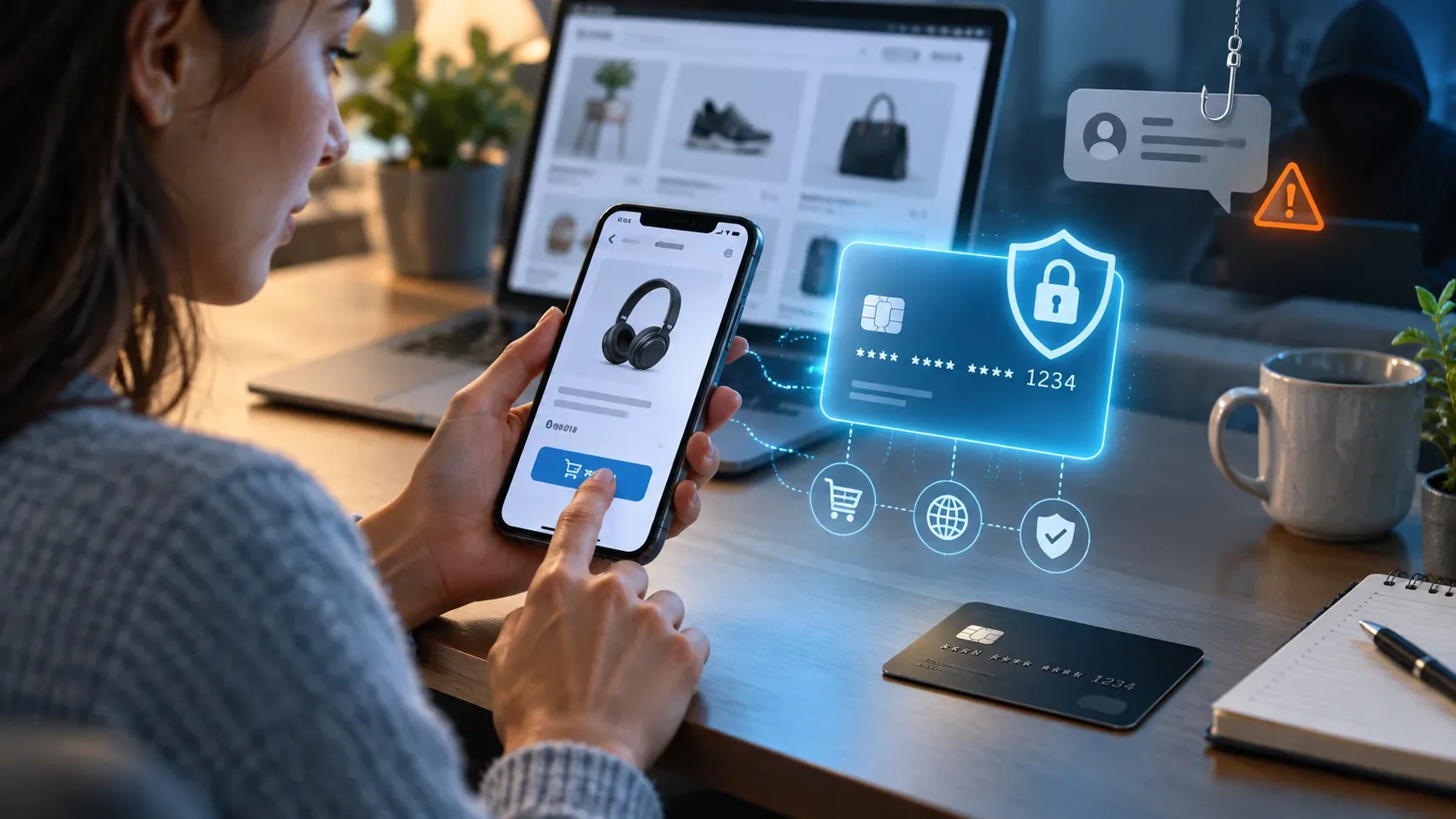
For online purchases, a virtual card can be safer than typing the details of your physical card — but only against certain kinds of risk. The main benefit comes from separating the credentials used online from the card you carry, plus features such as a dynamic CVV, blocking, deletion, or a dedicated limit when the issuer offers them. This can reduce the usefulness of leaked or copied data, but it does not stop scams in which the victim hands over valid details, authorizes a transaction, or loses control of the banking app.
That is why the more useful question is not “which card is invulnerable?” but “which threat does a virtual card actually help against?”. The answer varies by bank and by card design. CAIXA, for example, says its virtual credit card uses a dynamic security code, can be blocked or replaced, and lets the customer set a limit for online purchases. These controls improve security, but they do not make every transaction automatically safe.
The short answer: it reduces exposure, not fraud itself
When you always use the physical card number online, the same set of details may circulate among multiple stores, apps, and services. If the issuer provides a virtual card with its own credentials, you use a different identifier in the online environment. If an incident occurs, it may be possible to block, delete, or replace the virtual card instead of continuing to rely on the same exposed credentials.
The protection becomes stronger when there is a dynamic CVV or a limited-use credential. With CAIXA, the security code for its virtual credit card is checked in the app and, for non-recurring purchases, a new code is used for each purchase. This reduces the usefulness of a CVV captured earlier. Still, virtual-card behavior differs across issuers: some keep the card number and expiry date, some rotate only the CVV, and others offer disposable numbers or separate cards for specific purposes.
It is also important to remember that, with CAIXA, purchases made with the virtual card appear on the same statement and use the credit-card limit. “Virtual” therefore does not mean a financially isolated account: it is an additional layer of credentials and controls within the issuer relationship.
Threat vs. virtual card: how much does it help?
| Threat | Does a virtual card help? | Why |
|---|---|---|
| Data leak at an online store or service | Yes, in many cases | Separate credentials, a dynamic CVV, or the ability to replace the virtual card may reduce how long exposed data remains useful. It is not a guarantee because protection depends on the issuer's design and on how the transaction is authenticated. |
| Card data copied by a compromised website | Partly | The potential damage may be reduced if the credentials can be invalidated quickly. However, valid data can still be used before the block or in transactions that do not depend on the same CVV. |
| Fake website or phishing page that captures the data you just entered | Not much, by itself | If the victim gives current credentials to a scammer, the scammer may try to use them immediately. A virtual card does not, by itself, identify that a website is fake. |
| Fake bank-support scam that persuades the victim to open the app, install software, or authorize transactions | No, not by itself | The problem is compromise of the account, device, or the victim's decision-making, not just exposure of the card number. |
| Loss or theft of the physical card | It does not protect the physical card | The virtual card can separate online purchases from the credentials printed on the plastic, but a lost physical card still requires its own blocking and follow-up. |
| Subscriptions and recurring charges | It depends | Some issuers treat recurring transactions differently from one-time CVV checks. CAIXA says recurring transactions do not require a new security code for every charge. |
Where a virtual card adds meaningful protection
1. It keeps physical-card details from being spread across the internet
This is the easiest benefit to understand. By reserving the physical card for in-person use and using a virtual credential on websites and apps, you reduce the number of places that receive the details printed on the plastic. If the virtual card has its own number or can be deleted and recreated, an online incident is more likely to remain separated from the card in your wallet.
2. A dynamic CVV reduces the value of a captured code
The CVV is only one part of a transaction, but when it changes between purchases, an old code becomes less useful. CAIXA's card FAQ states that its virtual card uses a dynamic security code and that a new code should be generated in the app for each purchase, with an exception for recurring transactions.
This is different from saying that “leaked data can never work”. Depending on the merchant, the leaked credentials, the authentication flow, and issuer rules, fraud may still be possible. The accurate benefit is reducing the window of opportunity and the reuse of certain credentials, not eliminating all risk.
3. Limits, blocking, and deletion can contain damage
When the bank allows a specific virtual-card limit, temporary disabling, or deletion, these tools can help contain exposure. CAIXA allows customers to change the virtual-card limit, temporarily block it, and delete it in the app. For people who shop at many websites, keeping the limit aligned with expected online spending can be more useful than simply assuming that “virtual” equals “safe”.
What a virtual card does not prevent
Social engineering and fake support centers
Brazil's Central Bank warns about scams in which criminals pose as bank agents, send links, and ask the victim to open the app or perform supposed security procedures. In these cases, the scammer tries to gain control of the device, access the account, or persuade the person to carry out a transaction. Having a virtual card does not neutralize this kind of manipulation.
A practical rule is simple: if someone calls saying there is a suspicious purchase and asks you to perform operations in online banking, install something, click a link, or transfer money to “protect” the account, end the contact and reach the bank through an official channel. The Central Bank notes that banks do not ask customers to perform actions in online banking or at an ATM to “stop” a purchase in this manner.
A fake website that receives a valid virtual card
A virtual card helps when older credentials stop being useful, but it does not know whether the website where you are entering the details is legitimate. If a fake page captures the number, expiry date, and a valid CVV and tries to charge immediately, there is still risk. Checking the domain, the context of the purchase, and avoiding links received in messages remain necessary.
Compromise of the banking app or account
If a criminal gains access to the banking app or persuades the victim to authorize transactions, the threat is no longer just “my card number leaked”. In that situation, the attacker may be able to create new credentials, change limits, make payments, or perform other transactions. A virtual card is a compartmentalization tool; it does not replace a strong password, biometrics, device protection, system updates, and caution with unexpected contacts.
Merchant disputes are not the same as an unrecognized purchase
There are also cases in which the customer recognizes the purchase but the product never arrives, differs from the listing, or the service is not delivered. This is different from a transaction the customer says they never made. CAIXA distinguishes unrecognized purchases from merchant disputes and recommends keeping evidence of attempts to resolve the issue with the merchant when there is a commercial disagreement.
Virtual and physical cards are not absolute rivals
For online purchases, it makes sense to prioritize a virtual card when the issuer offers strong controls. For in-person purchases, the physical card — or a digital wallet linked to it — may remain the most practical option. The point is not to declare one universal winner, but to avoid using the same credential in every environment.
This also helps prevent a false sense of security. A virtual card with a dynamic CVV can be excellent against credential reuse, while being largely irrelevant if a scam persuades you to authorize a transfer, install remote-access software, or hand over the current code in real time.
If a purchase appears that you do not recognize
- Use an official bank channel immediately. Brazil's Central Bank advises victims to contact the bank and dispute the card purchase. Avoid calling back numbers or using links sent by someone claiming to be “resolving the fraud”.
- Block the affected card or credential. If the app allows it, temporarily disable the card while you check the transaction. If fraud is confirmed, follow the issuer's instructions for cancellation or replacement.
- Check the details before concluding it is fraud. The name on the statement may be the merchant's legal name, and purchases made by an additional cardholder may also appear in the history. This check helps avoid disputing a legitimate purchase by mistake.
- Open the dispute and keep case numbers. Record the amount, date, merchant, screenshots, and customer-service protocols. If the issue involves a product or service, also keep emails, messages, and proof that you tried to resolve it with the seller.
- Consider filing a police report. The Central Bank recommends doing so in parallel for unrecognized card purchases. Brazil's Ministry of Justice also advises documenting the transaction and supporting evidence.
- If fake support or account access was involved, treat the incident as larger than the card. Change passwords through official channels, review other transactions, and follow the bank's instructions to protect the account and device.
A dispute is not an automatic refund guarantee
It is important not to confuse “disputing” with “getting the money back immediately and permanently”. With CAIXA, for example, there may be a provisional credit while the transaction is reviewed. The bank says this credit is not guaranteed in every case and, if the dispute is denied, the amount can be charged to the statement again. In merchant disputes, the institution acts as an intermediary and the result depends on the review applicable to the case.
Deadlines and procedures also vary by issuer, card network, purchase type, and the nature of the problem. The best approach is therefore to act quickly, keep evidence, and use the bank's official channels. If the matter is not resolved, the Central Bank says consumers may contact consumer-protection authorities or the courts and may also file a complaint with the Central Bank, depending on the case.
How to use a virtual card with less risk
- Prefer the virtual card for online purchases when your issuer offers the option.
- Use a dynamic CVV or disposable card when available, without assuming it will stop phishing.
- Keep the limit aligned with expected online spending if the bank allows a separate limit.
- Disable or delete virtual cards that are no longer needed, especially those created for one-off use.
- Review subscriptions and recurring charges before deleting a credential used by legitimate services.
- Never disclose passwords, tokens, authentication codes, or banking credentials through an incoming call or message.
- When you receive a fraud alert, open the installed banking app or use the bank's official phone number or website instead of the contact details sent to you.
- Enable purchase notifications and review your statement; spotting a strange transaction early shortens the time to blocking and disputing it.
In summary
A virtual card is generally a better choice for reducing data exposure in online purchases, especially when it offers a dynamic CVV, a controllable limit, and quick replacement. But it does not stop social engineering, fake websites, banking-app compromise, or transactions the victim is tricked into authorizing. Stronger security comes from combining separate credentials, issuer controls, caution about contact channels, and a fast response when something looks wrong.