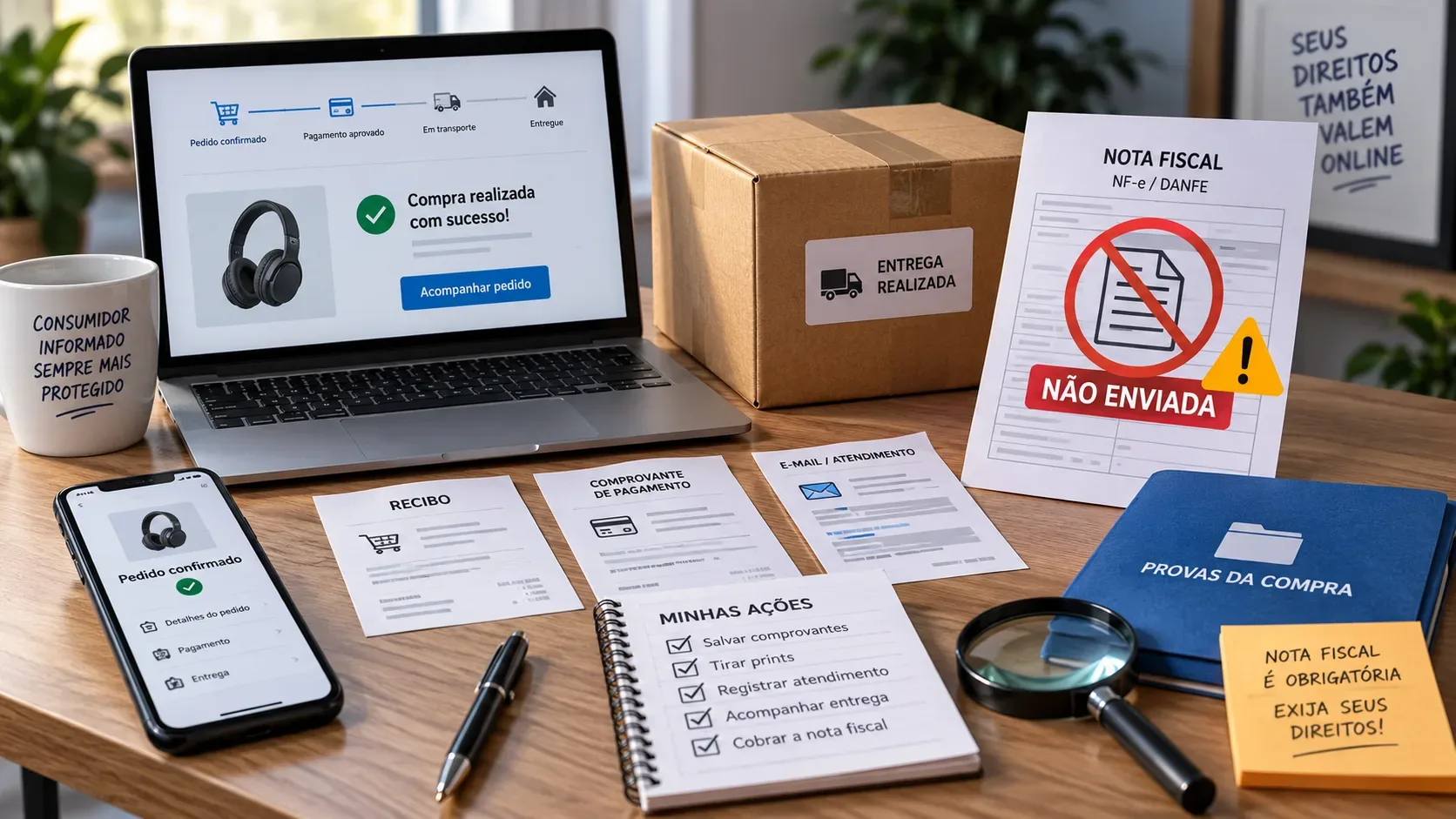
If an online store completed a sale but did not make the invoice available, the consumer should request the document through a channel that leaves a record while preserving evidence of the purchase. Procon-ES expressly states that issuing an invoice is also mandatory for online purchases and advises consumers to keep order data, payment records, emails, and the contract.
Is an invoice mandatory for an online purchase?
Yes. Buying online does not remove the obligation to document the transaction for tax purposes when the law requires a fiscal document. Law No. 8,846/1994 provides for the issuance of an invoice, receipt, or equivalent document when the transaction is carried out. For e-commerce, Procon-ES gives the practical rule: the invoice must be made available to the consumer under the same terms as purchases made in a physical store.
This does not mean that every record received after payment is an invoice. An order confirmation, card receipt, Pix payment record, paid bank slip, or approval email can help prove the purchase, but they serve different purposes from the fiscal document.
NF-e, DANFE, and proof of payment are not the same thing
For many sales of goods in Brazil, the invoice is issued as an NF-e, an electronic fiscal document. The DANFE is the auxiliary graphic representation of the NF-e. The Brazilian Electronic Invoice Portal explains that the DANFE does not replace the NF-e: among other details, it contains the access key used to confirm that the invoice exists.
If you received a DANFE or PDF containing a 44-digit access key, you can check the NF-e on the National NF-e Portal. If the key validates the invoice and the purchase details match, the fiscal document exists even if the store did not place a paper copy inside the package.
If there is no invoice, DANFE, access key, or invoice option in the order area, use a documented request process.
Where to look before filing a complaint
- Order page: look for labels such as “invoice,” “documents,” “NF-e,” “DANFE,” “download PDF,” or “access key.”
- Email and spam folder: some stores send the fiscal document separately from the order confirmation and delivery messages.
- Marketplace account: when the purchase is made through a platform, the document may be attached to the specific seller's order rather than the marketplace's general page.
- Packaging and shipping label: check for a simplified DANFE or a reference to an access key.
When you find a document, verify the issuer's business name, CNPJ when shown, invoice number, date, description of the transaction, and amounts. On a marketplace, pay attention to who actually sold the product because this helps direct the invoice request to the right party.
How to request the invoice without losing purchase evidence
Prefer a channel that generates a protocol number or lets you save the conversation, such as the platform's chat, email, customer-service form, or messaging within the order. Keep the request factual: provide the order number, purchase date, product, and amount, and ask the seller to make the invoice available or, if it has already been issued, provide the information needed to access it.
Decree No. 7,962/2013, which regulates e-commerce in Brazil, requires adequate electronic customer service for questions and complaints, immediate confirmation that the request was received, and a supplier response within five days. Record the date of contact and keep the protocol number.
Do not delete earlier conversations or overwrite files with newer versions. If the store changes order information, save the previous version as a screenshot or PDF as well, with the date visible whenever possible.
Which records should you preserve?
- order confirmation and purchase number;
- the offer page or a screenshot showing the price, product, delivery terms, and seller identity;
- Pix, card, bank-slip, or other payment confirmation;
- confirmation, shipping, and delivery emails or messages;
- conversations with customer service, the marketplace, or the seller, including protocol numbers;
- the contract, purchase terms, or contract summary shown at checkout;
- tracking and proof of delivery, when available;
- any DANFE, access key, label, or partial fiscal document received.
This evidence remains useful even if the invoice is sent later. Procon-ES recommends preserving purchase data, the order confirmation, messages exchanged with the supplier, and the contract in a format that can be stored and reproduced.
When to escalate the complaint
If the store does not make the invoice available after a formal request, gives an evasive response, or does not provide an effective customer-service channel, gather the records and consider filing a complaint with a consumer protection agency such as Procon. Another option, when the company participates, is Consumidor.gov.br. On that platform, a registered company has up to 10 days to review and respond to the complaint.
When escalating, keep the description focused: state that the purchase was completed, the fiscal document was not made available, and when and through which channels you requested it. Attach the relevant records. If there is another issue—such as a defective product, an unrecognized delivery, or an incorrect amount—describe it separately so each problem remains clear.
What to avoid
- Do not discard evidence just because the product arrived. Delivery does not replace the purchase documentation.
- Do not confuse proof of payment with an invoice. A payment record documents a financial step; the invoice documents the fiscal transaction.
- Do not expose unnecessary sensitive information. If you ask for help on social media or forums, hide CPF, address, card data, codes, and personal details.
- Do not rely only on phone calls. If you call, write down the protocol number, date, and time and, when possible, confirm the request in writing afterward.
Quick action plan
- Look for the NF-e, DANFE, or access key in the order area and your email.
- Save the order, offer, payment confirmation, messages, and seller information.
- Request the invoice in writing and keep the protocol number.
- If you receive an access key, validate it on the National NF-e Portal and check the data.
- If the issue is not resolved, take the complaint to Procon or Consumidor.gov.br when available.
The key point is simple: requesting the invoice and preserving evidence are complementary actions. An organized purchase record makes it easier both to locate the fiscal document and to file an administrative complaint if needed, without relying only on memory or pages that may later change.