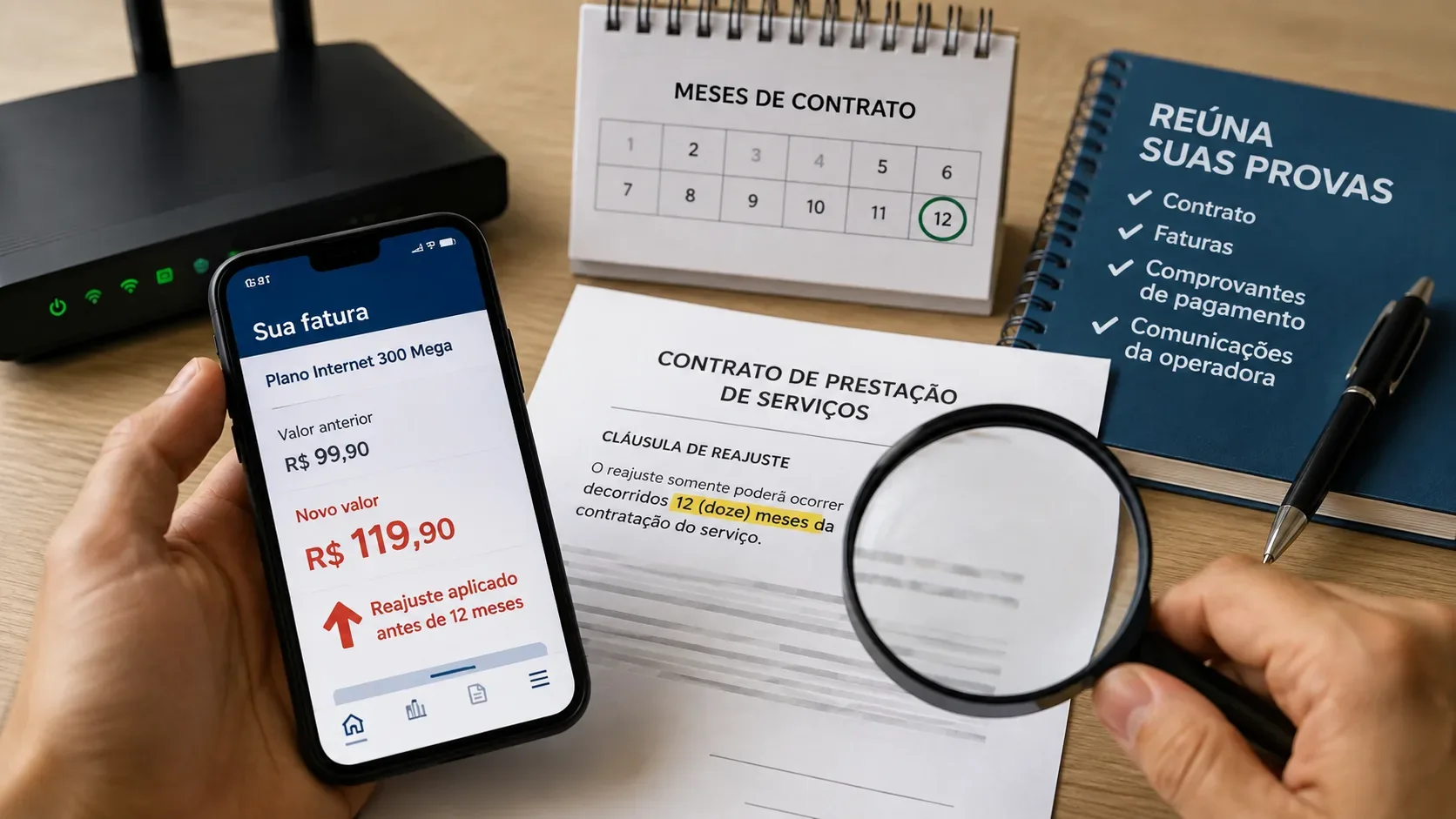
If your provider described the price increase as a price adjustment and it happened before the offer had been in effect for 12 months, there is an objective reason to challenge it. Under current Anatel rules, telecom service prices may only be adjusted after 12 months, and the contract must state the criteria, reference date and applicable index. The first task, however, is to determine whether the bill really went up because of a price adjustment: the end of a promotional discount or migration to another offer are different situations and require different evidence.
Before complaining, classify the increase
Comparing the previous bill with the new one helps, but it is not enough. Also find the contract, the offer's Standard Label and any message sent by the provider. The key question is why the amount changed.
| Situation | What usually happened | What to check |
|---|---|---|
| Price adjustment | The same offer remains active, but its base price is updated by an index or percentage. | Contract date, reference date, index stated in the contract and an interval of at least 12 months. |
| End of a temporary discount | The full offer price already existed, but a discount applied for a limited number of months; when the benefit ends, the bill returns to the full price. | Full price, discount amount, duration and conditions disclosed at the time of contracting. |
| Offer change or migration | The plan, offer code, allowance, speed, included services or other conditions change, possibly together with a new price. | Your consent, prior notice, the end of the previous offer's validity and the features of the new offer. |
This distinction matters because Anatel itself states that a price adjustment applies to the offer price without temporary or occasional discounts. Therefore, the mere fact that the bill rises in the fourth, sixth or ninth month does not by itself prove an early annual adjustment. If the increase happened because a clearly disclosed discount expired, it may not be an annual price adjustment. On the other hand, a poorly explained discount, a full price that never appeared in the documents, or an offer change without authorization may create a different basis for a complaint involving transparency or a contractual mismatch.
What the 12-month rule says
The General Consumer Rights Regulation for Telecommunications Services (RGC), in its current version since September 1, 2025, preserves the protection against price adjustments at intervals shorter than 12 months. Anatel's Offer and Contracting page states that prices may only be adjusted after 12 months counted from the offer's adjustment reference date or from the date the consumer contracted the offer. The Agency also requires the contract to state price, validity and adjustment rules.
For the first adjustment, use the date on which you joined the current offer as the practical reference. This matters especially if you were already a customer but later moved to another plan: do not confuse your total relationship with the provider with the contracting date of the offer now being billed. Check the offer code, contract and Standard Label.
Anatel allows providers to establish adjustment reference dates, but they cannot be used to shorten the required minimum interval. The contract must define the adjustment criterion and index. The Agency also notes specific exceptions for certain fixed-line plans — Basic Plan, PASOO and AICE — that do not follow the general 12-month rule. Those exceptions are not the typical scenario for a mobile postpaid plan or residential broadband.
The end of a promotion is not automatically a price adjustment
Consider an offer with a full price of R$120 but a R$20 discount for six months. If those amounts and the duration of the discount were clear when you signed up, the move from R$100 to R$120 in month seven may simply be the end of the benefit rather than an adjustment of the base price. This is why the bill by itself can lead to the wrong conclusion.
Red flags include a mismatch between the charge and what was disclosed: a discount with no clear end date, a full price that was never presented, promotional conditions different from what was promised, or a message that calls the increase an “adjustment” before 12 months. In these cases, keep the advertisement, screenshots, emails, SMS messages and provider-app notices.
An offer change also needs to be checked
The RGC treats an offer as a set of conditions that includes services, price, allowances, benefits and usage rules. According to Anatel's current guidance, the provider cannot change the price or conditions of an offer without the consumer's consent, except for the regulatory situations that already have their own rules, such as a contractually provided adjustment and migration at the end of an offer's validity.
When an offer is going to end, the provider must give at least 30 days' notice so that the consumer can choose another one. If the consumer makes no choice, migration may occur to a similar offer without a new lock-in period. If your bill increased because of a migration you do not recognize, compare the code, name, allowance, speed and services of the old and new offers. The issue may be an offer change, not a price adjustment.
Documents to gather before challenging the charge
- Current offer contract: find the contracting date, price, validity, adjustment index and reference date.
- Standard Label: it summarizes the main offer conditions and helps show what was contracted.
- Bills before and after the increase: highlight the recurring amount and the date on which it changed.
- Offer code and name: these help determine whether the same offer was adjusted or you were moved to another one.
- Advertising and contracting evidence: keep screenshots, emails, SMS messages, sales protocols and promotional terms.
- Provider notices: look for messages about adjustment, discount expiration, offer termination or migration.
- Service protocols: each contact with the provider should generate a traceable protocol number.
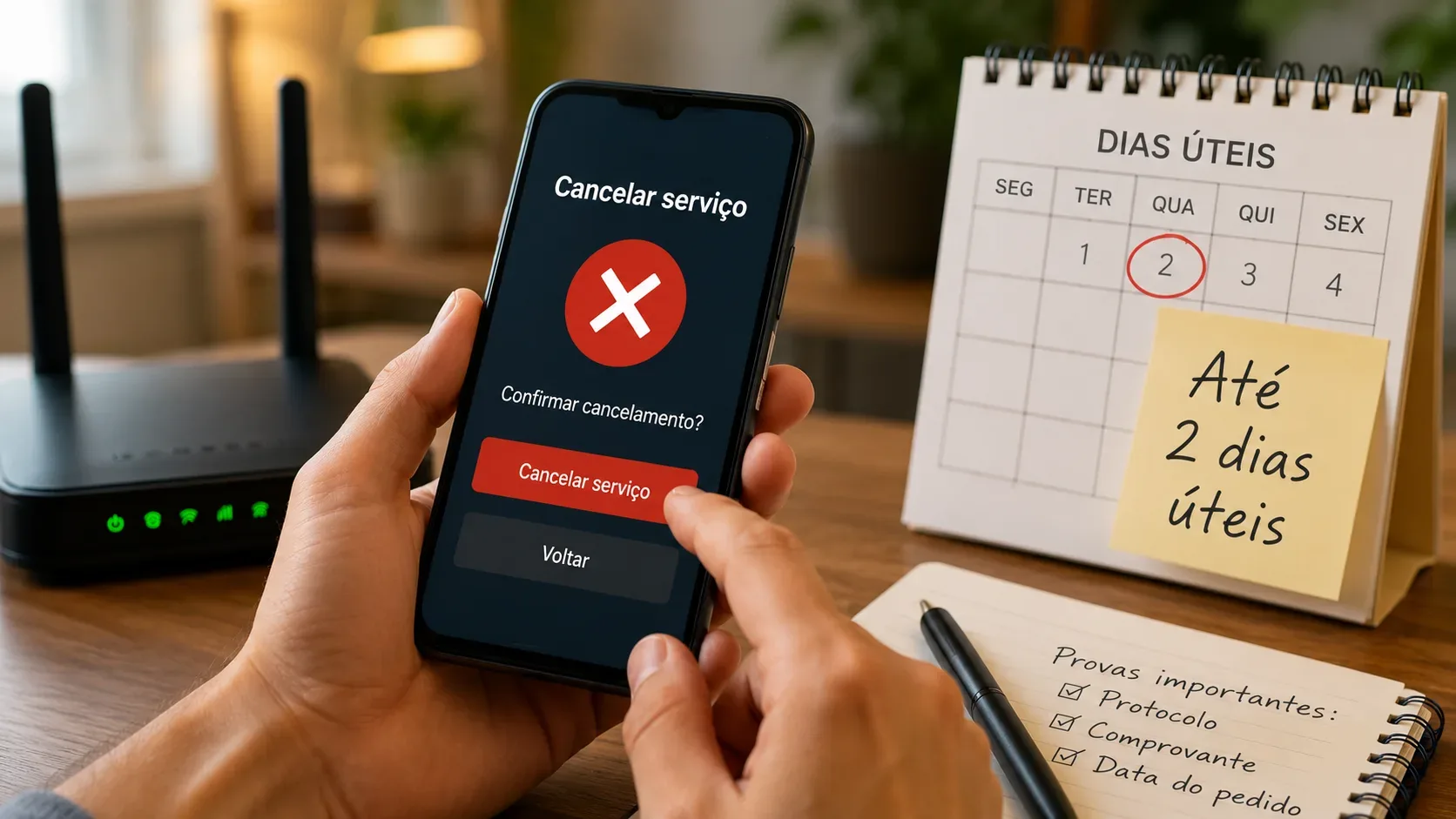
There are two useful ways to recover evidence. Anatel says providers must maintain a permanent repository of offers, including older ones, for three years after their validity ends. And if the offer was contracted by phone, the recording must be kept for 90 days; if the sale was recent, request it promptly.
How to count the 12 months
- Find the contracting date of the current offer.
- Find the first bill that shows the higher price.
- Check whether the provider said it was a price adjustment and which index was used.
- Confirm whether the contract contains that index and the reference date.
- Compare the dates. If the adjustment occurred before 12 months were completed, record that discrepancy clearly.
When writing the complaint, avoid relying only on phrases such as “the price went up too much.” A more verifiable formulation is: “I contracted the offer on [date] for [amount]. The bill for [month] began charging [amount] on the grounds of a price adjustment. Fewer than 12 months elapsed between contracting and the adjustment. I request a review of the charge and identification of the contractual clause, reference date and index used.”
How to dispute the charge while preserving your evidence trail
First, dispute it directly with the provider and keep the protocol number. For a billing dispute, Anatel states that consumers may question amounts charged up to three years after the charge. If the disputed amount has not been paid, its collection must be suspended and the provider must issue a bill containing only the undisputed amounts. That does not mean leaving the entire bill unpaid: identify precisely which portion is being disputed.
The provider has up to 30 days to analyze a billing dispute. If it acknowledges the error — or fails to respond within that period — it must cancel the disputed amount if unpaid or automatically refund improperly paid amounts in accordance with the applicable reimbursement rules.
If ordinary customer service does not resolve the issue, take the protocol to the provider's ombudsman. If the problem persists, use Anatel Consumidor. The Agency describes this three-step path: provider, provider ombudsman and Anatel complaint. After the complaint is forwarded, the provider has ten calendar days to respond through the system.
Checklist: when the challenge is stronger
- The provider itself called the increase an “adjustment”.
- The current offer had not completed 12 months on the date of the increase.
- The contract does not state the index or reference date used for the charge.
- The applied percentage does not match the contractual criterion.
- The increase is not explained by a clearly disclosed temporary discount.
- The plan, allowance, speed or included services changed without identifiable consent.
- You have bills, the contract, the Standard Label and protocol numbers showing the sequence of events.
In short, “the bill increased before 12 months” is the start of the analysis, not the conclusion. If it is a true adjustment of the offer price, the minimum interval and contractual criterion are central. If it is the end of a discount or a migration, the discussion shifts to transparency, promotional conditions and authorization for the new offer. Correctly classifying the increase and attaching the right documents makes the challenge much more objective.