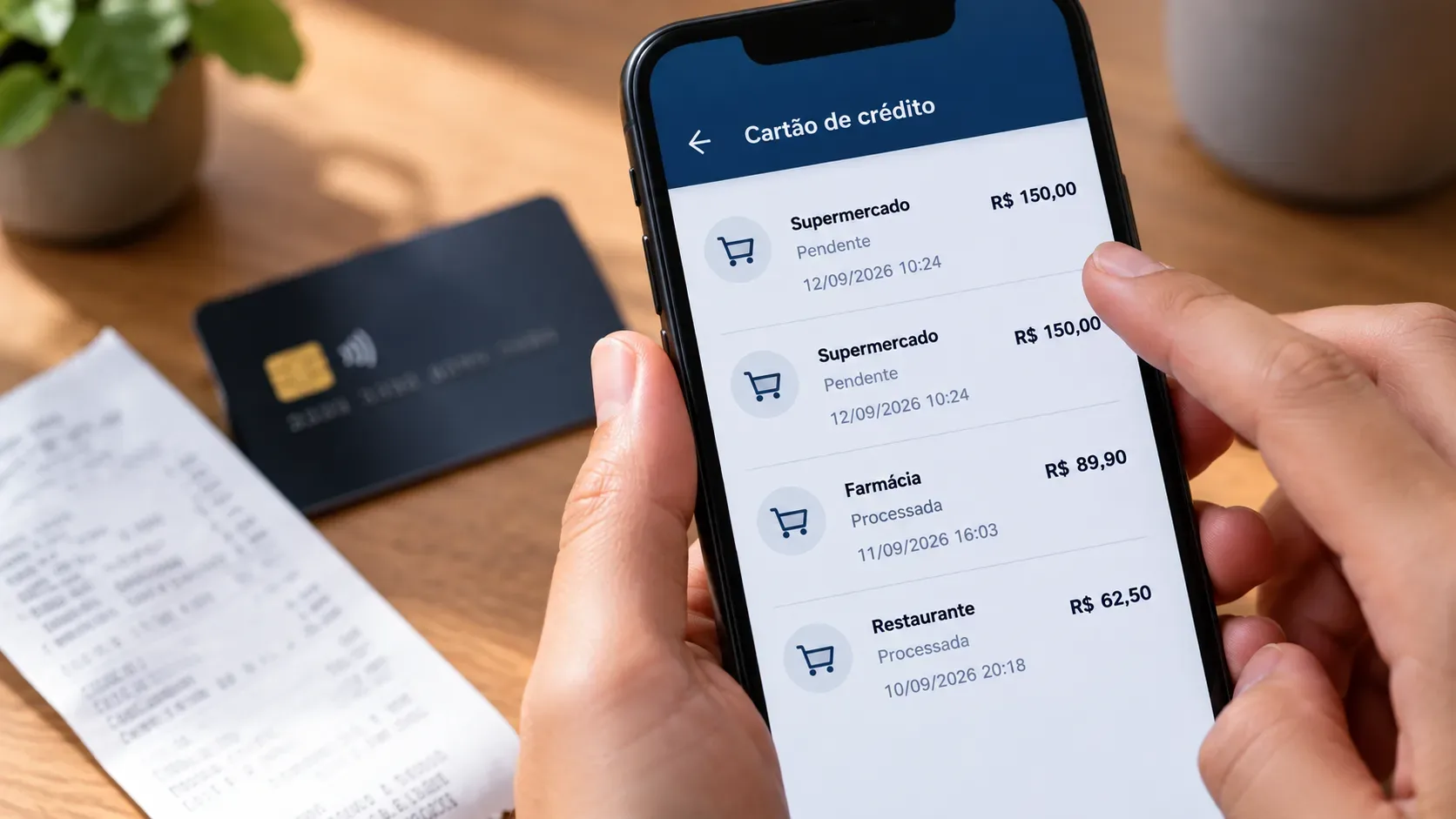
If a purchase appears twice on your card, the first step is not to dispute it immediately: it is to identify the status of each transaction. A pending transaction may simply be an authorization hold — a temporary reservation of available credit — while the other entry is already the final charge. A true duplicate becomes more likely when there are two posted charges for a single purchase.
The safest way to tell the cases apart is to compare status, amount, date, merchant and receipt. If the duplicate is confirmed, ask the merchant for a reversal and, if the issue is not resolved, open a dispute with the card issuer and attach your evidence.
First: are both transactions pending or posted?
Open the details of both transactions in the app. Labels vary by issuer — “pending,” “processing,” “authorized,” “posted” or “confirmed” — but the question is the same: has the amount become a final charge, or is it still in the authorization stage?
| What the app shows | What it may mean | Next step |
|---|---|---|
| One pending and one posted, with a similar amount | It may be an authorization hold followed by the final charge | Compare date, merchant and amount; monitor the pending entry and confirm with the issuer if needed |
| Two pending entries | They may be authorization attempts that have not settled yet | Keep the details and monitor them; if they remain or heavily reduce available credit, contact the merchant and issuer |
| Two posted charges for one purchase | There is a stronger sign of a true duplicate | Ask the merchant for a reversal and dispute it if the issue is not resolved |
| One pending and one posted for different amounts | There may be an adjustment between the preauthorization and the final amount | Check the receipt and the amount actually agreed before treating it as a duplicate |
According to Stripe’s explanation of authorization holds, a hold temporarily reserves funds or available credit and can appear as a pending charge until the transaction is finalized. This can make one authorization plus one final capture look like two separate charges.
When two entries may only reflect a preauthorization
Preauthorizations are common when the final amount may change or when the merchant needs to confirm that enough credit is available. Hotels, car-rental companies, gas stations, delivery apps and some digital services are common examples.
In these cases, the card may first show a temporary reservation and later the final charge. Stripe distinguishes a preauthorization from a pending charge: the first is the merchant’s request to hold an amount, while the second is the customer-facing status shown while the transaction has not yet been captured or settled.
The time it takes for a hold to disappear is not a universal refund deadline. It depends on the transaction type, merchant, card network and issuer. Some authorizations disappear quickly; others may remain for days and, in certain payment flows, longer. Use the timeframe provided by your bank or card issuer as the practical reference.
How to recognize a real duplicate charge
No single sign proves duplication, but the combination below is strong:
- both transactions are posted, confirmed or finalized;
- the merchant is the same or the statement descriptor points to the same business;
- the amounts are identical or clearly correspond to the same purchase;
- the dates and times are identical or very close;
- you have only one order, invoice, receipt or payment confirmation;
- the merchant confirms that only one charge should exist.
Visa’s dispute guidance addresses duplicate processing when the same transaction is processed more than once. For cardholders, this reinforces the value of keeping the receipt, order confirmation and transaction details to show that only one purchase took place.
In-app checklist: what to verify before disputing
- Status: note whether each transaction is pending, posted, confirmed or reversed.
- Merchant: open the details. The statement name may differ from the brand you saw at checkout; compare tax/business identifiers, city or descriptor when the app provides them.
- Amount and currency: confirm that they are actually the same. International purchases, hotels, gas stations and variable-price services may have different authorization and final amounts.
- Date and time: entries close together support the duplication hypothesis, but different dates do not rule out an adjustment or delayed processing.
- Receipt: gather the invoice, receipt, order confirmation, email or merchant payment proof.
- App evidence: save screenshots of both transactions and their statuses.
What to ask the merchant
If you recognize the purchase and the merchant, contacting the business is often the most direct route. Explain that two entries appear for one purchase and provide the necessary details without sharing your password, security code or full card number.
Ask for a clear answer: were there two captures, is one entry only an authorization, or has a refund/reversal already been submitted? If the merchant confirms a reversal, request proof, date and amount of that reversal. Keep the support ticket, email or chat record as well.
In their dispute guidance, banks such as Santander and Itaú recommend contacting the merchant for commercial issues when possible and preserving supporting documents for any later review.
When to dispute the card transaction
A dispute makes sense when the evidence points to an actual duplicate and the merchant has not corrected it. Examples include:
- both charges are posted and relate to a single purchase;
- the merchant acknowledged the error, but the promised credit did not appear within the stated timeframe;
- the merchant does not respond or refuses to correct the charge;
- the issuer instructs you to open a dispute directly through the app or support channel.
The procedure varies by issuer. Some apps provide a “duplicate charge” reason or equivalent. Digio, for example, instructs customers to select the transaction, choose the duplicate-charge dispute reason and attach proof. Always use your card issuer’s official channel.
What about the bill: pay it or subtract the duplicate yourself?
Do not assume that opening a dispute allows you to manually deduct the amount from your statement. The treatment of a disputed charge — provisional credit, suspension, later refund or temporary maintenance of the amount — depends on the issuer and the stage of the review.
If the due date is close, ask your bank or card company how to pay the bill while the dispute is being reviewed. Avoid simply paying less without confirmation, because that may create an outstanding balance, interest or fees under your card’s rules.
If you do not recognize the purchase, the situation is different
If you do not recognize the purchase or the merchant at all, treat the case as possible unauthorized use, not merely a processing error. Use the issuer’s official channel to lock or replace the card when recommended and report the transaction as unrecognized. Never share passwords, authentication codes or full card details with supposed support agents.
Practical summary: pending is not the same as being charged twice
- One pending + one posted: it may be a temporary authorization plus the final charge.
- Two pending: monitor the status before concluding that there are two final charges.
- Two posted charges for one purchase: gather proof, request a reversal and dispute if necessary.
- Release or refund timing: varies; confirm the applicable timeframe with the merchant and issuer.
- Bill due soon: ask the issuer how to handle the disputed amount; do not deduct it on your own.
The key is to separate an available-credit hold from a settled charge. That check helps you avoid disputing too early while still acting promptly when two effective charges exist for one purchase.