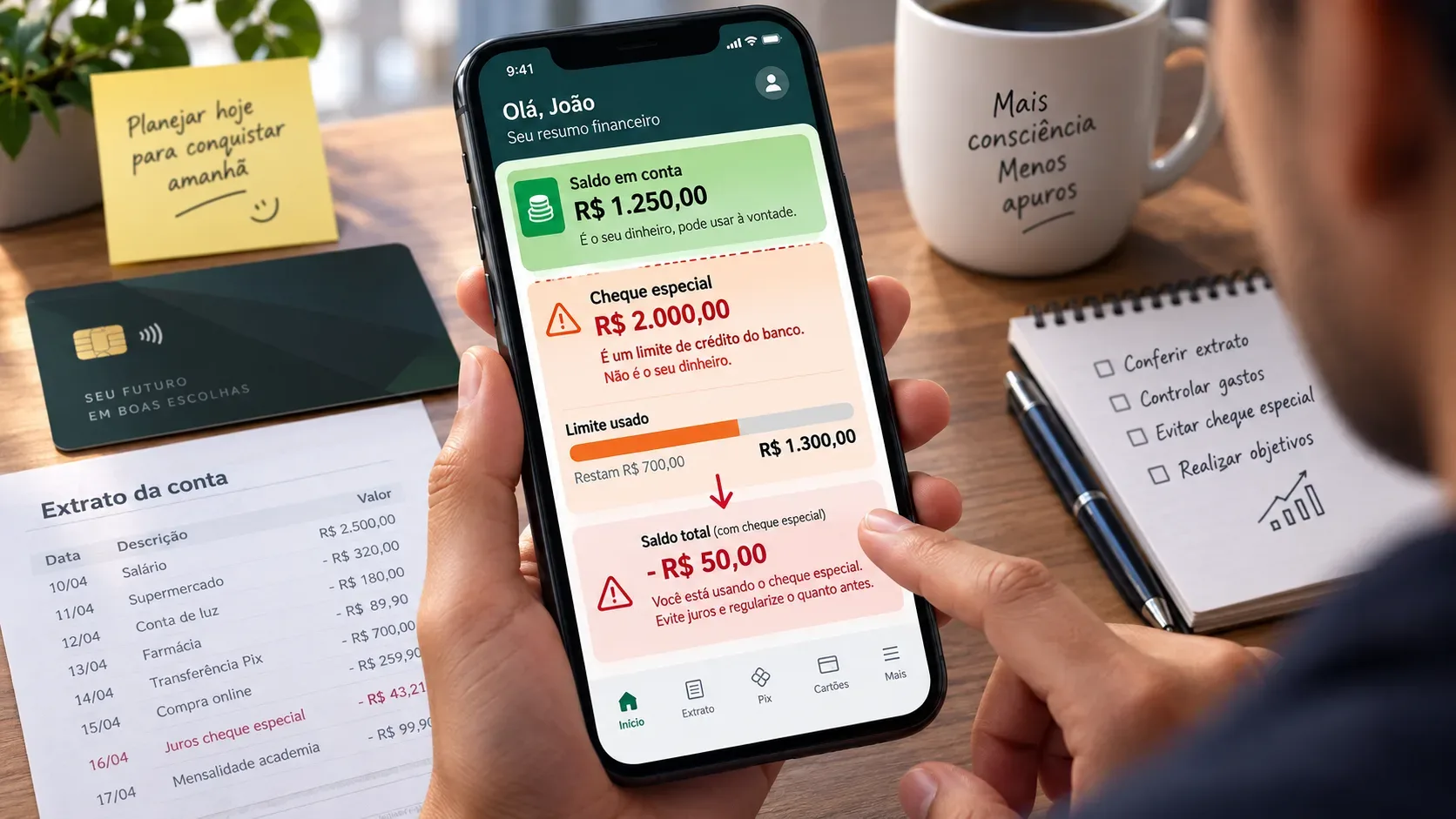
When an overdraft facility appears next to the account balance, the safest way to read the screen is to separate two things: the money actually held in the account and the credit limit made available by the bank. Brazil's Central Bank defines the overdraft facility, known locally as cheque especial, as a revolving credit line linked to a demand deposit account. Although the limit may appear on a statement or banking app, it is not the customer's own money. Once used, it becomes an outstanding debt subject to the charges of the credit operation.
Labels and screen layouts vary by bank. For that reason, a figure shown as “available balance” may not represent only the customer's own funds. The key is to identify how much is actual account balance, what the contracted overdraft limit is, and how much of that limit has already been used.
Why an overdraft limit can look like part of the balance
The overdraft facility is pre-approved and connected to the current account so it can cover transactions when the customer's own balance is insufficient. According to the Central Bank of Brazil FAQ on cheque especial, the limit may appear on the account statement, but it does not belong to the customer. It is bank credit.
This helps explain why two screens in the same app can show different figures. One may highlight only the account balance, while another may show an available amount that also considers the credit limit. Because interfaces are not standardized, look for labels equivalent to “account balance”, “overdraft limit”, “limit used” and “outstanding overdraft balance”.
How to separate your own money from the credit limit in four situations
| Situation | Example | How to read it |
|---|---|---|
| Positive balance | R$800 in the account and a R$1,000 limit | The R$800 is the customer's own money. The R$1,000 is available credit and should not be added to personal assets. |
| Partial use of the limit | Account balance at negative R$200 with a R$1,000 limit | R$200 of the overdraft facility has been used. The remaining limit is not cash on hand, only credit that has not yet been used. |
| An automatic debit reaches the limit | R$100 in the account and an automatic debit of R$250 | If the payment is processed using the overdraft facility, R$150 becomes borrowed credit. Brazil's Central Bank lists account debits among the transactions that may be covered by the product. |
| Returning to a positive balance | Account at negative R$200 and an incoming R$500 credit | As a practical reading of the account movement, the incoming funds first cover the outstanding balance and the remainder becomes the customer's own positive balance. In this example, that would be R$300 before any other transactions or pending charges. |
The cost starts when the credit limit is used
An unused limit is not money already spent. Interest cost arises when the overdraft facility is used. Brazil's Central Bank states that interest may be charged on the amount actually used, meaning the outstanding debit balance.
For individuals and individual microentrepreneurs, the remunerative interest rate on cheque especial is capped at 8% per month. This is a maximum, not a mandatory rate: a contract may set a lower percentage. The rule is established by CMN Resolution No. 4,765 and is reiterated by the Central Bank.
The Central Bank FAQ also states that individuals and individual microentrepreneurs may not be charged a fee simply for having an overdraft limit available. This is different from interest due when the credit is actually used. Any other charges or taxes applicable to the credit operation should be checked in the contract and in the account entries.
How to monitor use without being misled by the app's headline number
- Start with the account balance: find the amount that represents deposited funds only, without adding the credit limit.
- Check the amount of the limit already used: if any amount has been drawn, treat it as short-term debt, not as part of the balance.
- Read the statement entries: identify the transaction that pushed the account below zero, such as a purchase, cash withdrawal, transfer, bill payment or automatic debit.
- Check the contract rate: the 8% monthly cap does not mean every bank charges exactly 8%.
- Watch accumulated interest and other entries: the cost may appear separately from the principal amount borrowed.
A simple check before spending
Before treating a figure as money available for new expenses, use this check: your own balance minus payments already scheduled. Then look at the overdraft facility separately, as an emergency credit line. If the app shows a total available amount that includes the limit, do not use that total as a measure of how much money you actually have.
Automatic debits deserve special attention. A payment may still be processed after the customer's own balance becomes insufficient if the account has a contracted overdraft facility and the transaction is covered by the limit. Reviewing scheduled payments before their due dates reduces the chance of entering overdraft without noticing.
If the overdraft facility is used frequently
Repeated use can mean the credit limit is functioning as an income supplement, making interest a recurring part of the budget. In that situation, it is worth comparing the cost of the overdraft facility with other available forms of credit, reorganizing due dates and considering whether a lower limit would be more appropriate. The Central Bank says that taking out the overdraft facility is the customer's choice and that the limit amount must be agreed with the financial institution.
For statement reading, the practical rule is straightforward: a positive account balance is your own money; a negative balance is debt; an unused overdraft limit is only available credit. Keeping these categories separate helps prevent confusion between borrowing capacity and money actually available, and makes it easier to see when overdraft use starts generating cost.