Stopping an account does not mean closing it. If an old account still appears in the Registrato, if the bank says it was closed but the CCS shows no end date, or if fees have arisen after months of no activity, the safest course is to ask three separate questions: which relationship is still registered, what is the status of the specific account at the bank and where each charge came from.
This separation avoids two common mistakes. The first is to conclude that an account is automatically closed just because it has become unused. The second is to treat the Registrato as if it were a detailed bank statement. The Accounts and Relationships Report of the Financial System Customer Registry, the CCS, helps to locate links with institutions, but does not replace the bank's own documentation.
An account without transactions is not a closed account
The practical rule is simple: leaving the account idle does not equate to terminating the contract. An account can go without activity for a long time and remain open, with products or services linked to it, until there is an effective closure or another cause for the relationship to end.
There is frequent confusion with the old reference to six months of inactivity. Resolution 2,025, of 1993, defined as inactive, for a certain tariff purpose, an account that has not been active for more than six months. This section was revoked in 1996. Therefore, it is not correct to use the idea of “six months without use = account automatically closed” as a general rule today.
This also means that it is not enough to delete the application, leave the balance at zero, stop using the card or transfer the money to another bank. If the intention is to end the relationship, the relevant step is to request termination and save the confirmation.
What the Registrato shows: and what it doesn't show
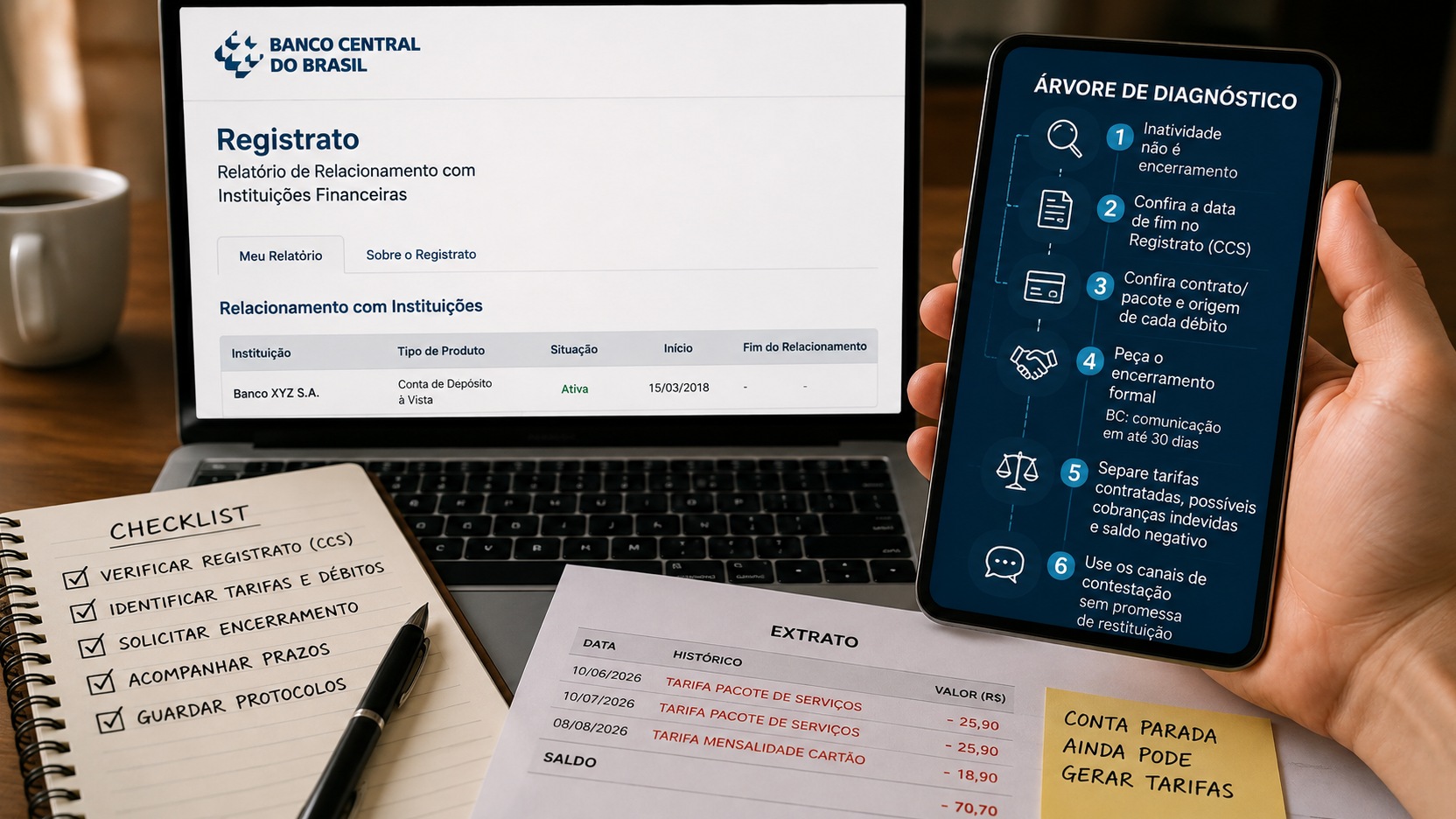
In the Registrato, the Accounts and Relationships report, known as CCS, informs which banks and other institutions there is or was a relationship in the name of the CPF or CNPJ. It also presents the start date and, if applicable, the end date of the relationship.
The report does not show branch number, account number, balance, statements or transactions. Therefore, an entry without an end date is a sign that there is still a registered relationship with that person
institution, but it is not sufficient, alone, to explain which account or product maintains this link.
This point is especially important for anyone who has had more than one account, investment, payment account or other product at the same institution or in the same group. The bank may have closed a specific account and another relationship still exists. There may also be registration discrepancies that need to be corrected by the institution itself.
If the CCS information is wrong or not recognized, the Central Bank itself recommends contacting the institution responsible for the information.
How to hold your first conference at CCS
To consult the report, the Central Bank informs that access to the Registrato uses a silver or gold level Gov.br Account, with two-step verification enabled. Within the system, the relevant report for this question is Accounts and Relationships.
When locating the institution, pay particular attention to whether there is an end date. If there is, the CCS records that that relationship with the institution ended on that date. If there is not, the relationship appears as current in the Central Bank registry.
The absence of an end date should not automatically be interpreted as proof that that specific old checking account is operational. As the public report does not contain an account number or statement, the next step is to ask the bank to identify the link and confirm the status of the account you want to close.
The report is updated daily. Still, do not use an isolated query as a substitute for formal confirmation from the bank, especially when closure has just been requested or when there is a persistent divergence between systems.
If the bank says it has closed, but the Registrato remains active
In this scenario, ask the bank for a verifiable answer. Ideally, you should obtain written confirmation of the specific account closure date, protocol number and identification of any products or relationships that remain active.
Then, compare this answer with the CCS. If the bank confirms that there is no longer any relationship that justifies active entry, ask the institution to correct the information sent to the Central Bank. The BC advises that corrections to the report be handled with the responsible institution.
If there is another active product, the divergence may only be apparent: the old account may have been closed and the general relationship with the institution continues for another reason. In this case, what needs to be checked is whether this product is known, desired and correctly contracted.
Ask the bank for information that the Registration does not provide
To complete the diagnosis, ask the bank for the status of the specific account, the date it was opened, the date of eventual closure, the current balance and the memory of the entries that formed any outstanding amount.
If there is a monthly charge, also ask for identification of the service package or product that generated the fee, a copy or proof of the contract and the fee table applicable to the period. If interest or charges appear, ask the bank to indicate which credit transaction caused them, such as an overdraft or other limit associated with the account.
It is also worth confirming whether there is a card, insurance, subscription, automatic debit or separate service that remains active even after the account is closed. Closing regulations require the institution to inform which products and services remain in force and which are closed together with the account.
How to formally close a deposit account
For deposit accounts, such as traditional current accounts, CMN Resolution 4,753 establishes minimum procedures for closing. The customer communicates the intention to terminate the contract, indicates the destination of any credit balance and resolves the measures related to checks, when applicable.
The institution must inform the deadline for closing measures, limited to thirty calendar days from the communication of the intention to terminate. It should also provide guidance on the payment of commitments made and clarify which products or services will remain active or end with the account.
At the end of this period, the bank must communicate the date of effective closure or inform the reasons that made the closure impossible.
The Central Bank also informs that the request can be submitted through service channels, including electronic ones, with the exception of the voice telephony channel. If the channel used to open the account is still available, the regulations ensure the possibility of requesting closure through that same channel.
What if it's a payment account
Not every account used by an application is technically a deposit account. Payment institutions and other entities may offer payment accounts, subject to BCB Resolution 96.
The closure logic is similar: communication of the intention to terminate, treatment of the remaining balance, information on any outstanding balance or other commitments, clarification on products that remain active and a period of up to thirty calendar days for action.
The institution must also communicate the closing date or the reasons that make it impossible. For postpaid payment accounts, the rule provides specific protection: closure cannot be refused just because there is an overdue balance or installments and future obligations, and the method of payment of these obligations cannot be changed without the holder's request.
Accumulated fare should not be judged by name alone
Finding a sequence of fees on a frozen account does not, in itself, prove that they are all due. It also does not prove that they are all undue. It is necessary to discover what was the trigger for each launch.
For individuals with a demand or savings account, there are essential banking services that must be offered free of charge within the limits defined by regulation. Furthermore, contracting a service package is optional and must be formalized in a specific instrument.
If there was a contracted package and it remained active while the account remained open, the absence of movement is not enough, alone, to conclude that the monthly fee was invalid. The analysis depends on the contract, the term of the package, the information provided to the customer and the nature of the launch.
On the other hand, if the bank is unable to demonstrate the contract, charges an essential service within the free franchise, launches a tariff that is incompatible with the applicable table or maintains charges after the effective closing date without an independent contractual basis, there is a concrete reason for dispute.
Service package can be canceled
The Central Bank informs that contracting a service package is optional. The customer can use free essential services and pay individually for non-free services, instead of maintaining a monthly package fee.
The regulations also provide that package cancellation may occur at any time. Therefore, anyone who discovers an old account that is still open does not need to wait for complete closure to question an unwanted package. It is possible to ask the bank to suspend or cancel the package and,
separately conduct account closure.
It is important to keep the protocol of both requests, because “cancel package” and “close account” are different steps.
How to interpret a negative balance
Negative balance deserves a breakdown. Ask how much came from purchases, withdrawals, transfers or authorized debits, how much corresponds to fees and how much corresponds to interest, IOF or other charges for a credit operation.
For deposit accounts held by individuals, Resolution 3,919 establishes that the fee debit cannot exceed the available balance, including considering any credit limit agreed between the parties. In practice, if there was an overdraft or other limit associated with the account, a fee could consume part of that limit and the statement would show a negative balance.
From then on, charges may appear related to the credit used. Therefore, a debt apparently formed by “fees from a frozen account” may have different components. The bank must be able to separate these values and demonstrate the basis for each.
Do not accept a global value without calculation memory if the origin of the debt is in dispute. At the same time, do not leave the situation unattended, as charges for a credit transaction may continue to take effect as long as the debt is not resolved.
What to dispute when the charge seems wrong
The objection becomes stronger when it points out a concrete inconsistency. Instead of just saying that the account was unused, identify the date of the last transaction made by you, the date on which you requested package cancellation or closure, the date that the bank claims to have closed the account and subsequent entries.
Request that each rate be linked to the contract, package or service that authorized it. If there is a charge after the closure, ask the bank to explain why it continued to exist and whether it corresponds to a product independent of the account.
If the debt was formed within the credit limit, ask for the evolution of the outstanding balance, with interest and other separate charges. If there is a discrepancy between the contract presented and the releases, record this in the complaint.
The objective is not to assume restitution. The refund of amounts depends on the nature of the charge, available evidence, the institution's response and, when necessary, analysis by consumer protection agencies or the Judiciary.
Keep proof of closure
The best document to avoid future doubts is the closure confirmation issued by the institution. Keep the request protocol, the final response, the effective closing date and proof of settlement or negotiation of remaining obligations.
After closing, consult the Registrar again. If an active relationship continues to appear and the bank states that there is no other product that justifies it, request the correction from the CCS in writing.
It is also worth keeping the last statement available. It helps to demonstrate when movements occurred, what tariffs were charged and whether charges were incurred after the date reported as closing.
When to escalate the complaint
The Central Bank recommends first trying the institution's own channels, such as an agency or SAC, and then the ombudsman's office. The ombudsman is especially useful when there is already a previous protocol and the response did not resolve the disagreement.
If the problem persists, the consumer can contact Procon or register a demand at Consumidor.gov.br. It is also possible to file a complaint with the Central Bank against supervised institutions.
It is important to understand the role of the BC in this process. The Central Bank does not decide the individual case nor directly determine a refund to the consumer. The complaint is forwarded to the institution for response and also feeds supervisory and regulatory activities. In 2026, the BC informs a deadline of up to ten business days for the institution to respond to a complaint registered on its channel.
A diagnostic guide to avoid leaving your account in limbo
If you found an old account, treat the situation as a sequence of confirmations. First, use CCS to find out if there is a registered relationship and if an end date appears. Then ask the bank for the specific account status and documents that Registrato does not provide. Then, if the account is still open, file a formal closure and ask for an end date.
If there are fees or a negative balance, do not mix everything into a single discussion. Identify the origin of each release, check the contracting of the package and separate fees, authorized debits and credit charges. Dispute what is not demonstrated, without assuming that simple inaction resolves the issue.
The account only stops being a pending issue when you can answer, with documents, two questions: which relationship ended and on what date. The Registrato helps to see the link; the bank is the one who needs to explain the account, the entries and the formal closing.