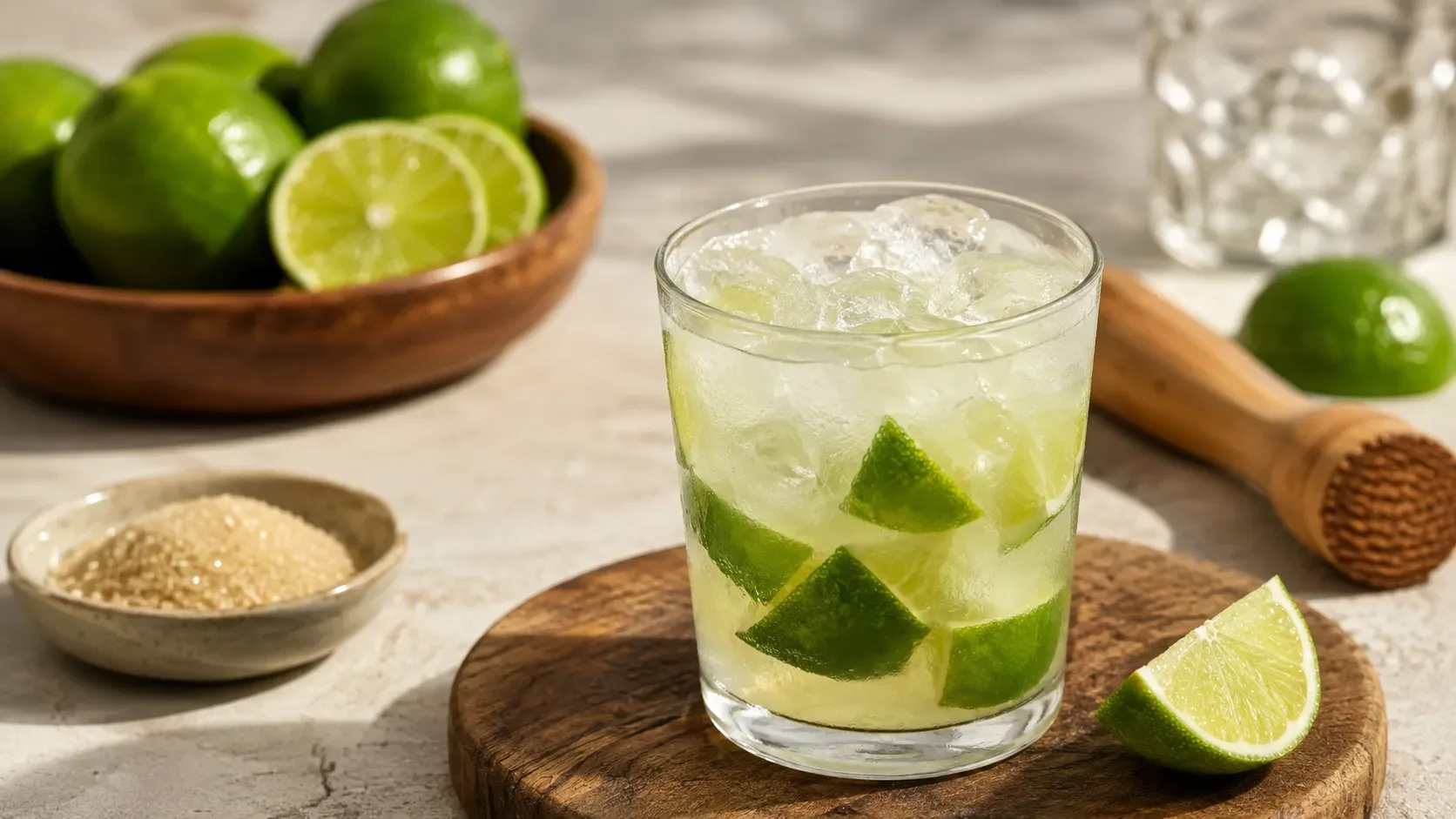
Few drinks need so little to be recognized. Cachaça, lemon, sugar and ice form a combination that crossed bars, restaurants, parties and borders until it became one of the cocktails most associated with Brazil.
The simplicity, however, hides a story that is less linear than it seems. There is no birth certificate capable of reliably indicating who prepared the first caipirinha and on what date. There are different versions involving the 19th century, the interior of São Paulo and old homemade mixtures used during epidemics. What can be safely stated is that the recipe has consolidated over time and today has a very defined identity.
In Brazil, this identity reached legislation. Decree No. 12,709, published on November 3, 2025, defines the industrialized caipirinha as a typical drink of the Federative Republic of Brazil, made with cachaça, lemon and sugar. The standard replaced Decree No. 6,871/2009, still mentioned in many old pages on the subject.
Where did the caipirinha come from?
The most correct answer is: the exact origin remains disputed.
One of the oldest stories goes back to Paraty, in Rio de Janeiro, in 1856. There are reports that, during a cholera outbreak, a mixture of water, cachaça, lemon and sugar was used by the population. The record is interesting as a precursor to the combination of ingredients, but it does not prove that the cocktail called caipirinha was born there.
Another historical line leads to Piracicaba, in the interior of São Paulo. According to the version attributed to historian Luís da Câmara Cascudo, farmers in the region were already preparing a drink based on cachaça, lemon and sugar in the 19th century, linked to the São Paulo sugarcane culture.
There is also the narrative of 1918, during the Spanish flu pandemic. In this version, a homemade preparation from the interior of São Paulo combined cachaça, lemon, honey and garlic. Over time, the garlic would have disappeared, the honey would have given way to sugar and the preparation would have become closer to the drink known today. This reconstruction is quite widespread, including in sources linked to the world of cachaça, but it should be understood as one of the possible historical explanations, and not as a sequence documented in all its steps.
The path to the current recipe was not direct
A record from 1945 helps us understand how the drink could still appear in different ways.
In the book Drinkologia dos Estrangeiros, by diplomat Maurício Nabuco, a drink known in Rio de Janeiro as Batida Paulista is described, prepared with cachaça, lemon and sugar. One of the versions also included egg white and was shaken in a cocktail shaker, coming closer to the sour family than the caipirinha mounted directly in the glass that we know today.
This record does not necessarily mean that Batida Paulista is an official stage in the evolution of the caipirinha. He shows something more interesting: in the first half of the 20th century, the combination of cachaça, lemon and sugar was already circulating, but names, proportions and techniques could still vary.
Over the following decades, the simpler version ended up prevailing: fruit macerated with sugar, plenty of ice and cachaça, all prepared in the glass itself.
International projection also grew. National Geographic records that the caipirinha joined the list of the International Bartenders Association (IBA) in 1995. Currently, it remains among the cocktails recognized by the entity.
What is a caipirinha today?
In Brazilian legislation in force in August 2026, the industrialized caipirinha is defined by Decree No. 12,709/2025 as a typical Brazilian drink made with cachaça, lemon and sugar, with an alcohol content between 15% and 36% by volume at 20 °C. The same decree establishes that cachaça is a typical and exclusive name for sugarcane spirit produced in Brazil, ranging from 38% to 48% in volume.
There is an important distinction: the range of 15% to 36% appears in the article that deals with industrialized caipirinha. It should not be used as if it were a graduation rule for each glass prepared at home or in the bar.
In cocktail making, the current IBA reference uses 60 ml of cachaça, a lemon cut into small pieces and four teaspoons of white cane sugar. The preparation is done directly in the glass with broken ice.
Classic caipirinha recipe
Yield: 1 drink
Ingredients
- 60 ml of cachaça;
- 1 lemon cut into small pieces;
- 4 teaspoons of white sugar;
- enough broken ice to fill the glass.
These proportions follow the reference recipe published by the International Bartenders Association. Tahiti lemon is a very common choice in Brazil, although the IBA sheet simply mentions lemon.
Preparation method
- Place the lemon pieces and sugar in a low, sturdy glass.
- Mash the lemon gently, just enough to release the juice and some of the aromas from the peel.
- Fill the glass with broken ice.
- Add the 60 ml of cachaça.
- Mix gently until the sugar, lemon, cachaça and the water produced by the beginning of the ice dilution are well integrated.
The important word in preparation is gently. The IBA itself recommends delicate maceration, and bartenders consulted by Forbes also draw attention to the risk of crushing the lemon with excessive force. The intention is to extract juice and aroma, not crush the peel.
Which cachaça to use?
For a caipirinha with a profile closer to the classic, a white or silver cachaça puts the lemon and the balance between acidity and sugar in the foreground.
A cachaça stored or aged in wood can also be used, but the result changes. Aromas of wood, spices or other characteristics of the distillate begin to participate more in the final flavor.
As the recipe has few components, the cachaça is not hidden. It is a central part of the drink, not just a source of alcohol.
The same goes for lemon. Fresh, juicy fruit without spoiled parts makes a difference. For sugar, the quantity in the IBA recipe works as a reference; In domestic preparations, it is common to adjust it slightly according to the acidity of the fruit and the preference of the person who will drink it.
Are caipirinha, caipiroska and other variations the same thing?
In everyday use, it is common to call almost any mixture of fruit, sugar, ice and some distillate a “caipirinha”. In cocktails, names can be more specific.
The IBA itself registers some substitutions: when cachaça is replaced by vodka, the variation is called caipiroska; with rum, caipirissima; and the entity also registers caipirão, prepared with Licor Beirão.
There are also numerous Brazilian versions with passion fruit, strawberry, cashew, tangerine, red fruits and other combinations. They can be excellent drinks and follow the logic of the caipirinha, but they should not erase a basic difference: in the classic definition and in current Brazilian identity, cachaça is the central distillate and lemon is part of the recipe.
This distinction even helps you make better choices at the bar. Anyone ordering a traditional caipirinha should expect cachaça, not vodka or sake.
When does caipirinha go well?
The citrus, iced, sweet and alcoholic profile makes the caipirinha a choice especially associated with informal meetings and meals with striking flavors.
It works well at barbecues and weekend lunches, accompanying savory snacks, meats, fried foods and more intense Brazilian dishes. The acidity of the lemon and the ice help to make the whole thing lighter on the palate.
It also finds space at parties, receptions, meetings between friends and occasions where the drink can be prepared individually. As the recipe is assembled in the glass itself, it is easy to adjust sugar, type of cachaça and intensity within reasonable limits without transforming the preparation into another drink.
On hot days, the caipirinha looks especially inviting because of the ice and lemon, but it remains an alcoholic drink — it should not be treated as a form of hydration.
And there's one situation where it definitely doesn't suit: before driving. Brazilian legislation adopts zero tolerance for the combination of alcohol and driving, reinforced by the Federal Highway Police in national actions carried out in 2026.
A classic that became simple after a complicated story
Perhaps part of the caipirinha's charm lies precisely in this contrast. Its history has competing versions, medicinal recipes, references to the interior of São Paulo, possible precursors in the 19th century and quite different ancient preparations. The recipe that beat the time, however, is almost minimalist.
Cachaça, lemon, sugar and ice.
When these elements are balanced and the lemon is treated delicately, there is no need to complicate things. It is this combination that transformed a drink of uncertain origin into a cocktail immediately associated with Brazil and which remains recognizable even after so many reinterpretations.