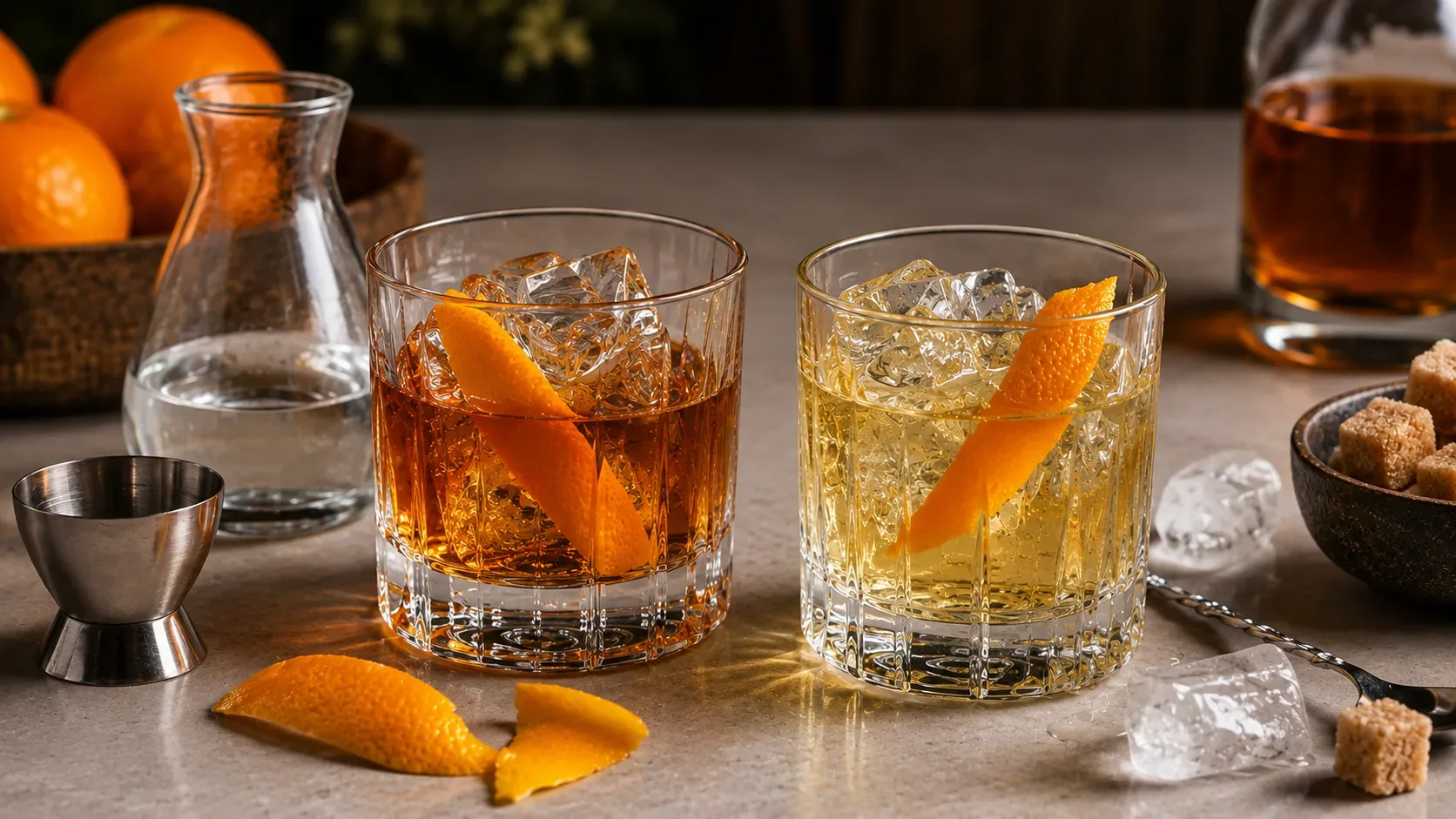
The cup is simple; the difference is in the water that enters without appearing. The official recipe from the International Bartenders Association, the IBA, involves 45 ml of bourbon or rye whiskey, a cube of sugar, a few doses of aromatic bitters and a few doses of water. The drink is assembled in the glass itself, filled with ice and stirred gently.
To prepare more consistently on Father's Day — celebrated on August 9, 2026 —, the proposal below transforms water into an explicit measure: 10 ml per glass as the starting point of pre-dilution. This volume is not part of the IBA numerical specification. It is a testable editorial adaptation, designed to reduce the difference between one preparation and another.
The alcoholic version remains a concentrated drink. Water reduces the alcohol content in the final liquid, but does not remove the ethanol placed in the glass. The 0.0% alternative, presented below, maintains the functions of aromatic base, sweetness, bitterness and citrus finish, without promising to exactly reproduce the flavor of the whiskey.
Content intended for people over 18 years of age. Do not serve alcoholic beverages to children or teenagers and do not drive after drinking. The World Health Organization informs that there is no completely risk-free form of alcohol consumption, including at low levels.
Recipe based on the IBA Old Fashioned
The IBA does not determine an exact number for bitters or water doses. In the table, two doses of bitters per glass were adopted as the operational starting point. The 10 ml pre-dilution is also a testing reference, not a universal rule.
Use the same dispenser model, the same brand of sugar and the same way to activate the bitter bottle throughout the batch. A “dash” can change depending on the bottle, the inclination and the force applied.
| Ingredient | 1 glass | 2 glasses | 4 glasses |
|---|---|---|---|
| Bourbon or rye whiskey | 45 ml | 90 ml | 180 ml |
| Sugar cube | 1 | 2 | 4 |
| Aromatic bitters | 2 dashes | 4 dashes | 8 dashes |
| Cold filtered water | 10 ml | 20 ml | 40 ml |
| Orange peel | 1 strip | 2 strips | 4 strips |
Also set aside enough ice to stir the drink and a new cube per glass for serving. The size of the ice alone does not guarantee less dilution: temperature, surface humidity, amount of ice, container and contact time also change the result.
How to prepare
- Place the sugar, bitters and measured water in a mixing glass or pitcher.
- Macere or stir until the sugar dissolves. For batches of two or four doses, check that there are no concentrated crystals left at the bottom.
- Add the whiskey and mix.
- Add plenty of ice and stir for about 10 seconds.
- Try a small amount. Adjust the water using the method described in the next section.
- Divide evenly between glasses with new ice.
- Twist the orange peel over the surface to release the oils and use as a garnish.
IBA recommends just a gentle stir after adding the whiskey and ice. In bar techniques, stirring also controls temperature, integration and incorporated water. Operating guides may suggest times close to 30 seconds for stirred and strained drinks, but there is no ideal time or percentage applicable to all recipes.
In this method, the initial stir is shorter because part of the water has already been measured. The result still depends on the temperature of the ingredients and the ice, which is why sensory testing is more useful than treating the timer as a definitive answer.
How to adjust dilution without guessing
Guides for batch-prepared cocktails can work with 25% to 30% water, calculated on the volume of the mixture, to compensate for the lack of normal ice dilution. This range, however, was developed for specific serving contexts and does not constitute a rule for an Old Fashioned served over ice.
Here, the 10 ml represents approximately 22% of the volume of whiskey. The point was kept more conservative because the drink will continue to be in contact with the ice in the glass.
Adjust in small increments:
- Prepare the first dose with 10 ml of water.
- Taste when the drink is cold.
- If the alcohol dominates the aroma, the texture is rough and the finish seems concentrated, add 2 ml of water and stir for another five seconds.
- If the drink becomes thin, short or lacks definition, do not add more water. For the next preparation, start with 8 ml.
- Write down the approved final volume, stirring time and type of ice.
Don't try to fix four glasses at once before getting a dose right. Validate the individual preparation first and multiply the approved volume.
Anyone who wishes to measure the water actually incorporated by the ice can weigh the drink before and after preparation. The method and its limitations are detailed in Dilution changes the drink: how ice, time and temperature change the result.
How much alcohol remains in the glass
Dilution changes the concentration, not the initial amount of ethanol.
In an example with 40% whiskey:
- 45 ml of whiskey contains approximately 18 ml of pure ethanol;
- after 10 ml of water and the volume occupied by dissolved sugar, the drink is close to 30% to 33% alcohol by volume before additional melting of the ice;
- the recipe for four glasses contains four times the total amount of alcohol in the individual recipe, although the concentration remains similar when the proportions are maintained.
This calculation is an estimate. The value changes depending on the strength indicated on the whiskey label, the actual amount released by the bitters, the water added and the ice melted.
“One shot” in this table means a complete cocktail, not a medical or official unit of consumption. Do not use dilution as an argument for driving, increasing the number of glasses or presenting the drink as safe.
Old Fashioned 0.0% for flavor functions
Removing the whiskey and filling the glass with water produces a sweet, diluted drink, not a balanced alternative. The non-alcoholic version needs to reconstruct the recipe functions:
- a base with body and woody or spicy aromas;
- enough sugar to round off the bitterness;
- bitter for complexity;
- orange peel for fresh aroma;
- water only in the amount that the new base tolerates.
Ingredients for a glass
- 45 ml of 0.0% base with a woody or whiskey-inspired profile;
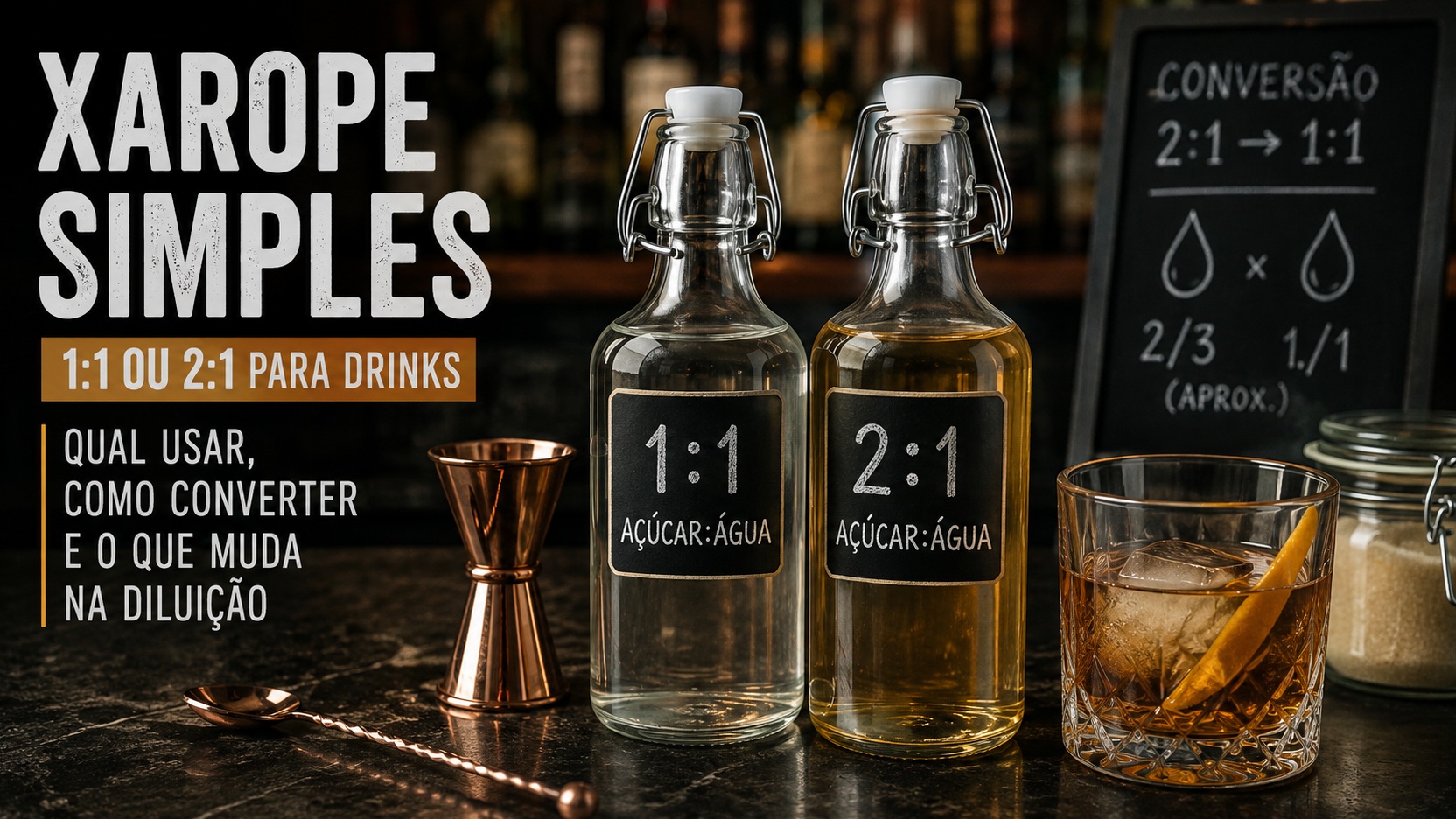
- 5 ml of demerara syrup 1:1;
- 2 dashes of aromatic bitters labeled 0.0%;
- from 0 to 5 ml of cold, filtered water;
- a strip of orange peel;
- ice.
1:1 syrup can be made with equal parts demerara sugar and water, measured by weight. Prepare only the amount needed, keep refrigerated and discard if the smell, appearance or taste changes.
To ensure a 0.0% formulation, check the label of the base and bitters individually. Do not assume that every product described as “alcohol-free”, “non-alcoholic” or “alternative” is necessarily 0.0%. The same care applies to bitters, aperitifs and fermented ingredients.
Preparation and adjustment
- Place the 0.0% base, syrup and bitters in the mixing glass.
- Add ice and stir for five to ten seconds.
- Taste before adding water. Bases without alcohol already have a lot of water in their composition and can lose body more quickly.
- If the drink seems excessively sweet, bitter or concentrated, add water in 2 ml increments, without exceeding 5 ml in the first test.
- Serve over new ice and top with orange peel.
For two or four servings, multiply the base, syrup and bitters. Do not automatically multiply the water: first taste the cold batch and adjust gradually.
The goal is not to make the 0.0% version “burn like whiskey”. Balance must appear in the sequence of aroma, controlled sweetness, bitterness and body. As the absence of ethanol changes the structure of the drink, the dilution target of the alcoholic cocktail should not be automatically transferred.
The test that must take place before publication
The pre-dilution formula and the 0.0% version have not yet been physically executed in this investigation. Before presenting the recipe as validated, the editorial team must prepare at least three repetitions of each version.
In alcoholic, compare 8, 10 and 12 ml of water per dose, keeping whiskey, sugar, bitters, ice, container and initial temperature as constant as possible.
At 0.0%, test the chosen base with 0, 2 and 5 ml of water. Register aroma, sweetness, bitterness, body, watery feel and overall balance. Different brands or formulas of alcohol-free foundations may require their own adjustments.
Until execution, water volumes must remain identified as editorial starting points, not proven results.
Save the table, validate a dose and choose consciously between the alcoholic version and the 0.0% alternative. If there is driving after the date, the choice should be non-alcoholic.