
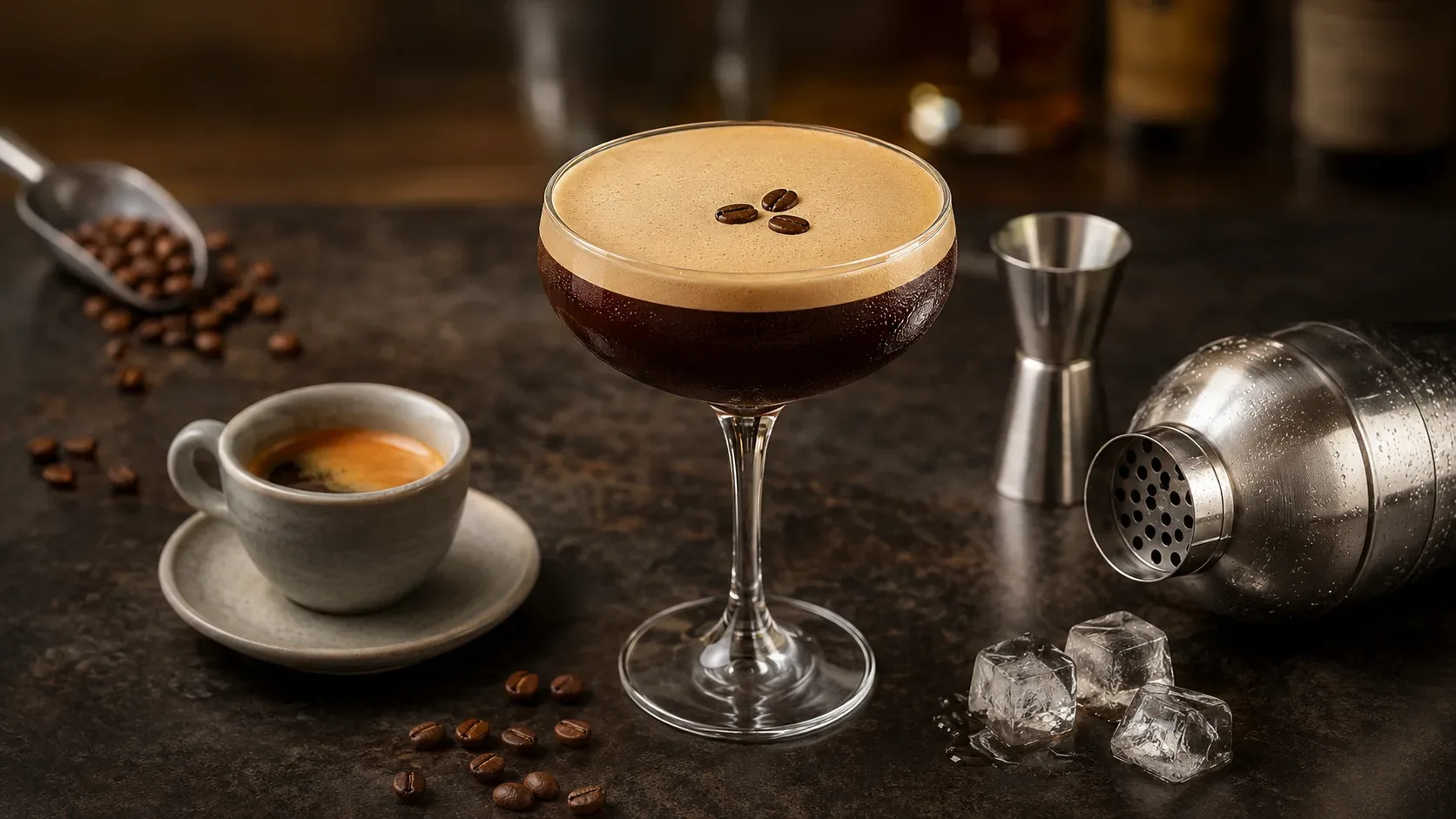
If the Espresso Martini arrives in the glass with a thin layer of foam or loses that foam in a few moments, blaming the cold coffee oversimplifies the problem too much. Foam depends on two things happening together: the agitation needs to incorporate air into the liquid, and the mixture needs to have components capable of keeping these bubbles separated long enough.
Fresh espresso usually makes the process easier because it comes out of the machine with crema. But this does not mean that a coffee that has cooled down is incapable of frothing, nor that using the espresso while it is still hot is a requirement. Temperature, coffee concentration and stirring technique affect in different ways.
The current official recipe from the International Bartenders Association helps establish a benchmark: 50 ml vodka, 30 ml Kahlúa, 10 ml sugar syrup and strong espresso, all shaken with ice before straining into a chilled glass. The specification itself requires stirring, but does not determine that the espresso needs to enter the shaker hot.
Where does the foam in an Espresso Martini come from
The crema in an espresso and the foam that appears in an Espresso Martini are related, but they are not exactly the same thing.
In espresso, part of the crema is formed thanks to the carbon dioxide retained in the coffee after roasting. A scientific review on coffee foam also points out that protein-like fractions favor foam formation, while polysaccharides extracted from coffee help with its stability. In other words: there are substances in the coffee itself capable of helping to form and maintain bubbles.
When the espresso enters the shaker, however, a new stage occurs. Agitation mixes the liquid with air and creates new bubbles. Therefore, thinking that the objective is simply to “preserve the crema intact” leads to the wrong conclusion: the shaker is deliberately destroying and rearranging that structure while creating another foam for the cocktail.
Fresh espresso has a practical advantage because it begins this process with plenty of gas and a frothy structure already present. A study published in Food Research International found greater crema volume in fresher coffees, although this “freshness” refers mainly to the roasted coffee and the amount of CO₂ still retained in the beans — not a rule that a shot necessarily stops working after a few minutes.
This distinction matters: fresh beans, freshly extracted espresso and still-hot espresso are three different variables.
Fresh espresso, chilled espresso and cold brew are not equivalent
When someone says they tried to make the drink with “cold coffee”, you need to know which coffee. An espresso prepared normally and then cooled is still coffee extracted under pressure and high temperature. Cold brew is another drink, produced by cold and prolonged extraction. Regular brewed coffee that has just been placed in the refrigerator is a third situation.
| Used coffee | What really changes | Practical trend for foam |
|---|---|---|
| Freshly extracted espresso | Arrives with crema, CO₂ and high temperature | This is generally the easiest condition to obtain obvious foam |
| Extracted and cooled espresso | Loses part of the visible crema, but retains many dissolved coffee compounds | Can produce good foam if stirring is efficient |
| Cold brew concentrate | It does not contain the crema created by the extraction of espresso and its composition depends on the method | It can work, but tends to require more concentration and agitation control |
| Cooled regular brewed coffee | Typically less concentrated than espresso or cold brew concentrate | This is the change with the greatest chance of making the drink thinner and the foam less consistent |
Studies comparing hot and cold brew coffee show that the extraction temperature changes which compounds and how many solids pass into the drink. This means that changing espresso to cold brew is not just changing the temperature: it also changes the extraction process and, depending on the recipe, the final concentration.
I did not find, among the scientific sources consulted, a controlled trial that prepares the same Espresso Martini with fresh espresso, chilled espresso and cold brew and directly measures the height and duration of the foam. Therefore, stating that “cold brew does not foam” would be too strong.
In professional practice, there are recipes that accept cold brew concentrate as a substitute. Liquor.com, for example, presents fresh espresso or concentrated cold brew as alternatives, although it notes that the profile of the drink changes.
The important point is the word concentrated. Replacing an intense shot of espresso with the same amount of weak filtered coffee adds water without delivering the same concentration of coffee. Even before discussing foam, this already alters body, flavor and balance.
Does hot espresso help with foam?
It may help to arrive at the shaker with plenty of crema, but “the hotter the better” is not a technical rule.
Some cocktail guides advocate the immediate use of freshly extracted espresso precisely because of the crema. Difford’s Guide, for example, uses fresh, still-hot espresso in its recipe.
On the other hand, there is a simple physical consequence: a hot ingredient needs to lose more heat until it reaches serving temperature. In a shaker with ice, much of this energy is removed by melting the ice. Therefore, starting with very hot espresso can produce more dilution than starting with the same previously cooled espresso, if both end up equally cold.
This is why another professional approach recommends quickly cooling the shot before shaking, reducing the thermal load without switching the espresso to another brewing method.
So the choice doesn’t have to be “hot espresso with foam” versus “cold espresso without foam”. A much more manageable alternative is to brew a good espresso and cool it quickly, rather than letting it sit for a long time.
Agitation is the point that is most missed in the diagnosis
Having good ingredients alone does not create the characteristic layer of the Espresso Martini. Air must be incorporated.
The IBA recommends shaking the cocktail well with ice, and professional recipes follow the same logic.
Experiments released by Dave Arnold and the Cooking Issues team further showed that, within normal bar conditions, the temperature and dilution of a cocktail quickly approach a threshold during shaking. In the tests carried out, after approximately 10 to 12 seconds the additional cooling gains were already small. The authors themselves highlighted, however, that texture and appearance could continue depending on the way of shaking.
This helps correct another common fear: there's no need to do a timid shake to automatically prevent the drink from becoming watery. For the Espresso Martini, a short, vigorous shake is more consistent with the purpose than moving the shaker gently for fear of ice.
As a starting point, shake vigorously for about 10 to 15 seconds, with enough ice to chill the drink. Don't treat this range as a universal formula: serving size, initial temperature of ingredients, ice and shaker all change conditions. The objective is to achieve a cold and clearly aerated cocktail.
How to fix a weak Espresso Martini
If the recipe already tastes good, change one variable at a time. This makes it easier to find out if the problem is with the coffee or with the execution.
- Standardize the recipe. Always use the same quantities during testing. The IBA ratio is a good initial control: 50 ml vodka, 30 ml coffee liqueur, 10 ml syrup and a strong espresso.
- Test first with freshly extracted espresso. If the foam improves significantly, you already know that the coffee you used previously was part of the problem.
- Repeat with the same quickly cooled espresso. If the foam is still good, the high temperature was not essential.
- Increase the shaking energy before increasing the time indefinitely. The objective is to circulate liquid, ice and air intensely inside the shaker.
- Strain and serve immediately in a cold glass. The foam is an unstable structure and begins to drain and coalesce as soon as it is formed.
- If you use cold brew, use real concentrate. If even with good concentration and stirring the result is thin, accept that the formulation may need adjustment rather than simply shaking for longer.
For volume production, cold brew consistency can be an operational advantage, but this transforms the task into recipe development: concentration, dilution and texture need to be recalibrated. It is not a neutral substitution of one ingredient for another.
What about dry shake or reverse dry shake?
It may be a correction tool, but it shouldn't be the first answer for every foamless Espresso Martini.
The dry shake consists of shaking without ice to increase aeration; In the reverse dry shake, the drink is first chilled with ice, the ice is removed and a second shake occurs without it. The technique is traditionally associated with egg white cocktails, in which proteins form a particularly efficient foamy structure.
In the Espresso Martini, a second shake without ice can increase air incorporation, but I have not found sufficient comparative scientific evidence to say that it always produces superior foam in the drink. Therefore, it makes more sense to treat it as an adjustment resource after coffee, concentration and basic agitation have been corrected.
If the Espresso Martini only works when given an extra technique, it is worth testing first whether the shaker was being shaken with enough energy or whether the “cold coffee” used was simply too diluted.
The most useful diagnosis
For weak foam, the order of causes is often more helpful than searching for a single trick.
Fresh espresso makes work easier, but it is not an absolute condition. Chilled espresso can work very well. Cold brew concentrate may work, but it doesn't automatically replicate the composition or crema of the espresso. And none of them solve insufficient stirring.
Temperature is mainly included in the cooling and dilution account. Cream offers a head start. The concentration determines how much coffee actually exists in the mixture. And the shaker provides the energy necessary to transform this assembly into a layer of microbubbles.
If the goal is consistency, do the simplest test possible: same recipe, same ice and same agitation; just change the coffee. Then keep the best coffee and compare the stirring technique. In two rounds you learn more about your Espresso Martini than by simultaneously changing espresso, liquor, sugar, ice and shake time.