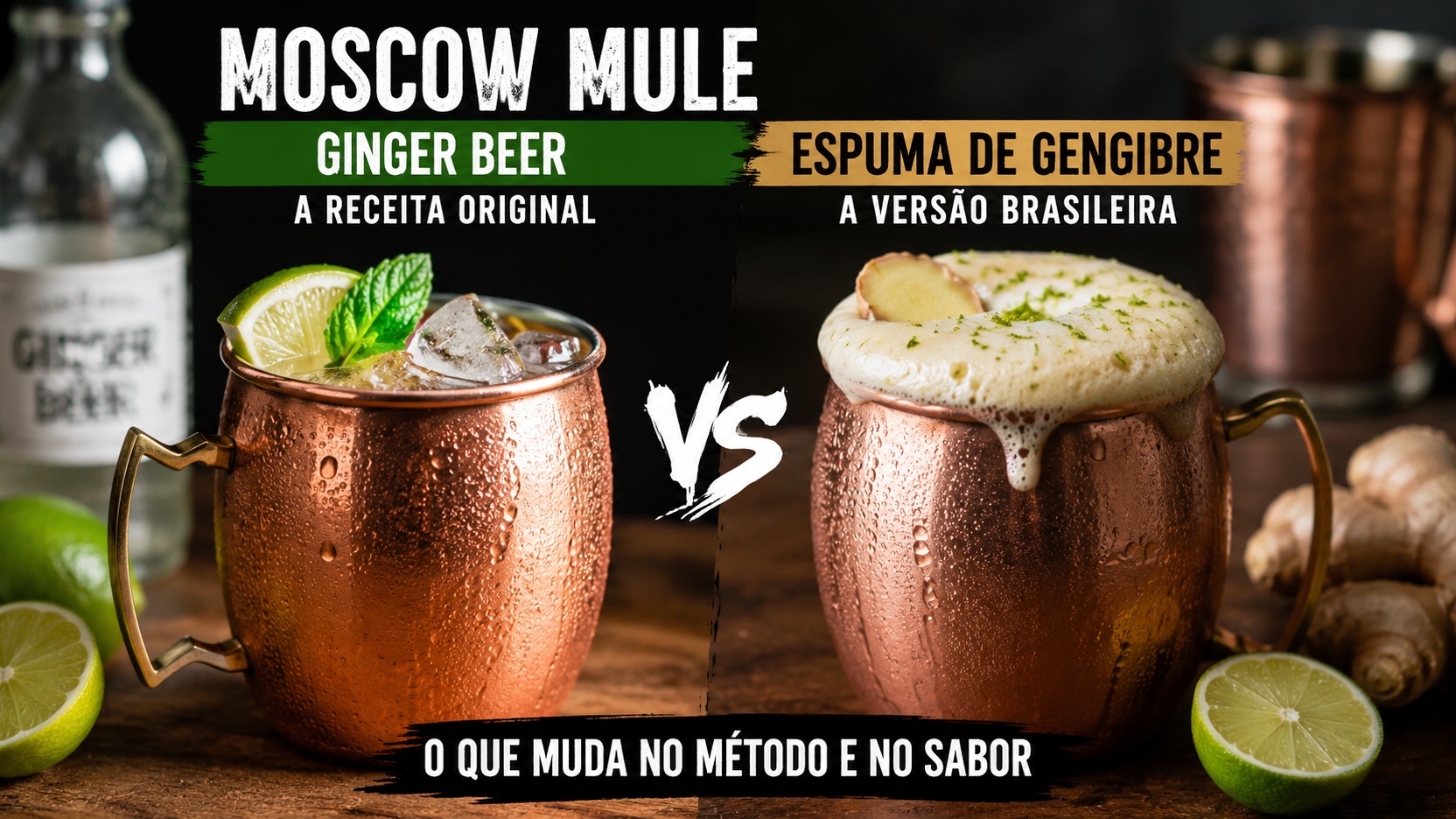
In Brazil, ordering a Moscow Mule usually means receiving a copper mug crowned with a generous layer of ginger foam. In much of the rest of the world, however, the same name leads to a much simpler drink: vodka, ginger beer, lemon and ice. It's not just a change of finish. The two versions use different techniques and deliver different carbonation, dilution, texture and flavor balance.
To prepare at home without mixing concepts, it's worth separating three things. There is the historical core of the Moscow Mule, based on vodka, ginger beer and citrus. There is the Brazilian reinterpretation attributed to bartender Marcelo Serrano, which has ginger foam and a base mixed with sugar and bitters. And there are domestic adaptations, made to overcome the lack of a siphon, ginger beer or specific ingredients. They may be delicious, but they should not be presented as if they were the same recipe.
Historic Moscow Mule: vodka, ginger beer and lime
The origin of the Moscow Mule has competing versions about who actually created the cocktail and in which bar the first mix was served. The most widespread narrative places it in the early 1940s, linked to the attempt to popularize Smirnoff vodka and Cock'n Bull ginger beer in the United States. Cock'n Bull's own history associates John G. Martin and Jack Morgan with the creation, while cocktail references record that bartender Wes Price also claimed authorship.
The least controversial point is the structure of the drink. The Moscow Mule was born around the combination of vodka, ginger beer and lemon, served with ice and associated with a copper mug. The mug has become part of the visual identity, but it is not an absolute technical requirement. The International Bartenders Association file consulted for this article accepts Mule Cup or rocks glass.
The IBA technical reference
In the official 2020 IBA sheet, the Moscow Mule contains 45 ml of Smirnoff vodka, 120 ml of ginger beer and 10 ml of fresh lemon juice. Vodka and ginger beer are combined in the container, lemon is added and the whole is given a gentle stir. The finish is a slice of lemon.
This formula helps to understand the logic of the classic. Ginger beer is not an aromatic detail. It represents the majority of the liquid volume of the drink. In addition to ginger, it brings sweetness, its own acidity and, above all, carbonation. That's why the classic Moscow Mule behaves like a refreshing long drink: plenty of ice, large mixer volume and bubbles that lift the aromas of ginger and citrus.
Ginger foam: the Brazilian reinterpretation
The foam version became so associated with the Moscow Mule in Brazil that many people first discover the reinterpretation and only later discover ginger beer. The most documented trajectory attributes this adaptation to bartender Marcelo Serrano.
In an interview published by UOL in 2020, Serrano said that, at the beginning of the 2010s, ginger beer was difficult to find on the Brazilian market. He sought a solution inspired by the wave of molecular gastronomy techniques and siphon foams. The idea was to concentrate the ginger flavor in a foam that finished the cocktail. The publication notes that this foam mixes with the drink and delivers the flavor that was missing when ginger beer was not available.
Mixology News details that Serrano put the version on the menu of the extinct MyNY Bar, in São Paulo, in the spring-summer menu of 2011. The same source reports that the drink gained great prominence later at the Brasserie des Arts. There is another Brazilian publication that cites 2009 as the beginning of the adaptation. As dates vary between sources, it is safest to treat the beginning of the 2010s as the period in which the reinterpretation emerged and was consolidated.
The recipe published in the name of Marcelo Serrano
The formulation published by Mixology News uses 50 ml of vodka, 20 ml of lemon juice, 20 ml of 1:1 sugar syrup, five drops of Angostura bitters and ginger foam. Unlike the IBA classic, the base goes into a shaker with ice, is shaken and then strained into a mug with ice. The foam only enters at the end.
The foam described in this publication is made with equal parts lemon juice, sugar syrup, fresh ginger juice and egg white, prepared in a siphon and kept refrigerated. It's a batch recipe, not a single mug.
There are also variations published with Serrano himself. In a 2021 video presented by Mohamad Hindi with the participation of the bartender, the base contains 50 ml of vodka, 20 ml of syrup, 20 ml of lemon and Angostura, but the foam formula appears in different proportions and uses pasteurized egg white. This shows that the core idea of the reinterpretation is more stable than a single foam ratio. The concept is a sweetened citrus base, shaken with ice, finished with an intense ginger foam.
The role of each ingredient
Vodka
In both families, vodka is the alcoholic base and must remain relatively neutral to let the ginger and lemon shine through. In the classic, it is lengthened by 120 ml of ginger beer.
In the Brazilian reinterpretation published by Serrano, the liquid foundation before the foam is much smaller and more concentrated. Therefore, if the two are served in similar-sized containers, the classic tends to seem lighter and more expansive, while the Brazilian version tends to seem more compact and intense per sip.
Ginger beer
In the classic, ginger beer fulfills several functions at the same time. It is the main source of ginger flavor, increases volume, sweetens, dilutes the vodka and brings gas. The choice of brand changes the result a lot, because there are ginger beers that are drier, sweeter, spicier or more citrusy.
In Serrano's Brazilian reinterpretation, the ginger beer comes out of the building. The ginger flavor migrates into the foam. This changes the sensory pathway of the drink: instead of the ginger being distributed throughout the carbonated drink, it arrives first through the aroma and top layer, then gradually mixes into the liquid as the person drinks.
Lemon
The lemon is structural in both versions, but appears differently. The IBA reference uses 10 ml in a drink quite elongated by ginger beer. Serrano's published recipe uses 20 ml in the base, in addition to the lemon present in the foam itself. To avoid aggressiveness, sugar syrup is also added.
This makes the Brazilian version work closer to a sweet-acid axis constructed by the bartender, while the classic version depends a lot on the balance already existing within the chosen ginger beer.
Sugar syrup and Angostura
Syrup and bitters are not part of the Moscow Mule IBA sheet consulted. In Serrano's version, the syrup is necessary to balance the citrus load and the intensity of the ginger.. Angostura adds spices and aromatic bitterness in small amounts, creating a layer that the classic does not have by default.
It doesn't mean that a profile is better. It means that the Brazilian reinterpretation is a more elaborate composition: the balance does not come from a single ready-made mixer, but from the combination of lemon, sugar, bitters, shaker dilution and foam.
Ice and dilution
The method changes as much as the ingredients. In the classic Moscow Mule, the drink is assembled and gently stirred. Ginger beer should remain carbonated, so there's no point shaking it in a shaker. Dilution occurs mainly due to ice during consumption and the presence of the mixer itself.
In the Brazilian version, the base is shaken with ice. The shake cools quickly and incorporates dilution water before the drink reaches the mug. This makes ice control important: beating for too long or using very small, melted ice can make the base watery before the foam even sets in.
Foam
Foam is not equivalent to carbonation. It creates a soft, aromatic and visually striking layer. The first contact is creamier, and the ginger reaches the nose before integrating into the liquid. Ginger beer gas, in contrast, is spread throughout the
drink and produces a sensation of effervescence from the first to the last sip, decreasing as the CO2 is lost.
That's why swapping ginger beer for foam doesn't preserve the same experience. She creates another Moscow Mule, with its own Brazilian identity.
How to compare the two versions at home
To make a useful comparison, use the same vodka in both mugs, the same batch of lemons, similar-sized ice, and pre-chilled containers. Prepare the two drinks in short sequence to avoid one of them melting for several minutes while the other is being assembled. Thus, the perceived difference comes more from construction and less from external variables.
Cup A: classic with ginger beer
Use as a reference 45 ml of vodka, 120 ml of very cold ginger beer and 10 ml of fresh lemon juice. Place ice in the container, add the vodka and ginger beer, add the lemon and stir gently. Do not shake the ginger beer in a shaker, as the aim is to preserve the carbonation. Finish with a slice of lemon if you want to follow the IBA presentation.
When tasting, observe four points. The first is the presence of gas. The second is how the ginger appears distributed throughout the liquid. The third is the degree of sweetness of the ginger beer. The fourth is the feeling of lightness created by the larger mixer volume.
Cup B: Brazilian reinterpretation of Serrano
If you have a siphon and want to reproduce the published logic, use 50 ml of vodka, 20 ml of lemon juice, 20 ml of simple syrup and five drops of Angostura. Shake these ingredients with ice, strain into a mug with new ice and finish with ginger foam.
The foam formula published by Mixology News uses 100 ml of lemon juice, 100 ml of simple syrup, 100 ml of fresh ginger juice and 100 ml of egg white. It's a large batch, designed for many portions. For home preparation, prefer pasteurized egg whites, keep the mixture refrigerated and follow the safety instructions for your siphon.. The version shown in 2021 with Serrano already uses pasteurized egg whites and different proportions, so there is no need to treat a single formula as untouchable.
When tasting, notice the absence of effervescence in the base, the texture of the foam, the aroma of ginger concentrated at the top and the more clearly constructed balance between lemon, syrup and bitters.
Without siphon: what is adaptation
If you don't have a siphon, there are two honest choices. The first is to prepare the classic Moscow Mule with a good ginger beer, which requires less equipment and delivers an internationally recognizable recipe. The second is to make a domestic foam and assume that it is an adaptation inspired by the Brazilian version.
In the 2021 video with Marcelo Serrano, Mohamad Hindi presents an alternative foam made with fresh cream, grated ginger, lemon and sugar. It is practical, but it changes the experience a lot because it adds fat and dairy flavor, elements that are not present in the egg white foam used in Serrano's recipe. It's a good example of a domestic adaptation that shouldn't be confused with the original remake of the bartender.
It is also common to find recipes that use ginger beer and foam at the same time. This hybrid may work, but it creates a third profile: it maintains the carbonation of the classic and adds the texture of the Brazilian version. For those who want to understand the differences, it is best to first try the two separate constructions before mixing them.
Ginger beer x ginger ale
Another common confusion is substituting ginger beer for ginger ale as if they were equivalent. In general, ginger ale is lighter, sweeter and less spicy, while ginger beer used in cocktails tends to have more intense ginger and a more robust structure. The substitution can produce a pleasant drink, but the result tends to be softer and less close to the classic profile.
If the idea is to prepare the historic version at home, look for a ginger beer that has a clear ginger flavor, good carbonation and sweetness that doesn't hide the lemon. As brands vary a lot, adjusting a few milliliters of lemon is more coherent than compensating for a very sweet ginger beer with big changes to the entire recipe.
Which version makes the most sense
The Moscow Mule with ginger beer is the simplest choice for those who want to reproduce the classic design: neutral vodka, lemon, ginger present throughout the liquid, carbonation and preparation directly in the glass. It's also easier to maintain consistency from one serving to the next, as long as the ginger beer is very cold.
The Brazilian version with foam is more laborious and scenic. It requires preparing a base, controlling the dilution in the shake and producing the foam separately. In return, it offers a texture that has become a visual signature of the drink in the country and a ginger that arrives in a concentrated and aromatic way on top.
If you taste the two side by side, the main conclusion should emerge before even discussing which is the favorite: ginger foam is not just a decoration that replaces ginger beer. She rearranges the entire cocktail party. The classic is a carbonated long drink in which ginger beer forms the body of the drink. The Brazilian reinterpretation is a citrus base, sweetened and blended, finished with a foam that carries much of the identity of ginger.
This distinction resolves the most common confusion surrounding the Moscow Mule in Brazil. The ginger beer recipe is a historical and international reference. The foam is a Brazilian reinterpretation attributed to Marcelo Serrano, consolidated in the early 2010s. And any solution made to adapt equipment or ingredients at home must be presented as an adaptation, not as if all these versions were the same recipe.