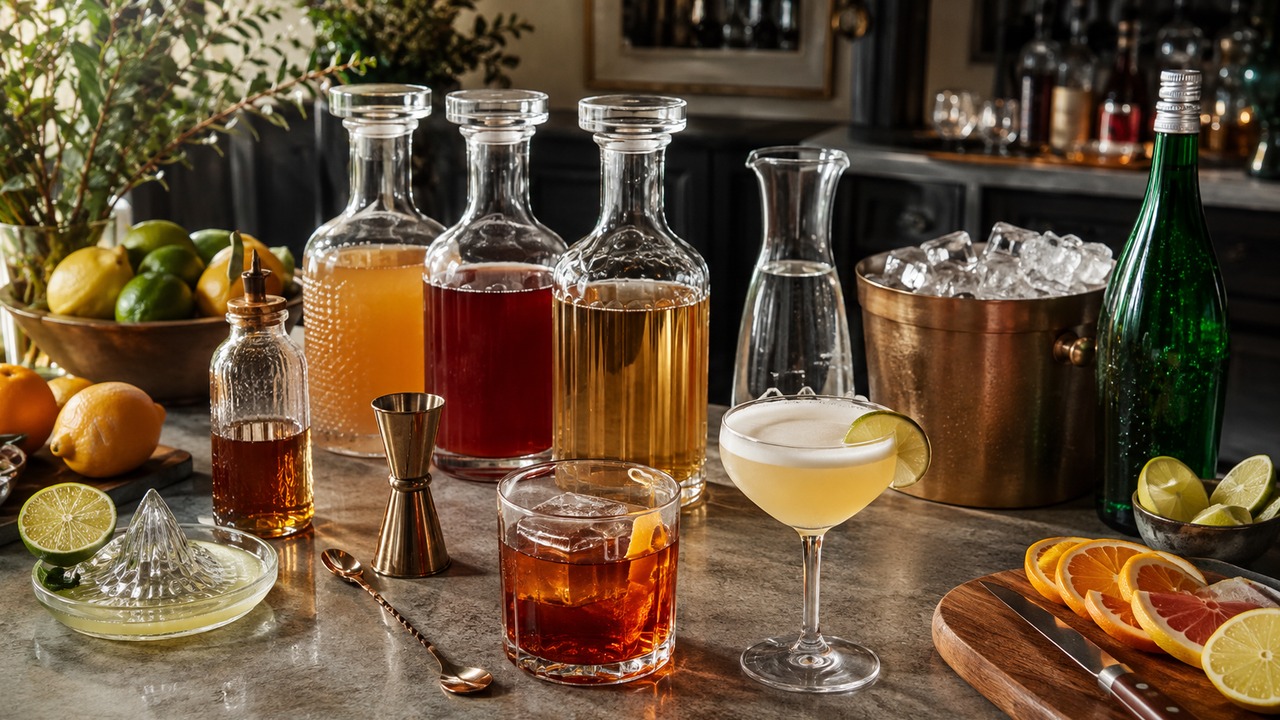
Preparing ten or twenty drinks before a party is not just multiplying the individual recipe. When a cocktail is stirred or shaken with ice, some of that ice turns to water and becomes part of the flavor, texture and strength of the drink. If the batch is served already chilled and without this step, the water needs to be calculated differently. If, on the other hand, the batch is still shaken or served over a lot of ice, adding all the dilution beforehand can make the result watery.
The safest method for working at home is to use your own recipe as a reference. Instead of adopting a universal percentage, prepare a control dose exactly how you like it, find out how much water the ice incorporated, and use that result to scale up. Then, separate the ingredients into three moments: what can be added in advance, what should be added close to serving and what only makes sense in the glass.
Start with a control dose, not the entire batch
Choose the individual recipe and write down the total volume of ingredients before freezing. If the drink contains 60 ml of distillate, 20 ml of vermouth and 10 ml of syrup, the initial volume is 90 ml. Prepare this shot as normal, using the same type of ice, the same technique, and a mixing time close to what you would use for the real thing.
After stirring or beating, strain the drink and measure the final volume. The difference between the final volume and the initial volume is a good approximation of the water that entered through dilution. If the recipe started with 90 ml and ended with 112 ml, approximately 22 ml of water was incorporated.
The calculation can be expressed like this: water per dose = final volume - initial volume. To estimate the dilution in relation to the original mixture, divide the incorporated water by the initial volume and multiply by 100. In the example of 90 ml reaching 112 ml, the dilution corresponds to approximately 24% of the initial volume.
Volume measurement is practical for the home bar, but it is not a laboratory measurement. Liquid that remains in the mixing glass, in the strainer or on ice and small differences in temperature can change a few milliliters. If you want more repeatability, do two or three control doses and work with an average. The goal is to reproduce your break-even point, not chase a universal number.
Scale the recipe and water separately
Once you know the water per serving, multiply each ingredient by the number of servings and do the same with the dilution. In the example of 90 ml of ingredients and 22 ml of water per serving, a batch for ten people would have 900 ml of the original ingredients and about 220 ml of water, as long as the plan is to serve the cocktail very cold without re-stirring it or shaking it with ice.
This detail changes everything. Water is not an adjustment made at the end because the drink was strong: it is part of the final recipe. The batch should be tasted at the temperature at which it will be served, because the cold reduces the perception of aromas and can make a mixture appear different from the same liquid at room temperature.
It's also worth leaving a small margin in the container. Bottles and jugs filled to the brim are more difficult to mix and cool. If the batch goes into the freezer, remember that drinks with a lower alcohol content may start to freeze; In these cases, the refrigerator is the most predictable choice.
What goes into the batch in advance
Spirits, liqueurs, and other stable alcoholic compounds are the easiest candidates for make-ahead. Syrups can also enter the batch when they are part of the recipe and will be kept appropriately refrigerated. For a stirred cocktail with a more alcoholic profile, it is often possible to leave practically the entire base ready, with the pre-dilution water already measured.
This is the situation in which batching comes closest to a serve-and-go system. The bottle stays cold, you pour it into the glass and finish with the garnish. The consistency tends to be greater because all doses come from the same mixture.
Bitters deserve a little more caution when the recipe is large. The size of a dash varies between bottles and dispensers, and the aromatic impact may be more evident on a larger scale. Instead of pouring in a blind multiplication of dozens of dashes, add a portion, mix, taste and adjust until you reach the control dose profile.
What comes close to the service
Citrus juices are the main component that requires the most attention. They can be prepared ahead of time, but the aromatic profile changes over time, especially after they are juiced and exposed to air. For a party at home, the simplest solution is to have the alcoholic base and syrups ready, keep the citrus refrigerated separately and combine everything a few hours before or closer to the guests' arrival.
This does not mean that every drink with lemon or lime needs to be assembled one by one. A sour without clear, for example, may have spirit and syrup pre-mixed and the juice incorporated near serving. If the proposal is to serve from a jug, the calculated water can also be added at this stage and the mixture must remain cold.
When the drink depends on aeration from the shaker to gain texture, however, serving just the still mixture from a pitcher changes the sensation in the mouth. In this case, the batch can function as a ready-made base: you portion out a dose and shake it with ice when serving. As the shaker will add water again, do not add all the dilution calculated for an ice-free service in advance.
What should only go into the glass or at the last moment
Sparkling water, soda, sparkling wine and other carbonated ingredients lose pressure after opening and mixing. Therefore, the best time to add them is just before serving or directly into each glass. If the cocktail is intended as a punch or highball, the carbonated component may provide some of the dilution that, in another recipe, would come from still water.
The rule of thumb is simple: if bubbles are part of the experience, don't leave the carbonated mixture waiting for hours in an open jar. Prepare the base, cool everything and add the gas at the end. This way you preserve the effervescence and avoid compensating for a drink that got boring with more ice or more soda in the last minute.
Trimmings also belong to the service. Orange peel, lemon slices, herbs and fruits fulfill aromatic and visual functions that are lost when they are soaked for a long time. Leave them ready and refrigerated when necessary, but finish the glass close to the moment of consumption.
Decide in advance whether the ice will dilute or just keep cold
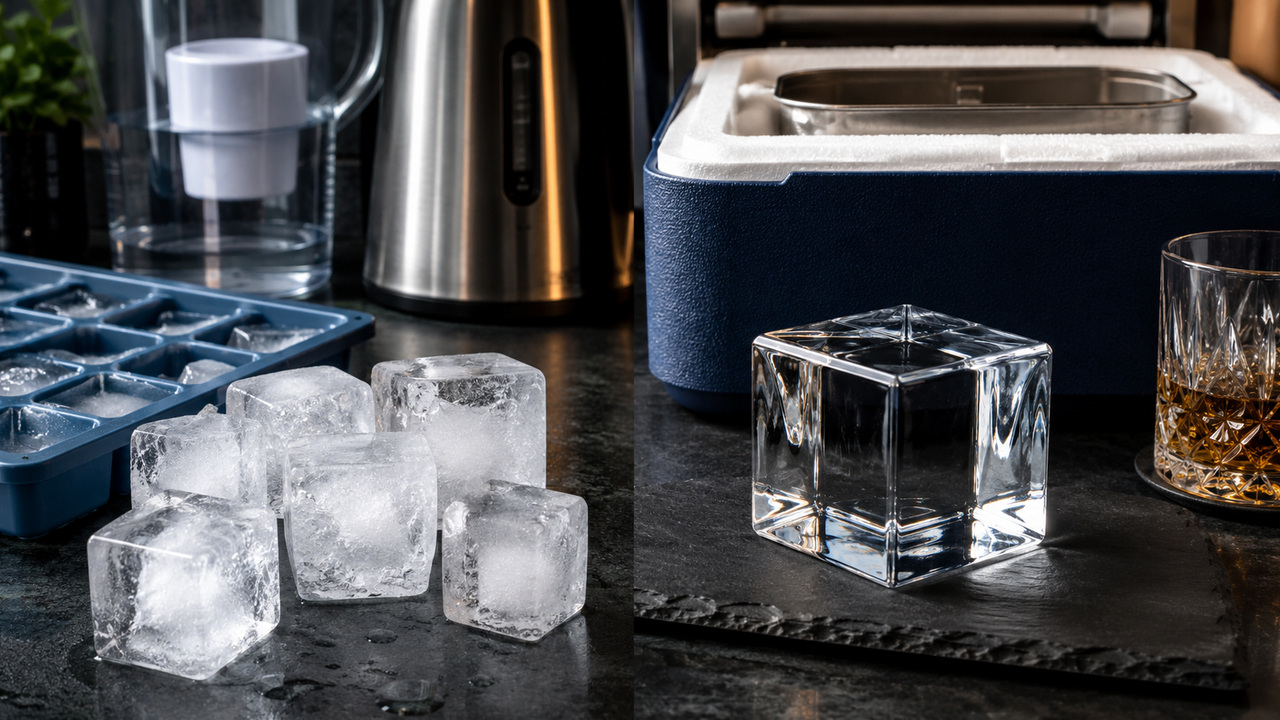
There are two consistent paths. In the first, the batch already contains practically all the water needed and is very cold. It is served neat in a chilled glass or on a large cube, which melts slowly.. In this scenario, the pre-dilution measured at the control dose makes almost complete sense.
In the second way, the batch is a concentrated base that will still be stirred, shaken or served over a relevant amount of ice. Here, the ice will keep adding water. If you also add all the dilution of the control dose in advance, the drink will receive twice the water.
Before preparing a large quantity, choose one of these models and test it with a single dose taken from the batch. Serve exactly as it will be served at the party. This final test reveals whether the combination of temperature, water and ice is working better than any single percentage.
Example of stirred drink for ten servings
Imagine a recipe with 60 ml of spirits, 30 ml of vermouth and bitters. Before ice, it's 90 ml. You prepare a control dose, stir until you reach the point you consider ideal and measure 112 ml after straining. The difference is approximately 22 ml of water.
For ten servings, the base consists of 600 ml of spirits and 300 ml of vermouth. If serving directly from a very cold bottle, add about 220 ml of water. The bitters are added little by little, comparing the aroma and bitterness with the control dose.
The final mixture is around 1.12 liters. Cool well and test with a portion before the party. If you decide to serve over small ice or leave the glass in the guest's hand for a long time, reduce the water a little in advance, as there will be additional dilution during consumption.
Example of sour without turning the party into a production line
Consider a sour of 60 ml of distilled spirit, 30 ml of citrus juice and 20 ml of syrup. The recipe is 110 ml before freezing. When blending and straining a control dose, assume the volume reaches 138 ml. In this case, approximately 28 ml of water was incorporated during preparation.
If the intention is to serve the sour from a pitcher without mixing each dose, multiply the ingredients by the number of people, add the citrus close to the service and use the measured water as a starting point. Keep the mixture very cold and taste a dose in the final glass. The flavor may be correct, but the texture will be less airy than a freshly shaken sour.
If you want to preserve the texture of the shaker, use another model: leave distillate and syrup in batch, add the citrus near the service and shake each portion with ice. In this case, the control dose water should not be added to the batch, because the ice in the shaker will do this part of the work.
Recipes with egg whites, cream, or ingredients whose texture relies heavily on stirring are not good candidates for a simply ready-to-pour batch. For a house party, it is more predictable to leave these components out of the advance mix and finish each serving with the appropriate technique.
A simple matrix to decide ingredient by ingredient
Think of the lot in three zones. The first is the advance preparation area: spirits, liqueurs, vermouths, syrups and pre-dilution water when the drink will be served ready and chilled. The second is the area close to service: citrus and other components whose freshness changes more quickly. The third is the glass zone: carbonation, garnishes and any element that relies on effervescence, newly released aroma or freshly created texture.
This division is more useful than memorizing a list of recipes that accept batching. It allows you to look at any cocktail and ask what each ingredient does. If it is stable and just needs to be mixed, it can go in early. If it loses freshness, wait. If you lose gas or depend on technique during the service, leave it until the end.
The errors that most unbalance a batch
The first mistake is to multiply the recipe and forget the water. The result often seems aggressive, alcoholic and less integrated, even when the proportions between the ingredients are correct.
The second is to correct this problem by putting a lot of ice in the container and waiting for it to melt. Ice can function as a planned part of the dilution in a punch, but without controlling temperature, size and time, the amount of water changes throughout the party. The first glasses and the last are no longer the same drink.
The third is to add all the pre-dilution water and then continue beating or stirring each dose normally. The drink undergoes two complete stages of dilution and loses body.
The fourth is to add the carbonated component too early. The flavor may still be correct, but the freshness and texture disappear. Leave the base cold and only open sparkling wine, soda or sparkling water near service.
The fifth is to treat a sour as if it were a stirred drink. Water can be calculated in the same way, but agitation also creates aeration and texture. If this is important to the recipe, batching should save measuring and assembly, not necessarily eliminate the shaker.
A protocol that works for almost any party
Choose an individual recipe that has already been tested. Measure the volume before ice, prepare a dose exactly how you like it, and measure the final volume. Use the difference as a water reference. Multiply the ingredients and dilution by the number of servings, but only add all this water if the service is not going to dilute the drink again.
Then classify the ingredients by the time of entry. Do what is stable in advance, leave citrus and other more sensitive components until closer to service, and preserve gas, garnish and texture techniques for last. Chill the batch, make a test shot using the actual party glass and ice, and adjust before guests arrive.
This process turns batching into a method, not an improvisation. The advantage is not just serving faster: it is reaching the first and last glass with the same balance of strength, water, temperature, acidity and freshness.