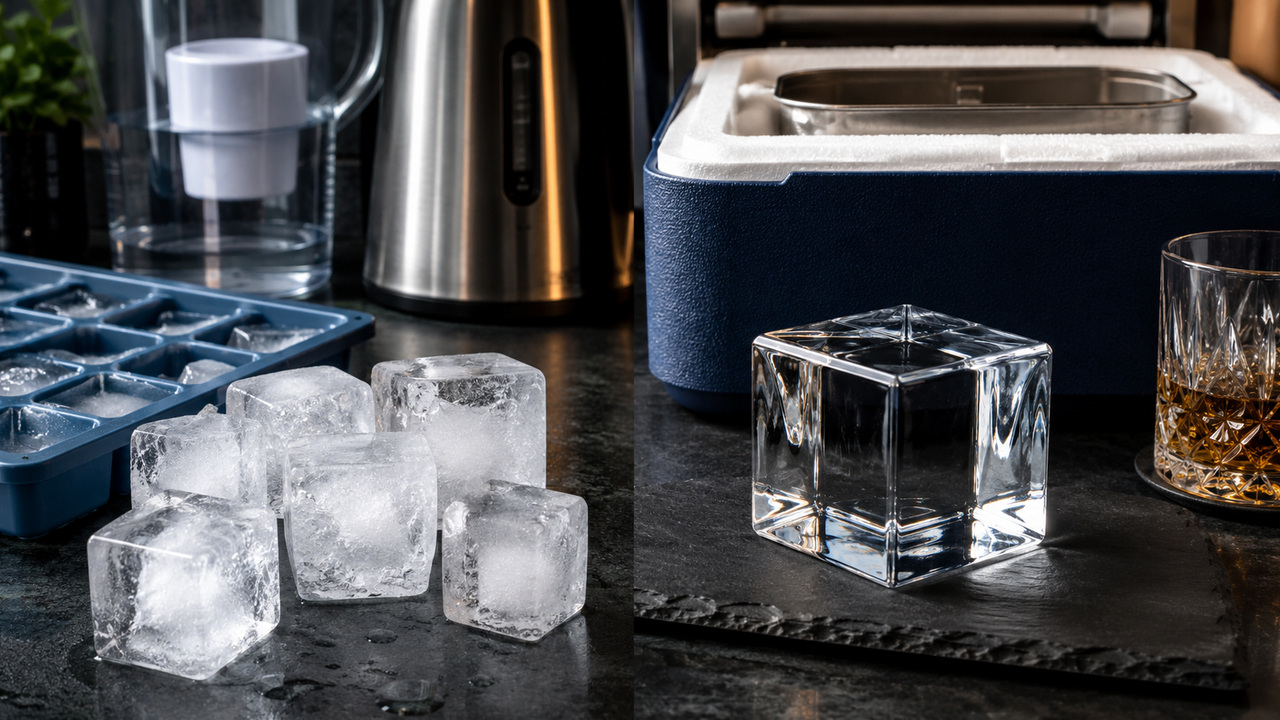
If the goal is to achieve clear ice in a repeatable way, the main variable is not choosing between tap, filtered or boiled water. The decisive point is controlling how the water freezes. In a common form, ice grows from several surfaces at once and pushes dissolved gases and impurities toward the region that freezes last. When these fronts meet, bubbles and concentrated material become trapped inside and scatter light, creating the white core typical of house ice.
Directional freezing changes this geometry. When insulating the sides and bottom of a container and leaving the top exposed to the cold of the freezer, solidification tends to advance mainly from top to bottom. Thus, most of the bubbles and solutes are displaced in front of the ice layer and end up concentrated in the last region to freeze. The result is not a magically perfect block from edge to edge, but a large, transparent portion accompanied by a cloudy band that can be discarded.
Why does ice turn white, full of bubbles or have an opaque core
The water we use at home contains dissolved gases and, to different degrees, mineral salts and other substances. During the formation of the ice crystal, much of this material does not fit easily into the solid structure and preferably remains in the liquid phase. As the freezing front advances, the still liquid water becomes more concentrated into gases and solutes.
If freezing occurs on all sides, as in a conventional way, this enriched region is compressed towards the center. Numerous microbubbles and areas of higher concentration of impurities can appear there. Light scatters at these interfaces, so a part that appears white may contain mainly trapped air, as well as salts or particles.
Speed also matters. A study published in 2024 in the International Journal of Refrigeration produced cubes under unidirectional solidification and compared tap water with boiled water, monitoring the initial amount of dissolved gas. The work shows that ice quality depends on both heat transfer conditions and air concentration, and highlights the solidification rate as a central variable. This helps explain why just changing the water can change the appearance, but does not transform an ordinary mold into a controlled process.
Cracks are another problem. They can arise when the block suffers internal stress during freezing or when it receives a thermal shock after it is ready. Therefore, visually transparent ice can still crack when removed from the freezer or when it comes into contact with much hotter liquid. Clarity and thermal shock resistance are related but not identical issues.
Boiled water: can reduce gas, but does not control freezing
Boiling water reduces the amount of dissolved gases while it is hot. This makes sense physically because gases are less soluble in hot water than in cold water. The problem is that water comes back into contact with the air when it cools and can dissolve gases again. Furthermore, boiling does not transform water into water without mineral salts.
Even when boiling reduces some of the dissolved air, a common form continues to freeze from the outside in. The mechanism that concentrates the remaining material in the center continues to exist. Therefore, boiled water may produce a slightly different cube under certain conditions, but it is not a reliable method for achieving transparency on its own.
Boiling can be used as a variable in a home experiment, especially if you want to observe whether there are fewer bubbles in your particular water. The gain, however, must be treated as secondary. If you have to choose where to invest effort, controlling the direction and speed of freezing tends to bring a more predictable result.
Filtered water: good decision for taste, not a visual guarantee
The term filtered water covers very different processes. A simple household filter can reduce particles, chlorine, odors or some compounds, while membrane systems can remove a much greater portion of dissolved salts. Therefore, there is no single answer to how much a filter will change the appearance of the ice.
For the home bar, filtering can make sense especially when the tap water has a noticeable taste or smell. This improves the raw material of the drink. But filtration does not prevent remaining gases and substances from being pushed to the last region to freeze. In a common mold, the center still tends to become the meeting point of the ice fronts.
With directional freezing, filtered water can be a practical choice if you already use this type of water for drinking. It does not, however, need to be treated as a requirement for the method to work.
Tap water can also produce a large transparent area
If tap water is drinkable and tastes neutral to you, it can be used in directional freezing. The presence of minerals can increase the amount of material concentrated in the final portion of the block, especially in harder waters, but the method still offers a way to separate a clear region from a turbid region.
This is important because it changes the logic of the problem. Instead of trying to remove absolutely everything from the water before it freezes, directional freezing creates a kind of disposal zone. The ice that forms first becomes cleaner, while that which was not incorporated tends to remain in the liquid and end up in the last frozen band.
The most reproducible method at home: directional freezing
The simplest household arrangement uses a small, rigid thermal container, without a lid, that fits flush in the freezer. Insulated walls and bottom reduce heat exchange through these surfaces, while the top opening remains directly exposed to cold air. The intention is to make the ice grow predominantly from top to bottom.
Fill the container with drinking water leaving space for expansion. Place it in the freezer without a lid and avoid moving it during the process. There is no universal time, because container size, freezer temperature, air circulation and water volume greatly change the freezing rate. The best indicator is the ice front itself.
If you stop the process before everything solidifies, you may find a transparent plate at the top and still liquid water at the bottom, already concentrated in
gases and solutes. This liquid portion can be discarded. If you prefer to freeze practically the entire block, the bottom strip tends to be the whitest and can be separated later.
Before cutting, let the block rest for a few minutes outside the freezer until the surface loses its extremely dry appearance and starts to become slightly damp. This temper reduces the temperature difference between the ice and the environment and usually makes the cut less prone to unexpected cracking. Work on a stable surface and avoid applying hot water to a block fresh from the freezer, as the thermal shock can crack it.
How to compare tap, filtered and boiled water in the same freezer
If the idea is to discover what really changes in your equipment, it's worth turning curiosity into a controlled test. Use identical containers for common mold samples and keep the same volume of water in all. Prepare a sample with tap water, another with filtered water and another with water that has been boiled and then cooled. Next to it, place an insulated container with the water you normally drink.
Freeze everything in the same cycle and on the same shelf whenever there is space for it. Then, photograph the pieces under the same lighting, observing the side view and a cross section. Instead of just evaluating whether the cube looks good, look for where the turbidity has concentrated, how many visible bubbles appear, whether there is a white core, and how much of the directional piece was usable before the turbid zone.
The expected result, according to the physical mechanism and available literature, is that the three samples in a common mold may present differences in the number of bubbles or intensity of turbidity, but remain subject to the opaque core due to freezing from multiple directions. The isolated container tends to produce the most obvious structural difference: a clear region followed by the region that froze last and concentrated the turbidity.
It makes no sense to invent a clear universal percentage of income. A small cooler in a home freezer does not exactly replicate another container in another unit. The useful data is its own performance: how high or massive the block was transparent before the white zone appeared and how long it took. Repeating this record two or three times teaches you more about your freezer than copying a fixed number from a tutorial.
What the appearance of the ice reveals about the fault
Transparent border and white center
This pattern is typical of multidirectional freezing. The first layers along the walls form relatively clear, while gases and solutes migrate into the remaining liquid in the center. Changing the water can reduce or increase the effect, but the most direct fix is to change the freezing geometry.
Light top and white base
In directional freezing, this is not a failure. It is precisely the sign that the material rejected by the ice was pushed to the last region to solidify. The solution is to stop before this region freezes completely or separate the cloudy base afterwards.
Bubbles spread across almost the entire block
This suggests that the freezing front is not displacing gases efficiently. The container may be receiving too much cold from the sides, solidification may be rapid or the internal design may be creating several nucleation points. More insulation and a container with simple geometry are often better options than insisting on boiling the water several times.
Clear ice that cracks when cut
Transparency does not eliminate thermal stresses. A very cold block can crack when it receives pressure or when it quickly changes to a very different temperature. Let the ice temper for a few minutes and make controlled cuts, without trying to force it while it is still extremely cold.
Entire block frozen with a large cloudy area at the bottom
This usually means that the method worked, but the process was carried out until the waste region solidified. In the next round, stop early or mark how long it took your freezer to get to the point where the cloudiness started to grow.
After all, which water to choose to make crystal clear ice
For most homes, it makes sense to start with water that you already consider safe to drink. If the tap has a neutral taste, test the tap water in directional freezing first. If the filter clearly improves the taste or if your water leaves a lot of mineral residue, use the filtered one. Treat boiling as an optional variable, not the secret to the process.
This order avoids a common mistake: trying to perfect the water while freezing continues uncontrolled. The directional method creates a route for gases and impurities to stay ahead of the ice and end up in a zone that can be disposed of. It is this spatial separation, combined with sufficiently controlled solidification, that makes the result repeatable.
What really works
Boiled water may have less dissolved gas at first. Filtered water may taste better and, depending on the filter, have fewer particles or salts. Neither of these choices alone guarantees a transparent cube when water freezes on all sides at the same time.
Directional freezing is the change that attacks the mechanism responsible for the white nucleus. At home, a small insulated container, used without a lid and visually monitored until the cloudy band forms, is the simplest way to transform the process into something observable and adjustable.
The best test is not to look for a fixed recipe for hours. It involves repeating the same arrangement, recording the point at which the turbidity appears and adjusting the moment to remove the block. When the method works, crystal clear ice stops looking like a special water trick and becomes about controlling where the last bit of water freezes.