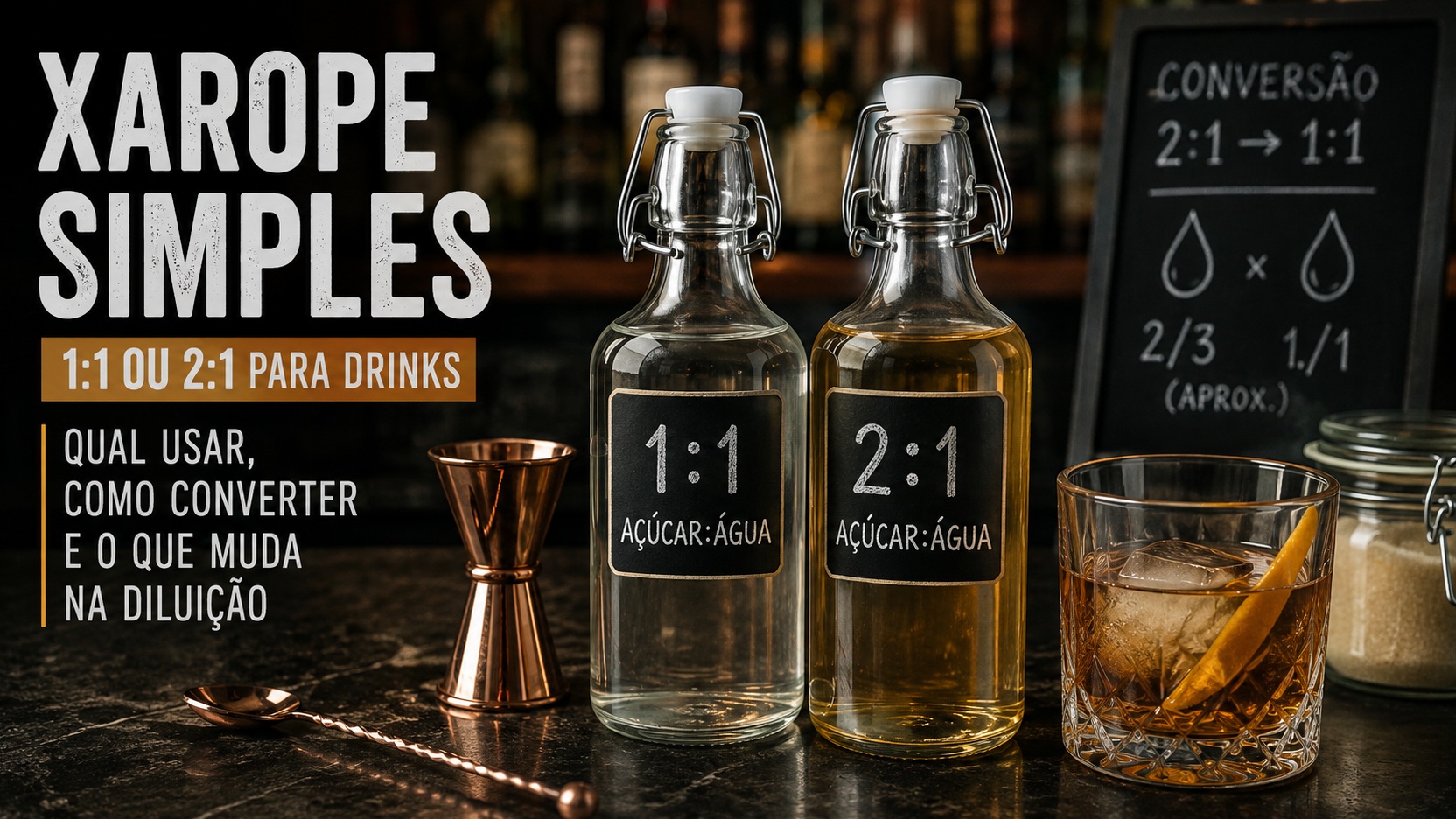
The difference between 1:1 and 2:1 simple syrup looks like elementary arithmetic, but two different conventions are often mixed together: how the syrup was made and how it is dosed into the drink. If
the sugar and water were weighed, the sweetness conversion by mass is exact and simple. If the bartender measures the syrup in milliliters or ounces, density enters the calculation and the factor changes. That is where apparently conflicting recommendations such as "use 3/4," "use about 2/3," or "use half" come from.
The practical answer is this: for syrups made by weight, 1:1 contains 50% sugar by mass and 2:1 contains about 66.7%. If the dose itself is also weighed, replacing 1:1 with 2:1 while keeping the same amount of sugar requires 75% of the original mass. In a jigger, for sucrose solutions near those concentrations, the conversion is close to 70% because 2:1 is denser. In bar measures, that normally becomes something like 30 ml of 1:1 to about 20 ml of 2:1. Half is not a correct sweetness equivalent.
What 1:1 and 2:1 really mean
When the ratio is defined by weight, 1:1 means one part sugar to one part water. One hundred grams of sugar with 100 g of water produce, without significant loss to evaporation, 200 g of solution containing 100 g of sugar: 50% sucrose by mass. In concentration terms, that corresponds to approximately 50 °Brix for a pure sucrose solution.
With 2:1, two parts sugar are used for one part water. Two hundred grams of sugar with 100 g of water produce 300 g of solution containing 200 g of sugar, or 66.7% sucrose by mass. Therefore, "2:1" does not mean that every gram of the finished syrup is twice as sweet as 1:1. It only means that the recipe uses twice as much sugar relative to water. The sugar fraction in the syrup rises from 50% to 66.7%, not from 50% to 100%.
The USDA technical sucrose conversion table treats degrees Brix as a percentage of sucrose and, at 20 °C, lists a specific gravity of 1.23202 for 50.0 °Bx and 1.32945 for 66.7 °Bx. These numbers matter because they show that rich syrup is not only more concentrated: it also weighs more per milliliter.
Weight and volume are two different questions
The first step in understanding any recipe is to determine whether "1:1" and "2:1" were defined by weight or by volume. Both practices exist. Liquor.com, for example, presents basic simple syrup as equal parts by volume and rich simple syrup as two parts sugar to one part water. Many bartenders, however, prefer to weigh ingredients to reproduce the concentration more precisely.
This matters because one cup of granulated sugar is not one cup of liquid. Sugar occupies an apparent volume that includes spaces between the crystals, while water is a continuous liquid. So a "one cup to one cup" recipe does not produce exactly the same composition as a "100 g to 100 g" recipe. Difford's Guide makes this distinction explicit and reports, for its volume-based approach, approximately 48.0 °Bx for 1:1 and 65.1 °Bx for 2:1.
For home use, both conventions work as long as they are treated as different conventions. The problem arises when syrup is prepared using one method and a conversion table calculated for the other is applied without noticing.
The exact conversion when everything is weighed
If the syrup was prepared by weight and you also measure the dose in grams, the calculation does not depend on density. A 1:1 syrup has half its mass as sugar; a 2:1 syrup has two thirds.
To replace 1:1 with 2:1 while keeping the same mass of sugar, multiply the mass of 1:1 by 0.75. Thirty grams of 1:1 contain 15 g of sugar. To get the same 15 g of sugar with 2:1, only 22.5 g are needed, because two thirds of 22.5 g is 15 g.
In the other direction, multiply the mass of 2:1 by 1.333. Thirty grams of 2:1 contain 20 g of sugar; 40 g of 1:1 are needed to deliver the same 20 g.
That is why "use 3/4" can be perfectly correct: it is the exact factor when comparing by mass between 1:1 and 2:1 syrups that were also prepared by mass, without significant evaporation.
When the dose goes into a jigger, density changes the factor
Cocktails, however, are almost always built by volume. The bartender reads 15 ml, 20 ml, 1/2 oz, or 3/4 oz and uses a jigger. In that situation, two syrups with different concentrations do not carry the same mass in each milliliter.
Using the densities in the USDA table as a reference for pure sucrose solutions at 20 °C, a 50.0 °Bx syrup has a density of about 1.232 g per ml. Half of that is sugar, which gives approximately 0.616 g of sucrose per ml. A 66.7 °Bx solution has a density of about 1.329 g per ml; two thirds of that mass correspond to approximately 0.887 g of sucrose per ml.
The result is that, by volume, 2:1 delivers about 44% more sugar per milliliter than 1:1. To keep the same mass of sugar, the volume of 2:1 is around 69.5% of the volume of 1:1. The inverse calculation is approximately 1.44 times.
In practice, 30 ml of 1:1 correspond to about 20.8 ml of 2:1 in terms of sucrose. Fifteen milliliters of 1:1 correspond to about 10.4 ml of 2:1. In the opposite direction, 20 ml of 2:1 correspond to about 28.8 ml of 1:1. Because jiggers use convenient increments, bartenders normally round: 30 ml becomes 20 ml, 22.5 ml becomes close to 15 ml, and 15 ml becomes close to 10 ml.
This is where the rule of thumb of "about two thirds" comes from when replacing 1:1 with 2:1 in a recipe dosed by volume. It is not the same calculation as 75% by mass, although both are trying to preserve the same thing: the amount of sugar.
Why some pages say 2/3 and others say 3/4
Both answers can be defensible when they make the measurement system clear. Three quarters is the exact mass ratio between a 50% solution and a 66.7% solution. Two thirds is a reasonable bar rounding when the syrup is dosed by volume and the greater density of 2:1 is taken into account.
Difford's Guide reaches the same practical neighborhood by another route: it presents its syrups by volume as about 48.0 and 65.1 °Bx, states that 2:1 is approximately 1.35 times sweeter under that comparison, and rounds 10 ml of rich syrup to about 15 ml of 1:1. The mathematics for pure solutions using USDA densities leads to a volume multiplier closer to 1.44. The difference should not be hidden; it shows precisely why a conversion table needs to say which syrup, which concentration, and which unit it is using.
The value "half," on the other hand, does not preserve the sweetness of a typical 1:1. If 30 ml of 1:1 are replaced with only 15 ml of 2:1, the drink will receive less sugar than before. A 2:1 recipe has twice as much sugar relative to water, but the finished syrup does not contain twice as much sugar per gram or per milliliter.
Swapping syrups also changes the water in the drink
Even when the amount of sugar is held constant, the composition of the cocktail changes because rich syrup brings less water with it. This difference is easy to see by mass. Thirty grams of 1:1 contain 15 g of sugar and 15 g of water. The equivalent dose of 2:1 for the same 15 g of sugar is 22.5 g and contains only 7.5 g of water. The swap removes 7.5 g of water from the formula before the ice even enters the picture.
If the goal is to preserve not only the sweetness but also the water originally supplied by the syrup, the complete substitution is 30 g of 1:1 for 22.5 g of 2:1 plus 7.5 g of water. The inverse logic also applies: using 1:1 in place of 2:1 to deliver the same sugar adds water to the recipe.
By volume, the effect is similar and slightly larger because of density. Thirty milliliters of 1:1 at 50 °Bx carry approximately 18.5 g of water. About 20.8 ml of 2:1 at 66.7 °Bx, enough to deliver practically the same sugar, carry about 9.2 g of water. The difference is around 9 g, close to 9 ml of water.
This does not mean every drink needs extra water when switching to rich syrup. In an individual shaken or stirred cocktail, the ice will also add water during chilling, and the final perception depends on the whole recipe. But it does mean the substitution is not neutral. In batching, pre-dilution, or precisely calibrated recipes, ignoring that water changes the volume, alcohol content, and balance of the batch.
So which should you use: 1:1 or 2:1?
The best choice is first to follow the recipe's specification. If the author calls for rich syrup, use 2:1 according to that source's method. If it calls for simple syrup and the site has a base recipe, check that definition before assuming. Liquor.com treats standard simple syrup as 1:1 by volume. Difford's Guide states that its own recipes use 2:1 and notes that 1:1 is common in American bars. The word "simple" by itself is not a universal guarantee of concentration across authors.
As a bar tool, 1:1 is fluid, easy to dissolve, and easy to adjust in sours, highballs, and recipes where small volume corrections are not a problem. A 2:1 syrup delivers more sugar with less water, takes up less space in a batch, and can add a sense of body because it is more viscous. That characteristic is often useful in more concentrated cocktails and in formulas where you want to control water separately.
The important point is not to turn those tendencies into a rigid rule. A Daiquiri can be excellent with 1:1 or 2:1 as long as the amount is recalibrated. An Old Fashioned can use rich syrup to reduce the water supplied by the sweetener, but it can also be built with 1:1 if the recipe is balanced for it.
How to convert without changing two things at once
Before swapping a syrup, decide which variable you want to preserve. If the goal is only to keep the amount of sugar, use the factor appropriate to the dosing unit. In grams, 1:1 to 2:1 is 0.75 and 2:1 to 1:1 is 1.333. In milliliters, for syrups near 50 and 66.7 °Bx, 1:1 to 2:1 is close to 0.70 and the reverse is close to 1.44, with bar roundings normally near 2/3 and 1.5 times.
If the goal is also to maintain the water in the formula, compensate for it separately. When replacing 30 g of 1:1 with 22.5 g of 2:1, add 7.5 g of water to reproduce the same sugar-and-water composition of the original syrup. In a batch measured by volume, calculate the difference using the actual concentration and density or use a deliberate approximation instead of pretending the syrup does not participate in dilution.
If the recipe was created by volume and your syrup was made by weight, or vice versa, treat the first test as calibration. The difference may be small in one glass, but it accumulates in large batches. Writing "1:1 by weight," "2:1 by weight," or the Brix concentration on the label removes much of the ambiguity.
Weight or volume: which method is better for making syrup?
For repeatability, weighing sugar and water is the clearest method. A scale avoids variations caused by how tightly sugar is packed and makes the mathematical composition explicit. One hundred grams plus one hundred grams always describe the same 1:1 by mass; two hundred grams plus one hundred grams describe the same 2:1 by mass, provided you do not evaporate a significant amount of water during preparation.
That does not require measuring the cocktail in grams. You can produce the syrup by weight, label it correctly, and continue using a jigger. The only difference is that the dose conversion must be done as a volume conversion, because that is what the jigger measures. For batch production, a scale
often simplifies things further because it lets you control sugar and water directly.
Heating only until dissolved also helps maintain the planned concentration. Prolonged boiling evaporates water and pushes the Brix upward, turning a nominal 1:1 or 2:1 syrup into something more concentrated than the initial calculation suggests.
The rule of thumb that avoids the most common mistake
If you make the syrups by weight and measure the dose in grams, use 75% as much 2:1 in place of 1:1, or 133% as much 1:1 in place of 2:1, to keep the same amount of sugar. If you measure the dose with a jigger, think of about 70% when going from 1:1 to 2:1 and about 1.44 times in the opposite direction; in bar practice, that is often rounded to approximately 2/3 and 1.5 times.
Then decide whether you also want to preserve the water. If so, compensate for the dilution difference explicitly. That is the detail that turns a syrup swap from a guess into a controlled conversion: first match the sugar, then treat the water as a separate variable.