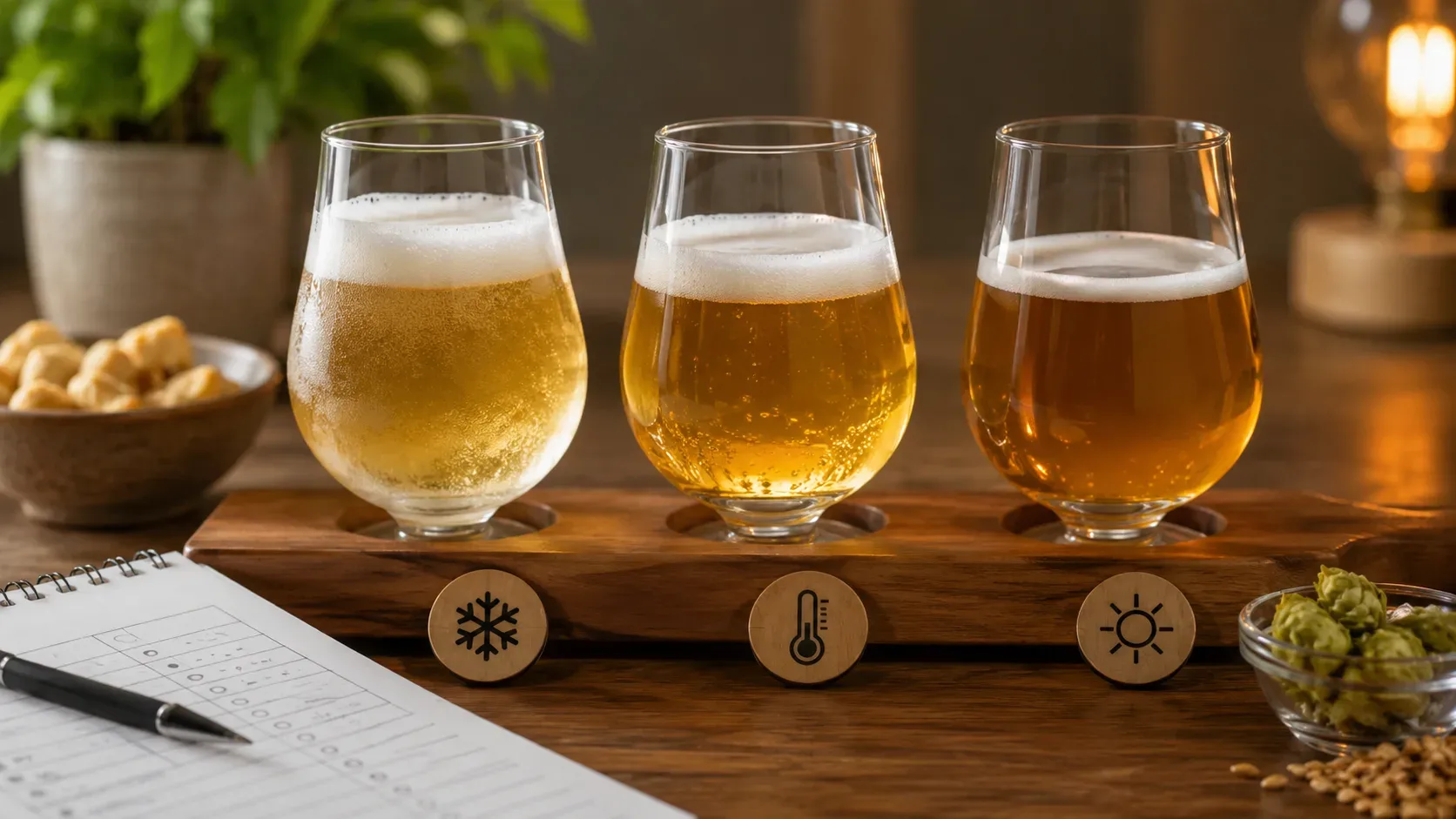
International Beer Day will be celebrated on Friday, August 7, 2026, following the tradition of occurring on the first Friday in August. Instead of turning the date into an incentive for consumption, the purpose of this test is to use small samples to answer a more interesting question: at what temperature does the same beer change its aroma, bitterness, gas and preference for you? content for people over 18 years old. The protocol is not a competition, does not require finishing the samples and can also be carried out with 0.0% beer. Anyone who consumes any amount of alcohol should not drive.
Temperature changes beer, but does not dictate a universal answer
The perception of a drink does not just come from the substances dissolved in it. Aroma, taste, thermal sensation, carbonation, texture and tactile stimuli are combined by the sensory system to form what we call flavor.
Temperature affects different parts of this experience. Volatile aromatic compounds pass from the drink into the space above the liquid and then reach the nose. This release depends on the properties of each compound, the composition of the drink and environmental conditions such as temperature and pH. Therefore, heating a beer can make certain aromas more available, but it does not increase all of them in the same proportion. it can also alter gustatory and tactile response. A review of taste perception describes temperature-sensitive mechanisms in the taste pathways, but does not establish a simple rule that every hotter drink necessarily becomes sweeter, bitterer, or more intense. The effect depends on the stimulus, the thermal range and the person trying it. with dealcoholized beer served at 6°C and 21°C, cold samples were associated with greater frequency and duration with carbonation and astringency. The work also found differences between participants in the perceived intensity of certain sensations. This supports the idea of testing temperature, but does not justify concluding that all beers or all consumers will respond in the same way. The goal is not to discover a “correct temperature” for all beers. It is to separate four questions that are often confused:
- At what temperature does the aroma seem most intense?
- At what temperature does bitterness seem stronger or more pleasant?
- At what temperature is the gas perceived most intensely?
- Which sample would you prefer to drink — regardless of whether it was the most aromatic?
The answer to each question may point to a different temperature.
What this test can demonstrate
The protocol allows comparing the same beer under three thermal conditions, keeping them the same as much as possible:
- brand, style and batch;
- quantity served;
- model and cleaning of glasses;
- way of serving;
- interval between samples;
- form and assessment scale;
- tasting environment.
Even with these controls, this is a home experiment, not a laboratory trial. It may indicate a reproducible personal preference, but it does not determine the ideal temperature for an entire style, a brand, or for all consumers.
The term blind test also deserves a caveat: the codes and order can be hidden, but the thermal sensation of the drink does not disappear. The participant may notice that a sample is colder. Blinding reduces expectations linked to the temperature number, the planned order or comments from other people; it does not mask the investigated stimulus itself.
Necessary materials
For one person, separate:
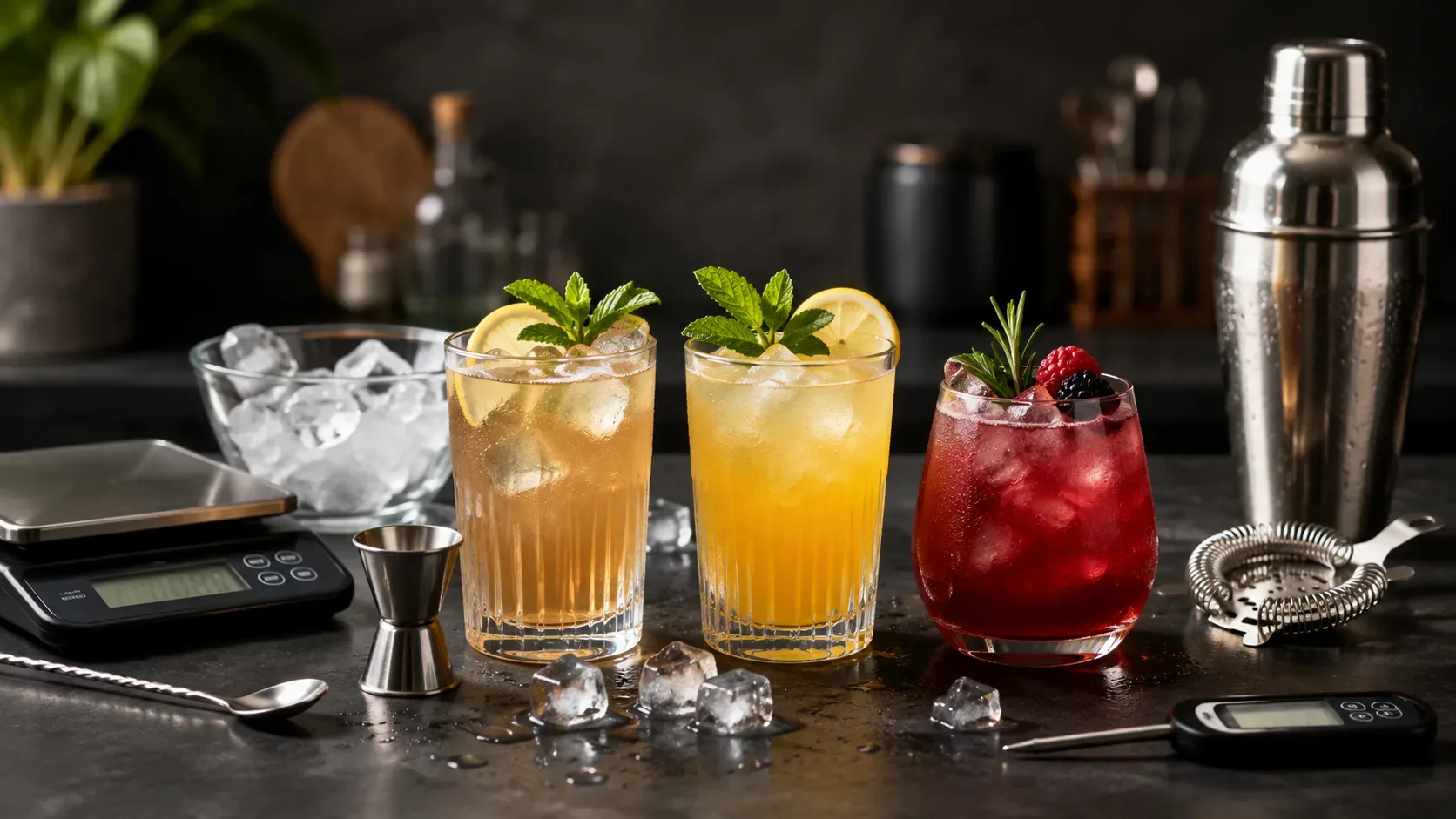
- three identical glasses, clean, dry and without detergent odor;
- three units of the same beer, preferably from the same batch;
- a sanitized digital culinary thermometer;
- a 30 milliliter measure;
- labels or small pieces of paper with three-digit codes;
- timer;
- water;
- evaluation form;
- disposal container, if the person prefers not to swallow the samples.
Using three closed packages reduces differences caused by time since opening and gas loss. As only a small portion of each unit will be used, this design can generate surplus. Do not treat the remainder as a mandatory part of the test.
A less wasteful alternative is to divide a single package into three small, tightly closed containers before adjusting the temperatures. In this case, note the limitation: transfer and waiting time may produce differences in carbonation between samples.
Three temperatures to compare
Use the following points as test operating conditions, not as universal service recommendations:
| Condition | Target temperature | Function in the test |
|---|---|---|
| Cold | 5 °C, with a tolerance of 1 °C | Represent a beer recently removed from intense refrigeration |
| Intermediate | 10 °C, with a tolerance of 1 °C | Create a point between intense cold and noticeable warming |
| Less cold | 15 °C, with a tolerance of 1 °C | Check changes after greater thermal release |
Five-degree contrast between samples makes home comparison easier. These temperatures are not intended to replace specific manufacturer, brewery, or style guidelines.
Adjust unopened packages in advance. The time required will depend on the initial temperature, the refrigerator, the container and the environment; So don't just rely on the watch. Measure the temperature just before serving and record the actual value, even if it does not exactly match the target.
How to prepare for the blind test
Code without revealing temperatures
Ask a second person to assign random codes, such as 284, 517, and 936, to the three conditions. The person responsible must keep the correspondence between code and temperature until the end.
Place the code on the base of the cup or on a card that does not reveal the condition. Avoid writing “cold”, “medium” or “hot”.
When the test is individual and there is no assistant, draw the order with three coded cards and keep the map folded. The procedure will be partially blind, as the preparation itself may reveal clues.
Randomize the order
With three samples, there are six possible sequences:
- ABC;
- ACB;
- BAC;
- BCA;
- CAB;
- CBA.
Draw one of them. In a multi-person test, distribute different sequences among the participants. This reduces the risk of the first or last sample being favored by position alone.
Randomizing the presentation and cleaning the palate are practices used to reduce effects of order and sensory permanence between samples, although they do not eliminate all biases. step by step
- Prepare the environment. Choose a place without smoke, strong perfume, food being prepared or music that interferes with concentration.
- Do not reveal brand, temperature or sequence. Whoever is serving should avoid comments such as “this is the most aromatic”.
- Serve one sample at a time. Measure 30 milliliters and always use the same serving motion. Record the actual temperature and start the timer.
- Observe for a few seconds. Record foam and appearance as auxiliary information only. The color will be practically the same, as the product is the same.
- Smell before shaking. Take two short breaths. Then, move the glass once and smell again.
- Taste a small amount. A sip of approximately 5 to 10 milliliters is enough to fill the form. Swallowing is not necessary.
- Record before talking. Give notes for aroma, bitterness, gas, body and preference. Write down free descriptors, even if they are simple, such as citrus, bready, cereal, floral, toasty or resinous.
- Cleanse your palate. Drink water and wait 60 to 90 seconds. A small piece of neutral bread or unsalted cracker can be used, as long as it is the same between all samples.
- Repeat the procedure. Keep the volume, observation time, and interval as constant as possible.
- Reveal the temperatures only at the end. Compare the notes first and then open the code map.
Perception sheet
Use the zero to five scale:
| Note | Intensity |
| 0 | Not noticed |
| 1 | Very low |
| 2 | Low |
| 3 | Average |
| 4 | High |
| 5 | Very high |
Fill in one line for each code:
| Code | Actual temperature | Aroma | Bitterness | Gas/carbonation | Body | Preference | Descriptors and observations |
| °C | 0–5 | 0–5 | 0–5 | 0–5 | 0–5 | ||
| °C | 0–5 | 0–5 | 0–5 | 0–5 | 0–5 | ||
| °C | 0–5 | 0–5 | 0–5 | 0–5 | 0–5 |
Add three final answers:
- The most aromatic sample was:
- The sample with the most pleasant bitterness was:
- The favorite sample in the set was:
Don't force a winner. “I didn’t notice a difference” is a valid result.
How to interpret without turning preference into a rule
Start by looking for clear changes between notes. A beer can receive aroma 2 to 5 °C and aroma 4 to 15 °C, for example. This indicates that, in that test, the participant found greater aromatic intensity in the less cold condition.
Then compare intensity and pleasantness. More aroma does not automatically mean greater preference. A sample may reveal more esters, hops or malt upon heating and, at the same time, lose some of the refreshing sensation desired by the participant.
Do the same with the bitterness. Register separately:
- perceived intensity;
- quality of bitterness;
- duration;
- please.
“Intense and pleasant bitterness” is different from “intense and harsh bitterness”. Temperature can interact with aroma, carbonation, astringency and individual differences, so don't anticipate that bitterness will necessarily increase or decrease. If the result is repeated, redo the test on another day, with new packaging from the same batch and in a different order. A conclusion that appears only once may have been influenced by expectation, fatigue, state of taste or small differences in service.
When comparing several people, do not discuss the samples before everyone turns in their cards. Then, observe both the group trend and divergences. An average should not erase the fact that consumers may perceive and prefer the same beer in different ways.
Version with 0.0% beer
The protocol can be repeated without changing the structure:
- use three units of the same 0.0% product;
- maintain the same temperature targets;
- apply codes and randomized order;
- use the same form;
- check the label for the declared alcohol content.
The 0.0% version is an alternative for those who do not intend to consume alcohol, but should not be treated as a perfect sensorial replica of the alcoholic version. Ethanol participates in the retention and release of aromatic compounds, while formulation and carbonation also influence body and mouthfeel. Non-alcoholic or low-proof beers can therefore respond to temperature in their own way. This is to compare the three temperatures within the same 0.0% product, and not use the results to automatically predict the behavior of an alcoholic beer.
Errors that weaken the result
Avoid:
- use glasses of different shapes or thicknesses;
- serve unequal volumes;
- estimate the temperature just by touch;
- open a sample much earlier than the others;
- letting a beer warm up in the glass for a much longer time;
- change brand or batch between conditions;
- discuss impressions before individual registration;
- use very spicy food between samples;
- interpret the preferred temperature as a technical standard;
- finish all packages just because they have been opened.
If a sample is several degrees off target, record the value and proceed. It is better to analyze a real condition of 12°C than to incorrectly call it 10°C.
Moderation is part of the method
Small doses reduce the amount needed to see differences, but do not make alcohol consumption risk-free. The World Health Organization informs that there is no completely risk-free form of consumption and that the risk depends on quantity, frequency, individual conditions and context. It must be carried out with alcoholic beverages by people under 18 years of age. Pregnant people, who use incompatible medications, have conditions aggravated by alcohol, cannot control their consumption or will carry out risky activities must opt for the alcohol-free version or not participate. Inspection adopts zero tolerance for the combination of alcohol and driving. The Federal Highway Police reiterated on June 19, 2026 that driving with any level of alcohol in the body constitutes a very serious offense. Plan transportation without a driver who has participated in the tasting. The idea is not “what temperature is right?”, but: at what point did each sensation change, what differences were really noticed and what condition worked best for that person and that beer?
Save the form, repeat the protocol in another order and explore the 0.0% version. The more controlled the test, the less the answer will depend on a ready-made rule.