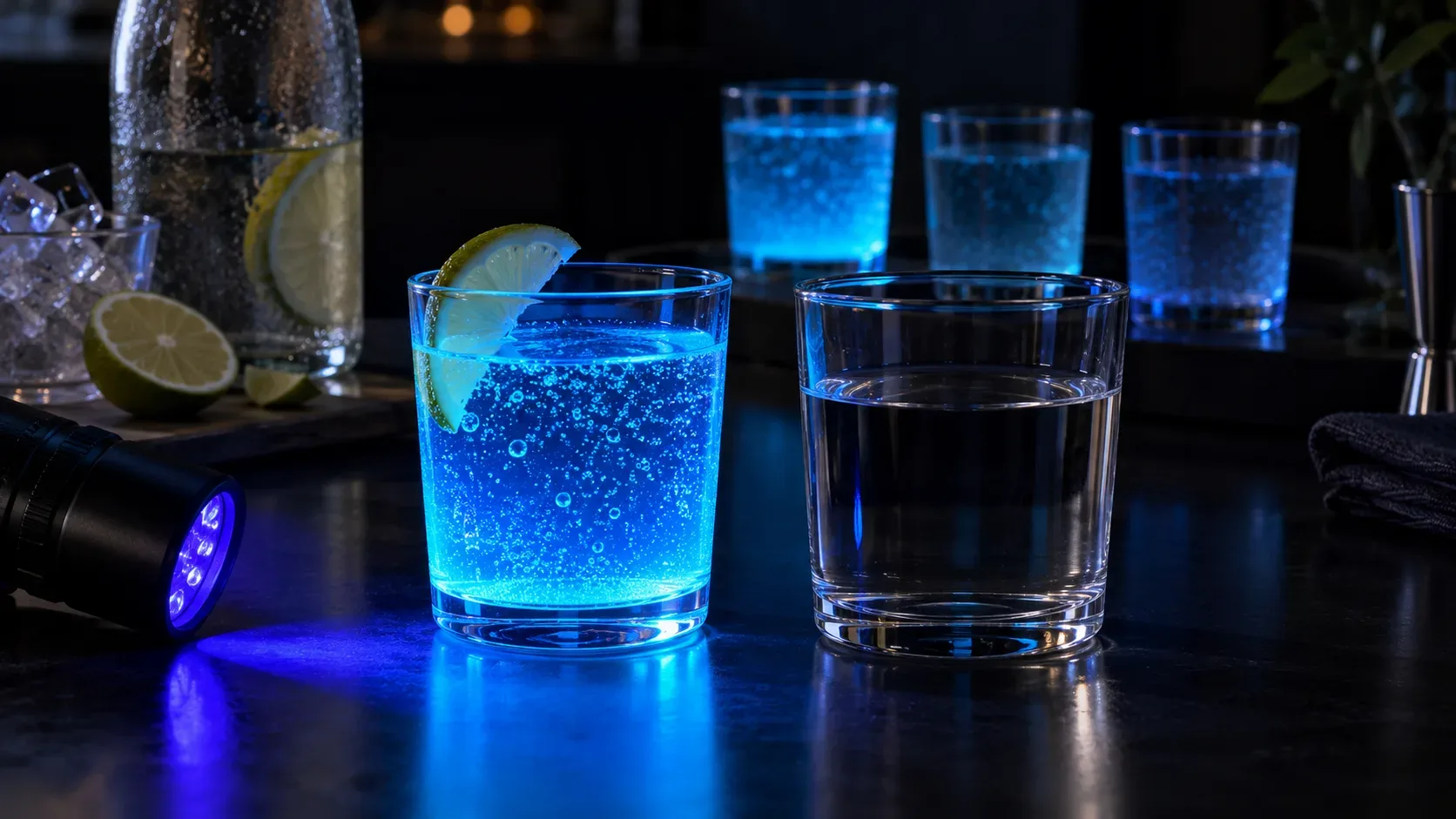
Place a glass of tonic water and a glass of plain water under ultraviolet light in a dark room. The difference is usually immediate: the tonic takes on a strong blue glow, while the plain water remains almost dark. The cause is quinine, the bitter compound used to give tonic water its characteristic taste and one that also fluoresces.
The effect is real and useful for demonstrating concepts in optics and chemistry. But one distinction matters: seeing a brighter glow is not automatically the same as measuring more quinine. In a laboratory, fluorescence can be used to determine concentration, but that requires controlled conditions, calibration, and corrections for factors that change the observed intensity.
Why quinine glows under UV light
Fluorescence begins when quinine molecules absorb photons of ultraviolet radiation. That absorption temporarily raises the molecule to a higher-energy state. Some energy is lost through internal processes, and the molecule then returns to a lower-energy state while emitting a photon of visible light. Under common quinine demonstration conditions, that emission appears in the blue region of the spectrum.
This is why a black light or UV flashlight can make tonic water look luminous. Educational materials from the UCAR Center for Science Education use this effect to show that quinine absorbs UV and re-emits part of that energy as visible light.
The emitted light also has a longer wavelength than the absorbed radiation. In fluorescence spectroscopy this is expected: the molecule loses part of its energy before emitting, so the emitted photon is less energetic than the excitation photon.
Fluorescence is not the same as “glow in the dark”
Tonic water looks bright only while it is receiving radiation capable of exciting the quinine. When the UV source is switched off, the glow disappears almost immediately. That behavior is typical of fluorescence and distinguishes it from phosphorescent materials, which can continue emitting light for some time after the excitation source has been removed.
A mini-experiment: plain water versus tonic water
To observe the phenomenon without turning the activity into a false concentration measurement, use a simple comparison.
- Use two identical transparent glasses and place the same volume of liquid in each.
- Fill one with plain water and the other with tonic water.
- Darken the room and keep the same UV flashlight at a fixed distance from both glasses.
- Illuminate both together first, then each one separately without changing the angle or distance of the source.
- Switch off the UV light and observe that the tonic’s blue glow disappears almost immediately.
The plain-water control matters because it shows that the effect does not simply come from the glass, the water, or blue ambient light. If you take photographs, also keep exposure, ISO, white balance, and camera position fixed: automatic adjustments can make one glass appear brighter without any chemical change.
Why a brighter glow does not simply mean “more quinine”
In dilute solutions under controlled instrumental conditions, fluorescence intensity can have a useful relationship with concentration. That is why laboratories can measure quinine in tonic water using spectrofluorometers and calibration curves. A recent study of commercial tonic waters, for example, prepared standards, diluted the samples, and fixed wavelengths and instrument parameters before calculating concentration.
Outside those conditions, observed brightness depends on several variables at the same time:
| Factor | How it can change the observed glow |
|---|---|
| UV source intensity and wavelength | Different sources excite quinine with different efficiencies; distance and angle also change how much UV reaches the sample. |
| Glass geometry and liquid volume | Optical path, reflections, and illuminated area change how much emitted light reaches the eye or camera. |
| pH and solution composition | Quinine fluorescence varies with its chemical environment. Laboratory protocols explicitly study pH dependence and effects from other species. |
| Very high concentration | The relationship stops being simply linear when the sample itself absorbs a significant fraction of the excitation or emitted light, an effect known as the inner-filter effect. |
| Camera and environment | Automatic exposure, reflections, background, ambient light, and image processing can strongly alter apparent brightness. |
The study of quinine fluorescence in commercial tonic waters shows why quantitative measurement needs standards, dilution, and defined instrument settings. Research on the inner-filter effect in fluorescence shows that proportionality between signal and concentration can fail when absorption by the sample itself becomes important.
pH can also change the response
Quinine does not have exactly the same fluorescence in every medium. Analytical chemistry exercises such as the Colby College quinine characterization protocol hold concentration constant and vary pH specifically to observe how intensity changes.
This helps explain why comparing different brands or recipes only “by eye” is weak evidence. Two beverages may differ in composition, acidity, colorants, sugars, and other ingredients. Even if quinine is the main source of the characteristic blue glow, the final visual intensity is not a universal meter.
A dilution series can show a trend, but it does not become a laboratory test
You can prepare four identical glasses with different proportions of the same tonic water, for example 100%, 50%, 25%, and 0%, topping up with water. With volume, glassware, position, and lighting kept constant, a visual trend of decreasing glow may appear as the tonic is diluted.
This is useful for showing that the amount of fluorescent substance influences the signal, but it should not be treated as a precise calibration curve. Dilution also changes the chemical medium, visual observation has no intensity unit, and small changes in geometry or lighting can outweigh the difference you are trying to measure.
The glow does not measure beverage quality
A tonic that looks brighter under a particular UV flashlight is not therefore “better.” Sensory quality involves formulation, the balance of bitterness, sweetness, acidity, carbonation, and aroma, as well as manufacturing and storage criteria. Fluorescence mainly shows the optical interaction of quinine and other sample components with the light used in the test.
It is also not a reliable way to decide which brand “has more quinine” without an analytical protocol. In the laboratory, the relationship between intensity and concentration is established with known standards, controlled conditions, and instrumental analysis, not a casual brightness comparison.
The glow does not reveal alcohol content
The characteristic blue fluorescence of tonic water is associated with quinine, not with the alcohol content of a drink. In a gin and tonic, for example, changing the ratio of spirit to tonic can change the amount of quinine per unit volume and therefore the appearance of the glow, but that does not create a direct, unique relationship between fluorescence and alcohol by volume.
Two mixtures with the same alcohol content can contain different amounts of tonic; two mixtures with similar glow can have different alcohol strengths. UV light therefore does not replace a label, recipe, or a measurement specifically designed for alcohol.
What the experiment really lets you conclude
- Yes: tonic water can fluoresce strongly because it contains quinine that absorbs UV and emits visible blue light.
- Yes: under controlled conditions, fluorescence intensity can be part of a quantitative method for measuring quinine.
- No: stronger visual brightness alone does not prove a higher quinine concentration.
- No: the glow does not measure sensory quality or alcohol content.
- For comparison: UV source, distance, geometry, volume, sample composition, and the way intensity is recorded must be controlled.
The best home or classroom use of tonic water under UV is therefore as a demonstration of fluorescence and experimental design. The blue glow is a striking visual sign of the interaction between matter and radiation; turning that observation into a number requires the extra step that defines analytical chemistry: measuring under known conditions and comparing with standards.