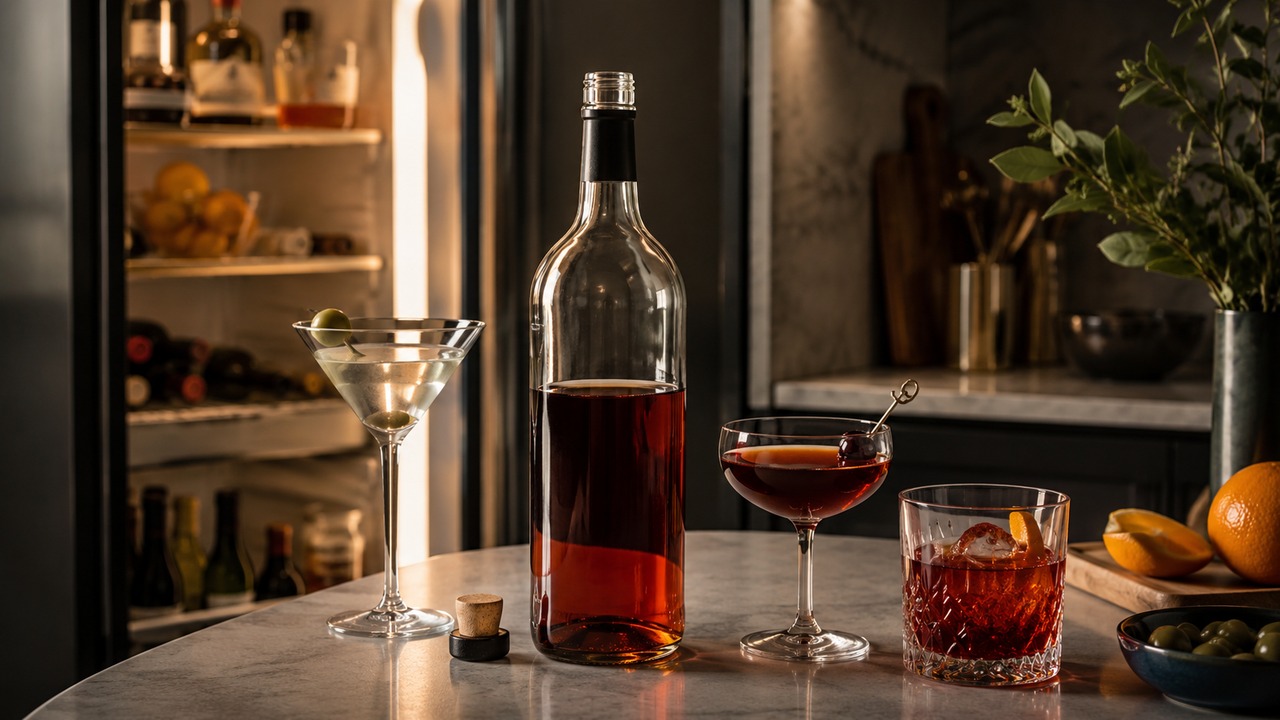
Opened vermouth does not have a clock that turns it from “good” to “bad” on an exact date. The most defensible rule of thumb is simple: After opening, close the bottle tightly, refrigerate it, and treat it for about a month as a quality control point. MARTINI informs that its vermouths, dry or sweet, maintain good quality for approximately one month when refrigerated. Cocchi recommends keeping your Storico Vermouth di Torino cold and consuming within a month. For the Vya line, Quady Winery says a month or more in the refrigerator.
These deadlines are useful, but they are not “universally valid”. Vermouths have different recipes, wine bases, alcohol content, sugars, botanicals and structures. The way the bottle was closed, how many times it was opened, how much liquid was left and how long it spent outside the refrigerator also alter the speed of sensory evolution.
Why vermouth changes after opening
Vermouth is an aromatized and fortified wine, not a distilled drink that remains practically stable indefinitely once opened. The wine base contains aromatic and phenolic compounds that continue to react over time. When opening the bottle, air enters; with new openings, there is a new exchange with the environment. The resulting oxidation can reduce freshness, aromatic intensity and complexity.
MARTINI herself describes the change in a very practical way: over time, the brightness and complexity decrease, and an old or poorly stored vermouth can become “flat” and “dull”, that is, more dull and lifeless, in addition to developing an unpleasant aroma. This is a more useful criterion for cocktail making than looking for a magical day when the bottle “expires”.
Wine studies help explain the direction of the process, although they do not determine a specific time frame for vermouth. Storage research shows that higher temperatures accelerate chemical and sensory changes and that conditions with more oxygen favor profiles perceived as more oxidized. In other words: refrigeration does not freeze evolution, but slows it down.
What manufacturers really recommend
MARTINI: about a month for dry and sweet
In the brand's official guide, the recommendation is to refrigerate any vermouth after opening, whether dry or sweet. The published reference is approximately one month of good quality in the refrigerator. After that, the brand does not claim that the drink automatically becomes unsafe; states that quality may decline as oxidation progresses.
This detail matters because it turns “one month” into an evaluation milestone, not a sentence. A bottle that is tightly closed, barely opened, and kept cold may still feel satisfactory after this point. Another one, forgotten several times on the counter, may lose its vivacity sooner.
Cocchi Storico: keep cold and drink within a month
The official data sheet for Cocchi Storico Vermouth di Torino, a sweet vermouth with 16% alcohol, advises replacing the cork, keeping the bottle cold and drinking within a month. Here again, the producer gives a simple operational recommendation to preserve the intended profile of the product.
The value of this guidance is to show that sweet vermouth should also be treated as open wine. The fact that it has more sugar or a darker color is not a license to leave it in the cupboard for months without expecting a sensorial change.
Vya: a month or more in the fridge, with difference between recipes
Quady Winery recommends refrigeration after opening and says its Vya vermouths will last a month or more in the refrigerator. In a specific text about the line itself, the producer also states that, outside the refrigerator, it would recommend consuming within 48 hours and that Vya Sweet tends to resist more than Extra Dry and Whisper Dry due to the wine composition of that recipe.
This example is useful precisely because it should not be generalized. It shows that two vermouths from the same house can react differently. The safe conclusion is not “sweet lasts X and dry lasts Y”, but rather that the product's formulation weighs as much as the category written on the label.
Dry and sweet vermouth last the same amount of time?
There is no universal rule in the manufacturer sources used here such as “dry lasts three weeks and sweet lasts three months”. MARTINI gives the same reference point, about a month refrigerated, for both. Cocchi recommends one month for its sweet vermouth. Quady describes a specific advantage of its Vya Sweet over its dry countertop condition, but relates this to the composition of the line itself.
Dry vermouth
Dry usually goes into drinks in which herbal freshness, floral, citrus and bitter notes are easily noticeable. If these aromas lose intensity, the drink may seem thin, lacking definition or simply less lively. For an opened bottle, the best policy is refrigerator from the first day and a control test after approximately one month.
Sweet vermouth
The candy should also go in the fridge. Darker color and more intense flavor may mask part of the evolution, but do not prevent oxidation. In Manhattan and Negroni, the loss of complexity may appear as a less integrated sensation of sweetness, less aromatic contrast and a duller finish.
Four factors that change the speed of quality loss
Temperature
It is the easiest factor to control. The guidance from the consulted manufacturers converges on refrigeration, and wine studies reinforce that higher temperatures accelerate chemical and sensorial evolution. Leaving the bottle permanently on the counter because it “contains alcohol”
this is treating vermouth as if it were distilled, which it is not.
Sealing
After serving, close the bottle immediately and firmly. Cocchi, for example, explicitly requests that the bottle be closed again with the cork. A poor seal facilitates air exchange and eliminates part of the refrigeration benefit.
Air space in the bottle
The smaller the volume of liquid remaining, the larger the gas space inside the bottle. This doesn't allow you to convert “half a bottle” into an exact number of days, but it is a good reason to take a closer look at bottles that are already at their end. Wine studies show that the oxygen present in the liquid and in the space above it participates in post-bottling evolution.
If consumption at home is very slow, smaller formats, when available, reduce the time a large bottle spends open. Transferring the remainder to a smaller, clean, food-friendly, tight-sealing jar may reduce air space, but this is a management measure, it does not replace the refrigerator or create a new guaranteed shelf life.
Frequency of opening and time out of the refrigerator
A bottle used several times a week exchanges air with the environment repeatedly. If, in addition, it stays on the bench for hours and only returns to the cold at the end of the night, it spends more time at a temperature favorable to evolution. The simplest routine is to remove, serve, close and return to the refrigerator.
How to know if vermouth is already harming the drink
The first question is not “how many days are there?”, but rather “does it still deliver the profile it should?”. When a bottle is opened, it is worth tasting a small amount and recording mentally or in writing how it smells and tastes. This reference makes it easier to notice the drift weeks later.
Useful signs are loss of vivacity, less distinct aroma, feeling of flatness and reduced complexity. In some wines, warmer storage and oxidation are associated with a decline in fruity attributes and an increase in toasted or aged notes. In vermouth, however, botanicals and styles vary so much that a single descriptor such as “vinegar smell” should not be used as a universal test.
Color doesn't solve it alone either. A vermouth rosso can already be amber, red or brown due to its formulation; a dry can discreetly darken without this change, alone, saying how much it will affect a cocktail. For the home bar, nose and palate are more informative instruments.
A blind protocol to compare the opened bottle with a new one
If the doubt is recurring, you can transform the decision into a small reproducible test. It does not measure microbiological safety or replace the manufacturer's recommendation. It just serves to answer the question that matters to the drink: can I notice a loss of quality, and does it change the final result?
Step 1: Create a reference
Use a new bottle with the same label, ideally the same presentation. Let the new and old come to the same serving temperature. Temperature differences change aromatic perception and can make a sample seem better or worse for reasons unrelated to age.
Step 2: do the coding without knowing which is which
Ask someone else to pour small portions into two identical glasses and mark them only as A and B. Blind tasting reduces the tendency to automatically prefer the new bottle because you already know which one should be “fresher”.
Step 3: compare pure first
Smell slowly and then taste a small amount of each sample. Observe intensity, definition of herbs and spices, freshness, bitterness, sweetness, acidity and length of the finish. Instead of looking for dramatic defects, ask which sample looks sharper and more complex.
Step 4: Repeat inside the cocktail
Make two small versions of the same drink, with identical measurements and the same dilution, just changing the vermouth. For dry vermouth, a Martini is a natural comparison. For sweet vermouth, Manhattan or Negroni place the bottle in the context in which it will actually be used. Again, taste without knowing which version received the old bottle.
Step 5: Use a simple decision rule
If the old sample is consistently duller and the drink with it loses balance or definition, the bottle is no longer a good choice for this use. If the difference is not noticeable, this only indicates that, at that moment and at that cocktail, the sensory loss is not yet relevant to you. It does not mean that the oxidation has stopped; It is worth repeating the comparison later.
What changes in Martini, Manhattan and Negroni
In Martini, especially in versions that emphasize a clear presence of dry vermouth, the loss of floral, herbal and citrus notes can take away from the drink's precision. The result may still be “drinkable” but appear less fresh and less defined.
In Manhattan, sweet vermouth works together with whiskey and bitters to build aroma, sweetness and bitterness. When the vermouth is tired, the cocktail can lose some of the aromatic lift that keeps the mix from just seeming heavy or sweet.
In the Negroni, gin and bitters bring enough intensity to hide small changes, but the vermouth remains structural. A dull profile reduces the vinous and botanical layer that connects the other components. Therefore, a vermouth that seems acceptable neat may still be rejected when compared side by side within the drink.
So, how much time is considered “good” at home?
For a household routine, about a month refrigerated is the best starting point because it appears explicitly in different manufacturers' guidelines. This doesn't mean throwing the bottle away on the 31st day. It means that, from then on, relying solely on the date becomes less useful and sensory evidence becomes more important.
A bottle that has been opened for three or six months may have been kept in very different conditions than one of the same age. If it was always cold, well sealed and only opened a few times, it may have preserved its profile better. If it has a lot of air space, has been outside the refrigerator for long periods or has been opened daily, the loss may be greater. One year, on the other hand, is well beyond the quality recommendations of the manufacturers consulted and should not be treated as a normal freshness target for cocktails.
The most useful way to store vermouth, therefore, combines calendar and taste: mark the opening date, keep the bottle cold and closed, and use a month as a reminder to reevaluate. When in doubt, compare with a new bottle under equal conditions. The best deadline is not the most confident number found on the internet; is the point at which the bottle stops delivering the aroma and balance that your Martini, Manhattan or Negroni needs.