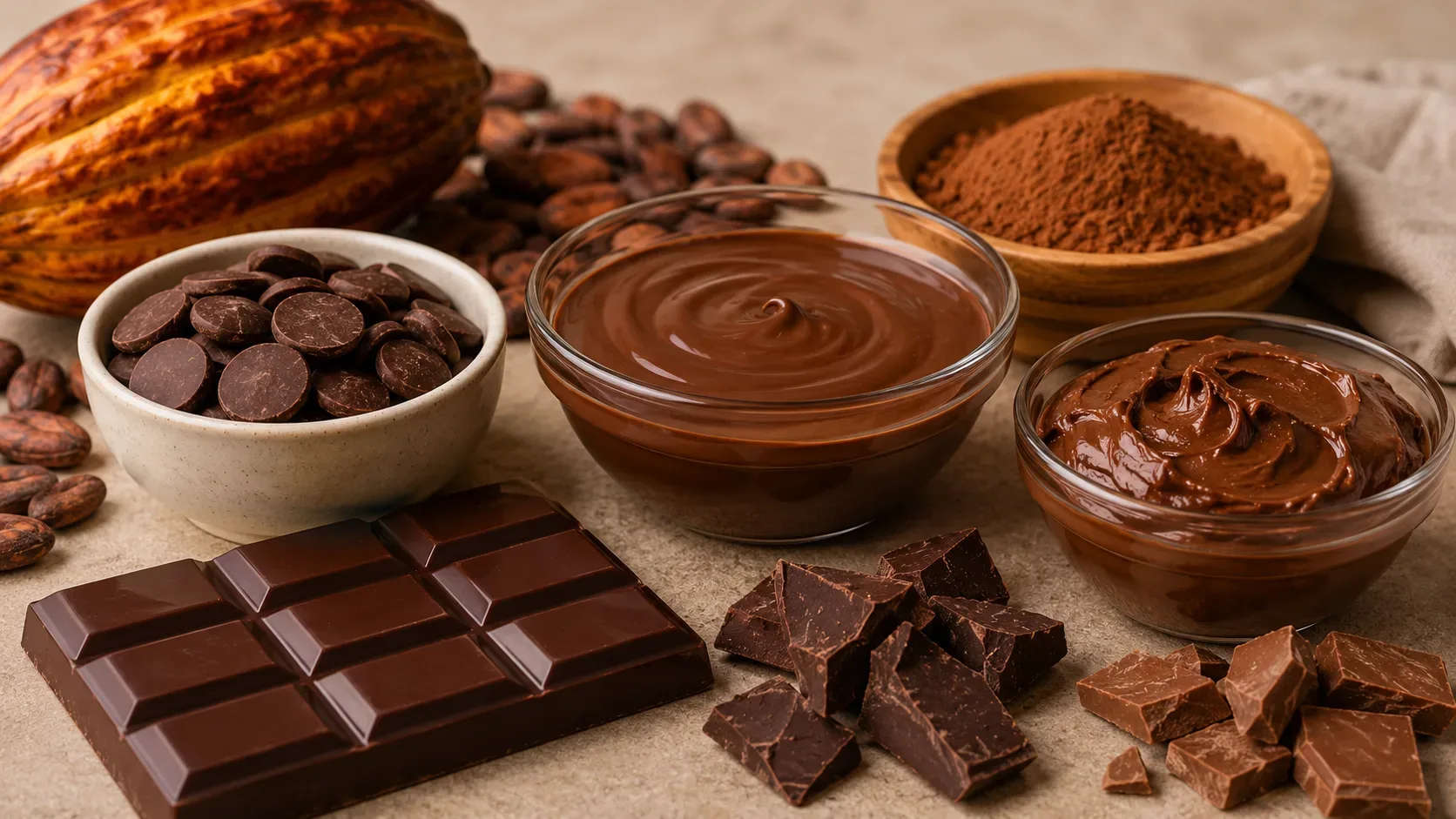
Chocolate, frosting and “chocolate flavor” are not just similar names. Law No. 15,404/2026 created its own definitions, established minimum percentages of cocoa components and determined that the cocoa content be informed prominently on the front of packaging.
This, however, still does not mean that all labels found on the market today must follow the new requirements. The law was officially published on May 11, 2026 and will come into force on May 6, 2027, after the 360-day period provided for in the text. Until that date, the requirements of RDC nº 723/2022 continue to apply, according to Anvisa itself.
Before entry into force, the agency will hold, on August 11, 2026, a virtual sectoral dialogue to discuss technical points that still need to be regulated. The meeting will serve to present the state of the work, receive input and discuss alternatives — it should not be treated as if it already produced a definitive regulatory decision.
The chronology of the new chocolate law
| Date | What happened or will happen |
|---|---|
| May 8, 2026 | Law No. 15,404/2026 was sanctioned. |
| May 11, 2026 | The text was published in the Official Gazette of the Union, starting the 360-day period. |
| August 11, 2026 | Anvisa will hold the sectoral dialogue on regulation, from 9am to 12pm, in a virtual environment. |
| May 6, 2027 | Date indicated by Anvisa for the law to come into force. |
The distinction between these dates is important. The law already exists, but its new obligations are not yet enforceable as a general market rule. Furthermore, part of its application will depend on technical criteria that are being prepared by Anvisa.
What Law No. 15,404/2026 has already defined
The law establishes categories and composition requirements for national and imported products sold in Brazil. When it comes into effect, the name used on the packaging must correspond to the product's framing.
| Category defined by law | Minimum composition or main requirement |
| Cocoa powder | At least 10% cocoa butter in relation to dry matter and a maximum of 9% moisture. |
| Chocolate powder | At least 32% total cocoa solids. |
| Chocolate | At least 35% total cocoa solids, including at least 18% cocoa butter and 14% fat-free solids. The text limits the total of other authorized vegetable fats to 5%. |
| Milk chocolate | At least 25% total cocoa solids and 14% total solids from milk or its derivatives. |
| White chocolate | At least 20% cocoa butter and 14% total milk solids, as well as being free of coloring matter. |
| Chocolate, fantasy chocolate, compound chocolate, chocolate-flavored topping or white chocolate-flavored topping | At least 15% cocoa solids or 15% cocoa butter. |
| Chocolate or filled chocolate candy | Filling with edible substances and chocolate coating. The law does not set, in this section, a specific minimum percentage for the complete product. |
| Sweet chocolate | At least 25% total cocoa solids, of which 18% would be cocoa butter and 12% fat-free solids. |
These percentages are written directly in the law and cannot be freely changed by regulation. The complementary act must explain how to calculate, prove and apply them to different commercial presentations.
There is a particular issue in the definition of sweet chocolate: although the text requires 25% total solids, the two minimum fractions mentioned — 18% cocoa butter and 12% fat-free solids — add up to 30%. Anvisa classified the point as an internal inconsistency and referred a query to its Federal Attorney's Office. Until official guidance exists, it is not safe to present a definitive interpretation of this category.
“Coverage” and “chocolate flavor” do not mean the same thing as chocolate
The law does not create a generic category called just “coverage.” It expressly mentions “chocolate flavored frosting” and “white chocolate flavored frosting” within the group that must have at least 15% cocoa solids or 15% cocoa butter.
The product classified simply as chocolate must reach a minimum of 35% total cocoa solids and comply with the specific fractions of cocoa butter and fat-free solids.
In practice, this aims to reduce situations where colors, images, word size or fancy names make a topping appear equivalent to chocolate, despite the two formulations belonging to different categories.
The legal text determines that products that do not meet the definitions of chocolate and other specified categories use a compatible sales denomination. It also prohibits images, expressions, colors or graphic elements capable of misleading the consumer as to the nature of the product.
It is still necessary to clarify how this rule will reach foods in which “chocolate flavor” appears only as an indication of flavor — for example, cookies, cakes, drinks, fillings or desserts — and not as a name for the cocoa product sold alone. Anvisa included among the discussion points the treatment of foods in which cocoa derivatives are just ingredients and the use of expressions related to characteristic flavors.
What is defined, what remains to be regulated and what to observe today
| Subject | Defined by law | Still under regulation | What can be seen today |
| Minimum percentage of chocolate | Chocolate must have at least 35% total cocoa solids. | Calculation method, countable ingredients, process losses and proof. | Until May 6, 2027, RDC nº 723/2022 maintains the minimum 25% for the chocolate category. |
| Front information | The phrase “Contains X% cocoa” must appear on the main panel, in an area no less than 15% of the front of the packaging. | Decimal places, rounding, minimum guaranteed percentage, documentation and application to assortments, filled products and multipacks. | Some manufacturers already highlight percentages voluntarily, but this information should not be assumed to be identical to the future standardized declaration. |
| Total cocoa solids | They are the sum of cocoa butter and defatted dry solids obtained from almonds. | Calculation basis, compound raw materials, composition variations and proof methods. | The ingredients list shows which derivatives were used, but does not necessarily reveal their exact quantities. |
| Other vegetable fats | The “chocolate” category will have a limit of 5% of other authorized vegetable fats. | Which fats will be authorized, calculation basis, accepted processes and limit range. | The presence of vegetable oil or fat must already appear in the list of ingredients when it is part of the formulation, but its proportion is generally not informed. |
| Milk and white chocolate | The law requires 14% total milk solids in both categories. | Countable dairy ingredients, method of calculation and proof. | Ingredients such as powdered milk, dairy fat and derivatives can be identified in the list, without this alone informing the total percentage. |
| Product name | Products outside the categories must use a compatible name and cannot appear to be chocolate through misleading presentation. | Treatment of terms such as “bitter”, “semi-bitter”, “intense” and “dark”, as well as names of fillings, assortments and industrial products. | The sales name is already mandatory information and must be read separately from the trade name or brand. |
| Front nutrition labeling | It was not created by the new chocolate law. | It is not part of the core of this regulation. | The “high in” magnifying glass already indicates excess added sugars, saturated fat or sodium, in accordance with current nutritional rules. It does not indicate the cocoa percentage. |
| Transition of stocks | The law provides for entry into force after 360 days. | Possibility of additional time for adaptation, use of old packaging and disposal of stocks. | It is not possible to say that all previous packaging will disappear from stores exactly on May 6, 2027. |
Separation is essential because several very visible elements of the future labeling are already fixed, but the method of application may still vary depending on regulations. Anvisa emphasizes that its analyzes are preliminary and do not represent definitive decisions on the content of the future act.
How to compare products available today
While the new front declaration does not take effect, the comparison needs to match different parts of the label.
1. Look for the sales name
Don't limit yourself to the biggest words on the packaging. Identify how the product is officially called: “chocolate”, “white chocolate”, “chocolate flavored coating”, “covering preparation”, “chocolate flavored biscuit” or other expression.
The brand name and promotional phrases may take up more space, but they do not replace the legal name of the food. RDC nº 723/2022 already establishes names for the products currently covered.
2. Read the list of ingredients in the order presented
Under current rules, ingredients are declared in descending order of proportion. This means that the first ingredient is, as a rule, the one used in the greatest quantity in the formulation.
When comparing two products, note the position of terms like:
- sugar;
- cocoa dough, paste or liquor;
- cocoa butter;
- cocoa powder;
- powdered milk and other dairy ingredients;
- fat or vegetable oil;
- flavoring and sweeteners.
The order offers a qualitative view, but does not allow you to accurately calculate the cocoa percentage. Two products can list the same ingredients and still have different proportions.
3. Don’t treat every current “70% cocoa” claim as equivalent to the future legal phrase
The future declaration “Contains X% cocoa” must represent the percentage of total cocoa solids contained in the product. Anvisa notes that this is not necessarily equal to the amount of an ingredient incorporated at the beginning of manufacturing.
Therefore, a voluntary claim found today should not be automatically compared with the future standardized claim without knowing the criteria adopted by the manufacturer.
4. Separate cocoa content from nutritional profile
The cocoa percentage does not replace the nutritional table. To compare added sugars, saturated fat, sodium and energy value, use the data per 100 grams and per serving.
The “high in” magnifying glass, when present, informs you that the food has reached the defined limits for added sugars, saturated fat or sodium. It does not classify the product as chocolate nor assess its cocoa content.
5. Consider the culinary purpose
The legal category helps to understand the composition, but does not function as a complete technical sheet. To melt, mold, cover, fill or prepare ganaches, also consult the manufacturer's instructions and instructions for use.
A coating may have been formulated for a certain culinary process, while a chocolate with a higher cocoa content may require different temperature and texture control. The legal name tells you what the product is; does not alone guarantee that it is the most suitable for every recipe.
What Anvisa will discuss on August 11, 2026
The sectoral dialogue will be open to interested parties, without prior registration, and will take place virtually from 9am to 12pm. Among the topics announced are:
- limits for shells, skins and other almond by-products;
- calculation, declaration and proof of total cocoa solids;
- added vegetable fats and application of the 5% limit;
- definition of total milk solids;
- framing of the different categories;
- selling names and prevention of misleading information;
- laboratory methods and supporting documents;
- multiple packaging, assorted products and industrial products;
- adaptation of labels and eventual stock flow;
- compatibility of the new law with RDC nº 723/2022.
The agency will also assess whether regulatory intervention will be restricted to what is necessary to execute the law or whether it will include additional improvements, such as categories of covering chocolate, gianduja, chocolate flakes and different types of cocoa powder. These topics are under analysis and cannot be presented as approved rules.
Quick questions about the new chocolate law 2026
Does chocolate already need to have 35% cocoa solids?
No. Until the entry into force of Law No. 15,404/2026, on May 6, 2027, Anvisa informs that RDC No. 723/2022 continues to apply, which currently requires a minimum of 25% total cocoa solids for the product called chocolate.
Does the packaging already need to say “Contains X% cocoa” on the front?
Not as an obligation created by the new law. The requirement will come into force with the new framework, and the additional criteria will still be regulated.
The absence of this standardized phrase before May 6, 2027, in isolation, does not demonstrate irregularity.
A product with vegetable fat cannot be chocolate?
It is not possible to answer just by looking if there is vegetable fat in the list. Under the future law, the “chocolate” category will have a limit of 5% of other authorized vegetable fats, but the calculation basis, scope and permitted fats still need to be defined.
In addition, until the law comes into force, the framework continues to follow the currently applicable standards.
Will every “chocolate flavor” product be a topping?
No. “Chocolate flavor coating” is a category expressly mentioned in the law, but the expression “chocolate flavor” can also appear as a characteristic of other foods. The treatment of these cases is among the points to be clarified by the regulation.
Should all old packaging leave stores in May 2027?
It is not possible to say yet. Anvisa is legally analyzing the possibility of additional rules for the adequacy and flow of stocks. The decision will depend on the future regulatory act.
What changes for the consumer
The main expected advance is to make comparable information that today appears in different ways — or does not always appear.
When the new rules are fully applicable, consumers should be able to distinguish more easily:
- what is the legal name of the product;
- how much total cocoa solids does it contain;
- if the formulation reaches the category minimum;
- when it is chocolate or a chocolate-flavored coating;
- which packaging elements are merely an indication of flavor or commercial presentation.
Until then, the best strategy is to combine sales denomination, list of ingredients and nutritional table, without assuming that the size of the word “chocolate” or the color of the packaging reveals the composition.
Save this explainer and return after the publication of the results and Anvisa's regulatory acts. The article should be updated after the dialogue on August 11, 2026 and again when the complementary standard is published.