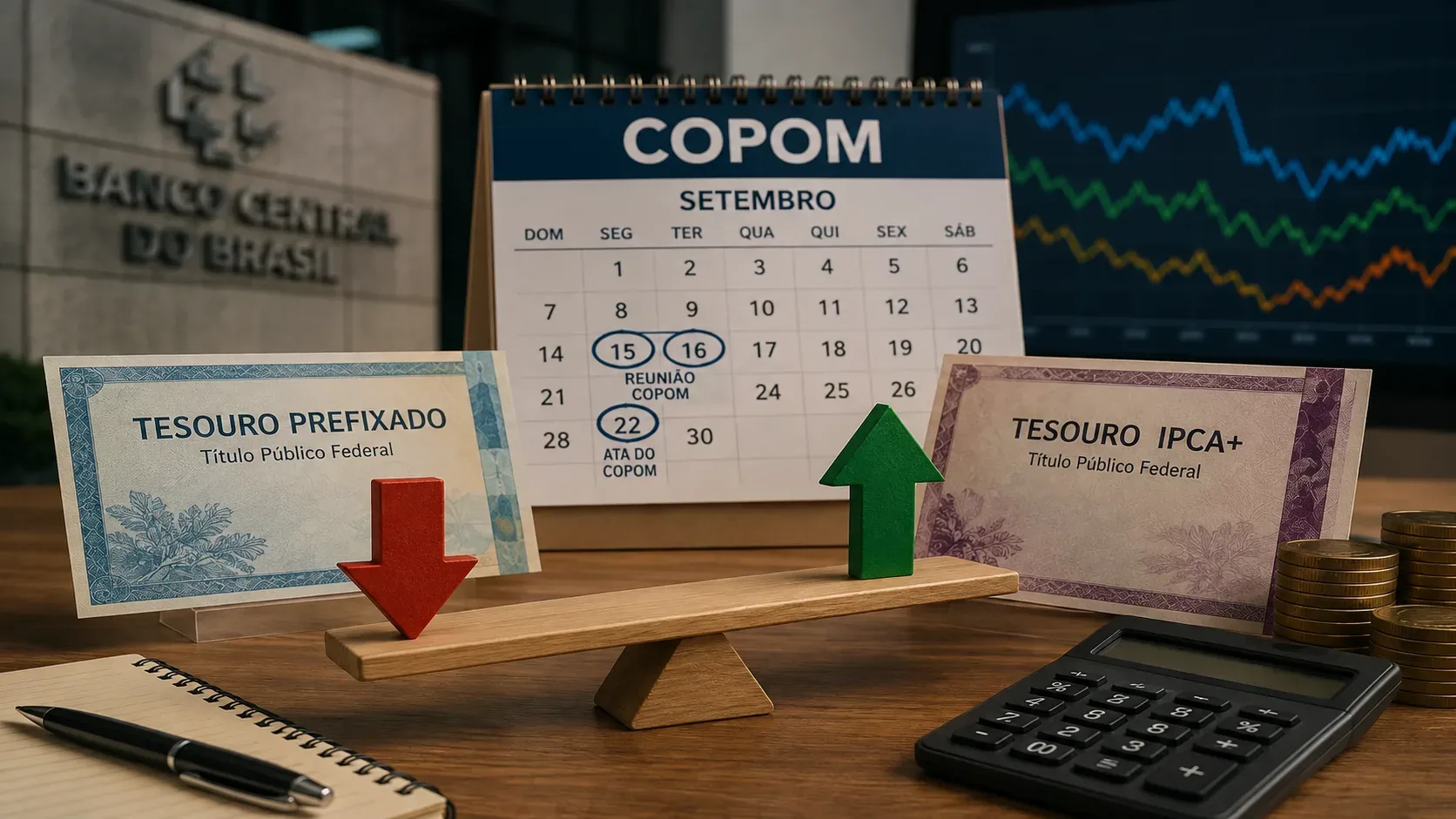
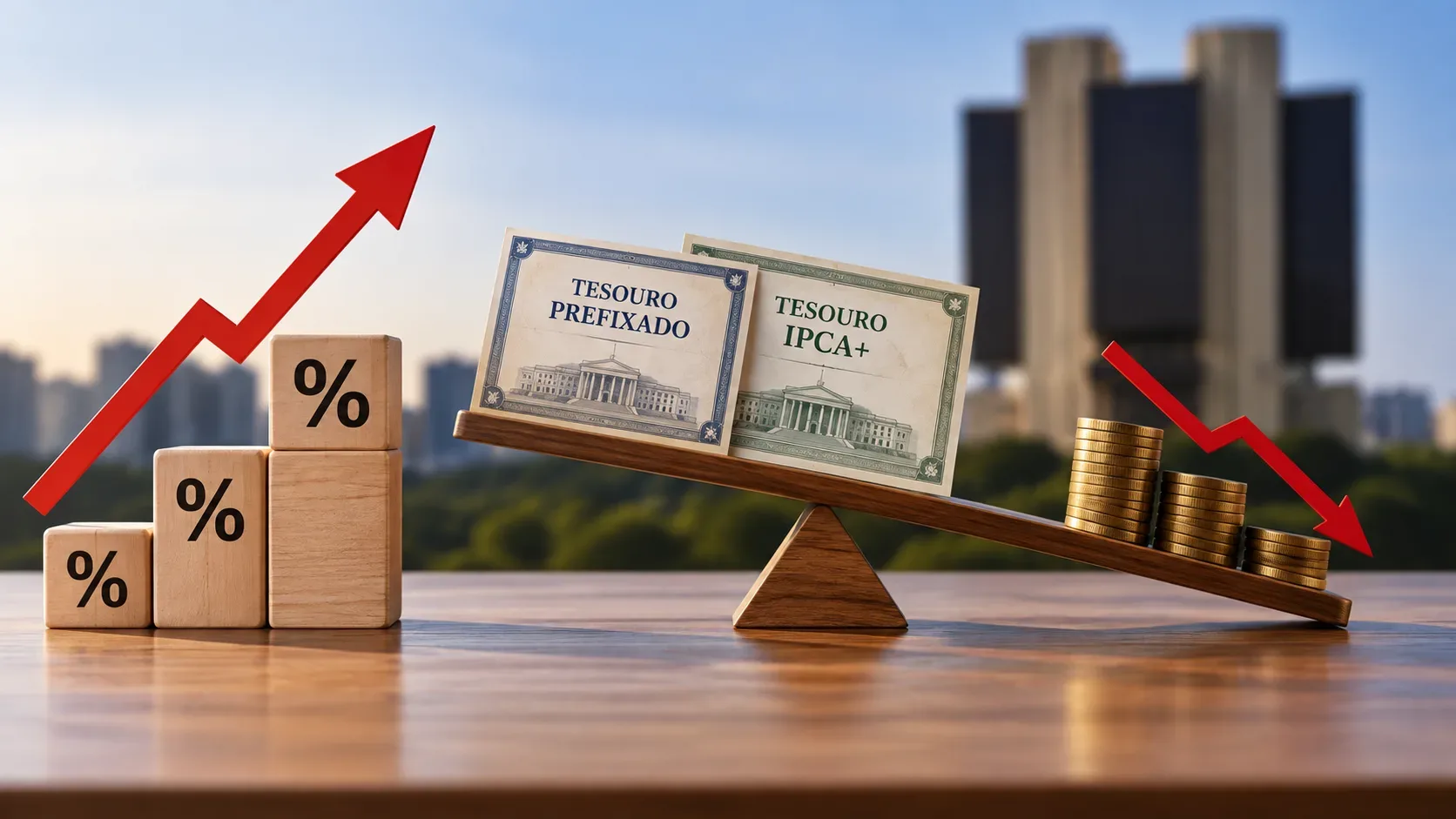
When the yield required by the market rises, the price of an already-issued bond tends to fall because the same future cash flow must offer a higher return to anyone buying it at that moment. When the yield falls, the opposite happens: the older cash flow becomes relatively more attractive and its price rises. This inverse relationship is the core of mark-to-market pricing in Brazilian Treasury fixed-rate bonds and Tesouro IPCA+.
Why do price and yield move in opposite directions?
A fixed-income security is essentially a sequence of future payments. To determine what those payments are worth today, the market discounts them to present value using a discount rate. If that rate rises, present value falls; if the rate falls, present value rises.
With a Tesouro Prefixado without semiannual coupons, the mechanism is especially easy to see. The official Tesouro Direto material states that one whole bond has a nominal value of BRL 1,000 at maturity and that its price can be expressed, in simplified form, as that future value discounted by the rate and the remaining term. Tesouro Direto itself highlights the inverse relationship between price and yield and notes that an increase in the market yield relative to the purchase yield causes the bond price to fall. See Tesouro Direto's fixed-rate bond calculation material.
What does mark-to-market change in Tesouro Direto?
Mark-to-market pricing updates a bond's value according to current trading conditions. This matters mainly before maturity: if the investor wants to sell, the Brazilian Treasury repurchases the security at the prevailing market price, and the realized return may be above or below the yield originally contracted.
The program rules explain that Tesouro Direto prices and yields are based on rates traded in the secondary market and that, between purchase and maturity, prices may vary with market conditions and expectations for future interest rates. See Tesouro Direto's rules and regulations.
This also helps separate two concepts: the return contracted if held to maturity and the return from an early sale. The first depends on the bond's rules and on holding it to its final date; the second depends on the price at which the bond can be sold on that day.
Tesouro Prefixado: a simple numerical example
To isolate the effect of the yield, imagine a single BRL 1,000 payment to be received two years from now and keep the remaining term constant. For this educational example, ignore business-day conventions, repurchase spreads, taxes and fees.
| Market yield | Approximate theoretical price | Interpretation |
|---|---|---|
| 8% p.a. | BRL 857.34 | Lower yield, higher price |
| 10% p.a. | BRL 826.45 | Reference scenario |
| 12% p.a. | BRL 797.19 | Higher yield, lower price |
The simplified calculation is: price = 1,000 ÷ (1 + yield)². The point is not to predict the value of a specific bond, but to isolate the mechanism. In practice, Tesouro Prefixado uses a 252-business-day convention, and actual prices reflect market conditions.
Tesouro IPCA+: the rate that moves the price is the real yield
Tesouro IPCA+ combines the variation of Brazil's IPCA inflation index with a contracted real yield. Its price also depends on an inflation-adjusted nominal value known as VNA. In Tesouro Direto's technical material, the price of a non-coupon IPCA+ bond is formed by the projected VNA multiplied by a quotation; that quotation, in turn, falls when the real yield rises. See the official Tesouro IPCA+ methodology.
That is why saying only that “the Selic rate went up” is not enough to calculate the movement of an IPCA+ bond. What directly matters for mark-to-market pricing is the market real yield required for that maturity, along with the VNA update. The Brazilian Treasury explains that, in the secondary market, NTN-B inflation-linked bonds are quoted using their real internal rate of return, while fixed-rate bonds use the nominal interest-rate curve as a key reference. See how prices are formed in the secondary market.
Timeline: what happens when yields rise or fall
- Purchase: you buy a Tesouro Prefixado or IPCA+ at a yield consistent with the market on that day.
- Later, the market yield rises: new buyers demand a higher return for the remaining term. For the older bond to offer that return from today's price, its price must fall.
- If the market yield falls: the previously contracted cash flow becomes relatively more valuable and the bond price tends to rise.
- As time passes: the remaining term shortens. If the bond is held to maturity, market fluctuations no longer determine the value of an early sale because no early sale is being made.
In real life, yields and time change simultaneously. As a result, an account balance may not reproduce a simple isolated “yield up, price down” example exactly. Inflation indexation, the approach of maturity, coupon cash flows when applicable and changes in the yield curve all act together.
Why do longer-maturity bonds usually fluctuate more?
The farther away a payment is, the greater the effect of changing the rate used to discount it back to present value. This is the foundation of duration, a measure of a bond's price sensitivity to interest rates. Two bonds can therefore move in the same direction after a rate change but by different magnitudes.
There is also a difference between zero-coupon structures and bonds with semiannual interest payments. Coupon bonds return part of the cash earlier, which changes their sensitivity. A simple single-payment example should therefore not be applied mechanically to every Treasury series.
If I hold to maturity, does a drop in my account become a loss?
Not necessarily. For securities held to maturity, Tesouro Direto states that the return contracted at purchase is preserved according to the bond's rules. For Tesouro Prefixado, that means convergence toward the nominal amount due at maturity; for Tesouro IPCA+, it means receiving the IPCA adjustment combined with the contracted real yield, according to the security's structure.
Mark-to-market becomes a realized gain or loss when there is an early sale. Before that, the fluctuation shows how much the market would pay for the bond at that moment. Tesouro Direto even publishes a series of accumulated returns in the event of early redemption, distinguishing that outcome from the logic of holding to maturity.
What to check before selling early
- Current yield on the same bond or a comparable maturity: it helps explain the repurchase price.
- Remaining term: the longer it is, the greater the sensitivity to yield changes tends to be.
- Type of bond: fixed-rate bonds react to the nominal curve; IPCA+ bonds react especially to real yields and the VNA.
- Coupon structure: bonds with semiannual interest have multiple cash flows and do not behave like a single future payment.
- Sale price, costs and taxation: the net result is not just the visible change in the gross bond price.
- Investment objective: selling because of a temporary fluctuation may conflict with a plan built around a future date.
Three common interpretation errors
“Fixed income cannot fall.” The cash-flow rule may be defined, but the market price before maturity can fluctuate.
“If the Copom raises the Selic rate, every Tesouro Prefixado or IPCA+ automatically falls by the same proportion.” No. Prices respond to the yield curve relevant to each maturity and, for IPCA+, to the real yield. Copom decisions influence expectations, but they do not replace the market rate used in pricing.
“A drop in my account means the contracted yield disappeared.” It does not. For an investor who holds the bond to maturity, the contracted remuneration rule is what matters; for an investor who sells early, the market price on the sale date matters.
In one sentence
Mark-to-market translates changes in yields into changes in prices: a higher yield requires a lower price; a lower yield allows a higher price. In Tesouro Prefixado, this appears directly in the discounting of a fixed future value; in Tesouro IPCA+, the same logic acts through the real yield and quotation while the VNA tracks inflation. Understanding this mechanism is what allows investors to interpret a pre-maturity fluctuation without automatically confusing it with the return contracted for the end of the term.