Fixed income ETFs, CDBs and Tesouro Direto securities can appear side by side in a conservative portfolio, but they work in different ways. A CDB is a security issued by a bank. Tesouro Direto provides direct access to Brazilian federal government bonds. A fixed income ETF, in turn, is a fund share traded on an exchange and designed to track a benchmark index. This structural difference changes how each product is bought, the price shown on the screen, liquidity, risks, taxation, FGC coverage and the logic of maturity.
For investors, the useful question is not which product is “best” in general. It is understanding what mechanism is being purchased and which conditions must be checked before placing an order.
What you buy in each case
When you buy a CDB, you lend money to a financial institution and receive a promise of payment under the security's return and maturity terms. The Brazilian Investor Portal page on bank-issued securities notes that liquidity conditions can vary and that an early exit may depend on the issuer's rules.
Through Tesouro Direto, you buy a specific Brazilian federal government bond with a defined indexation method, rate and maturity date. If you hold it to maturity, the return logic follows the terms of that security. If you sell earlier, the amount received depends on the market price at that time, as explained in the Tesouro Direto rules.
With a fixed income ETF, you buy a share of an index fund. The fund holds a portfolio of securities and seeks to track the performance of a benchmark index. The Brazilian Investor Portal explains that when the underlying index is rebalanced, the ETF portfolio is also adjusted to reflect the new composition.
Quick comparison: fixed income ETF, CDB and Tesouro Direto
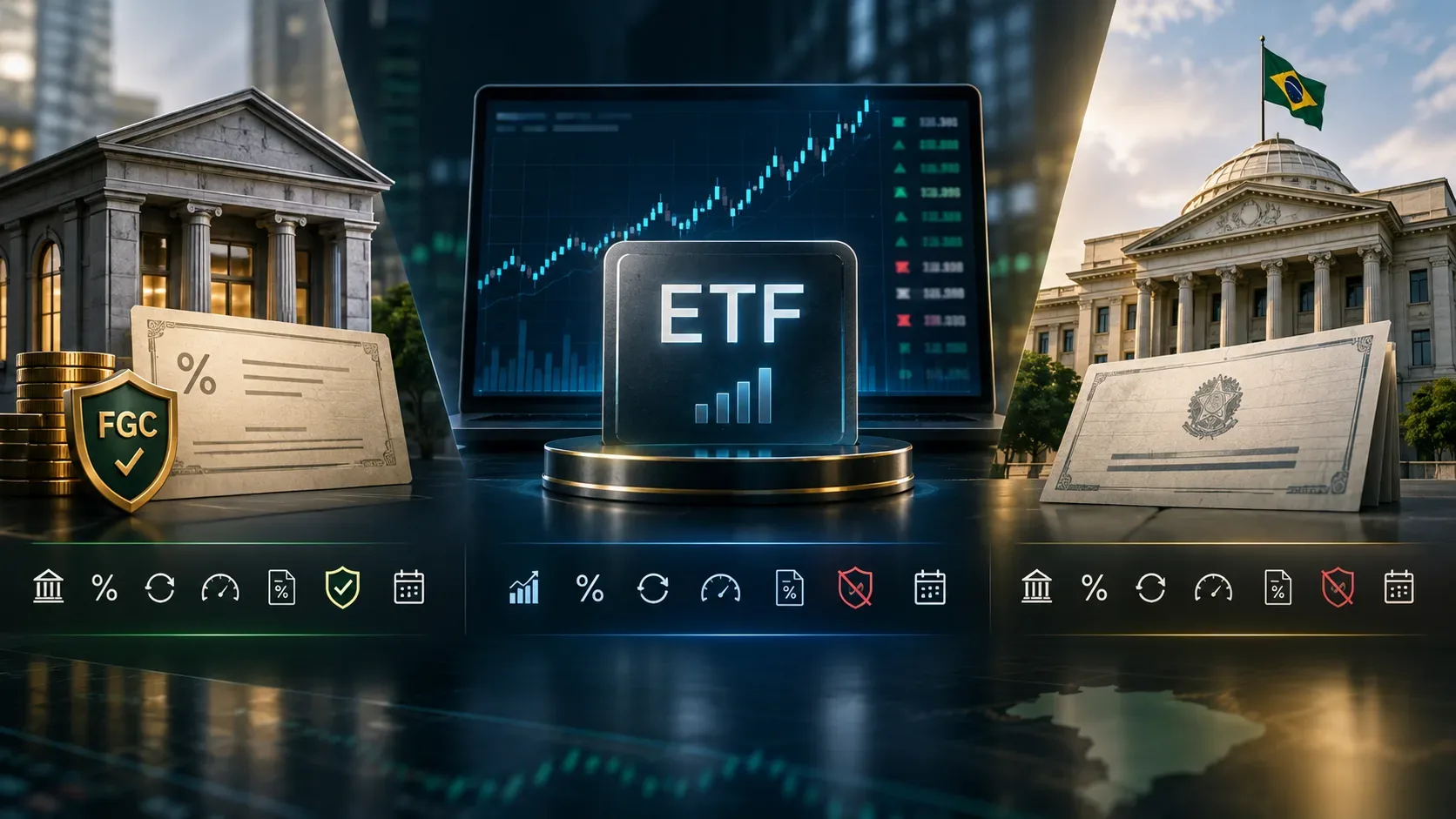
| Criterion | Fixed income ETF | CDB | Tesouro Direto |
|---|---|---|---|
| How to access | Buy and sell fund shares on the exchange through a broker | Invest in a bank-issued security through a bank or investment platform | Buy a government bond through an institution authorized for Tesouro Direto |
| Return reference | Seeks to track a fixed income index | Return defined by the security, such as a percentage of CDI, a fixed rate or another structure established at issuance | Terms of the chosen bond, such as Selic-linked, fixed rate or inflation plus a rate |
| Price during the investment | Exchange price changes during the trading session | Balance follows the security's terms; an early exit depends on issuer conditions | Market price changes; an early sale occurs at the prevailing market price |
| Liquidity | Depends on the market, spread, trading volume and the relationship between price and NAV | Varies by issue; there may be daily liquidity or funds may remain committed until maturity | There is an early-sale mechanism to the Treasury, subject to market price and operational rules |
| Main risk | Market risk, liquidity risk and risks of the assets held by the fund | Credit risk of the issuing bank, plus liquidity terms and valuation effects when applicable | Price fluctuations before maturity and risk associated with the Brazilian federal government bond |
| FGC | No | Yes, when eligible and within FGC limits | No |
| Income tax | Rate depends on the ETF portfolio's average maturity, not on how long the investor held the share | Regressive schedule based on the investment holding period | Regressive schedule based on the investment holding period |
| Maturity for the investor | The fund share normally has no single maturity date equivalent to an individual security | The CDB has a maturity date defined at issuance | Each government bond has a maturity date |
For an ETF, the index is the starting point
A fixed income ETF does not promise the investor a contracted rate through a final date. It seeks to reproduce the behavior of an index. That index may represent fixed-rate government bonds, inflation-linked bonds, private credit or other permitted segments, depending on the product methodology.
As a result, two ETF tickers both classified as “fixed income” can behave very differently. What matters is which index is tracked, which assets are included, the portfolio's average maturity or duration and how the index is rebalanced. The expression “fixed income” by itself does not remove price volatility.
There can also be a difference between index performance and the fund's actual performance. Management fees, costs, cash positions, operational adjustments and small replication differences can create what is known as tracking difference. The objective is to follow the index, not to guarantee perfect equality in every period.
Quoted price: an exchange price is not the same as a contracted rate
An ETF share trades on an exchange. Investors see bid and ask prices in the order book and can trade during the session. The market price can sit slightly above or below the share's net asset value, or NAV, because supply and demand operate in the secondary market.
Authorized participants and arbitrage mechanisms help keep the traded price close to the value of the fund's assets. Even so, investors should observe the bid/ask spread and the relationship between the exchange price and NAV. The Brazilian Investor Portal's ETF risk section cites the spread, average trading volume and proximity to NAV as relevant factors when evaluating liquidity.
A CDB uses a different reference. The investor contracts the terms of that bank-issued security, and the possibility of exiting before maturity depends on the issue and the institution. Tesouro Direto also has a rate at the time of purchase, but the bond is marked to market. If it is sold early, the realized return may differ from what the investor expected when buying.
Liquidity: the word is the same, but the mechanism changes
An ETF can be traded on an exchange, but that does not mean any quantity can always be sold immediately at a price considered fair. Liquidity involves order-book depth, spreads, trading volume and the presence of agents willing to trade. During stressed markets, the gap between bid and ask prices can widen.
For CDBs, “daily liquidity” is a contractual feature of some issues, not a universal rule. Some CDBs allow daily redemption, while others keep the funds committed until maturity or depend on a repurchase condition. Investors need to read the specific terms of the issue.
Tesouro Direto allows sales before maturity, but the Treasury repurchases the bond at the current market value. This provides an exit route without freezing the price. Bonds that are more sensitive to interest rates can show meaningful fluctuations before maturity.
Risk: a fund, a bank and a government bond are different exposures
In an ETF, the investor is exposed to the fund's portfolio and to the market dynamics of the fund share itself. An ETF that tracks long-duration securities can fluctuate significantly when interest rates change. A private-credit ETF also adds risks related to the issuers of the securities included in the index and portfolio.
For a CDB, the central credit risk is the issuing bank. Eligible CDBs may be covered by the ordinary FGC guarantee within applicable limits and rules. The FGC states that coverage is up to BRL 250,000 per CPF or CNPJ per institution or financial conglomerate, subject to the other conditions and the global cap established for a four-year period.
ETFs and government bonds are not included in the ordinary FGC guarantee. That does not mean they have the same risk as each other. It only means FGC protection is not the coverage mechanism for these products. Comparing risk requires looking at who owes the money, which assets are in the portfolio, how the price can move and how long the investor intends to hold the position.
Tax: the easiest difference to misunderstand
The rules below reflect the sources consulted in September 2026. Because tax rules can change, investors should confirm the current rule and product documents before investing.
For CDBs and Tesouro Direto, income tax on returns follows the regressive fixed income schedule based on the time elapsed since the investment. Tesouro Direto states rates of 22.5% up to 180 days, 20% from 181 to 360 days, 17.5% from 361 to 720 days and 15% above 720 days. Investments redeemed within the first 30 days may also be subject to IOF tax on the return.
For a fixed income ETF, the logic is different. The rate depends on the average maturity of the fund's portfolio, not on the number of days the investor held the share. B3 material on ETF taxation lists 25% for portfolios with average maturity up to 180 days, 20% from 181 to 720 days and 15% above 720 days. Tax is withheld at source when a sale produces a gain. Recent B3 materials also state that fixed income ETFs are not subject to IOF.
| Product | What determines the income tax rate | Main rates | IOF on short holding periods |
|---|---|---|---|
| Fixed income ETF | Average maturity of the portfolio | 25%, 20% or 15% | No, according to the B3 guidance consulted |
| CDB | Time invested | 22.5%, 20%, 17.5% or 15% | May apply before 30 days |
| Tesouro Direto | Time invested | 22.5%, 20%, 17.5% or 15% | May apply before 30 days |
This creates an important practical consequence: holding an ETF for a short period does not necessarily result in the highest rate because the bracket depends on the fund's portfolio. Likewise, holding a short-average-maturity ETF for many years does not lower the rate simply because the investor held the share longer.
FGC and maturity make the structure even clearer
A CDB has a defined maturity date and, when eligible, may have FGC coverage under the guarantee rules. Tesouro Direto also consists of securities with defined maturity dates, but government bonds are not covered by the FGC.
A fixed income ETF, by contrast, is a fund. Securities inside it mature, are replaced, bought or sold according to the fund policy and index methodology. For the investor, there is not necessarily one date on which the fund share “matures” as there is with a CDB or an individual government bond. To close the position, the investor normally sells the shares in the market.
This also changes planning. Someone who needs a known cash flow on a specific date may evaluate an individual security with a defined maturity differently from a fund that continuously maintains a portfolio of securities.
How to compare without turning the decision into a ranking
Before deciding, compare the features of the actual product, not only the label of the asset class. A useful checklist is:
- Goal: does the money have a specific use date, or can it remain invested without a defined maturity?
- Index or rate: for the ETF, which index is tracked? For the CDB and Tesouro Direto, what is the return structure and maturity?
- Interest-rate sensitivity: what are the duration and maturity profile of the assets, and how much can the price move before exit?
- Liquidity: are the ETF's spread and volume adequate? Can the CDB be redeemed? In Tesouro Direto, are you comfortable selling at market price?
- Credit and protection: who is the issuer, or which issuers are in the portfolio? Is there FGC coverage and, if so, is your balance within the limits?
- Taxation: does the rate depend on time invested or on the portfolio's average maturity?
- Costs: are there management fees, brokerage, exchange fees, custody fees or other costs relevant to that transaction?
Fixed income ETFs, CDBs and Tesouro Direto can meet similar needs, but they are not interchangeable versions of the same investment. An ETF brings the logic of an index, a fund and exchange trading. A CDB creates a credit relationship with a bank under issue-specific terms. Tesouro Direto provides access to individual government bonds with maturity dates and mark-to-market pricing. Understanding that structure is what makes it possible to compare liquidity, risk and tax without relying on a generic ranking.