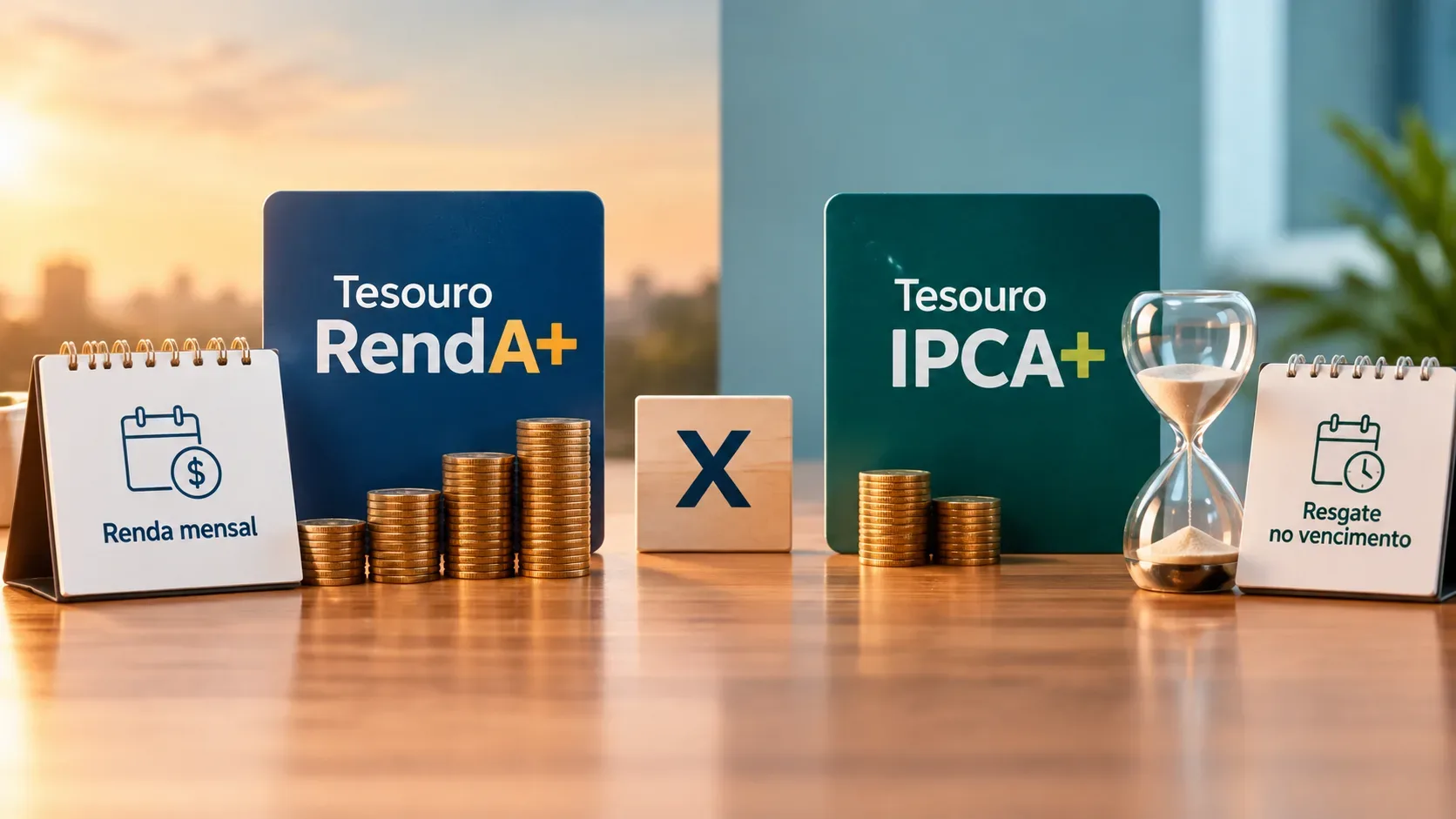
Tesouro RendA+ and Tesouro IPCA+ start from the same return logic: capital is adjusted for inflation measured by the IPCA and earns a real rate set at the time of purchase. The decisive difference is not the indexer but how and when the money is paid back to the investor. With Tesouro IPCA+ without semiannual coupons, the cash flow is concentrated in a single payment at maturity. RendA+ has an accumulation phase and, from the conversion date onward, makes 240 monthly payments over 20 years.
The difference in one sentence
If the goal is to build a lump sum for a specific date, Tesouro IPCA+ generally fits the objective better. If the goal is to turn accumulated savings into future monthly income for 20 years, RendA+ was designed for that cash-flow pattern.
| Aspect | Tesouro RendA+ | Tesouro IPCA+ |
|---|---|---|
| Contracted return | IPCA + real rate set at purchase | IPCA + real rate set at purchase |
| Accumulation phase | Yes, until the conversion date | Yes, until maturity |
| Payment structure | 240 monthly payments over 20 years | Single payment at maturity |
| Typical use | Supplement future income, especially in retirement | Medium- or long-term goal with a target date and lump sum |
| Early sale | After a 60-day holding period for each purchase, at market price | Available under Tesouro Direto liquidity rules, at market price |
| Risk of exiting early | The price may be above or below the contracted path; selling also dismantles part of the planned income stream | The price may be above or below the contracted path, changing the effective return |
Why do both track the IPCA but pay differently?
The indexer answers “how is the value updated?”; the cash-flow structure answers “when does the investor receive the money?”. These are different dimensions. Both securities combine inflation with a real interest rate. Their payment design, however, creates very different use cases.
With Tesouro IPCA+ (NTN-B Principal), there are no semiannual coupons. The investor receives the accumulated value at maturity if the security is held until that date. This product should not be confused with Tesouro IPCA+ with Semiannual Interest, which is a different security and pays coupons along the way. Tesouro Direto itself describes the principal-only IPCA+ as a simple cash-flow security with payment concentrated at the end.
With Tesouro RendA+ (NTN-B1), the structure was created for scheduled income. The security accumulates until the chosen conversion date. From that point, principal begins to be amortized in 240 monthly installments. The balance that has not yet been amortized continues to be updated according to the security's structure, including the IPCA and the contracted rate.
For RendA+, the “conversion date” is not the maturity date
This distinction prevents a common misunderstanding. The date associated with a RendA+ issue indicates the start of the income period, not the point at which the entire investment ends. Tesouro Direto's technical documentation states that the 240 amortizations begin on the conversion date and end 240 months later, on the maturity date.
In practice, an investor choosing RendA+ for a given date is choosing when the income stream should begin. Monthly payments then continue for 20 years. RendA+ is therefore not a lifetime annuity and does not pay out the entire balance on the first income date.
When Tesouro IPCA+ makes more sense
Tesouro IPCA+ without semiannual coupons is more consistent with a goal that requires a lump sum on a specific date: a home down payment, renovation, long-term project, wealth accumulation or another concentrated expense. The investor can align the maturity date with the goal horizon and, in principle, reduce the need to sell early.
This structure also simplifies reinvestment decisions: because there are no periodic payments before maturity, there is no need to decide every month what to do with received cash. On the other hand, it does not create monthly income by itself. An investor who wants to turn the final amount into a cash-flow stream will need to plan withdrawals or choose another product for the spending phase.
When RendA+ makes more sense
RendA+ is better aligned with a goal in which the investor wants to convert accumulated wealth into future monthly income. It can supplement retirement income because it already contains a 20-year payment schedule. This reduces the need to manually build a maturity ladder or sell fractions of a security every month.
The design also imposes a constraint: the income stream is temporary. If income is needed for more than 20 years, the plan must include other sources of funds. In addition, because each purchase has a 60-day holding period before it can be sold, the product should not be treated as an emergency reserve.
Daily liquidity does not eliminate mark-to-market risk
The Brazilian Treasury repurchases securities before maturity under the program's rules, but an early sale takes place at the market price of the day. This applies to IPCA+ and, after its specific holding period, to RendA+ as well. If market interest rates rise, the price of an existing security may fall; if market rates fall, its price may rise.
Therefore, “IPCA + real rate” does not mean that every early sale will deliver exactly the rate contracted at purchase. The contracted return is the reference for the security's scheduled cash flow. By exiting early, the investor replaces that path with the market price available at that moment.
Custody fees: an important difference
Under the current Tesouro Direto rules, the B3 custody fee for Tesouro IPCA+ follows the standard rule of 0.2% per year on the value of the securities, subject to the program's charging conditions. RendA+ has a differentiated structure: custody is charged on early redemptions or on monthly income above the exemption threshold. For investors who carry the security through the full payment stream, monthly income of up to six minimum wages is exempt; the amount above the threshold follows the rule published by Tesouro Direto.
Because fees, limits and operational conditions may change, investors should check the official Tesouro Direto rules and regulations page before making a decision.
How to choose between RendA+ and IPCA+
- Define the type of exit. Do you need monthly income or a lump sum on a specific date?
- Match the term to the goal. The better the security matches the horizon, the lower the chance of depending on an early sale.
- Do not compare only the displayed rate. Different maturities and cash flows change both mark-to-market sensitivity and how the money can be used.
- Keep liquidity elsewhere. Long-term goals do not replace an emergency reserve.
- Plan for the period after the income stream. RendA+ pays for 20 years; the plan should not assume lifetime income.
Decision summary
Both securities can protect purchasing power when used according to their structure because their return is linked to the IPCA plus a real rate. Tesouro IPCA+ concentrates the value at maturity and is better suited to lump-sum goals. Tesouro RendA+ turns the final phase of the investment into 240 monthly payments and is better suited to scheduled-income goals. The decision, therefore, is not abstractly “which one yields more”, but which cash-flow structure best solves the goal and reduces the need to sell at the wrong time.
Official sources
- Tesouro Direto — Tesouro RendA+
- Tesouro Direto — Tesouro IPCA+
- Tesouro Direto — Tesouro RendA+ methodology and cash flow
- Tesouro Direto — rules, custody fees, liquidity and early sales
Informational content only. This is not individualized investment advice.