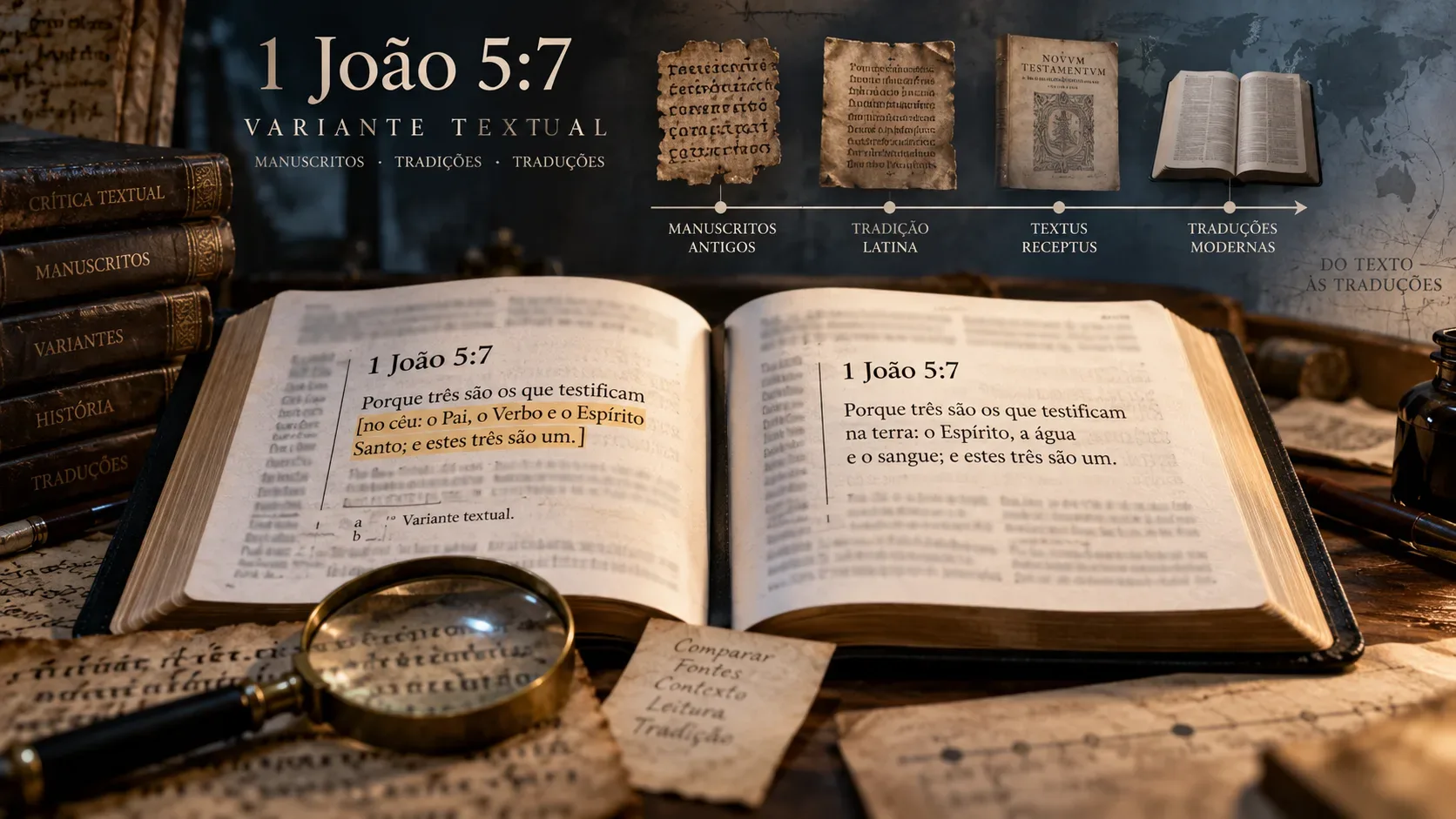
If one Bible includes in 1 John 5:7 a reference to the Father, the Word, and the Holy Spirit while another does not, the difference is not simply a matter of translation style. It depends mainly on which form of the Greek text and which manuscript traditions the edition follows. The longer reading is known as the Comma Johanneum, a textual variant in 1 John 5:7-8 that gained wide circulation in part of the Latin tradition and later in printed editions of the New Testament.
Short answer: why is the phrase in some Bibles but not others?
Translations that retain the wording about three witnesses “in heaven” generally follow a textual tradition that preserved this longer reading in early printed editions. Many modern translations, by contrast, are based on critical editions of the Greek New Testament that give priority to the older and broader body of available evidence; in that evidence, the longer reading is not part of the main text. As a result, some versions omit it, some place it in a footnote, and others keep it in the text.
The key point is that this is not merely a case of translating the same Greek words differently. Before translation begins, 1 John 5:7-8 raises a textual question: which words belong to the earliest recoverable form of the passage?
What the Comma Johanneum is
Comma Johanneum is the traditional name for the addition that mentions three heavenly witnesses — the Father, the Word, and the Holy Spirit — within 1 John 5:7-8. The shorter form still speaks of three witnesses, but identifies them as the Spirit, the water, and the blood.
The difference is obvious when two Bibles are placed side by side. In Portuguese, for example, the Almeida Revista e Corrigida 2009 keeps the longer reading in the text, while the Nova Versão Internacional uses the shorter form and records the variant in a note. The Nova Versão Transformadora likewise keeps the shorter form in the main text and notes that a few late manuscripts add the longer wording. These differences can be checked directly in Bible Gateway comparisons: NVI and ARC and a broader Portuguese comparison.
Why manuscripts matter so much
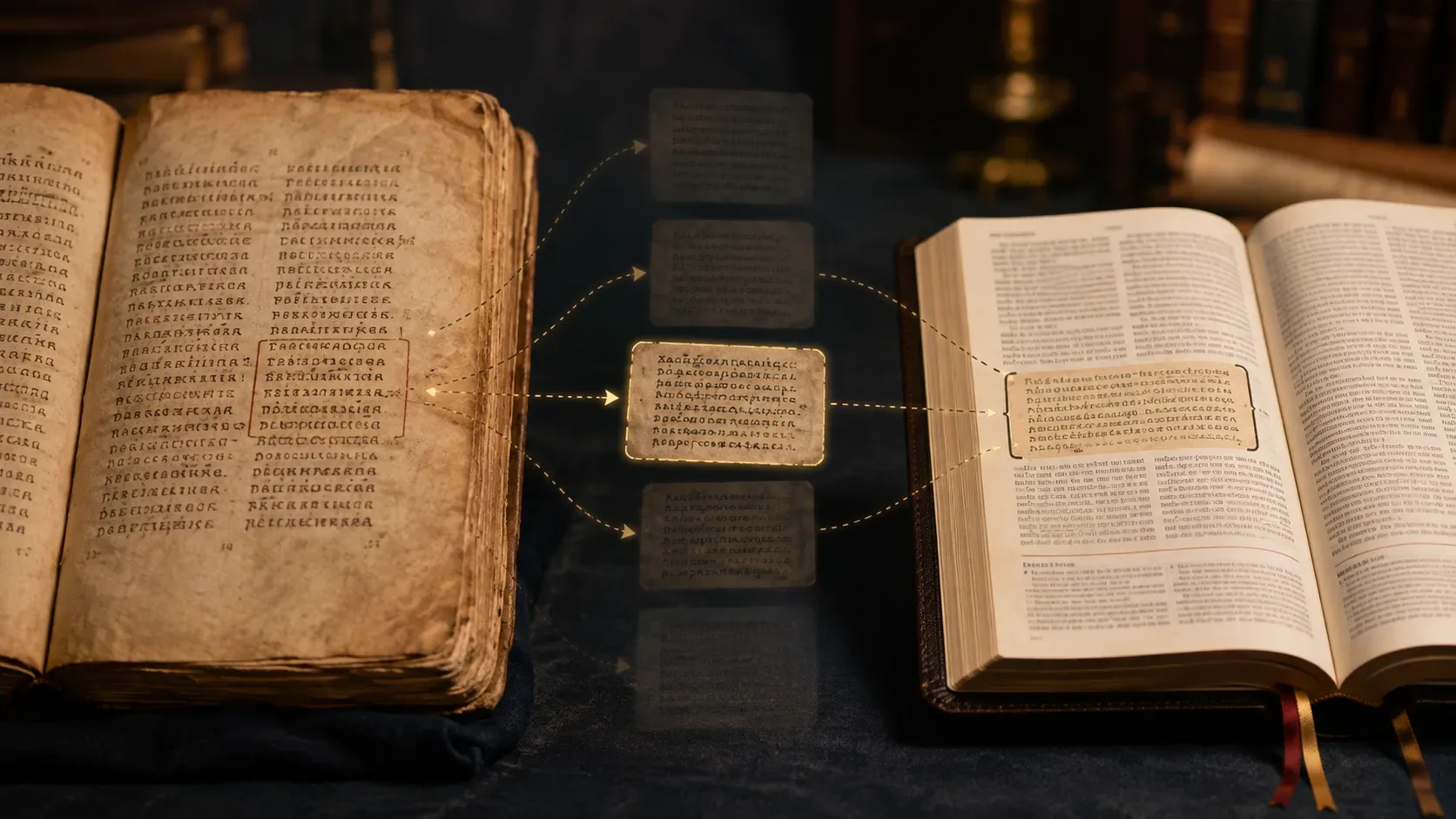
Before printing, the New Testament circulated for centuries in handwritten copies. As with any work transmitted in this way, differences arose between copies: substitutions, transpositions, omissions, repetitions, and sometimes explanatory expansions. Textual criticism compares these witnesses in order to estimate the earliest recoverable form of a passage.
For the Comma Johanneum, the issue is especially clear because Greek support for the longer reading is late and limited. The Center for the Study of New Testament Manuscripts (CSNTM) notes that the formula was absent from the Greek manuscripts available to Erasmus in his first editions and that the Greek witnesses preserving it are few and late; in some cases, the reading was added later in the margin. CSNTM documents one manuscript whose main text has the shorter form while a later hand added material in the margin. See Manuscripts 101 and The Comma Johanneum in an Overlooked Manuscript.
This helps explain why modern critical editors do not assign the longer phrase the same documentary weight as the shorter reading. The decision does not rest on the age of a single manuscript alone, but on the combined evidence of date, geographical distribution, independence of witnesses, and the most plausible explanation for how the variants arose.
How the Latin tradition enters the story
The longer reading had a stronger history in the Latin tradition than in the Greek one. During medieval transmission, it came to appear in part of the Vulgate manuscript and printed tradition. This helps explain why readers and theologians in the early age of printing were already familiar with the Trinitarian wording even when it was absent from Greek manuscripts available to some editors.
The tension between Latin tradition and Greek evidence made 1 John 5:7-8 a prominent case in the sixteenth century. The controversy did not begin with modern translations: it was already active when printed Greek New Testaments were first being produced and compared systematically with the Vulgate.
Erasmus: 1516, 1519, and the 1522 edition
Erasmus of Rotterdam published his first Greek New Testament in 1516 and a second edition in 1519. In both, the longer reading in 1 John 5:7-8 was absent from the Greek text because it was not found in the Greek manuscripts he had available. In his third edition, published in 1522, Erasmus included the passage after gaining access to a Greek manuscript that contained it.
A popular story says that Erasmus promised to print the passage if anyone could produce a single Greek manuscript and that a manuscript was then manufactured solely to force him to honor that promise. Research by Henk Jan de Jonge has shown that there is no secure documentary basis for treating that “promise” as an established fact. The real episode is more nuanced: Erasmus stated that he would have used the reading had he found Greek support, and he later included it. De Jonge’s classic study is available as Erasmus and the Comma Johanneum. A later academic discussion likewise warns against the simplified promise story: Biblical Criticism in Early Modern Europe.
From Erasmus to the Textus Receptus
Erasmus’s editions influenced other printed Greek New Testaments in the sixteenth century. The longer reading remained in the stream of printed texts later associated with the name Textus Receptus. Translations tied to that printed tradition therefore inherited the Comma Johanneum in the main text.
This helps explain why the King James Version in English and certain traditional Almeida revisions in Portuguese include the longer wording. Translations produced from modern critical Greek editions, by contrast, usually follow the shorter form, sometimes preserving the longer wording only in a footnote.
Why footnotes, brackets, and editorial treatment differ
Two Bibles may agree on the underlying textual evidence and still present it differently. Editorial policy matters too. A publisher may choose to:
- retain the longer reading in the main text and explain in a note that it is absent from early witnesses;
- use the shorter form in the main text and record the longer reading in a footnote;
- use brackets to signal disputed textual status;
- explain the text base in the introduction without giving a long note at every variant.
So “is it there or not?” is not the only useful question. It also matters where the variant is shown and how the edition explains its decision.
A simple timeline of the variant
| Stage | What happens | Effect on 1 John 5:7-8 |
|---|---|---|
| Early Greek tradition | The earliest known Greek witnesses contain the shorter form. | The formula about the Father, Word, and Holy Spirit is not part of the main text in these witnesses. |
| Medieval Latin tradition | The longer reading gains circulation in part of the Latin transmission. | The phrase becomes familiar in Western Christianity. |
| 1516 and 1519 | Erasmus publishes the first two editions of his New Testament. | The Comma is absent from the Greek text of these editions. |
| 1522 | Erasmus includes the longer reading in his third edition. | The variant gains stronger circulation in an influential printed line. |
| 16th-17th centuries | Later editions consolidate the tradition later called the Textus Receptus. | The longer reading enters influential translations tied to that base. |
| Modern critical editions | The Greek text is reconstructed using a much larger body of manuscripts and other witnesses. | The shorter form appears in the main text; the longer one may be placed in the apparatus or translation notes. |
What the difference between Bibles actually means
The variation in 1 John 5:7 does not by itself mean that one version “removed the Trinity,” nor does it prove bad faith on the part of a version that retains the phrase. It shows that translations can rely on different textual traditions and different editorial policies.
The textual question is specific: was the longer formulation part of the earliest recoverable text of 1 John? The dominant judgment in modern critical editions is that it was not. That conclusion is separate from a theological debate about the doctrine of the Trinity, which does not depend exclusively on this verse and is argued from a much wider set of passages.
How to compare translations without turning textual criticism into a confessional dispute
- Read the footnote. It often tells you whether manuscripts add or omit the reading.
- Check the translation preface. Look for information about the Greek text used.
- Compare more than one family of versions. A traditional translation and a modern one make the difference easy to see.
- Separate textual base from translation style. Two versions can differ in literalness while still using the same critical Greek text.
- Do not infer motive from omission alone. In textual criticism, leaving a later reading out of the main text can be precisely the result of following witnesses judged earlier.
In summary
1 John 5:7 differs across Bibles because the Comma Johanneum had an uneven textual history. The longer reading became prominent in the Latin tradition and in printed editions associated with the Textus Receptus, while the older Greek tradition supports the shorter form. Traditional translations may therefore retain the phrase in the text, whereas modern translations may move it to a note or omit it from the main text.
To understand any particular edition, the best approach is to examine three things together: the textual base, the variant note, and the translation’s editorial policy. That explains the difference without turning a question of manuscript transmission into an automatic accusation against a Bible or a religious tradition.