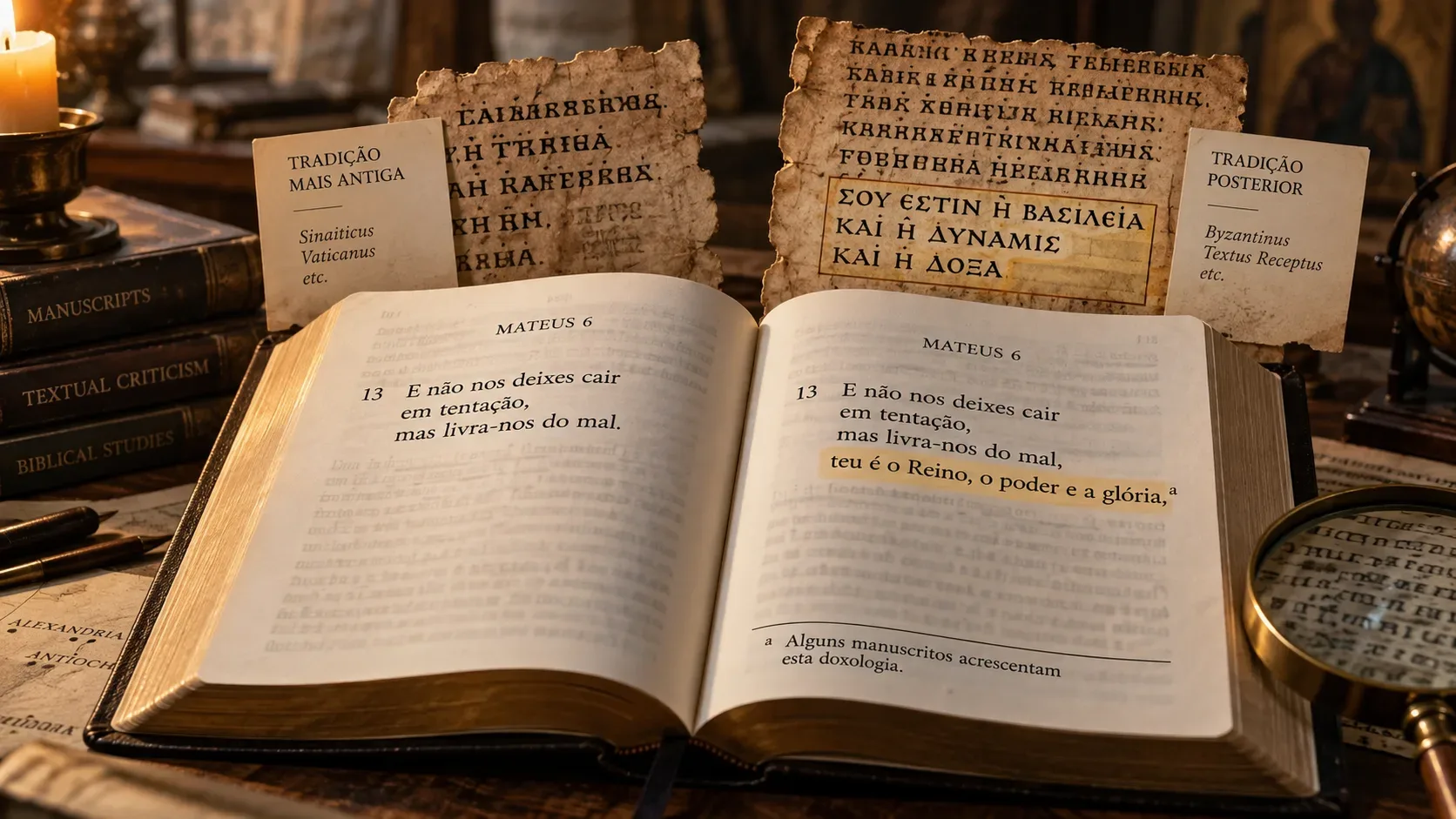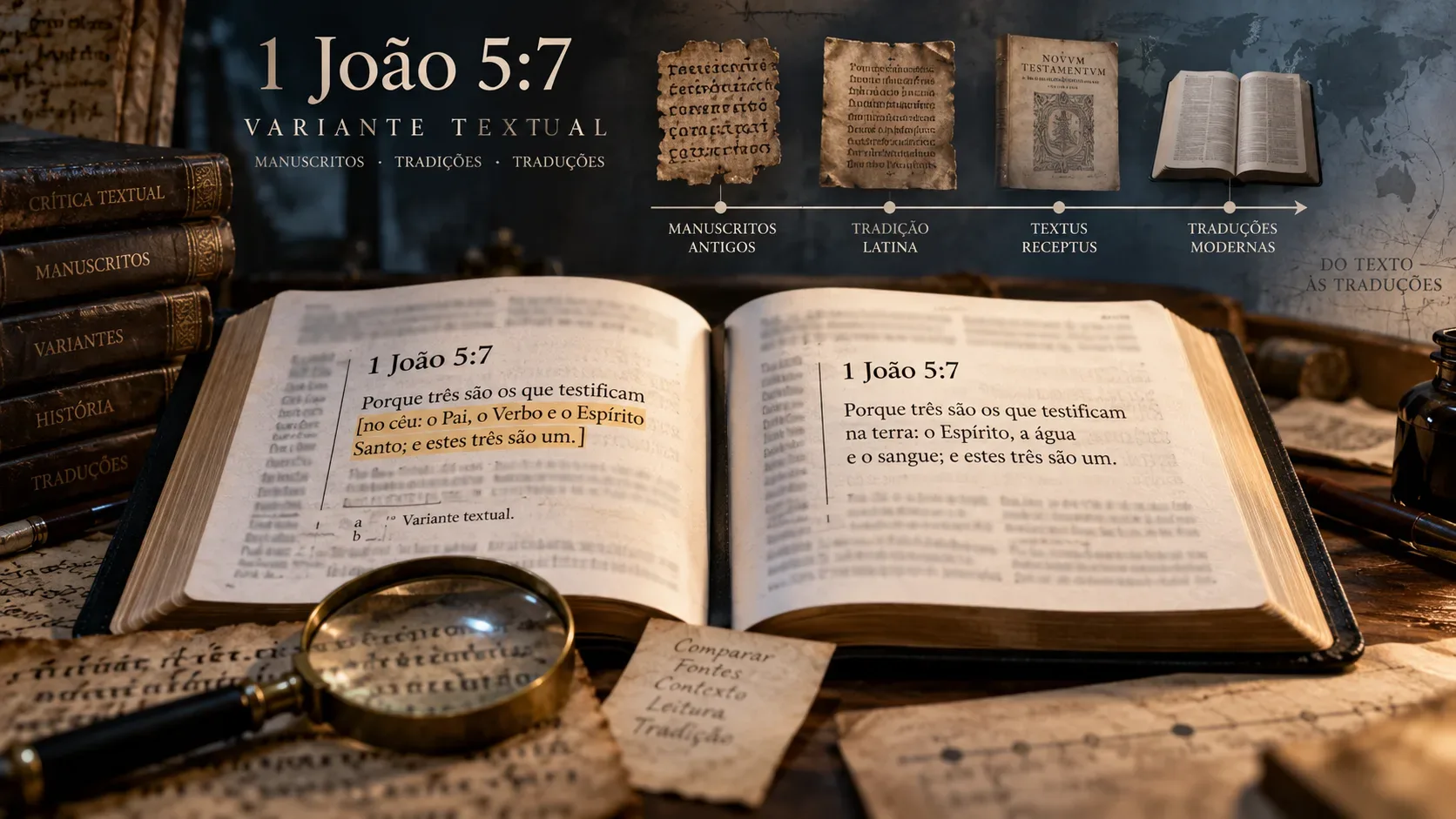
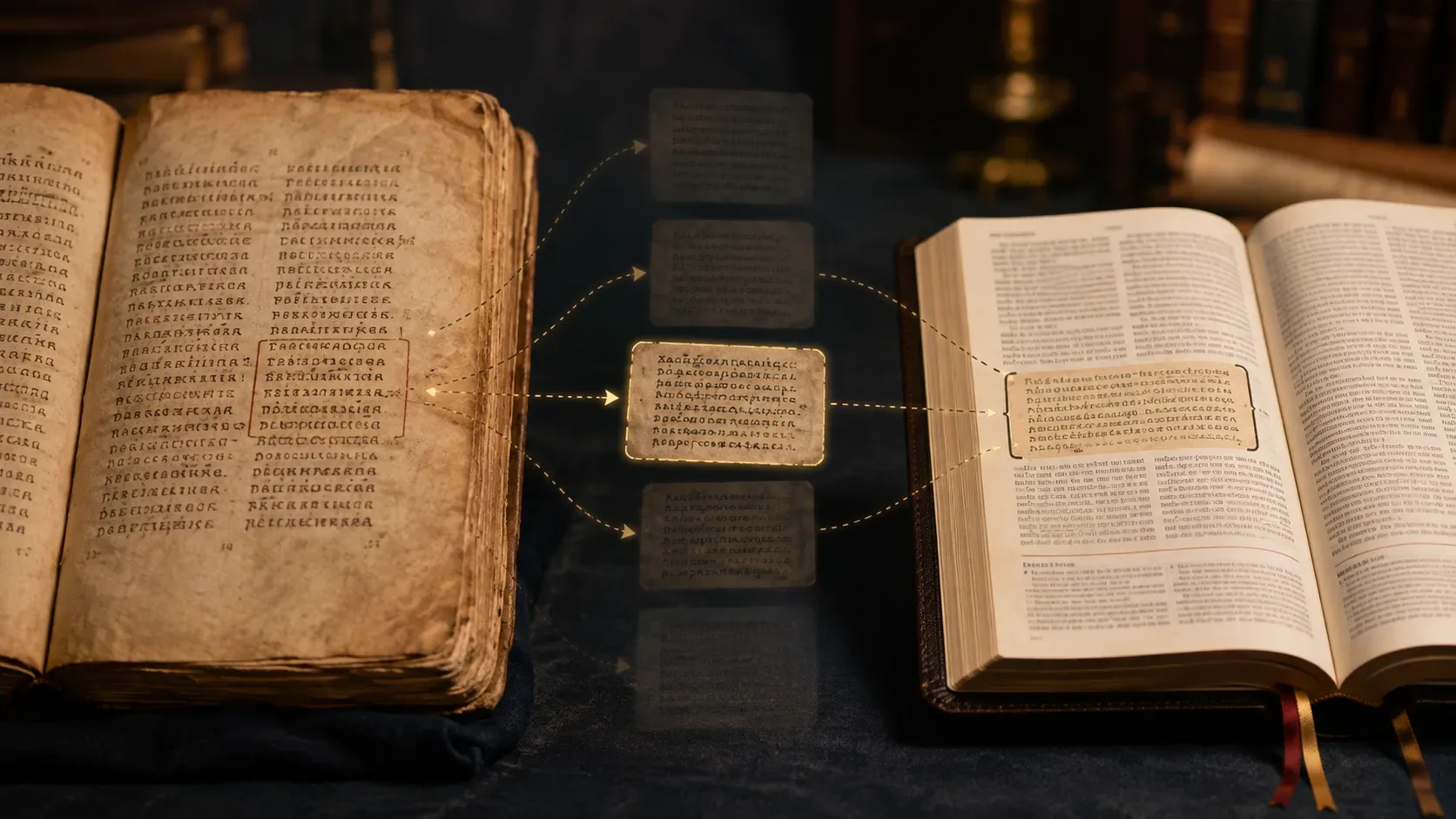
When John 7:53–8:11 appears in brackets, with a footnote, or with another editorial marker, the translation is alerting readers that both the presence and the location of this passage vary in the manuscript tradition. The question is not whether the story is well known or important in Christian tradition, but whether it belonged to the earliest recoverable form of the Gospel of John. The dominant view in contemporary textual criticism is that the so-called Pericope Adulterae was not originally part of John’s text, even though it was preserved and transmitted by many later manuscripts.
What brackets and notes are meant to say
Brackets, footnotes, and notices such as “the earliest manuscripts do not include this passage” are tools of editorial transparency. They allow a traditionally familiar passage to remain visible in the biblical text while informing readers that its textual evidence differs from that of passages with a more stable transmission history.
The signal varies by edition. The Portuguese NIV, for example, notes that some manuscripts do not include John 7:53–8:11 and that others move the verses to different locations. In English, the NIV and ESV likewise flag the unit and mention omission or alternative placement. The NET prints the section in double brackets and explains that the mark indicates it was most likely not part of the original text of John, while still preserving it because of its importance in the history of transmission.
Which manuscripts are at the center of the issue
The most frequently cited evidence begins with early witnesses to John that move directly from 7:52 to 8:12 without the story of the woman accused of adultery. These include Papyrus 66, Papyrus 75, Codex Sinaiticus, and Codex Vaticanus. The NET textual note lists these alongside additional witnesses to omission.
The passage does appear in later manuscripts. Cambridge University Library describes Codex Bezae, dated to about 400 CE, as the oldest known manuscript to include the pericope. That is why the issue is not simply “the text exists” versus “the text does not exist”: the story has a long transmission history, but the chronological and geographical distribution of the witnesses matters when reconstructing the earliest text.
A map of the documented locations of the pericope
One of the most useful facts behind modern translation notes is that the passage does not always occupy the same location. The CSNTM lists several documented placements:
| Location | Documented example | What it shows |
|---|---|---|
| After John 7:52 | Traditional location in many later manuscripts | This is the placement by which the passage became familiar in printed Bibles. |
| After John 7:36 | Codex 225 | The unit circulated at another point within the same chapter. |
| After John 7:44 | Some Georgian manuscripts | There are also relocations within the sequence of John 7. |
| After John 8:12 | Codex 115 | Some scribes placed it after the point where other witnesses resume the text. |
| At the end of John, after 21:25 | Family f1 and some Armenian manuscripts | The story can appear as a preserved unit outside its traditional location. |
| After Luke 21:38 | Family f13 | The passage even circulated within another Gospel. |
| After Luke 24:53 | Corrector of manuscript 1333 | There is evidence of its insertion at the end of Luke. |
This mobility matters because a paragraph that belongs to the original sequence of a work would normally be expected to have a stable location in transmission. Multiple locations are compatible with the idea that the story circulated with some independence before becoming fixed, in most later copies, after John 7:52. This is an argument about textual history; by itself it does not decide whether the episode preserves an early tradition about Jesus.
Why a manuscript can include the passage and still signal uncertainty
The twelfth-century manuscript GA 807 is a useful example showing that “included” does not necessarily mean “the textual issue was unknown.” In its discussion of a digitized copy, the CSNTM notes that the manuscript contains the pericope but also has reading signs and an instruction connected with liturgical use. The markings are interpreted as evidence that readers and scribes could preserve the passage while also being aware that its textual status was unusual.
That combination helps explain the practice of many modern Bibles: keeping the passage because of its long history of reading and reception does not prevent editors from telling readers that the oldest witnesses and the variable placement create a textual-critical question.
Why translations do not treat John 7:53–8:11 in exactly the same way
Translations differ because they use different editorial policies and textual bases. Editions that closely follow modern critical texts tend to mark the unit with brackets, a note, or another warning. Editions connected with textual traditions in which the passage is already part of the main text may print it without the same visual emphasis. Presentation also varies: one Bible may retain the passage in its traditional location and explain the variant in a footnote; another may use brackets; another may discuss the issue in an introduction or apparatus.
For that reason, the fact that the passage is printed in the body of a Bible does not, by itself, mean the edition denies the textual problem; and brackets do not mean an editor is simply “erasing” the story. The marker tells readers that an editorial decision has been made in light of manuscript evidence.
What textual criticism can conclude — and what it cannot conclude by itself
On the combined evidence of omission in early witnesses, alternative locations, and the broader transmission pattern, most New Testament scholars conclude that John 7:53–8:11 was not part of the earliest form of the Gospel of John. The CSNTM itself summarizes that judgment as the majority view.
That conclusion is narrower than it can sound. Textual criticism tries to reconstruct the earliest recoverable wording and placement of a text from surviving witnesses. By itself, it does not prove that the episode was invented, nor does it settle how different Christian traditions should judge its canonicity, inspiration, or liturgical use. Nor does it make later transmission simply an “error”: later manuscripts are precisely the evidence for how communities copied, read, and preserved the text across centuries.
How to read the note in your Bible
- Check whether the note mentions omission. That means some witnesses do not contain the unit at that point.
- Check whether it mentions alternative locations. In John 7:53–8:11, this is especially important because the passage appears in more than one location in the manuscript tradition.
- Notice the edition’s method. Brackets, a footnote, or no visible marker can reflect different editorial choices made in response to the same general body of evidence.
So when a Bible brackets John 7:53–8:11 or adds a note, the editorial purpose is to flag an unusual transmission history. Early witnesses that omit the passage and manuscripts that relocate it explain why the unit receives different treatment from one translation to another — without requiring the textual discussion to become an automatic theological verdict.