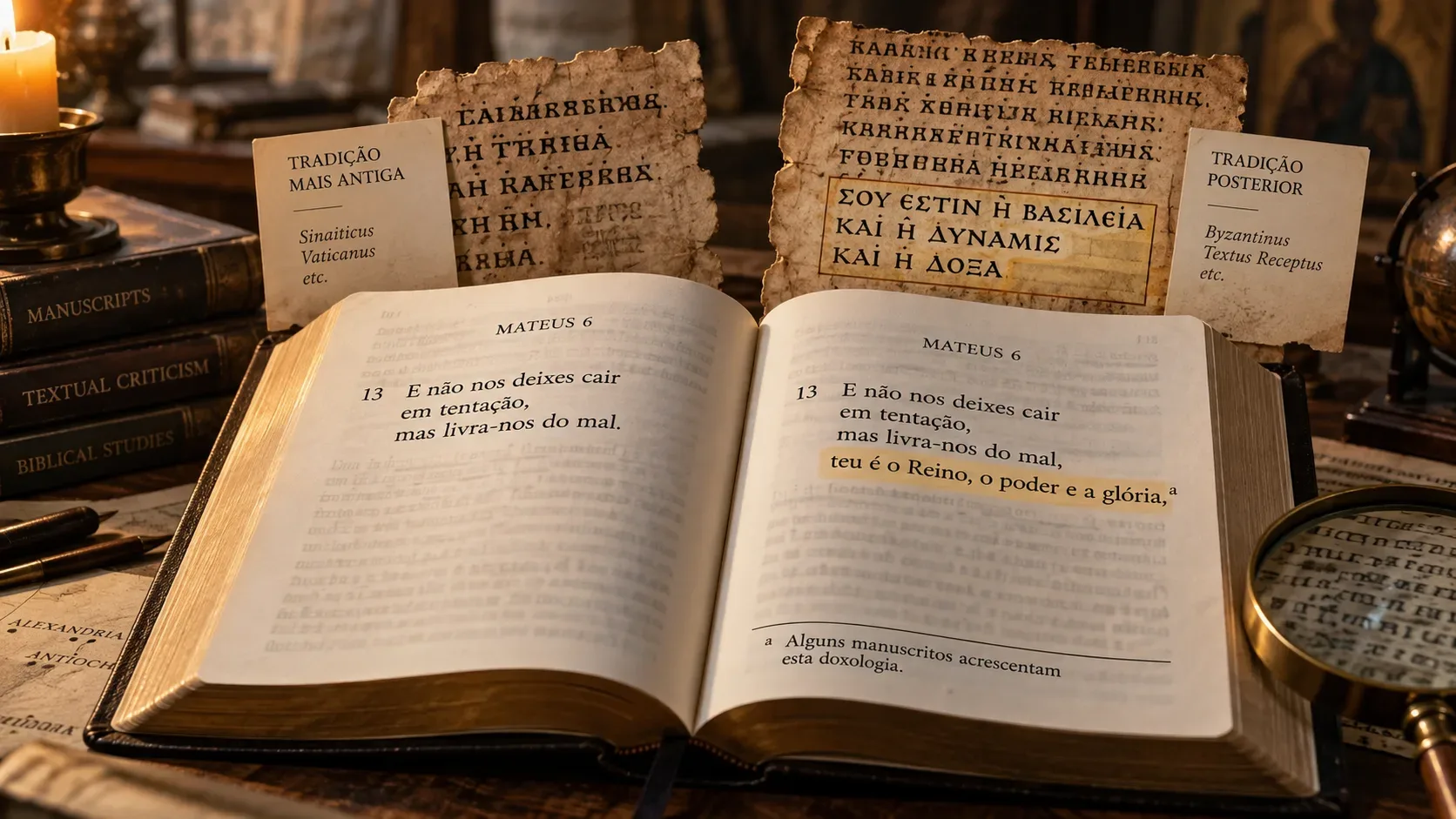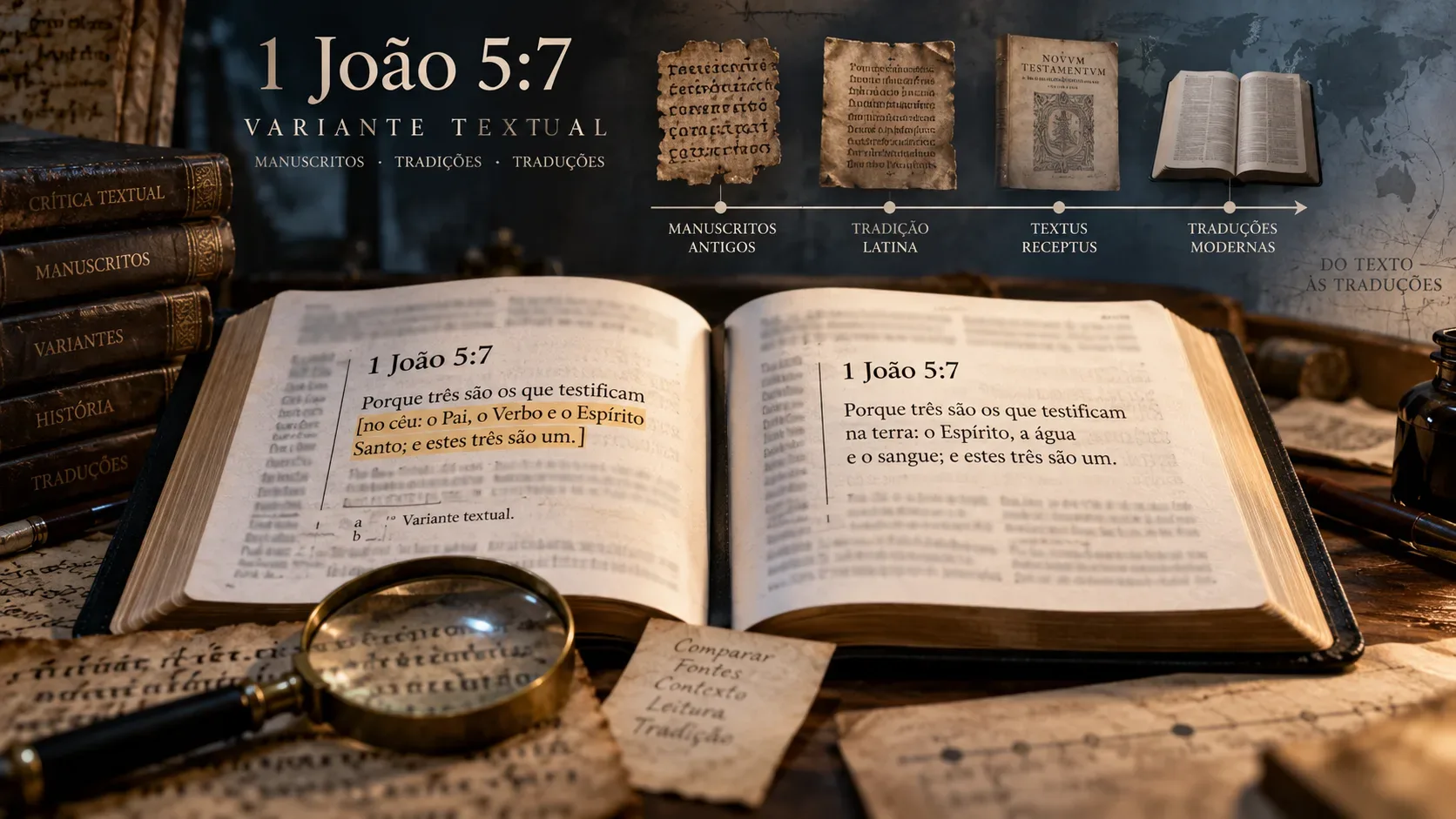

Acts 8:37 did not simply “disappear” from some Bibles. What changes from one edition to another is the editorial decision made in response to an ancient textual variant. The sentence in which Philip makes faith a condition for baptism and the eunuch confesses Jesus Christ as the Son of God appears in part of the manuscript tradition and in early Christian testimony, but it is absent from important surviving Greek manuscripts and from the main text of modern critical editions of the New Testament.
That is why a translation may print the verse normally, place it in brackets, move it to a footnote, or retain only the number 37 with no running text. Those solutions do not by themselves mean that one Bible “removed” a teaching or that another deliberately “added” doctrine. They show how each edition communicates a real difference among textual witnesses.
Short answer: why does Acts 8:37 appear, disappear, or move to a note?
In Acts 8, Philip explains Isaiah to the Ethiopian eunuch. In verse 36, the traveler sees water and asks what prevents him from being baptized. In some textual traditions, a short exchange follows: Philip says baptism is possible if there is wholehearted faith, and the eunuch confesses faith in Jesus Christ. In other witnesses, the narrative moves directly from the question in verse 36 to the order to stop the chariot and the baptism in verse 38.
The decisive point for current critical editions is that the passage is absent from a series of relevant Greek witnesses. The textual note in the NET Bible lists, among the witnesses without the verse, papyri P45 and P74 and codices such as Sinaiticus (א), Alexandrinus (A), Vaticanus (B), and Ephraemi Rescriptus (C). The Greek Nestle-Aland 28 edition does not include the content of 8:37 in its running text.
What exactly is the Acts 8:37 variant?
The variant is not merely a single word or a spelling difference. It is a short unit of dialogue inserted between Acts 8:36 and 8:38. In content, it has two elements:
- Philip presents sincere faith as the condition for baptism;
- the eunuch responds with a Christological confession that Jesus Christ is the Son of God.
The wording is not identical in every witness that preserves it. Minor variations occur, which is common in manuscript transmission. So when a note says “some manuscripts add” or “later manuscripts include,” it is summarizing a textual situation rather than claiming that every copy containing the verse is identical.
The manuscript evidence: absence from major early surviving witnesses
Textual criticism does not simply count how many manuscripts have or lack a reading. It also weighs age, textual character, geographical distribution, and genealogical relationships among witnesses. In Acts 8:37, the issue is especially visible because the dialogue is missing from several important witnesses.
| Witness | Approximate date | Status at Acts 8:37 |
|---|---|---|
| P45 | 3rd century | does not contain the verse |
| Codex Sinaiticus (א) | 4th century | does not contain the verse |
| Codex Vaticanus (B) | 4th century | does not contain the verse |
| Codex Alexandrinus (A) | 5th century | does not contain the verse |
| Codex Ephraemi Rescriptus (C) | 5th century | does not contain the verse |
| Codex Laudianus (E/08) | 6th century | contains the variant |
The CSNTM dates Codex Laudianus, a Greek-Latin manuscript of Acts, to the sixth century. It is among the earliest surviving Greek witnesses to preserve the passage. The verse later appears in some additional manuscripts and in traditions that influenced later printed editions.
This helps explain why editors following the modern critical text normally do not regard 8:37 as part of the earliest recoverable text of Acts. Even so, the history of the variant is more interesting than the simple claim that it “appeared late” would suggest.
The confession is ancient: Irenaeus knows the tradition in the second century
One important fact prevents an oversimplified story: the idea—and part of the wording—of Acts 8:37 circulated long before Codex Laudianus. Around the end of the second century, Irenaeus, in Against Heresies 3.12.8, refers to the eunuch confessing that Jesus Christ is the Son of God while commenting on Philip’s encounter.
This patristic evidence shows that the confession was not invented in the sixth century. It was already known in the early church. But a church father quoting or paraphrasing a tradition does not automatically prove that the sentence stood in the original text of Acts. Patristic citations may reflect a local textual form, liturgical memory, catechetical harmonization, or a reading tradition circulating in parallel.
So two statements can be true at once: the confession is very old in Christian tradition, and the major surviving early Greek witnesses to Acts do not have it at this point in the text.
Why does the sentence fit a baptism scene so naturally?
The fit is obvious. The eunuch asks what prevents his baptism; the variant supplies an explicit answer about faith and then a profession of faith before the act. This resembles catechetical and baptismal practices known in early Christianity, in which a confession precedes baptism.
That natural fit can be read in two ways. Defenders of the traditional reading may see it as the narrative’s original continuity. Modern textual criticism, however, considers it plausible that a confession known from church practice was incorporated into the story to make explicit a condition already implied by the context. Manuscript evidence—not merely the theological appropriateness of the sentence—is what drives the editorial judgment.
Why is there still a “verse 37” when the text is omitted?
Verse numbers were not part of the New Testament autographs. A numbering system similar to the one used today was introduced by Robert Estienne, also known as Stephanus, in his 1551 Greek New Testament. Tyndale House explains the history of this division.
In the printed tradition that became established in the sixteenth and seventeenth centuries, Acts 8:37 had a verse number. When later editions preferred a form of the text that did not contain the passage, removing or renumbering every later verse would have created major incompatibility with concordances, commentaries, liturgies, and existing references.
That is why a Bible may show 8:36 and then 8:38, or display “[37]” followed by a note. The number acts as a historical reference marker: it shows where the variant known from other editions belongs.
What brackets, footnotes, and skipped numbers mean
These editorial devices have different functions and should be read carefully:
- Normal running text: the edition chooses to retain the traditional reading in the text presented to the reader.
- Bracketed text: the edition prints the passage but signals textual uncertainty or a special textual status.
- Footnote only: the main text follows the reading without 8:37, while the note preserves the variant for consultation.
- Jump from 36 to 38: the edition keeps traditional verse numbering but does not print the passage in the running text.
Brackets do not mean “false text,” and a footnote does not mean “forbidden text.” They are ways of making the transmission history visible without completely interrupting the reading.
How several Portuguese translations present Acts 8:37
The exact display can vary by print edition, revision, and digital platform. It is therefore important to compare the actual edition in your hands. In the online examples consulted:
| Translation/edition | How Acts 8:37 appears | What the reader should notice |
|---|---|---|
| Almeida Revista e Corrigida (ARC) | in the running text | retains the traditional reading as a regular verse |
| Almeida Corrigida Fiel (ACF) | in the running text | keeps the received traditional form |
| Almeida Revista e Atualizada (ARA) | in brackets | prints the passage while marking its textual status |
| Nova Almeida Atualizada (NAA) | in brackets | keeps the reading visible while signaling that it is not part of the main base text |
| Nova Versão Internacional (NVI) | treatment varies by edition/platform; some print it with a note while other presentations move it to a note | the editorial note of the specific edition matters |
The Brazilian Bible Society displays Acts 8:37 in brackets in the NAA, and the ARA also prints it in brackets. The Almeida Revista e Corrigida preserves the verse in the flow of the text. Digital environments may render notes differently, which is why comparisons should identify the revision and platform rather than relying only on the translation acronym.
“Omitted” and “different textual tradition” are not the same claim
Simply saying that a translation “omitted a verse” can suggest the wrong picture: that there was one undisputed text and someone later decided to erase a line. The historical situation is different. Surviving manuscripts disagree, and editors evaluate which reading best explains the origin of the others.
Translations based on the Textus Receptus or closely related traditions tend to keep 8:37 in the running text. Translations based on contemporary critical editions tend to mark it, move it, or leave it out of the main text. In either case, a responsible edition can inform readers through a note.
A short chronology of the variant
- 2nd century: Irenaeus knows the eunuch’s confession, showing that the tradition is ancient.
- 3rd–5th centuries: important surviving Greek witnesses to Acts, including P45, Sinaiticus, Vaticanus, Alexandrinus, and Ephraemi, do not contain the verse.
- 6th century: Codex Laudianus preserves the passage in Greek and Latin.
- 16th century: the passage stands in the printed Greek tradition that contributes to the Textus Receptus; in 1551 Estienne’s verse system fixes the reference “8:37.”
- Modern era: critical editions such as Nestle-Aland prefer the text without the passage, while translations vary among running text, brackets, and notes.
How to read your Bible’s note without turning the variant into a trust dispute
When you encounter a note at Acts 8:37, look for three things. First, what base text the translation uses. Second, whether the note speaks of “some,” “many,” “earlier,” or “later” manuscripts; those expressions summarize the evidence and may vary with editorial policy. Third, where the translation places the variant: in the text, in brackets, or in a footnote.
It is also useful to separate the textual question from the theological question. The idea that faith in Christ is related to baptism does not depend on Acts 8:37 alone; the New Testament discusses faith, confession, and baptism in several other contexts. The specific historical question here is: did this sentence belong to the earliest form of Acts that we can reconstruct?
The dominant answer in modern critical editions is probably not. At the same time, Irenaeus shows that the confession is a very early tradition, older than the complete Greek manuscripts of Acts that survive today. That combination—ancient tradition, uneven manuscript evidence, and different editorial choices—is exactly why Acts 8:37 appears so differently across Bibles.