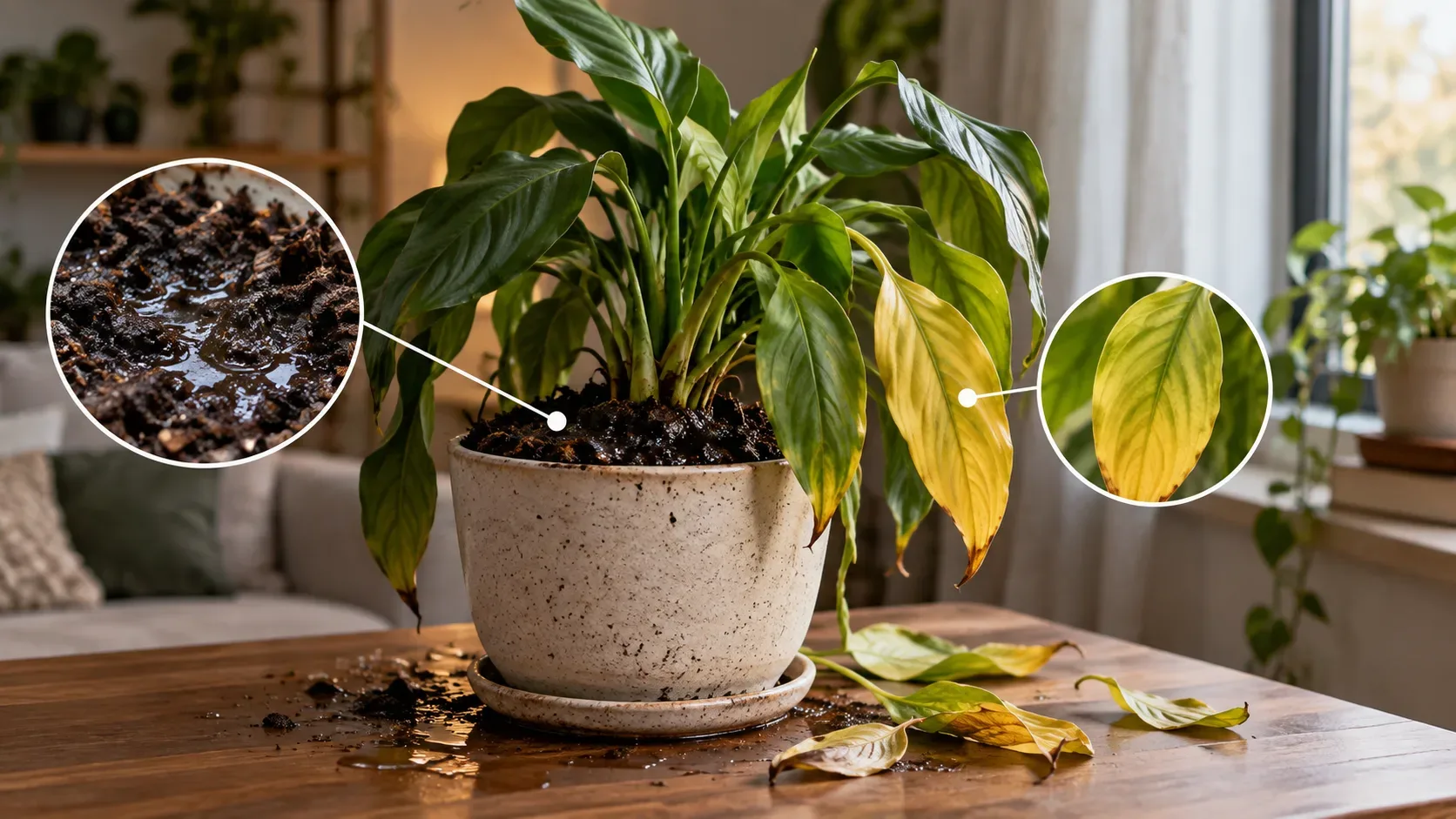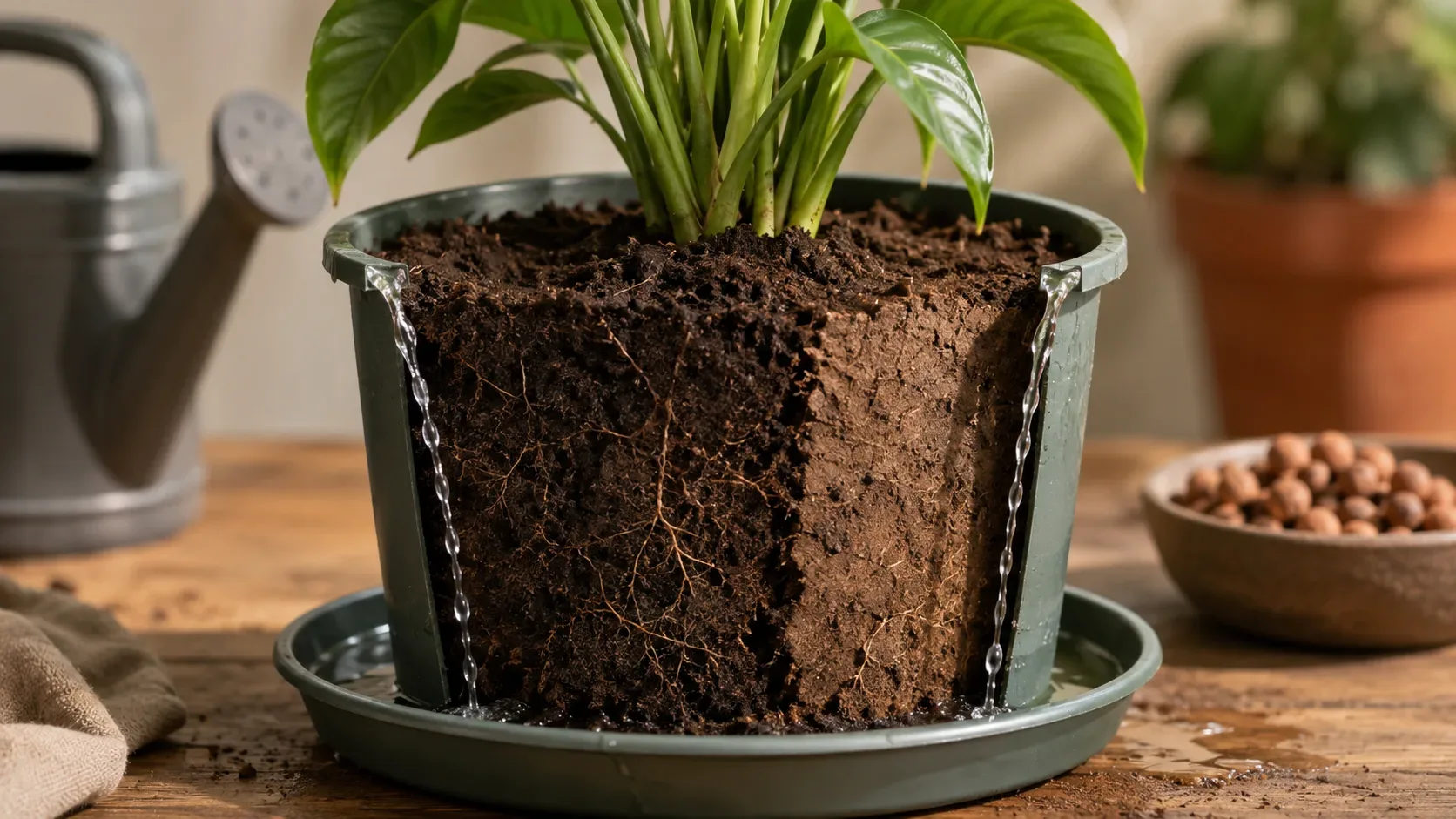
You water, the water appears almost immediately in the dish or comes out through the holes in the vase and everything seems to be resolved. Minutes later, however, just check a few centimeters below the surface to find a still dry lump.
In this case, the drainage speed can be deceiving. Water coming out the bottom does not necessarily mean that the entire substrate has been hydrated. Very dry mixtures, especially those containing organic materials such as peat and bark, may have difficulty absorbing water again. Virginia Tech rightly describes excessively rapid drainage, the still light pot and the presence of dry areas inside as signs of a substrate that has not rehydrated adequately.
What does it mean for a substrate to become hydrophobic
Hydrophobic, in this context, is the substrate that has difficulty being wetted by water. Instead of spreading through the pores and moistening the root ball relatively evenly, water finds preferential paths and passes through certain regions while others remain dry.
This behavior is well documented in organic materials used in horticulture. The University of Connecticut even recommends moistening potting mixes before planting because dry organic compounds can become water repellent and create uneven moisture levels in the root zone.
Sphagnum peat is one of the most studied examples. Research into its physical properties shows that drying modifies water retention, material shrinkage and wettability. In other words, a substrate that was once uniformly moist may behave differently after intense drying.
The effect may also become more evident when the dry lump shrinks and moves away from the vessel wall. The water then finds a low-resistance passage between the lump and the container, quickly runs down that side and exits through the drainage hole without necessarily reaching the center. Virginia Tech itself includes moving the substrate away from the edges of the pot among signs of dryness.
How to differentiate hydrophobicity from simply rapid drainage
A well-aerated substrate can drain water quickly and still function perfectly. Mixtures with coarser particles, such as bark and perlite, naturally tend to drain more than finer mixtures. The diagnosis, therefore, should not be made just by looking at the plate.
Look for the combination of signs:
- water starts to come out the bottom a few moments after watering, but the pot remains surprisingly light;
- the surface darkens, while the center of the clod remains light, dry or brittle;
- there are very humid areas alongside completely dry pockets;
- the clod retracted and left a gap next to the wall of the vessel;
- the plant shows signs compatible with a lack of water, even when it receives apparently abundant watering.
The weight of the vessel is especially useful. If a lot of water was applied, but the container barely gained weight, a considerable part of that water was probably not stored in the substrate. Virginia Tech recommends lifting the pot after watering as one of the ways to detect the problem.
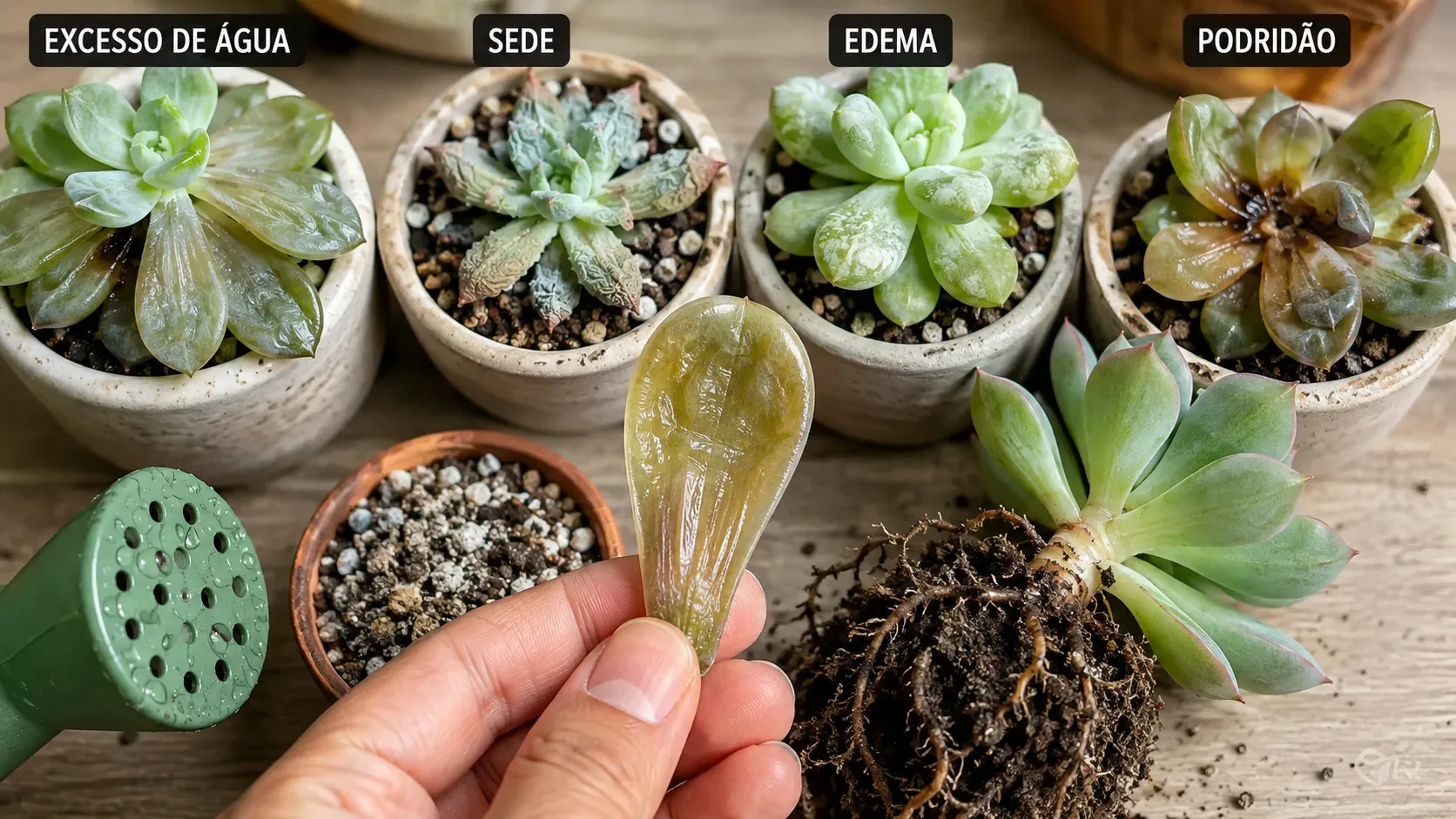
The leaves alone are not enough to complete the diagnosis. Wilting, leaf drop and reduced growth can occur with both lack and excess of water. It's safest to check the root zone before deciding to water again.
Check the center of the vessel
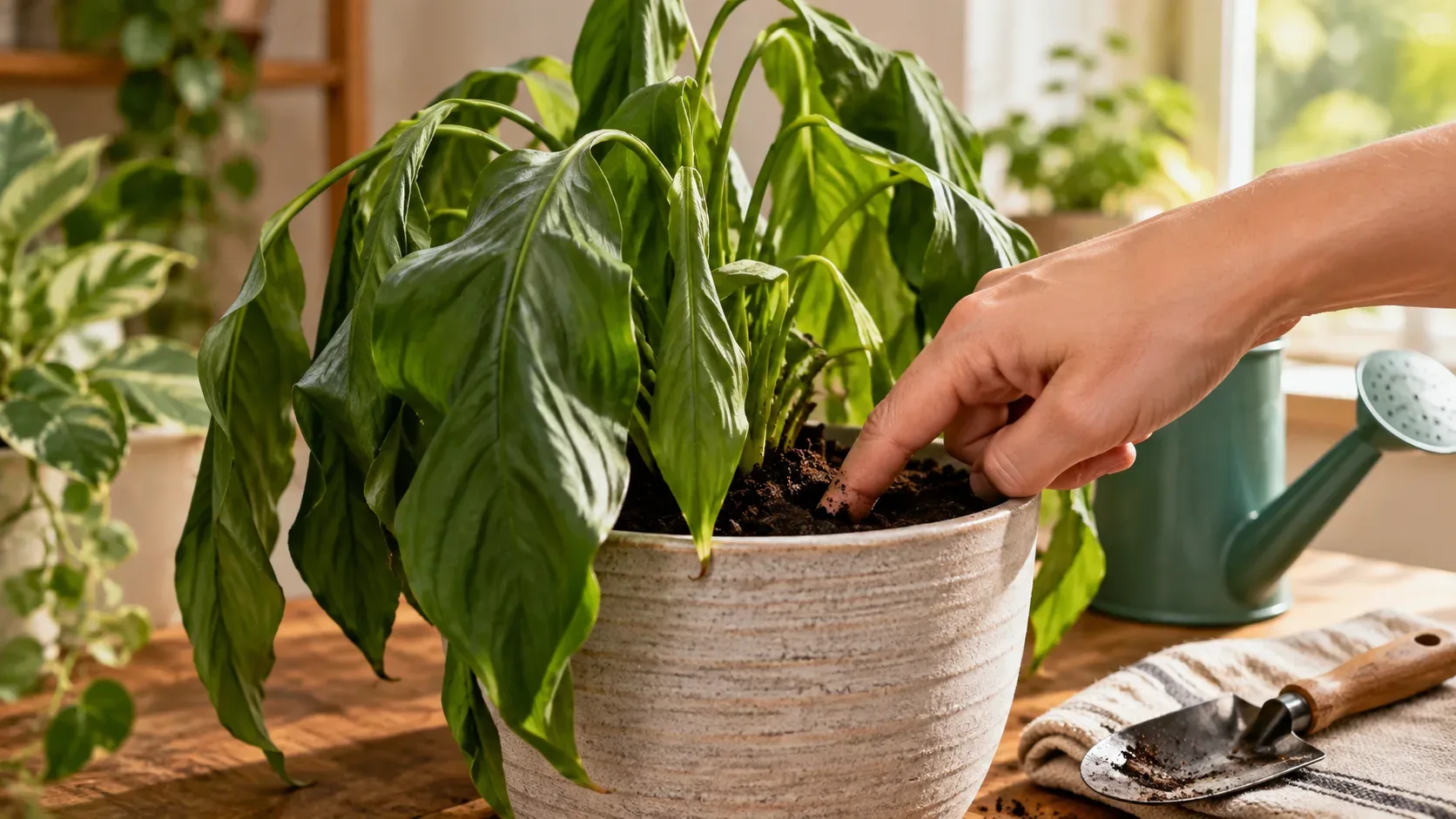
After watering, wait for the water to finish draining and insert your finger a few centimeters into the substrate, looking for a region closer to the center of the root ball, and not just the surface.
In larger pots, the Royal Horticultural Society recommends checking the humidity at approximately one-third of the depth of the container. The entity also warns that an apparently wet surface does not necessarily inform what is happening below.
If the pot allows it and the plant is well rooted, another option is to carefully remove the root ball from the container to observe its sides. A pattern of dark, moist spots interspersed with large dry regions reinforces the suspicion of uneven hydration.
It is not necessary to disassemble delicate roots just to do this test. Vessel weight, touch depth and water behavior usually provide sufficient information.
How to rehydrate a clod that is repelling water
When the problem is still moderate, start by watering from above, but change the way you apply the water.
- Water slowly the first time. Distribute the water over the surface, without pouring it all in one spot.
- Wait a few moments. The first application may begin to moisten the particles and facilitate the entry of the next water.
- Repeat two or three times. Virginia Tech recommends successive slow applications when there are still dry areas within the root ball.
- Check the center again. The goal is not to make more water come out the bottom, but to eliminate the dry pockets.
RHS also recommends watering containers slowly and carefully, giving the substrate time to absorb the water before reapplying.
If water continues to bypass the root ball, watering from below may work better. Place the pot, which must have drainage holes, in a shallow container with about 5 to 8 centimeters of water. Recent guidance from Virginia Tech is to leave regular pots for 15 to 30 minutes; Hydrophobic substrates may require more time or another round for moisture to advance into the rootball.
Remove the pot as soon as the substrate is adequately moist and let it drain. Don't turn recovery into staying in the water. The same publication advises not to leave indoor plants in basins of water for more than 60 minutes, as prolonged excess humidity reduces the availability of oxygen to the roots and increases the risk of root problems.
Then check the center again. If there is still a dry area, new controlled hydration is more useful than simply increasing the frequency of watering in the following days.
Watering too much once is not the same as overwatering
This point often causes confusion. When a substrate really needs water, the goal is to moisten its root zone completely.. The problem with excess is mainly watering again before the substrate has lost the appropriate amount of water for that plant.
Virginia Tech summarizes this difference by highlighting that excess watering is linked to the frequency and time that the root zone remains saturated, and not simply the volume used to achieve complete hydration.
This does not mean keeping all pots constantly moist. Cacti, succulents and other plants adapted to dry periods continue to require longer intervals. The hydrophobicity correction is to ensure that when it's time to water the water actually reaches the substrate and roots instead of just passing through the container.
Detergent should not be the default solution
It is possible to find homemade recommendations for adding detergent or soap to the water with the intention of making it penetrate better. The logic comes from surfactants: these substances reduce the surface tension of water and wetting agents are actually used professionally on substrates, including to facilitate the hydration of dry peat.
But that doesn't make any household detergent suitable for roots. Formulations and concentrations vary, and the University of Georgia Cooperative Extension warns that inappropriate surfactants or wetting agents and excessive doses can cause damage to roots and leaves.
So for a domestic pot, it makes more sense to start with slow rehydration or watering from below. If a commercial wetting agent is truly necessary, choose a product designed for substrates and follow the manufacturer's concentration exactly.
When the substrate needs to be changed
An episode of dryness does not require replanting immediately. If the clod absorbs water uniformly again after rehydration and the structure remains adequate, it can remain in use.
The change becomes more reasonable when the substrate is very degraded, compacted, difficult to wet repeatedly or when there is practically no substrate space left between the roots. Potting materials also physically change over time; the University of Connecticut notes that even good mixtures eventually degrade.
When replanting, use a mixture appropriate to the species and moisten the new substrate before placing the plant. This reduces the chance of starting with dry pockets when changing the pot.
How to prevent the problem from returning
After the root ball is hydrated, observe what happens between waterings. The objective is not to follow a rigid calendar, but rather to prevent species that prefer moderate humidity from repeatedly passing the necessary drying point.
Check the inside of the substrate, not just the appearance of the surface. Water slowly and in sufficient quantity when the plant really needs it. Small pots and terracotta containers tend to lose water more quickly, as do plants kept in warm, bright places.
If the water immediately comes out the bottom again, use the weight of the vessel and the humidity in the center as referees. The sign of good watering is not seeing water in the dish: it is finding the hydrated clod where the roots are.