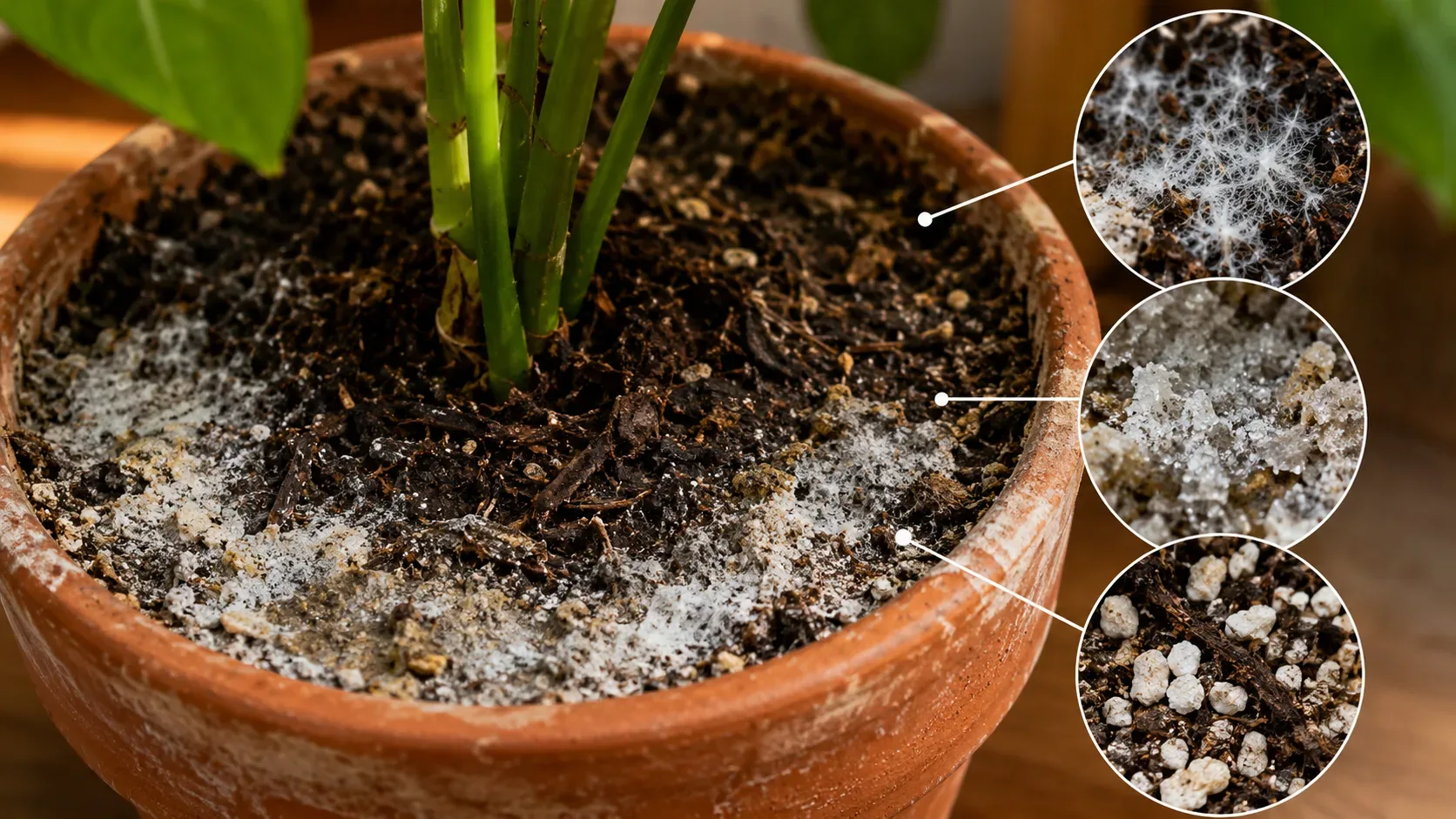
A white layer on potting soil does not automatically mean mold — and, by itself, it is not a reason to replace all the potting mix. The white material may be surface fungal growth, accumulated mineral salts from water or fertilizer, or light-colored ingredients already present in the potting mix, such as perlite and vermiculite. The safest way to tell them apart is to look at texture, distribution, watering and fertilizing history, and the plant’s overall condition before disturbing the roots.
First, look at how the white material behaves
Before scraping, rinsing, or repotting, inspect the top of the pot closely. Appearance and location usually offer better clues than color alone.
| What you see | Most likely explanation | Practical clue |
|---|---|---|
| Threads, fuzz, or an irregular white-to-gray film | Surface fungal growth | Often appears where the potting mix stays moist for too long |
| A hard whitish crust with a dry, powdery or crystalline look | Mineral or fertilizer salts | May also show on the pot rim and return after watering |
| Separate white pebbles or granules scattered through the mix | Perlite or another mineral component | Particles keep their own shape and do not “grow” across the soil |
| Light gray-silver or beige flakes mixed through the substrate | Vermiculite | It is part of the mix and looks flaky rather than crusty |
When it looks like mold: look for threads or a film
Fungi that live on organic matter in potting media can form a white-to-gray layer on the surface. The University of Maryland Extension explains that fungi can grow on the surface of moist growing media and that this superficial growth is usually not harmful to the plant by itself. The University of New Hampshire Extension likewise notes that fungi and slime molds may appear on potting media while feeding on dead organic matter, especially when the mix remains wet for long periods.
The useful question is therefore not only “is this fungus?” but why is the surface staying moist long enough for it to thrive? An oversized pot, poor drainage, slow evaporation, weak air movement, or watering again before the medium has dried to the degree appropriate for that species can keep the top layer wet.
If the plant is firm, there is no foul smell from the pot, the stem base is not dark or mushy, and the roots show no signs of rot, there is usually no need to dismantle the root ball just because a surface film appeared. A thin layer may respond to adjusted watering and better air movement. If a thick mat develops, Maryland Extension recommends breaking up or removing the affected upper layer. Management should still match the plant’s needs: allowing the surface to dry does not mean severely dehydrating a tropical plant that prefers consistent moisture.
When it looks like salt: look for a dry, crystalline, recurring crust
Mineral and fertilizer deposits usually look different. According to the University of Maryland Extension, they commonly appear as a white crystallized coating on leaves or as a white crust on the growing medium or pot. They may come from hard water containing dissolved minerals or from salts present in soluble fertilizers.
These clues make salt buildup more likely:
- the material is dry, brittle, or chalky rather than fuzzy;
- a white line is also visible on terracotta or the outer surface of the pot;
- the problem began after fertilizing more often or at a stronger concentration;
- the plant is almost always bottom-watered, without periodic flushing from the top;
- the container has poor drainage;
- leaf tips or margins have begun to brown, especially alongside other stress symptoms.
Brown tips alone do not prove salt excess. Low humidity, underwatering, root damage, and other problems can cause similar symptoms. A white crust becomes a stronger clue when it matches the fertilizing history, water quality, and drainage pattern.
Perlite and vermiculite: the “white” material may be normal
Many commercial potting mixes contain several different ingredients, some of them naturally pale. Illinois Extension lists perlite and vermiculite among common ingredients in houseplant media. The University of New Hampshire Extension describes perlite as a white, lightweight, porous volcanic material used to improve drainage and aeration, while vermiculite is a gray, spongy material that increases water and nutrient retention.
In practice, perlite often looks like small irregular white granules or pebbles. Because it is very light, some pieces can migrate toward the surface after repeated watering. Vermiculite is more likely to look like light-colored flakes or layers, often gray-silver, beige, or gold. Neither one forms a spreading film over other materials.
A simple check can help: gently move aside a small patch of the upper layer. If similar particles are distributed below the surface and consistently mixed with the rest of the medium, they are more likely to be potting-mix ingredients than a new growth or deposit.
How to tell the difference without dismantling the pot
- Look before touching. Threads and fuzz point more toward fungi; crystals and a dry crust toward salts; separate particles toward components of the mix.
- Compare the soil surface with the pot rim. White buildup on terracotta or the rim is compatible with salts left behind as water evaporates.
- Check the potting-mix label. If perlite or vermiculite is listed, that may explain pale granules that have been present since planting.
- Review the watering history. A constantly damp surface favors fungal growth; poor drainage can worsen both excess moisture and salt accumulation.
- Review the fertilizing history. Frequent applications, concentrated doses, or fertilizing without periodic leaching raise the likelihood of salt buildup.
- Look at the entire plant. A white surface layer alone rarely justifies root disturbance. Persistent wilting, yellowing, leaf drop, a soft stem base, foul odor, or dark mushy roots make the situation more urgent.
What to do in each situation
If it is surface fungal growth
Adjust watering to the pot’s actual drying rate, make sure drainage holes are open, and improve air circulation. If a thick layer has formed, remove only the affected top portion and replace it with clean potting medium appropriate for the plant. Avoid automatically reaching for a fungicide: surface growth may simply be a sign of persistently wet conditions, and correcting those conditions is often more useful than merely trying to kill the visible white material.
If it is a salt deposit
Review fertilizer rate and frequency as well as water quality. Maryland Extension recommends, in many cases, leaching the potting mix with clean water from the top and allowing it to drain completely; severe cases may require fresh potting medium. This only makes sense in a container with unrestricted drainage and for a plant that can tolerate this kind of flushing. If the pot has no drainage hole, the priority is fixing drainage rather than pouring more water into it.
If it is perlite, vermiculite, or another mix component
Nothing needs to be removed. These materials are part of the physical structure of the potting medium. Washing the soil, changing the pot, or picking out the particles can create unnecessary stress when the plant is otherwise healthy.
Drainage connects all three possibilities — in different ways
Drainage helps interpret the context. Illinois Extension notes that containers with drainage holes are best for most houseplants and that pots without drainage increase the risk of problems associated with waterlogged media. A medium that remains wet too long can encourage fungal growth on the surface; practices that do not allow water to move through the medium can also contribute to salt concentration.
That does not mean every white layer signals “poor drainage.” Perlite may be present specifically to improve aeration and drainage. Diagnosis depends on combining appearance, distribution, and history.
When it is worth taking the plant out of the pot
Root inspection is useful when there are signs of trouble below the surface, not as a first response to every white residue. Consider carefully removing the root ball if the plant keeps declining despite appropriate watering, the potting medium smells foul, the stem is soft at soil level, roots are visibly dark and mushy, or the medium stays saturated for a length of time that is inconsistent with the species.
If the plant is growing normally and the only finding is white material on the surface, start with the least invasive identification steps. In many cases, the material will turn out to be a normal component of the mix or a management clue that can be corrected without repotting.
Practical summary
- Fuzzy, threadlike, or film-like: think surface fungus and investigate persistent moisture.
- Dry, hard, crystalline, also on the pot: think mineral or fertilizer salts.
- Separate granules or flakes mixed through the substrate: think perlite, vermiculite, or another potting-mix component.
- Do not disturb roots just because the surface is white. Use plant symptoms, drainage, watering, and fertilizing history to decide whether root inspection is actually needed.