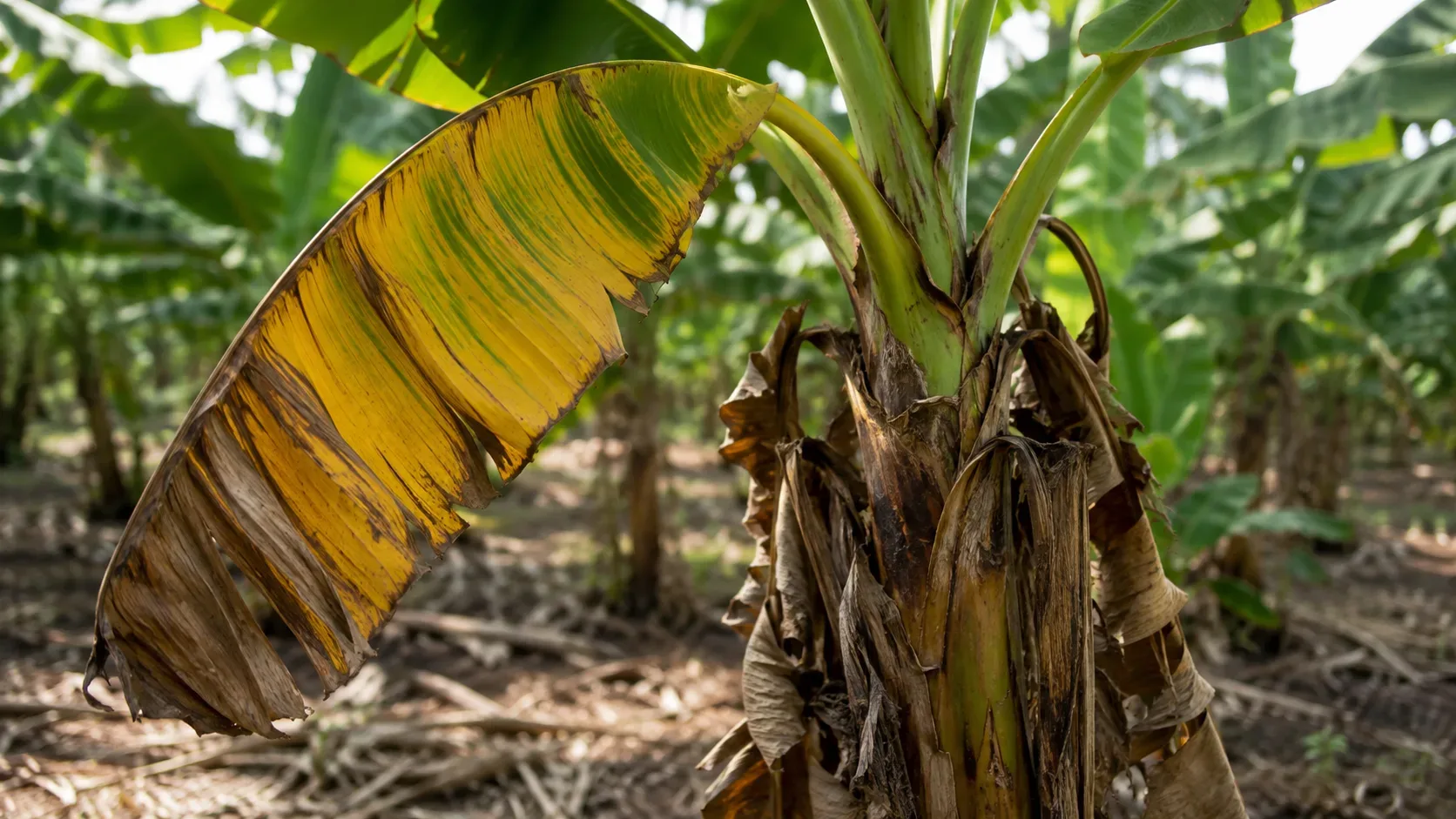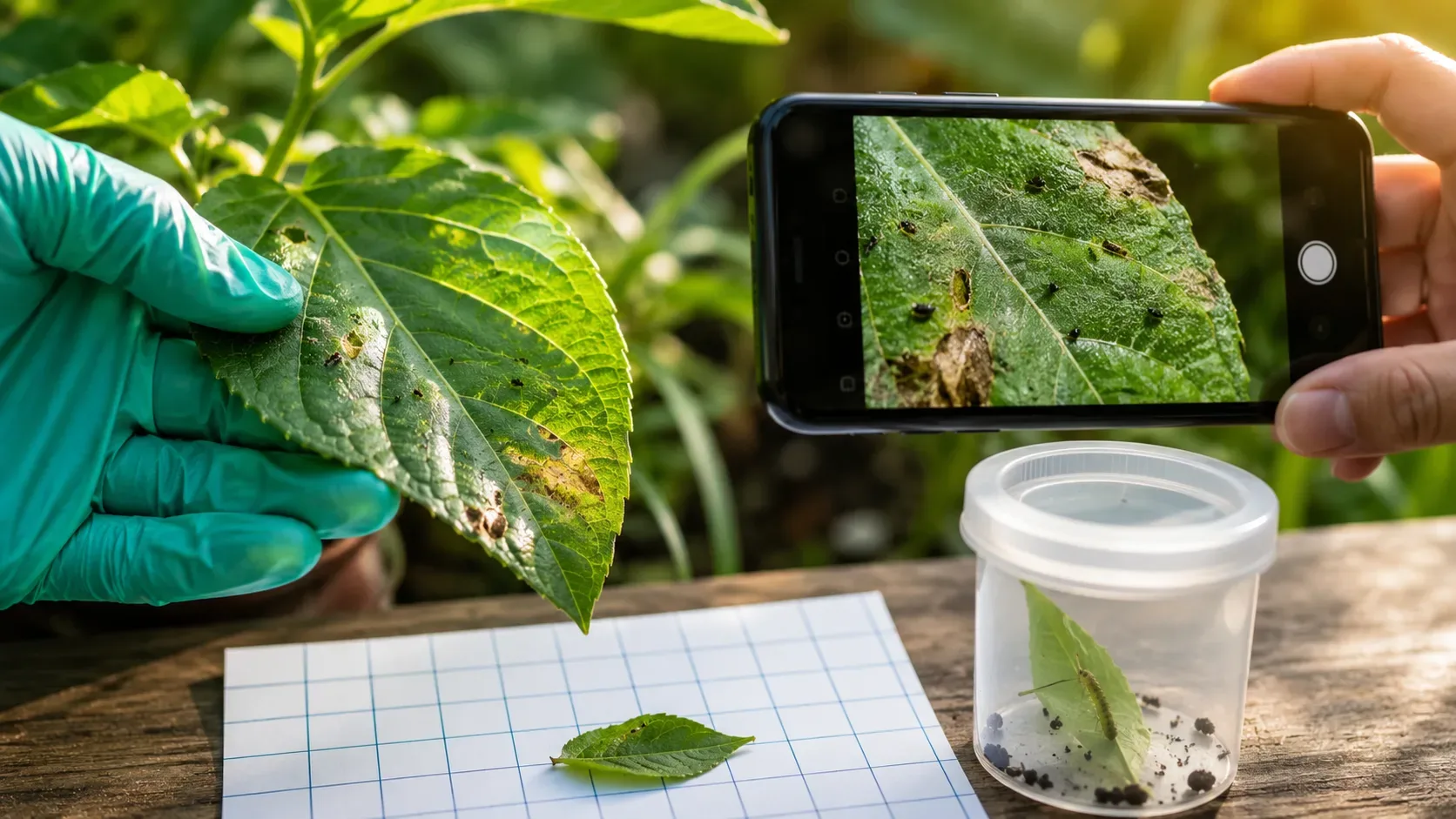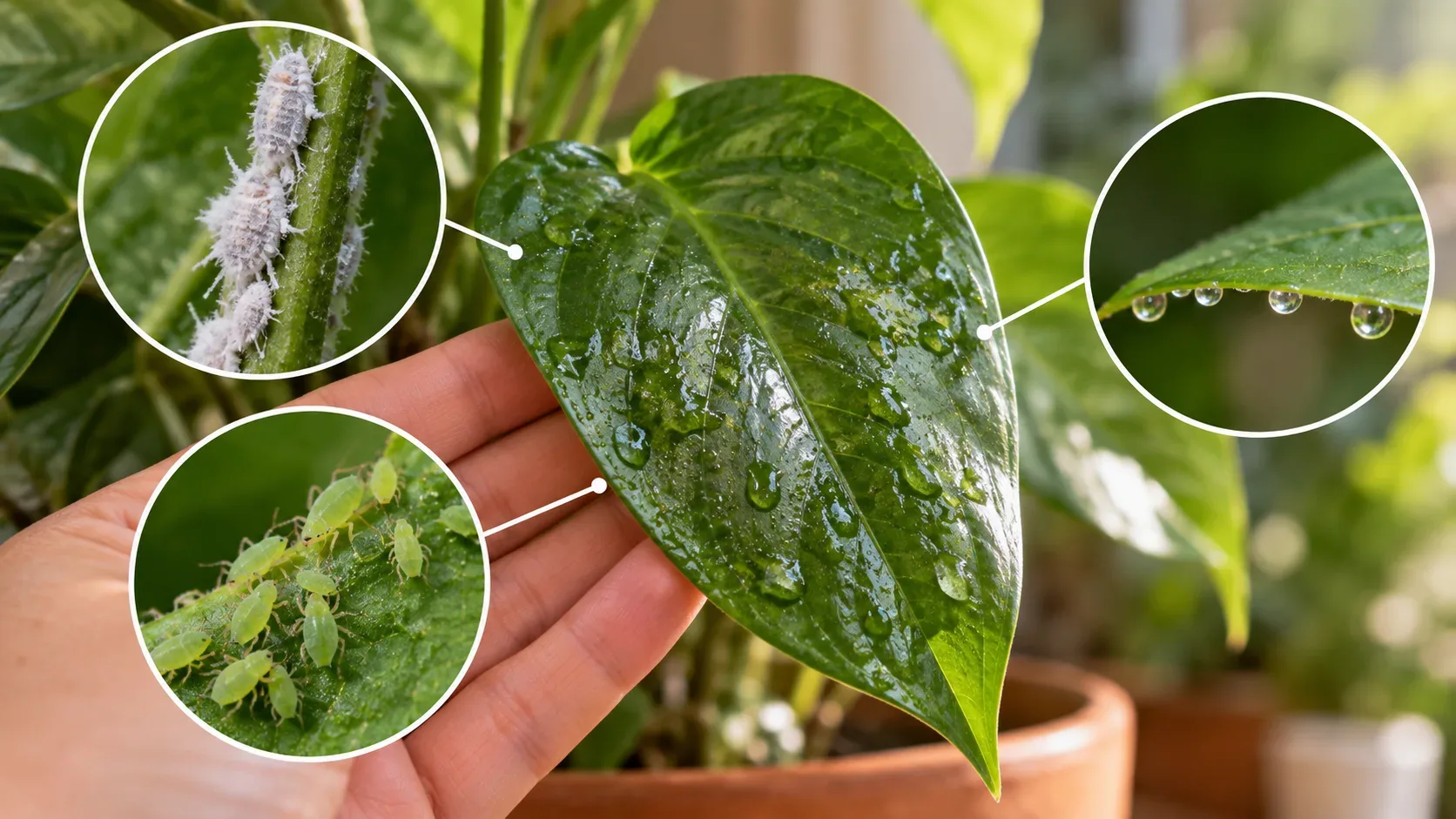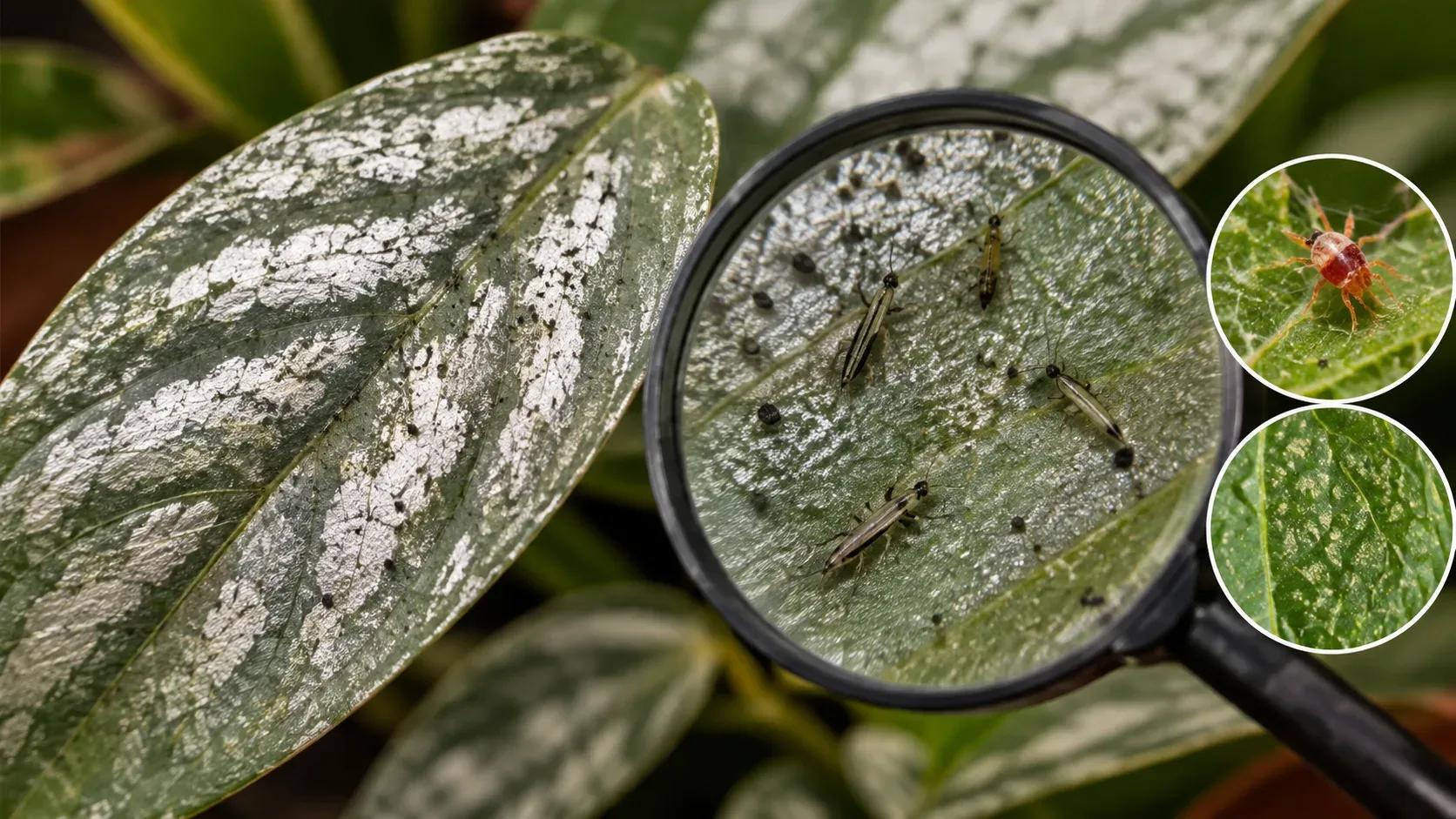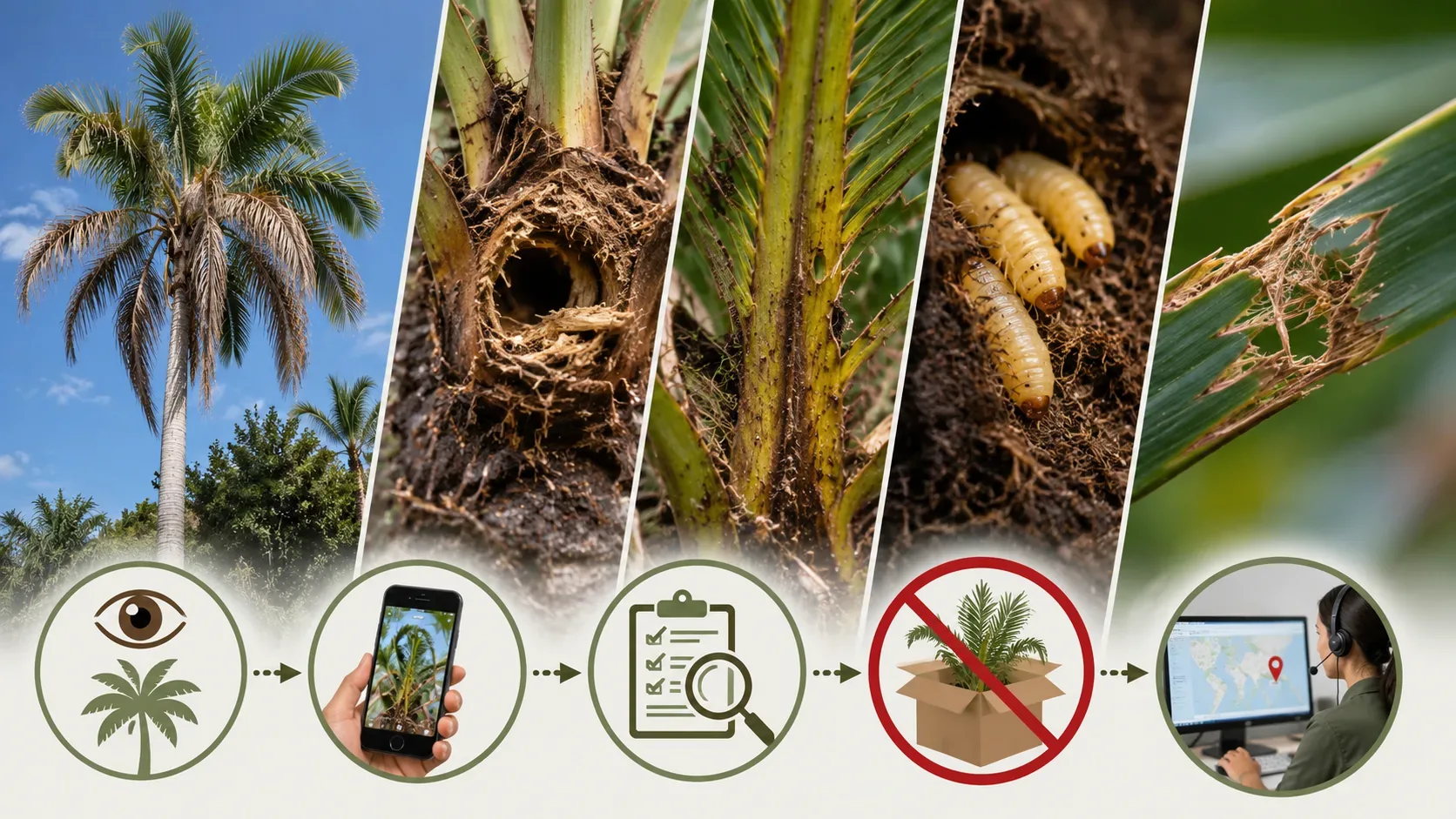
A palm tree with yellow, dry or fallen leaves does not confirm the presence of the red weevil. These signs also appear in problems with irrigation, lighting, nutrition, cold, injuries and other illnesses. The phytosanitary alert serves to increase vigilance and speed up the investigation of unusual situations — not to turn every weakened palm tree into a case of the pest.
Until August 4, 2026, the Ministry of Agriculture and Livestock, MAPA, classified the red palm weevil, Rhynchophorus ferrugineus, as a quarantine pest absent from Brazil. The national pest alert page was updated on July 10, 2026, and the suspected notification channel was updated on July 15, 2026.
The practical guidance is simple:
Observe → photograph without handling → compare the pattern → do not transport → notify
It is not necessary to obtain a particular diagnosis before reporting a suspicion. MAPA itself informs that unknown or unusual signals may be reported without prior technical confirmation. Analysis, eventual field inspection and material collection are the responsibility of the responsible teams.
What the MAP alert means
The red weevil is an insect whose larvae develop inside the palm tree, feeding on young tissues and opening galleries in the stem and growth region. Because much of the damage occurs internally, the early stages may go unnoticed. In advanced infestations, destruction of the central region can deform or cause the crown to collapse and lead to the plant's death.
Brazilian concern increased with the expansion of the plague in South America. It was officially detected in Uruguay in 2022 and had the first Argentine record confirmed in January 2026, on Martín García Island, in the province of Buenos Aires. In Argentina, identification was confirmed by morphological examinations and followed by official phytosanitary emergency measures.
In Brazil, however, alert does not equate to confirmed occurrence. The pest remains on the official list of Absent Quarantine Pests, established by Ordinance SDA/MAPA nº 1,291, of May 22, 2025, published in the Official Gazette of the Union on May 27, 2025.
The objective of the alert is to promote early detection, especially because infested seedlings, plants transported without control and the irregular transit of plant material can take the insect to new areas. MAPA recommends special attention to adult palm trees, urban and rural areas, nurseries and regions close to borders or plant circulation routes.
What signs of the red weevil deserve attention
The signs described by MAPA and Embrapa must be observed together and within the context of the plant. None of them, on their own, serve as visual confirmation.
Signals directly associated with the stem and crown
Deserve registration priority:
- small holes on the stem, at the base of the plant or near the crown;
- sap, resin or wet material coming out of the holes;
- chewed or crushed fibers accumulated near holes or on the ground;
- strong and unpleasant smell coming from inside the palm tree;
- new or central leaves deformed, yellowed or fallen;
- abnormal inclination of the central part of the canopy;
- absence of central leaves and flattened or asymmetrical shape of the crown;
- rapid weakening or progressive collapse of the central part of the plant.
The location of the signal is relevant. Changes in the center of the canopy, the youngest leaf or the growth region require more attention than the isolated drying of old and lower leaves. Still, other pests, diseases and disorders can affect the same region.
Does a reddish insect confirm the species?
No. Red weevil adults may present variations in shade, and Embrapa warns that they can be confused with the coconut eye borer, Rhynchophorus palmarum. Confirmation of the species must be done by experts, considering characteristics that cannot be reliably assessed in a casual photo.
If a suspicious insect is seen, photograph it at the location using the zoom feature, without capturing it or placing it in a container for transport. Also record the entire palm tree and nearby signs.
Leaves falling: how not to confuse alert with diagnosis
Yellowing, spots, dryness and leaf fall are symptoms of low specificity. In palm trees, old yellowing leaves may be related to nutritional changes. Spots and necrosis can also appear due to foliar diseases, water stress, sunburn, cold, phytotoxicity or physical damage. The exact cause of some injuries can only be determined by technical assessment and, in certain cases, by laboratory analysis.
In ornamental plants in general, changes in the amount of light, lack or excess of watering and nutritional imbalance can also produce yellowing and leaf fall. This does not mean that the owner should choose a fertilizer or treatment based on appearance alone: even excessive fertilizer application can worsen the condition.
Safe reading of signals
| What was observed | How to interpret without diagnosing |
|---|---|
| Only lower and older leaves slowly yellowing | Non-specific signal. Observe irrigation, light, recent cold and management history. Do not conclude that there is a plague. |
| Spots restricted to leaf blades | May be related to injury, foliar disease, nutrition or environmental stress. Appearance alone does not identify the cause. |
| New center sheets deformed, skewed or collapsed | Higher priority signal, especially when the change is recent and outside the plant's standard. |
| Holes accompanied by sap or chewed fibers | Set compatible with the alert and which must be photographed and communicated without manipulation. |
| Unpleasant smell, crushed material and deformed cup | Set of high concern, associated with advanced internal damage, but still dependent on official confirmation. |
| Brown, orange or reddish insect near palm tree | Color does not confirm species. Photograph and forward the observation for specialized analysis. |
The table is a screening tool, not a diagnostic key. Don't wait for all the signs to emerge to report a really unusual situation: MAPA accepts communications without prior technical confirmation.
Decision tree: what to do when faced with a suspicious palm tree
1. Watch from a distance
See the entire palm tree before focusing on one leaf. Compare the two sides of the crown, the central region, the base of the stem and the surrounding soil.
Ask:
- is the change only in the oldest sheets?
- was the center of the canopy also affected?
- are there holes, crushed fibers, sap or an unusual odor?
- did the change come quickly?
- do other palm trees nearby show the same pattern?
- was the plant recently purchased, transplanted or transported?
This information helps the authority understand the context, but should not be used to make a domestic diagnosis.
2. Shoot without manipulating
Make records of:
- entire palm tree, including the crown;
- center of the cup, using zoom;
- stem and base of the plant;
- holes, sap or fibers, when visible;
- material already found in the soil;
- suspicious insect at the location;
- palm trees nearby, if they also show changes.
Do not climb the plant, do not insert tools into the holes and do not pull the central sheet to “test” whether it is loose. The official guidance in case of suspicion is not to manipulate the palm tree or transport the material.
3. Compare the standard, but don't choose a treatment
If the problem is limited to old leaves and coincides with cold weather, changes in light or changes in watering, record the progress. The related article “Plant suffering in winter: how to separate cold, low light and excess water” can help organize this observation.
If there are unusual signs in the center of the canopy, holes accompanied by fibers or sap, a strong odor, rapid deformation or a suspicious insect, go directly to notification.
4. Do not cut or transport
Do not remove pieces of the stem, leaves, larvae, cocoons or soil to take to a store, mail or show in person. Also, do not move the palm tree, seedling or pot to another area.
MAPA highlights that the transport of infested plants is one of the main ways of spreading the pest and determines that, in case of suspicion, the plant is not manipulated nor the material transported.
5. Notify the phytosanitary authority
The suspicion can be forwarded to the channel alertapragas@agro.gov.br, to the Federal Superintendencies of Agriculture or to the state plant health defense agency.
According to MAPA, the communication must contain:
- description of the observed problem;
- city, location and date of observation;
- images, when possible;
- additional information to help with the analysis;
- name and contact of the person communicating.
Messages are evaluated by the technical team, which can trigger surveillance for field inspection, sample collection and other procedures.
When notification should be made
The official rule is broader than a closed list of symptoms. You must report when there are unknown or unusual signs, apparently exotic organisms or signs of a pest that does not officially occur in the region or country. It is not necessary to present a report, identify the insect or consult a professional before sending the information.
In the case of palm trees, the notification takes priority when there is:
- recent change in the center of the cup;
- fall or deformation of central leaves;
- holes accompanied by sap or chewed fibers;
- odor of fermentation or decay coming from the plant;
- tilted, flattened or collapsing crown;
- insect similar to a large weevil next to the palm tree;
- occurrence in seedlings of unknown origin or recently transported;
- unusual situation in a border area or area with intense plant trade.
Notifying does not mean declaring that the pest is present. It means delivering a note to the responsible authority so they can decide whether an investigation is needed.
What not to do in the face of suspicion
The impulse to “open” the palm tree or apply some substance can destroy important signs, expose people and animals and, if there is a pest, encourage the movement of the material.
Just in case:
- do not pierce or cut the stipe;
- do not tear out central sheets;
- do not capture larvae or adults for transport;
- do not take leaves, fibers, cocoons or pieces of the plant to another location;
- do not install improvised traps;
- do not apply pesticides, oils, solvents or homemade mixtures;
- do not dispose of waste in green waste, wasteland or compost;
- do not contract the removal before reporting the suspicion and receiving appropriate guidance.
These restrictions derive from the official recommendation to not manipulate the plant or transport suspicious material. Any intervention, treatment or destination must be defined by the authority and a qualified professional, according to the results of the evaluation.
If the canopy is tilted, parts are falling or there is an immediate risk to people, vehicles or properties, keep your distance and also call the municipal service responsible for afforestation or emergency. Phytosanitary communication does not replace addressing a structural risk.
Quick questions
Should every palm tree with fallen leaves be notified?
Not necessarily. The loss restricted to old leaves may be due to the plant cycle or environmental and nutritional causes. However, an unknown, rapid change or change accompanied by changes in the canopy, holes, fibers, sap or odor justifies communication.
Do I need to be sure it's the red weevil?
No. MAPA expressly states that no prior technical confirmation is required to submit a suspicion.
Does a photograph allow you to identify the insect?
It helps with screening, but may not allow confirmation. The red weevil varies in color and can be confused with another insect of the same genus. Definitive identification must be specialized.
Can I keep the insect or send a sample?
The safest advice is not to handle or transport. Photograph at the location and wait for instructions from the authority, who can organize appropriate collection.
Should I apply insecticide preventively?
Not on your own. A visual symptom does not identify the cause, and the inappropriate product can create risks without solving the problem. First register and notify; Any management decision must be technical and case-specific.
Save the sequence and use the official channel
MAPA's alert does not mean that every weakened palm tree is infested. It means that unusual situations need to reach those who can investigate them quickly.
Save this string:
Watch without touching. Photograph the set. Don't cut. Do not transport. Notify.
To register a suspicion, consult MAPA's official Prague Suspicion Notification channel or forward the information to alertapragas@agro.gov.br.