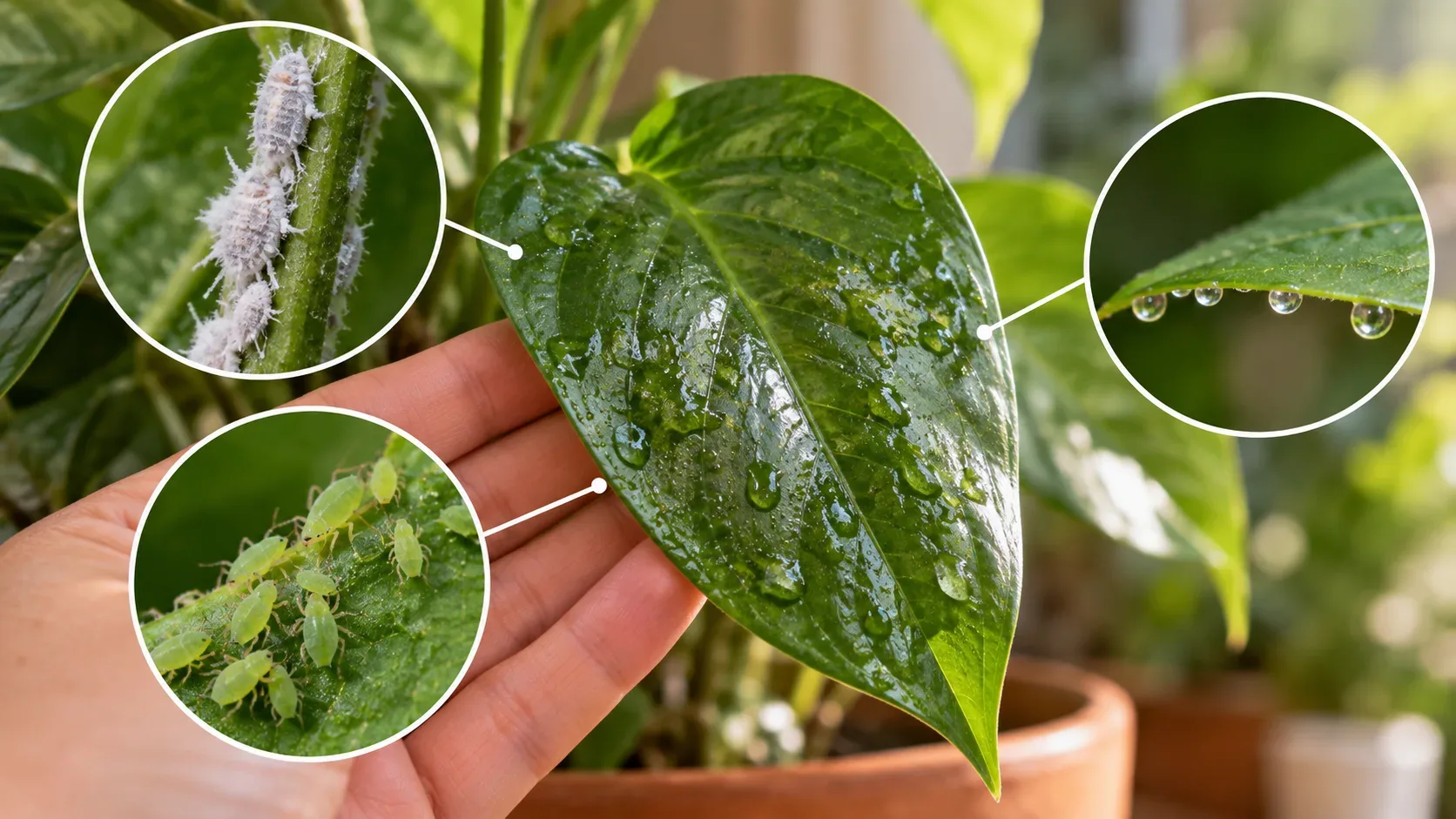
Sticky leaves do not automatically mean a plant needs insecticide. First determine where the liquid appears, what pattern it follows, and whether sap-feeding insects are present. Aphids, mealybugs, and scale insects can produce honeydew — a clear, shiny, sugar-rich excretion that becomes sticky on leaves, stems, and surfaces below the plant. Guttation, by contrast, is a plant process: water is released through structures at leaf edges or tips, especially when the growing medium is moist and transpiration is low.
Mini diagnostic key: read the pattern before treating
| What you see | Most likely cause | What to check next |
|---|---|---|
| Shiny sticky film on upper leaf surfaces, including leaves below other foliage | Honeydew from sap-feeding insects | Leaf undersides, new growth, veins, leaf axils, and stems |
| Repeated droplets along edges or tips, often easiest to see in the morning | Guttation | Moist potting mix, humid night, no insect colonies |
| Clusters of tiny soft-bodied insects on shoots and leaf undersides | Aphids | Curled new leaves, pale shed skins, honeydew |
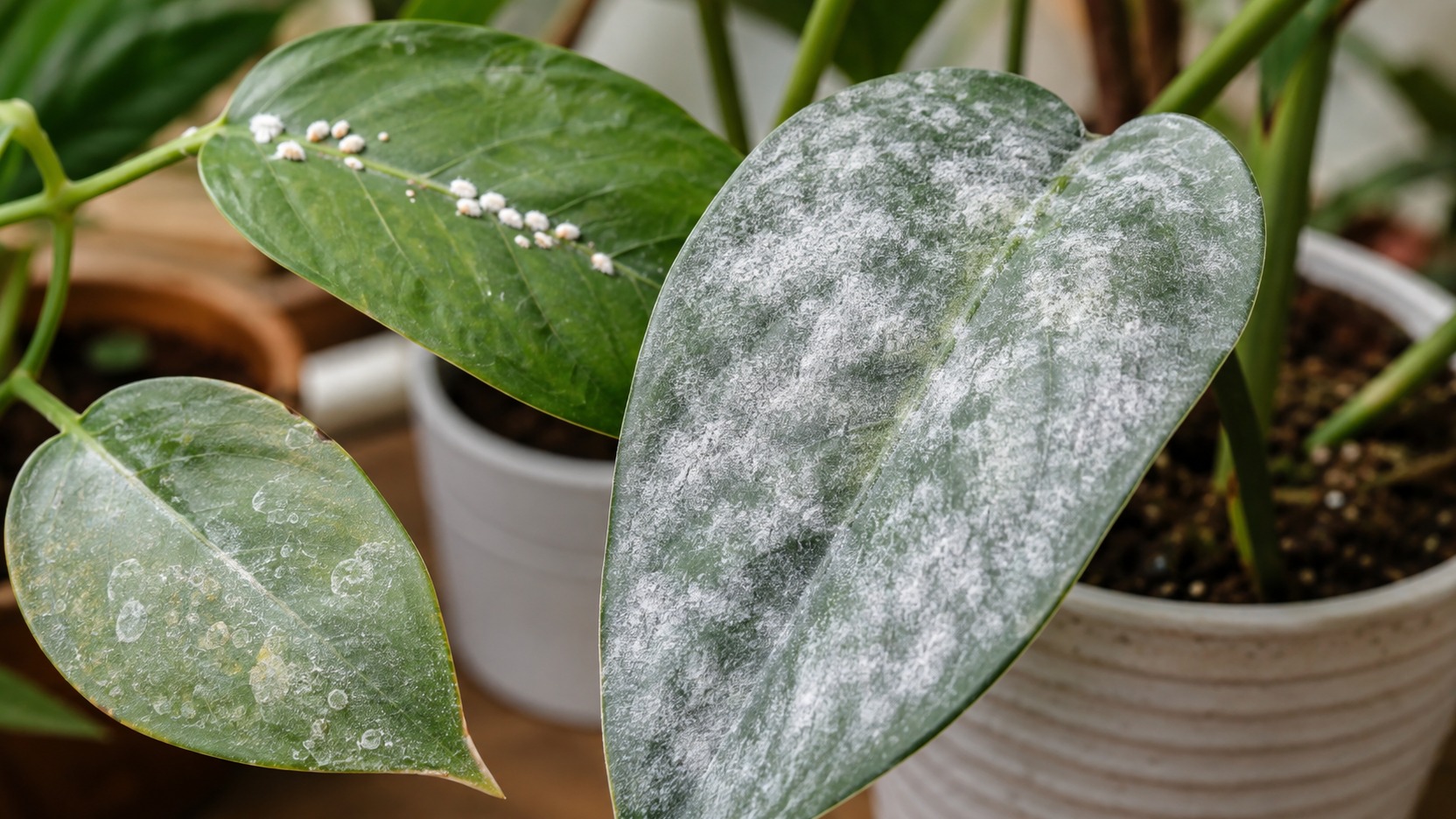
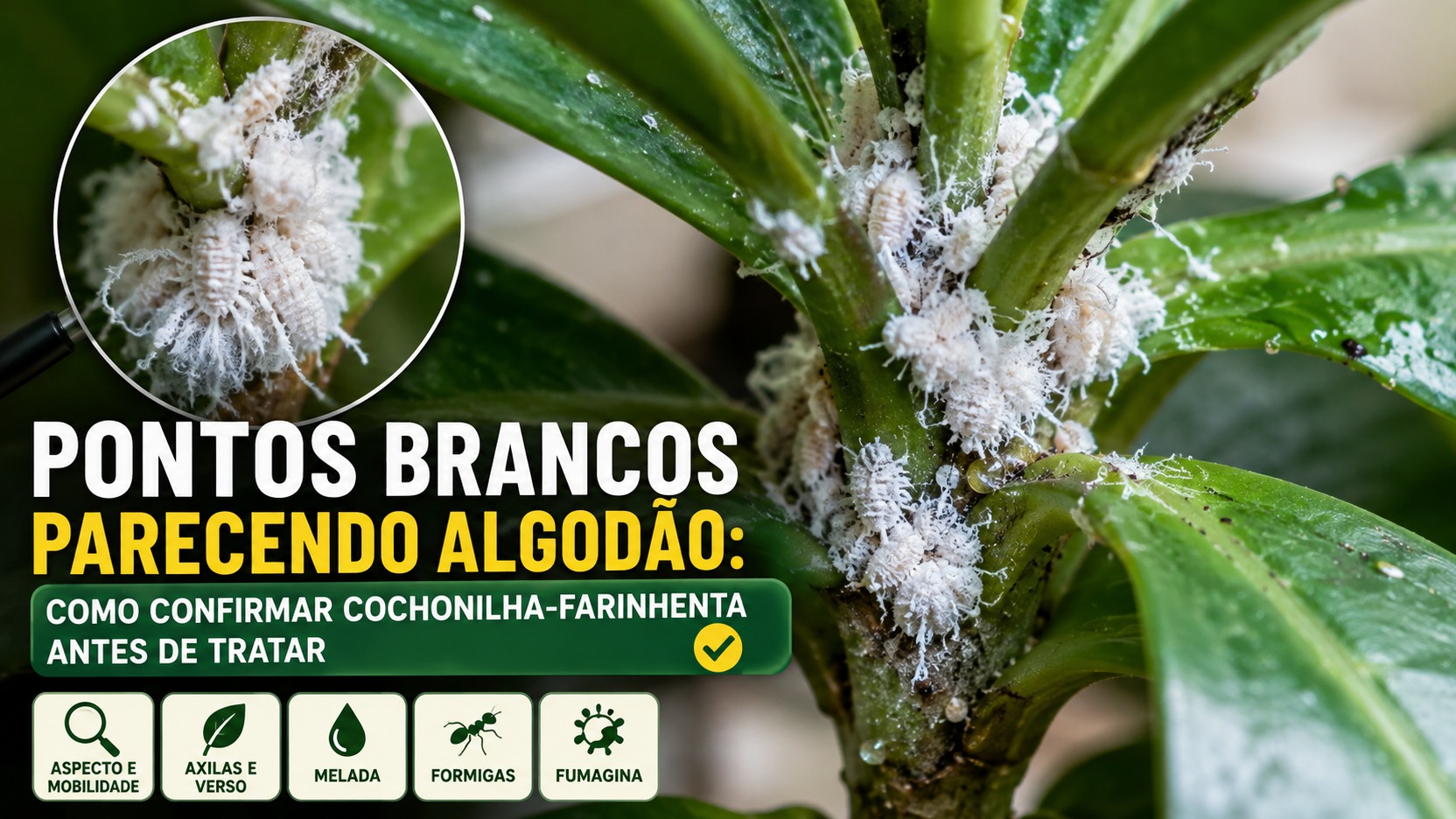
| White cottony masses in leaf axils, along veins, or on stems | Mealybugs | Hidden insects in joints and crevices, honeydew |
| Small shell-like bumps attached to leaves and stems | Scale insects, especially soft scales | Honeydew nearby or on lower leaves and reduced vigor |
1. Find where the stickiness is located
The University of Minnesota Extension advises watching for honeydew as a shiny, sticky substance produced by aphids, mealybugs, and scale insects, including on upper leaf surfaces and on objects around or below the plant. The residue can drip from insects feeding higher up.
A sticky leaf may therefore contain almost no pests itself. Inspect the leaf directly above it, branch tips, fresh growth, and stems. A sticky shelf, table, or floor beneath the pot also strengthens the honeydew hypothesis.
2. Turn leaves over and follow the veins to the stems
Penn State Extension recommends monitoring foliage, stems, and soil and notes that aphids, whiteflies, mealybugs, and scale insects can secrete honeydew.
How to recognize aphids
Aphids are small, soft-bodied insects that often gather on young tissue. The University of Minnesota Extension describes adults and nymphs at roughly 2–4 mm and notes that pale shed skins may remain caught in honeydew. Distorted, curled, or yellowing new growth adds weight to the diagnosis when colonies are present.
How to recognize mealybugs and scale
Mealybugs usually look like small white cottony tufts and hide in leaf axils, joints, and protected crevices. Scale insects can resemble small oval or round plates fixed to leaves or stems. Some scale insects, especially soft scales, produce honeydew, so look for the insect at the source rather than only the sticky residue below it.
3. When the pattern fits guttation better
During guttation, liquid exits through hydathodes at leaf edges or tips. The University of Missouri explains that the phenomenon is favored when soil is moist, humidity is high, and transpiration is low, as can happen at night. Root pressure moves water toward the leaves, and small droplets appear near vein endings.
The key visual clue is regularity: droplets at repeated positions along a margin or tip rather than a broad sticky film. Guttation fluid can contain minerals and small amounts of solutes, so a dried droplet may leave a mark; that alone does not prove a pest infestation.
If you only find marginal droplets, especially in the morning, and careful inspection reveals no insects, shed skins, cottony masses, or attached scale, it is reasonable to observe before applying pest treatment.
4. Honeydew, guttation, or dew?
Dew forms when atmospheric moisture condenses on cool surfaces and tends to be distributed more broadly. Guttation originates at specific leaf-edge or tip sites. Honeydew is tied to sap-feeding insects and often remains tacky after some water evaporates.
No single clue is perfect. Combine droplet position, time of day, moisture in the potting mix, insect presence, and the distribution of stickiness on the plant and its surroundings.
5. Extra clues that support honeydew
- Sooty mold: a dark surface growth can develop on honeydew.
- Ant activity: some ants seek sugary substances and may visit plants with honeydew-producing insects.
- Leaves sticking together: sugary residue can glue touching surfaces.
- Residue below the plant: a sticky shelf, cachepot, or lower leaf suggests the source is above.
6. What to do if you still cannot find the pest
Do not spray “just in case.” Temporarily isolate the plant, inspect leaf undersides, new growth, and axils, and use a hand lens if needed. Cleaning one leaf can help you see what returns, but note where the residue was before wiping it away.
If stickiness returns without visible insects, watch the pattern for a few days and compare it with watering, humid nights, and edge droplets. If clear pest evidence appears, treatment can target the correct organism.
7. If aphids or mealybugs/scale are present, start simple
For small infestations, university extension guidance prioritizes washing leaves, physically removing pests, and pruning heavily infested parts. The University of Minnesota mentions removing mealybugs with tweezers or an alcohol-dipped cotton swab and removing small numbers of scale insects manually; water sprays can also dislodge some insects.
If insecticidal soap, horticultural oil, or another product labeled for indoor ornamental plants is needed, follow the label and confirm that it is appropriate for both the plant and the pest. Avoid improvised household mixtures: household soaps not formulated as insecticides can burn plants.
8. When not to treat it as a pest problem
There is no reason to apply insecticide simply because one or two droplets appeared on a leaf edge. Treatment makes sense when there is evidence of the target organism — insects, colonies, attached scale, or a consistent set of associated signs.
If the plant is rapidly losing vigor, yellowing, developing necrotic areas, or wilting persistently in ways that do not match the insects found, broaden the diagnosis to watering, roots, nutrition, and disease.
Two-minute checklist before any treatment
- Is the liquid a sticky film or localized droplets?
- Is it on top of lower leaves as if it dripped from above?
- Are aphids present on new growth or leaf undersides?
- Are there white cottony masses in axils or on stems?
- Are small scale-like bumps attached to veins or stems?
- Do droplets appear mainly on edges/tips after a humid night?
- Was the potting mix quite moist when the droplets appeared?
The more clues point to the same pattern, the lower the chance of treating the wrong plant for the wrong problem.