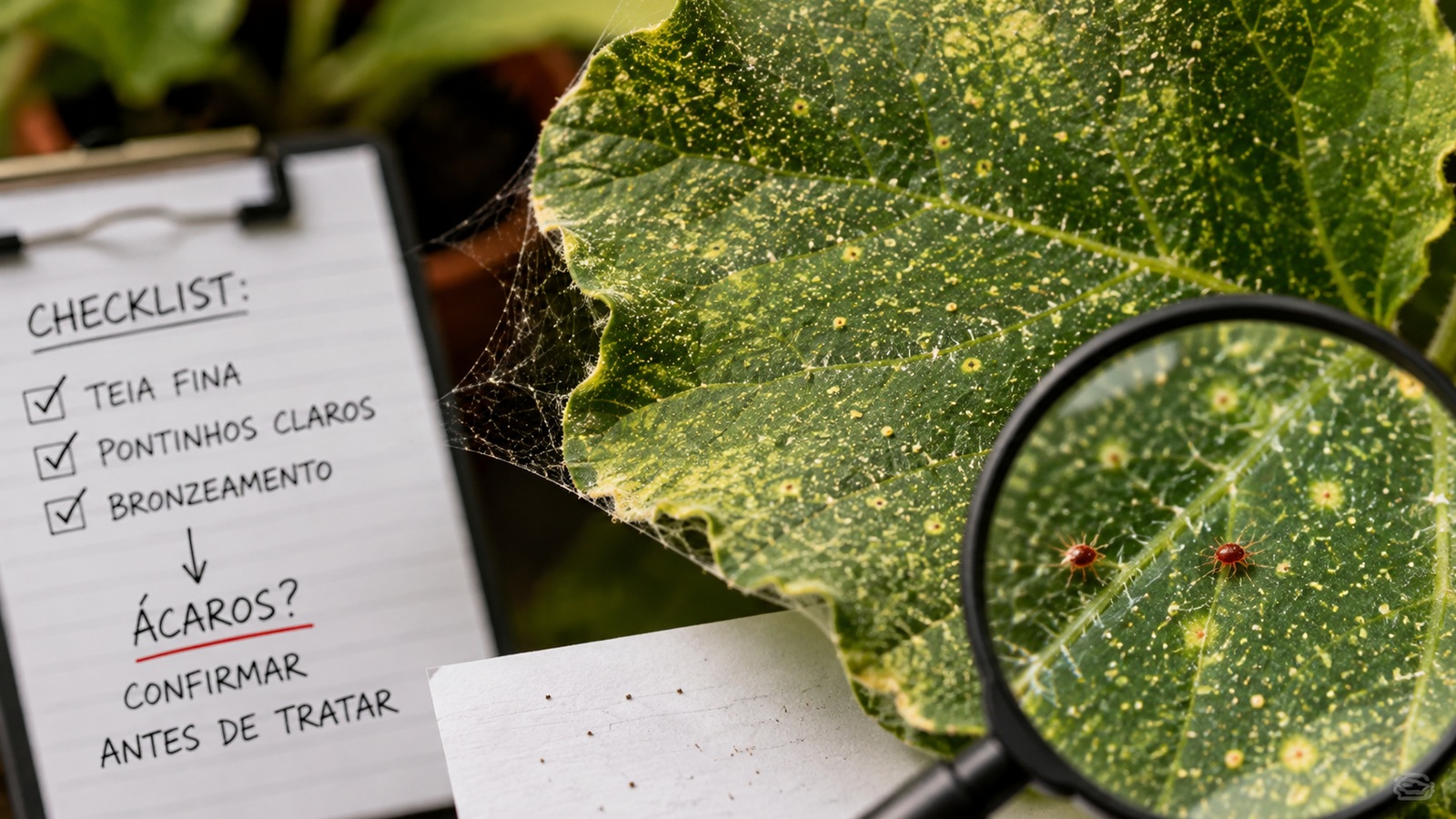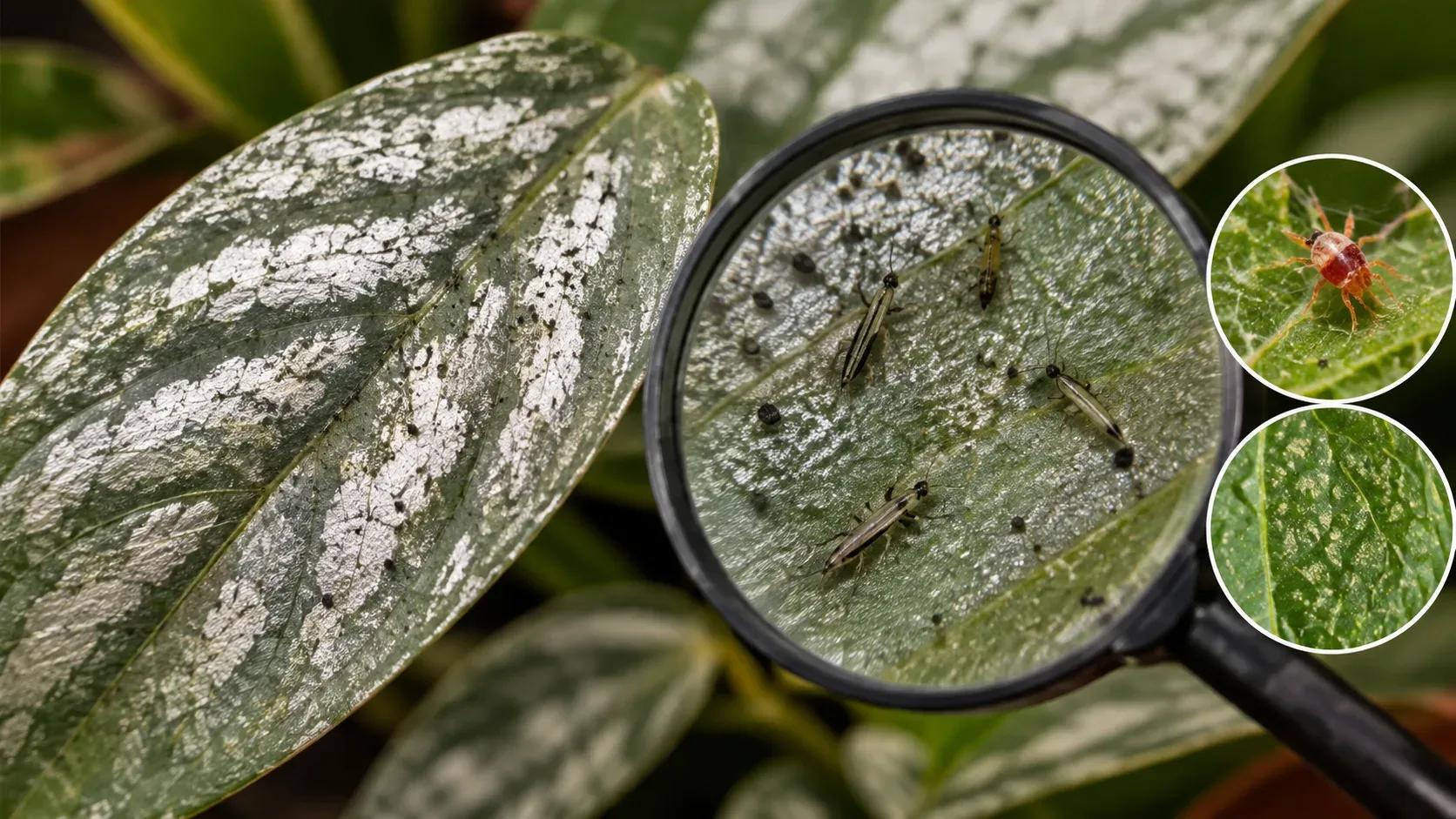
Silvery leaves with tiny black specks are a combination that points toward thrips, but those symptoms alone should not determine treatment. The clue becomes stronger when the silvering is irregular, the dark specks occur beside scraped-looking areas, and you find very small, slender insects on leaf undersides, new growth, or flowers. Embrapa documents this exact association between irregular silvery patches and black dots on leaves damaged by thrips. Spider mites, by contrast, more often cause very fine pale stippling and, as populations build, webbing on or beneath leaves.
The goal of a home diagnosis is not necessarily to identify the exact thrips or mite species, which may require specialist expertise. It is to gather enough evidence to answer the practical question first: does the damage fit thrips, spider mites, or is it still inconclusive? This step helps prevent treating a plant based only on leaf appearance, something UC IPM advises against because harsh weather, poor plant care, pathogens, and other organisms can cause similar-looking damage.
What points more strongly to thrips
Thrips are tiny, narrow insects. In Embrapa material, common adult thrips on soybean are described as about 1 to 2 mm long with rasping-sucking mouthparts. Feeding damages surface cells and can leave foliage whitish, silvery, or scarred.
In vegetable crops, Embrapa also records irregular silvery patches and black dots as infestation symptoms. UC IPM describes those dots as small dark fecal specks that are often associated with feeding scars.
- Irregular silvering: patches, streaks, or larger scars rather than only an even field of tiny dots.
- Black specks: especially when they occur beside silvered or scarred tissue.
- Slender insect: adults are narrow; immature stages tend to be paler and wingless.
- Hidden feeding sites: check leaf undersides, new leaves, shoot tips, buds, and flowers.
Thrips vs. spider mites: compare the pattern, not one symptom
| Clue | More consistent with thrips | More consistent with spider mites |
|---|---|---|
| Leaf damage | Silvery, whitish, or scarred patches and streaks, often irregular | Very fine white or yellow stippling; later, bronzing or bleaching |
| Black specks | Common as small fecal marks beside feeding damage | Not the classic sign used to confirm spider mites |
| Webbing | Not characteristic of thrips | An important spider-mite clue, especially in heavier infestations |
| Pest itself | Narrow, elongated insect, generally measured in millimeters | Much smaller, oval mite that is difficult to see without magnification |
| Where to look | Leaf undersides, new growth, buds, flowers, and tight plant crevices | Mainly on the undersides of discolored leaves and in colonies protected by webbing |
| White-paper test | Tapping foliage or flowers can dislodge thrips | The same method can also dislodge mites, so shape and the other clues still matter |
The most useful difference usually comes from the cluster of evidence: irregular silvering + black specks + slender insects favors thrips; fine stippling + mites on the underside + webbing favors spider mites. The University of Minnesota Extension describes spider-mite injury as tiny white or yellow spots that give foliage a stippled or mottled look and may progress to bronzing or bleaching.
A five-minute check before treating
- Choose two or three leaves with recent damage. Prefer leaves still attached to the plant and compare a damaged area with tissue that looks healthy.
- Turn the leaf over and inspect veins and crevices. For thrips, look for narrow bodies; for mites, look for extremely small moving dots and possible webbing.
- Check new growth and flowers. Many thrips feed while hidden in shoot tips, buds, and beneath floral structures, so inspecting only one old leaf can miss them.
- Gently tap the leaf or flower over a sheet of white paper. UC IPM recommends this for thrips, and the University of Minnesota also recommends it for spider mites. Use a hand lens if available.
- Match what fell with the damage pattern. Thrips should fit silvery scars and dark specks; mites should fit fine stippling and, when populations are larger, webbing.
If you can see only old damage and repeatedly find no pest, the diagnosis remains open. With thrips, visible injury may outlast the insects at that exact spot; UC IPM notes that damage is often noticed before the thrips themselves are found.
Why the black specks help but do not prove the diagnosis
Dark specks are a strong clue because several technical references associate them with thrips feces on damaged tissue. UC IPM guidance for ornamentals notes that thrips injury can resemble spider-mite injury, but dark, varnishlike fecal specks favor thrips, whereas webbing and cast skins are more typical of spider mites.
Even so, a black dot is not automatically proof of thrips. Other insects and debris can also leave dark marks, and a leaf may carry dirt, superficial fungal growth, or old damage at the same time. Confidence rises when the black specks occur beside compatible silver scars and the insect itself is found.
No webbing does not mean “no spider mites”
Webbing is very useful when present, but its absence does not rule out an early spider-mite infestation. The University of Minnesota indicates that webbing becomes especially evident in heavier infestations. Before that, the main clue may be pale stippling on the upper leaf surface plus extremely small mites on the underside.
The reverse is also true: a very silvery leaf with no black specks and no slender insect does not confirm thrips. Damage varies with plant and pest species, and non-pest causes can imitate part of the pattern.
What to do after confirmation
Once you know which organism is actually present, choose management appropriate for the plant and growing situation. Do not expect a product to erase old injury: UC IPM notes that damaged tissue remains marked until it drops, is pruned away, or is replaced by new growth.
- If thrips are confirmed: when suitable for the plant, remove heavily damaged or heavily infested parts; physical and cultural measures can be part of control. Check the label and plant-specific recommendation before using any pesticide.
- If spider mites are confirmed: a strong stream of water can dislodge mites and remove webbing on plants that tolerate it. The University of Minnesota warns against homemade household-soap mixtures, which can burn foliage; products should be used according to their labels.
- If neither pest is confirmed: do not choose an insecticide or miticide based only on silvering. Reinspect new tissue and consider environmental injury, disease, or another insect.
Quick checklist: thrips or spider mites?
- Irregular silvering with nearby black specks: thrips becomes more likely.
- Slender insects found on leaves, shoots, or flowers: thrips becomes much more likely.
- Fine pale stippling, especially visible on the upper surface: consider spider mites.
- Webbing under leaves or between plant parts: strong evidence for spider mites.
- No webbing: do not rule out an early mite infestation.
- Only damage is visible and no pest is found: the diagnosis is still inconclusive.