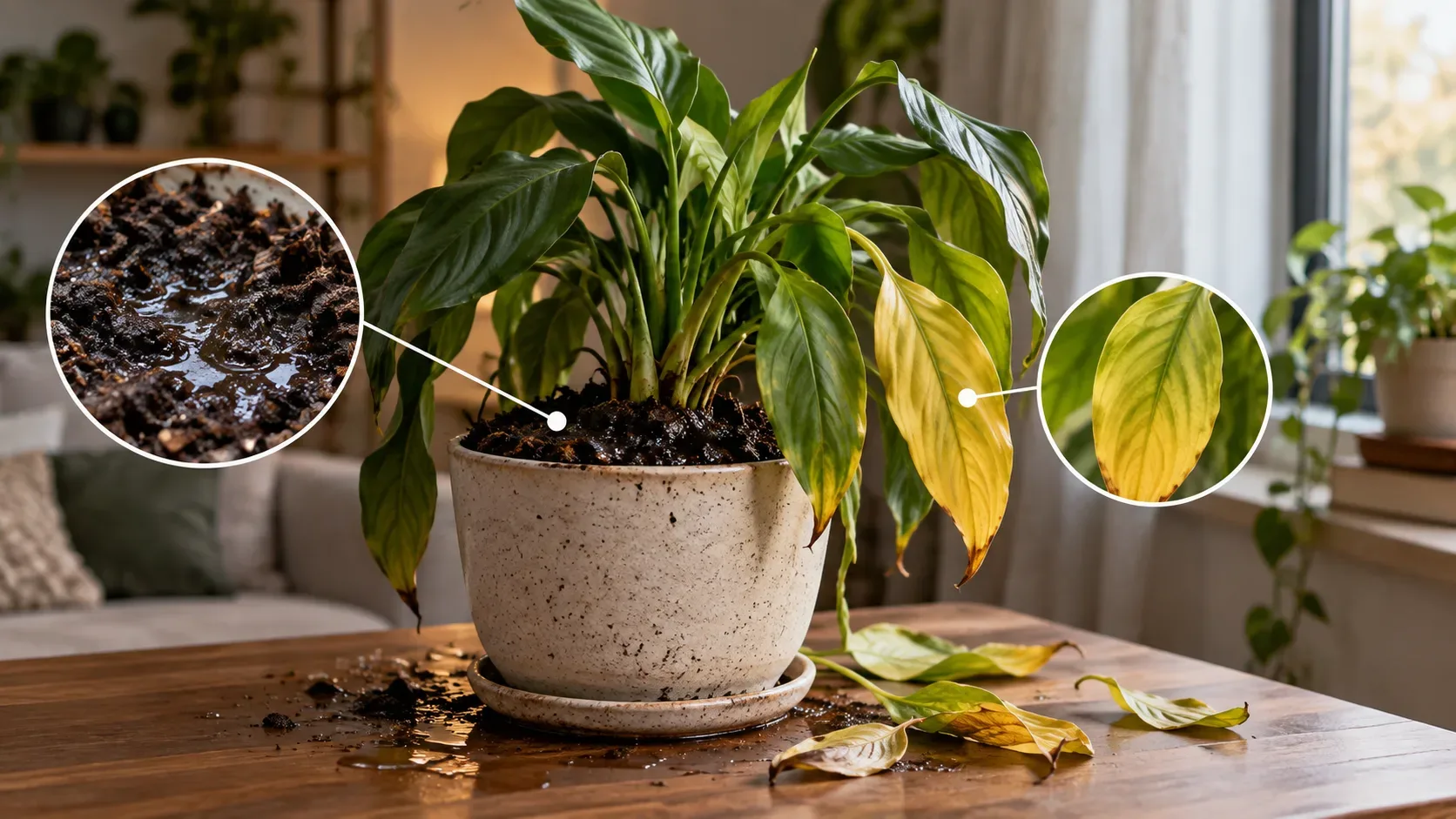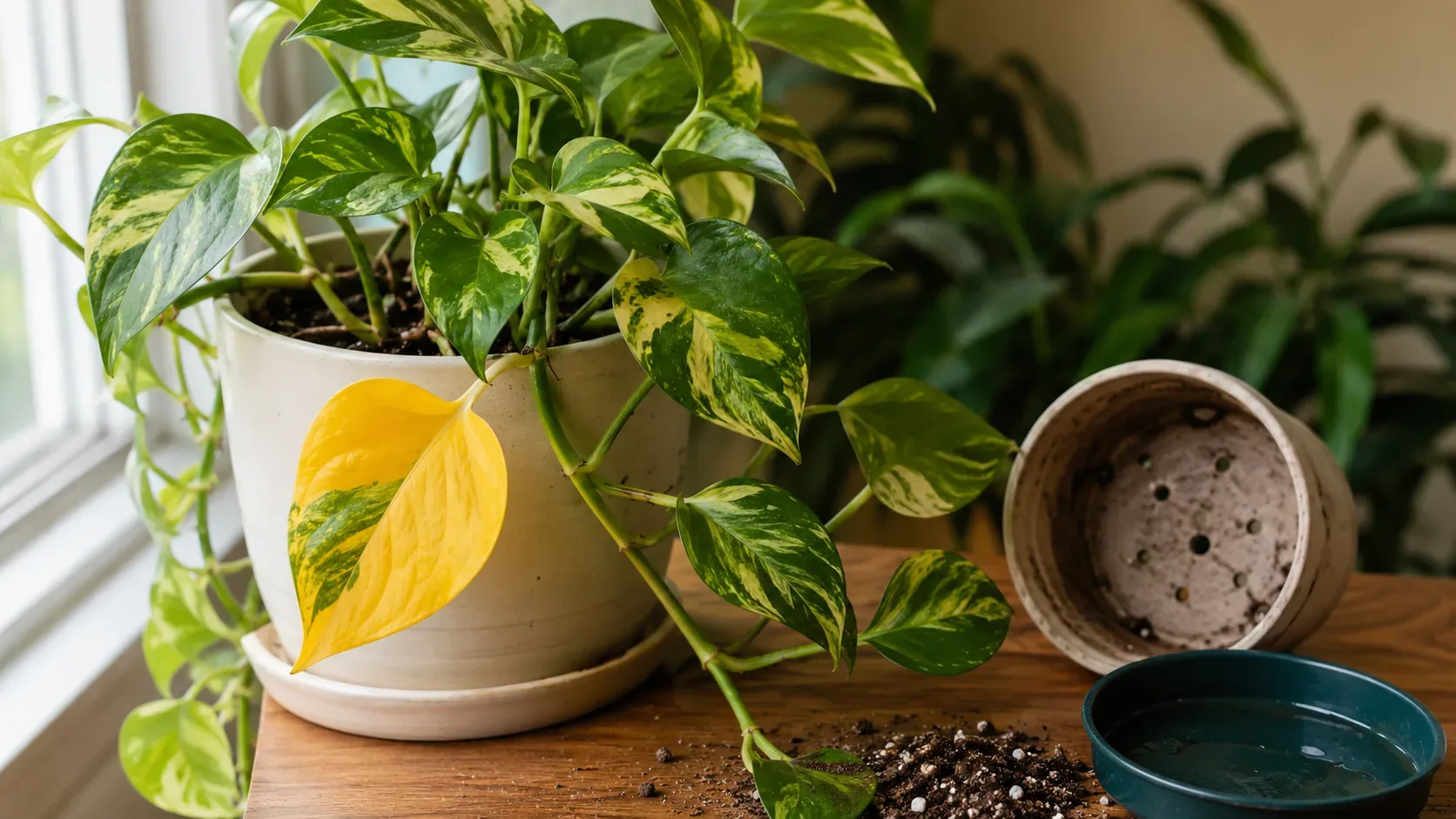
A yellow leaf on a boa constrictor is a sign, not a diagnosis. Excess water, dry substrate, low light, natural aging and root problems can produce similar changes. The photograph of the leaf alone does not show whether the center of the clod is still wet nor whether there is water hidden inside the cachepô.
Before watering again or repotting, record three things: how the humidity is below the surface, how much light the plant actually receives, and where the yellowing started. A three-day follow-up helps choose the first low-risk action, although it is not a substitute for inspecting the roots when there are signs of deterioration.
The three-day time frame used in this guide is a home screening protocol, not a botanical test capable of confirming a cause. Large pots, very retentive substrates and cold or humid environments may require longer monitoring.
First, confirm that the color has actually changed
Some boas have yellow or cream markings as a normal part of the variegation. The cultivar known as Neon, for example, has naturally greenish-yellow leaves. What deserves investigation is a change in relation to the plant's previous pattern: a leaf that has lost its green, turned entirely yellow, softened or started to fall.
An old leaf, close to the base of the branch, may turn yellow and fall off during natural renewal. The suspicion of a problem increases when several leaves are affected in a short time, new leaves also turn yellow or appear wilted, dark spots, softened stem and persistently moist substrate.
Why water and electricity need to be evaluated together in winter
The boa grows best in bright indirect light, although it tolerates less lit environments. In lower light conditions, growth tends to slow down and the plant uses less water. Therefore, maintaining the same watering frequency in winter as during a lighter period can leave the substrate wet for longer.
This does not mean automatically reducing watering on a calendar date. Drying speed depends on light, temperature, air humidity, pot size and material, substrate composition and root volume. The decision must follow the vase, not a fixed routine.
Low light should also not be diagnosed by the presence of yellow alone. In boa constrictors, it becomes more likely when other signs appear, such as thin and spaced growth, smaller new leaves, inclination towards the window and loss of variegation. When these signs appear near a vase that remains damp, too little light and too much water may be acting at the same time.
Three-day diary: observe before changing your routine
Day 1: record substrate, drainage and leaf pattern
Photograph the entire plant in a well-lit location, without changing the position of the pot. Also take a close-up image of the affected leaf next to a healthy leaf.
Then write it down:
- How many leaves are yellow and where on the branches they appear.
- Whether they are old sheets, new sheets, or a combination of the two.
- Whether the tissue is firm, soft, translucent, dry, or has brown edges.
- The date of the last watering, fertilization and change of location.
- If there has been a recent increase in watering frequency.
- If the plant is inside a cachepot or decorative container.
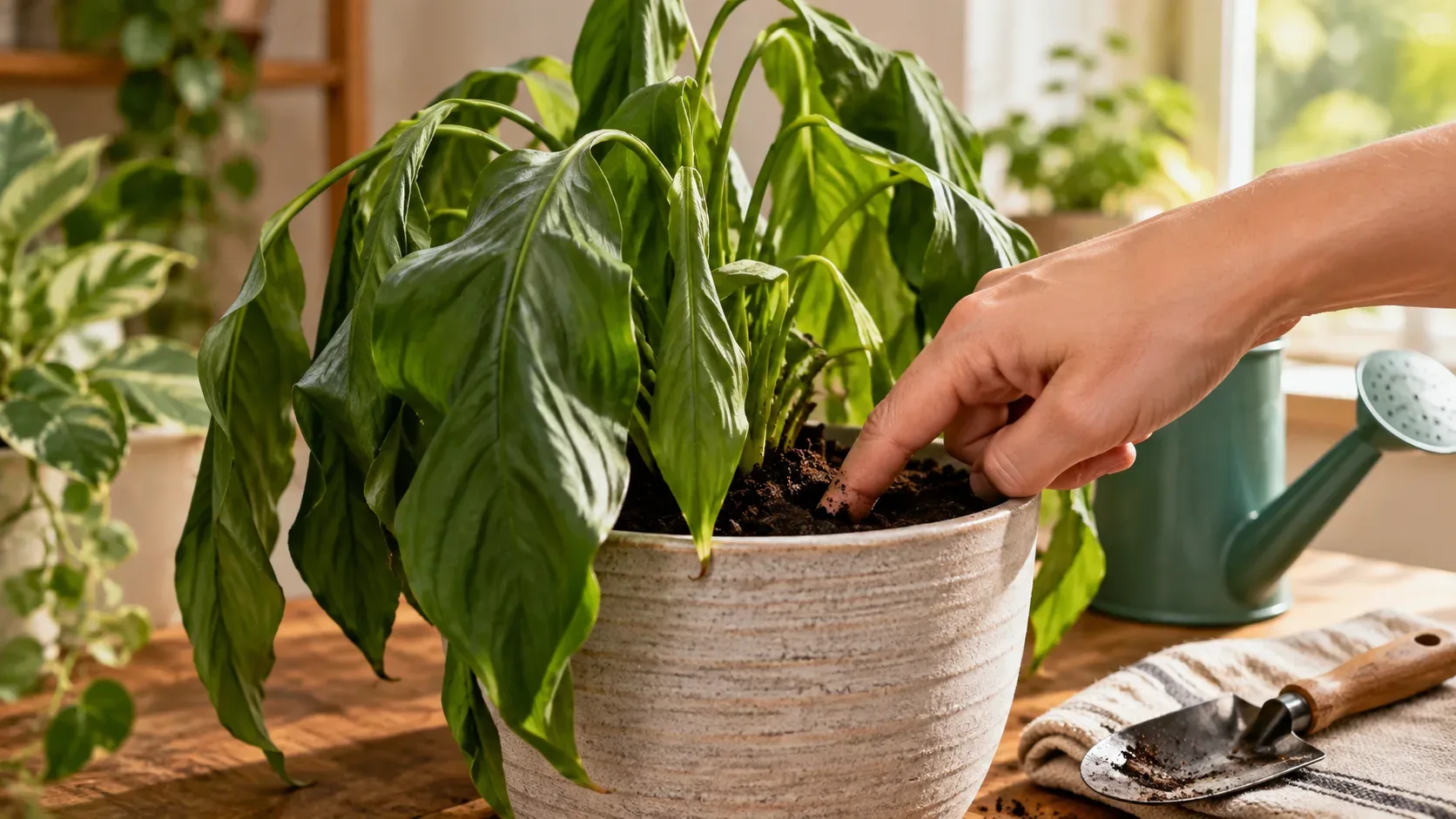
Touch the substrate close to the edge of the pot, advancing a few centimeters below the surface. The top layer may appear dry while the central region remains moist. Also compare the weight of the vase: a container that is still heavy after several days usually holds more water than its surface suggests. Touch, weight and joint observation are more reliable than watering scheduled for a specific day of the week.
Remove the inner vase from the cachepô and see if there is any accumulated water. Confirm that there are drainage holes and that they are free. Standing water should be discarded even if no other changes are made at that time. Dead-end containers or pots kept in water favor substrate saturation and root damage.
If the substrate is damp, do not water because of yellow leaves or wilting. If it is clearly dry in depth, the pot is light and the leaves have dry edges, water thoroughly, let any excess drain and record the time. Do not let water remain in the dish.
Day 2: monitor the real light at the location
Observe the position of the boa constrictor in the morning, in the middle of the day and in the late afternoon. Don’t just assume that the room “seems bright.” Awnings, buildings, curtains and the distance from the window can greatly reduce the light reaching the leaves.
Look for these signs of low light:
- longer and thinner branches;
- increasing spaces between one sheet and another;
- smaller new leaves;
- directed growth towards the window;
- loss of light spots in variegated varieties;
- gradual fall of old leaves;
- substrate taking longer to dry.
The boa tolerates low light, but tends to maintain denser foliage in bright indirect light. Loss of variegation is a particularly useful sign in varieties that typically have yellow or cream markings.
Do not transfer a plant that was in a dark corner directly into bright sunlight. If the position is inappropriate, plan to gradually approach a window with filtered light, avoiding intense afternoon sun, which can cause faded or burned areas.
Repeat the plant photograph from the same angle and, preferably, at the same time as on the first day. Check the humidity and weight of the vase again.
Day 3: Compare the trend
A leaf that has already turned yellow will not turn green again. The most important information is to know whether new leaves have been affected, whether the wilting has progressed and whether the substrate has started to dry out.
Compare records:
- Is the vase still heavy and damp?
- Did another yellow leaf appear?
- Are new and old sheets being affected at the same time?
- Does the plant continue to wilt despite the wet substrate?
- Is there a sour or decaying odor?
- Are the branches elongated and facing the window?
- A plant that was dry has regained some of its firmness after watering?
- Is there only one old sheet affected, with no progression of the problem?
These responses drive the decision tree. They should not be substituted for the appearance of a single photograph.
Decision tree: what is the first low-risk action?
1. The substrate remains wet and there is water in the cachepô or poor drainage
Excess water is the main hypothesis. Suspend further watering until the substrate reaches the appropriate drying level, discard accumulated water and keep the holes unobstructed.
Yellowing, drooping, wilting in wet soil and browning of banks can accompany excess water. Prolonged saturation reduces aeration of the substrate and compromises root function.
If the plant is also in a very dark place, correct the position gradually. More indirect light can restore a more compatible growth rate and water consumption, but it will not recover roots that are already rotten.
2. The pot drains, the substrate is not waterlogged, but there are accumulated signs of low light
Gradually move the boa constrictor closer to a bright, indirect light source. Keep watering conditioned to the humidity of the substrate; do not increase the amount of water to compensate for pale leaves.
Low light tends to produce a range of signs: weak or elongated growth, smaller leaves, leaning towards the window, loss of variegation and dropping of old leaves. The effect of lack of light is not corrected by more water, fertilizer or automatic changing of pots.
3. The substrate is dry, the pot is light and the leaves have dry edges
Water shortage becomes more likely. Water thoroughly, allow the excess to escape through the holes and watch for firmness to recover. Old leaves may turn yellow first on a plant that has become dry, often accompanied by wilting and brown or brittle edges.
Do not make up for the delay by leaving the pot in water or starting daily watering. Record how long it takes the substrate to start drying and use this information in your next decision.
4. Only one old leaf has turned yellow and the plant continues to grow
Yellowing may be part of normal renewal. Keep handling and observe for a few more days. Changing the pot is not justified when there is no progress, the base remains firm, the container drains and the rest of the plant is healthy.
5. There are delimited spots, webs, sticky spots or white masses
Research should no longer be restricted to water and electricity. Spider mites, mealybugs and foliar problems can also produce yellowing. Photograph the back of the leaves, temporarily move the plant away from other pots and look for identification before applying any product.
When root inspection becomes necessary
Changing the pot just because a leaf has turned yellow adds an intervention without confirming the cause. Root manipulation becomes more justifiable when two or more of these signs appear:
- substrate that remains saturated for several days;
- increasing wilting despite high humidity;
- yellowing advancing rapidly;
- sour or decaying odor;
- dark or softened stem base;
- roots visible in hole that are soft or falling apart;
- container without drainage;
- compacted substrate that does not absorb or release water uniformly.
Functional roots tend to be firm and flexible. Compromised roots may become brown or black, soft, brittle and have an unpleasant odor. Color alone is not enough: texture, structure and smell must be evaluated together.
If these alerts are present, remove the root ball carefully enough to examine the outside and bottom. Do not pull the plant by its leaves or pull up all the roots to “look” for a problem.
When the roots are firm, the substrate begins to dry and there is no abnormal odor, correcting the drainage and watering routine may be sufficient. If the roots are soft and deteriorated, it may be necessary to remove clearly dead tissue with a clean tool, use aerated substrate and transfer the plant to a clean container with holes. A bigger pot is not automatically better: the volume must match the healthy roots that remain.
To delve deeper into this decision, consult the guide When not to change a potted plant: signs to watch out for before repotting. The broader context of cold, light and humidity is in Plant suffering in winter: how to separate cold, low light and excess water.
Photographic checklist to compare the three days
Take the images before any changes to the location, watering or removing the pot:
- whole plant, with the vase and window in the frame;
- affected leaf next to a healthy leaf;
- point on the branch where the yellowing began;
- substrate surface;
- base of stems;
- back of affected sheets;
- drainage holes;
- interior of the plate or cachepô;
- general photograph repeated at the same angle and time.
Avoid relying on color differences between photographs taken under different lights. The record should mainly show quantity, distribution, wilting, falling and advancement of damage.
What not to do during the three days
Do not fertilize the boa just because the leaves have turned yellow. Nutritional deficiency is a possibility, but fertilizing a plant with compromised or slow-growing roots can increase salt buildup without correcting the root cause. Fertilization should be reevaluated after humidity, drainage and light are stabilized.
Also, do not apply fungicide, insecticide or homemade mixture without identifying a pest or disease. These products will not correct low light, standing water or undrained containers.
Avoid changing the pot, substrate, lighting, watering, pruning and fertilization on the same day. If the plant gets better or worse, it will be difficult to figure out which change produced the response.
Boa contains calcium oxalate crystals and should not be ingested. The sap can also irritate sensitive skin; wear gloves when cutting roots or branches, and keep the plant out of reach of children and animals that could chew it.
Before changing your routine, record three observations: subsurface moisture, drainage condition, and yellowing pattern. This set tells more about the boa constrictor than the color of an isolated leaf.