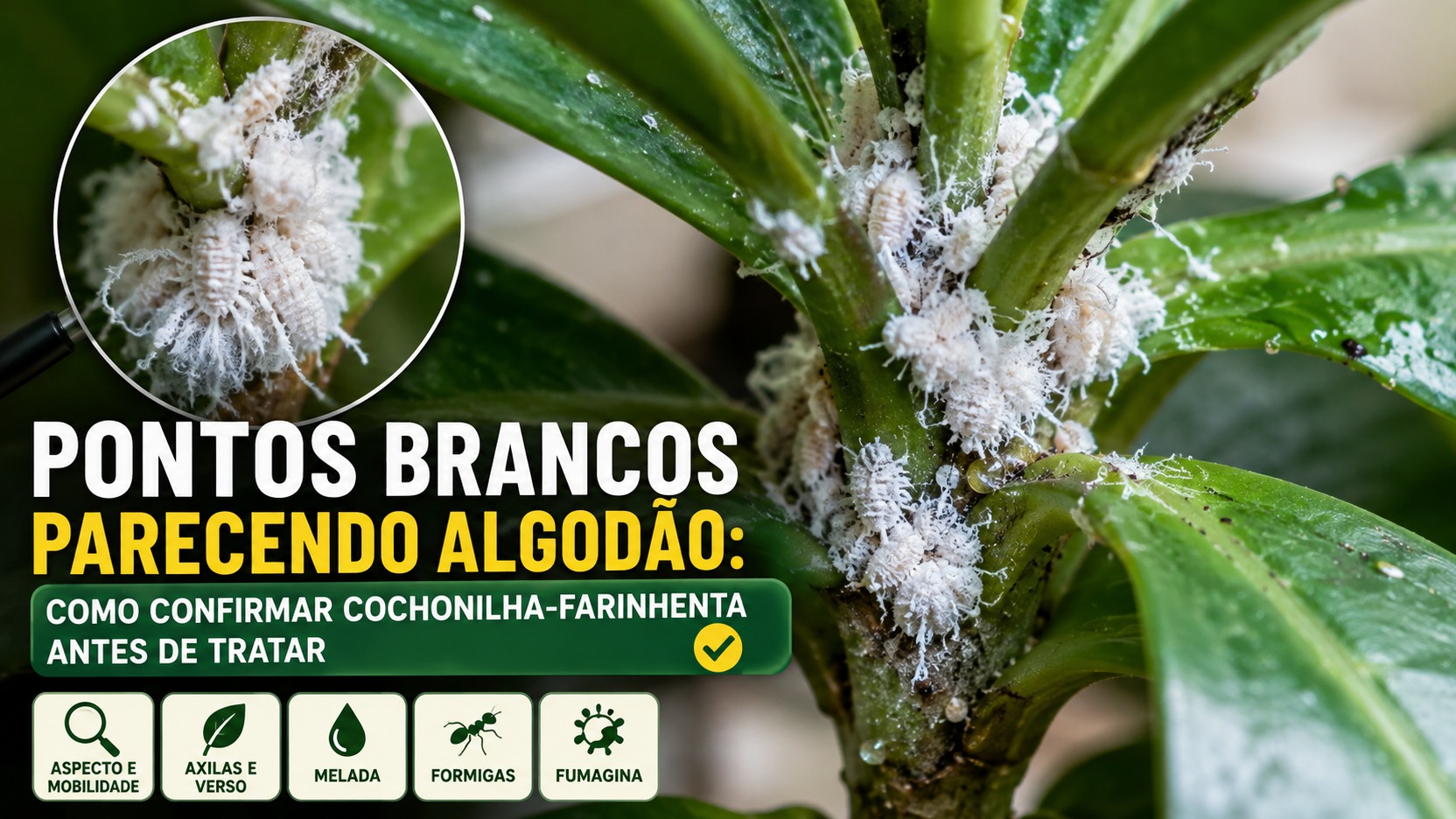
White dots that resemble cotton wool are a classic sign of mealybug, but the white appearance alone is not enough to confirm the diagnosis. The safest way is to confirm if there are insects with a defined body, look for their preferred hiding places and check indirect signs before applying any product. This avoids treating fungus, dust, mineral residue or another insect as if it were cochineal.
First confirm whether there is an insect under the white
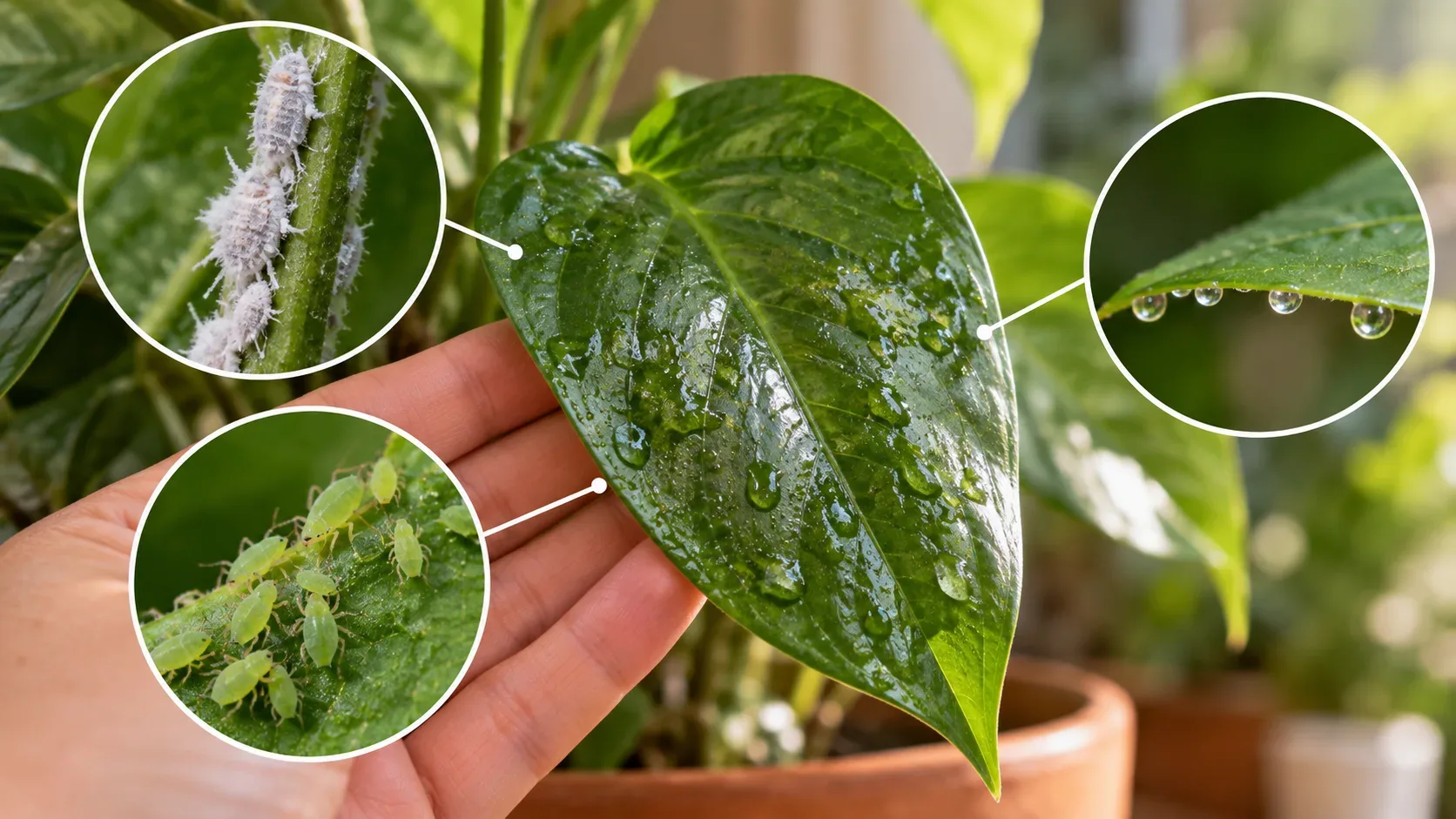
The mealybug is a sucking insect with a soft, oval and segmented body, generally covered with a white waxy layer. In visible infestations, the aggregate may look like flour, cotton wool or small clumps stuck to the plant. With a magnifying glass or your cell phone camera, look for an oval body beneath the wax and, where possible, white filaments around the sides.
Mobility helps, but should not be used as a sole test. Young nymphs move around the plant and females of many species maintain functional legs, but individuals already installed at a feeding point can remain almost stationary. If you touch it lightly with a toothpick and notice the body, legs or movement, suspicion increases. If there is no movement, continue the inspection rather than concluding it is fungus.
Look for the places where cochineal usually hides
An isolated white dot in the middle of a leaf says less than several outbreaks concentrated in protected regions. Mealybugs usually live where leaves join the stem, in axils, folds, new shoots, veins on the back of leaves, crowns, bifurcations and parts touching each other. Some species can also occur in the stem close to the substrate and in the roots.
Examine the plan from top to bottom and don't stop at the part that catches your attention. Gently open overlapping leaves, look at the back, check the base of the petioles, the meeting between leaf and stem, the new shoots and the gaps in the vase, tutor and small dish. In plants that present the problem again after successive cleanings, it is also worth checking the collar region and white marks near the drainage holes.
Use honeydew, ants and sooty mold as supporting clues
The cochineal feeds on sap and can excrete honeydew, a sticky, sugary substance. Shiny or sticky leaves, drops on surfaces beneath the plant, and nearby honeydew objects reinforce the suspicion of a sucking insect. Still, honeydew isn't exclusive to mealybugs; aphids, whiteflies and some scale insects can also produce it.
Ants repeatedly circling the stem and leaves are another clue, as they may seek out the honeydew. The presence of ants does not alone confirm which pest is present, but it does indicate that it is worth looking carefully for hidden sucking insects.
Sooty mold appears as a dark or black layer that grows on surfaces covered in honeydew. It also works as an indirect sign: it points to persistent production of sugary secretion, but does not identify the species responsible. If sooty mold is present, look for the source of the honeydew before trying to resolve just the black layer.
How to differentiate from mold, powdery mildew and white residue
The best difference is to look for the organism's structure and distribution pattern. In mealybugs, the white often forms localized clumps and may reveal segmented oval bodies, waxy filaments, and cotton-like egg masses.. The concentration in armpits, folds and junctions is also very characteristic.
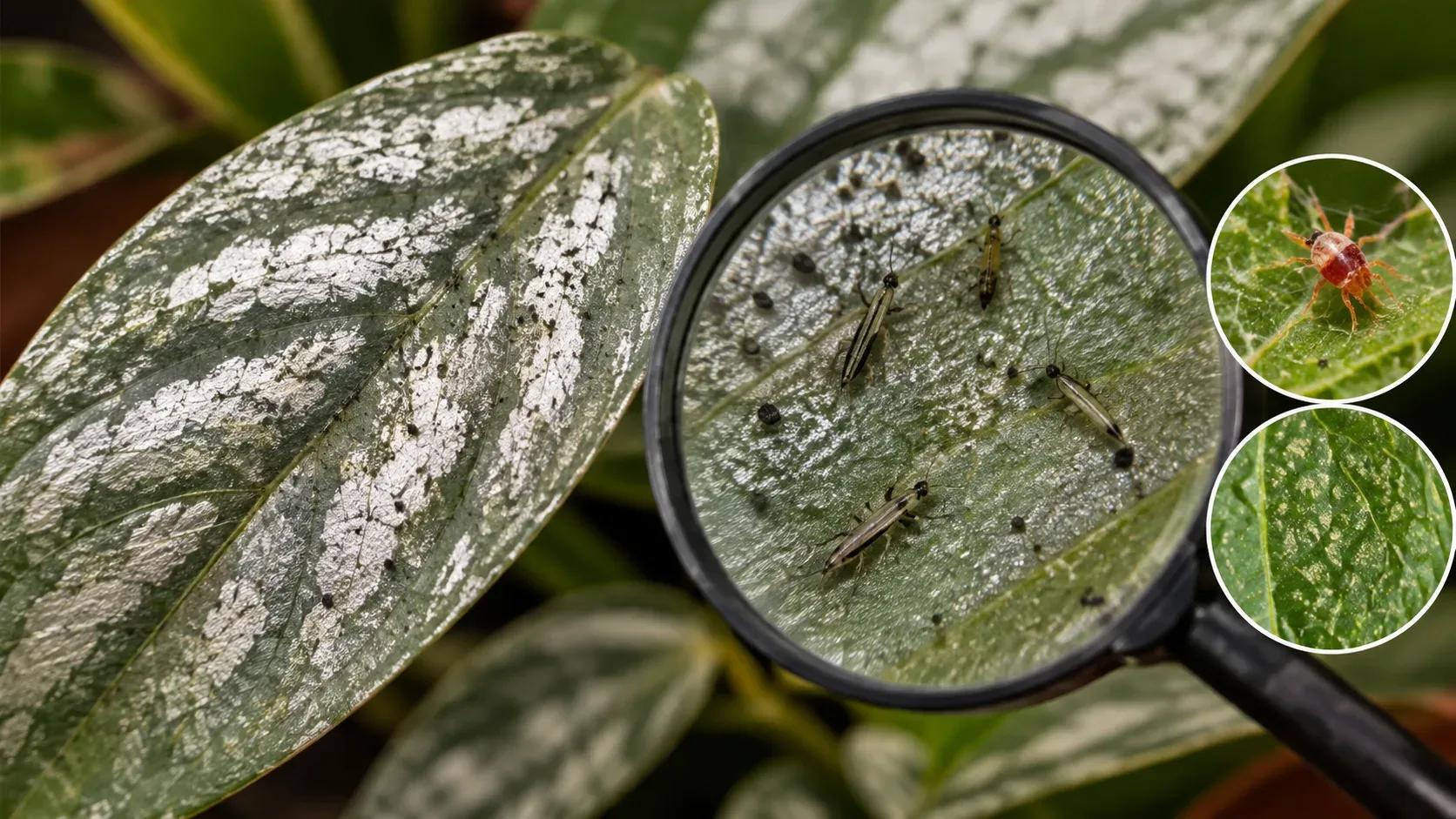
Powdery mildew, on the other hand, tends to form whitish, powdery spots or plaques on the surface of leaves, buds and stems, with the appearance of talc or scattered flour. You don't find an individual insect body within each stain. Other fungi can produce fuzzy growth on diseased tissue, especially when there is injury, rot, or high humidity; in this case, the context of the injury matters as much as the color white.
Residues from hard water, foliar fertilizer, dust or sprayed products can also leave clear marks, but they are generally not systematically concentrated in axils and shoots nor are they accompanied by segmented bodies, honeydew and ants. If the mark comes out as a uniform film and there are no insects visible even under magnification, avoid applying insecticide just for visual similarity.
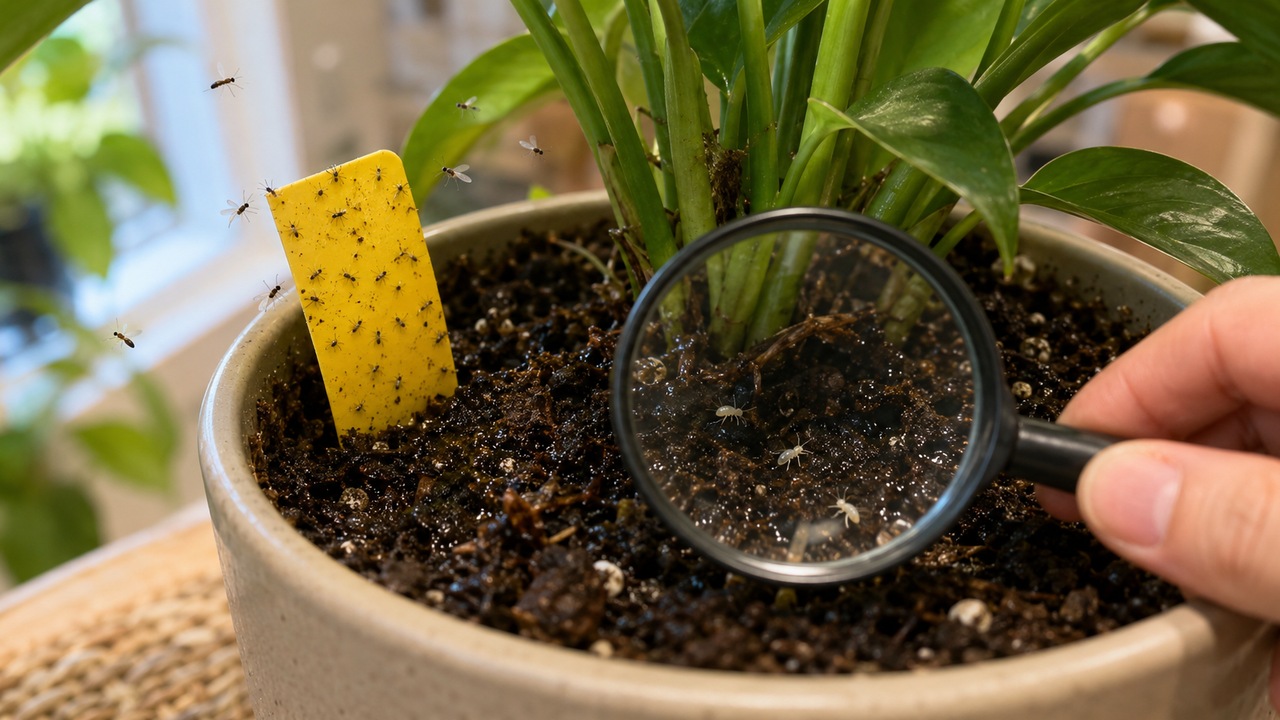
There are also other insects that produce white wax. Whiteflies, scale insects and other suckers can generate clear deposits and honeydew. Therefore, the strongest confirmation comes from the combination of segmented oval body, waxy or cotton-like covering and typical location, and not from a single sign.
If the focus is small, start with the localized control
When there are few individuals on an indoor plant and the infestation is restricted to a few axils or leaves, the first intervention may be mechanical. Move the plant away from the others, especially if leaves in neighboring pots touch, as young mealybugs can walk from one plant to another. Remove visible individuals with tweezers, cloth or cotton swab and discard the removed material.
In resistant plants, a jet of water can dislodge part of the exposed population. Another option used for small outbreaks is to directly touch the insects with cotton dipped in isopropyl alcohol at an appropriate concentration. As some plant species can suffer from burns, test first on a small area and wait a day or two to observe the reaction before expanding use.
A well-done cleaning rarely means the problem is gone. Eggs, very small nymphs and hidden insects can remain out of sight. After the first removal, continue inspecting the plant, the pot, the holder and nearby plants at regular intervals and repeat the removal whenever new outbreaks appear.
If the infestation is widespread, change your strategy
When tufts appear on many leaves, shoots and junctions, individual removal may no longer be sufficient. Heavily infested parts can be pruned if the species tolerates pruning and if it does not compromise the plant too much. The removed material should be discarded immediately, as insects can survive while the fabric remains damp.
Contact products, such as commercial insecticidal soaps and plant-friendly horticultural oils, can reduce populations when they reach insects directly. Coverage is important because the wax layer and hiding places protect part of the population. In many cases, reapplications are necessary according to the product label.
Avoid using household detergent as a substitute for insecticidal soap. Homemade formulations can cause burns and do not have the same standardization as products formulated for use on plants.. For any product, confirm on the label that the plant species and place of use are compatible, apply at the indicated dose and test on a small area when there is a risk of sensitivity.
If the mealybug keeps coming back, look for the source that was hidden
Recurrence after several cleanings may mean that eggs and nymphs are escaping inspection, that nearby plants remain infested, or that there are mealybugs in less visible regions. Examine the base of the stem, cracks in the vase, holder, cachepot and small plate. White masses near drainage holes, yellowing without a clear cause, wilting or poor growth may warrant inspection of the roots, as some mealybugs live below the substrate.
Root infestations are more difficult to control with contact measures applied only to the aerial part. In a very infested, weakened and easily replaced plant, discarding the specimen may be more practical than prolonging an outbreak capable of contaminating other plants. The decision depends on the value of the plant, the degree of damage and the possibility of separating the pot during handling.
Be careful with phytotoxicity and overtreatment
The purpose of confirming the pest before taking action is to avoid a second problem caused by the treatment itself. Alcohol, soaps, oils and other products can harm sensitive species, especially when applied in inadequate concentrations, to dehydrated plants or in unfavorable conditions. Test on a small part, follow the label and observe the reaction before treating the entire plant.
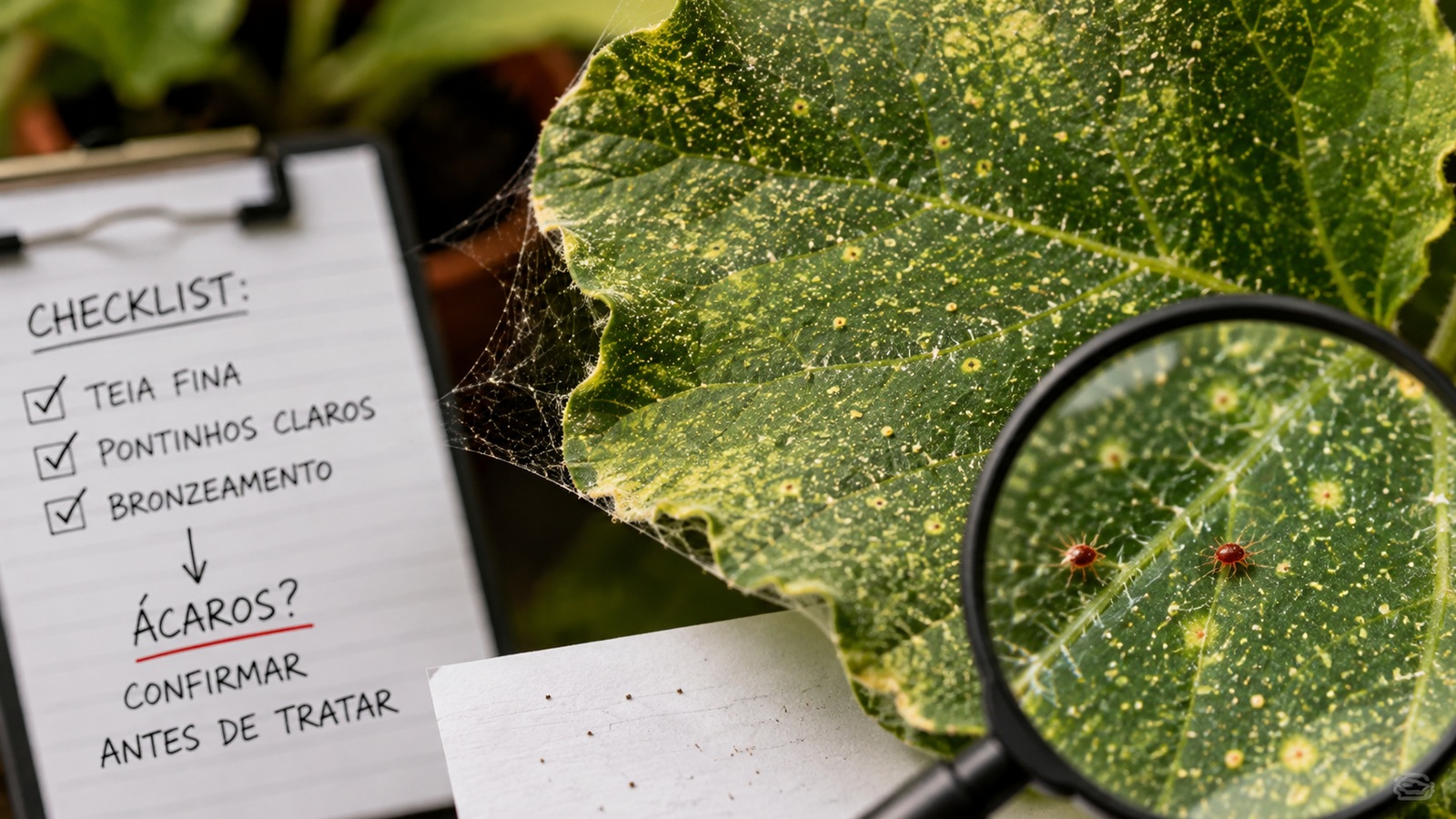
More product does not compensate for uncertain identification. If the white does not reveal insect bodies, does not appear in typical hiding places, and there are no coherent signs such as honeydew, eggs, or localized recurrence, return to diagnosis. Enlarged photographs, inspection with a magnifying glass, and observation for a few days are often more helpful than starting several treatments at the same time.
Confirmation comes from the set of signals
The mealybug becomes much more likely when you find small oval and segmented bodies covered in white wax, concentrated in axils, folds, ribs or buds, accompanied or not by cottony masses of eggs. Honeydew, ants and sooty mold reinforce the picture, but they are secondary clues.
With few individuals, remove and monitor. With widespread infestation, combine cleaning, pruning when appropriate and contact products compatible with the plant. If the problem reappears, look for hiding places and roots before increasing the treatment. This sequence reduces the risk of mistaking simple residue or fungus for mealybug and helps treat the stage and location that is actually sustaining the infestation.