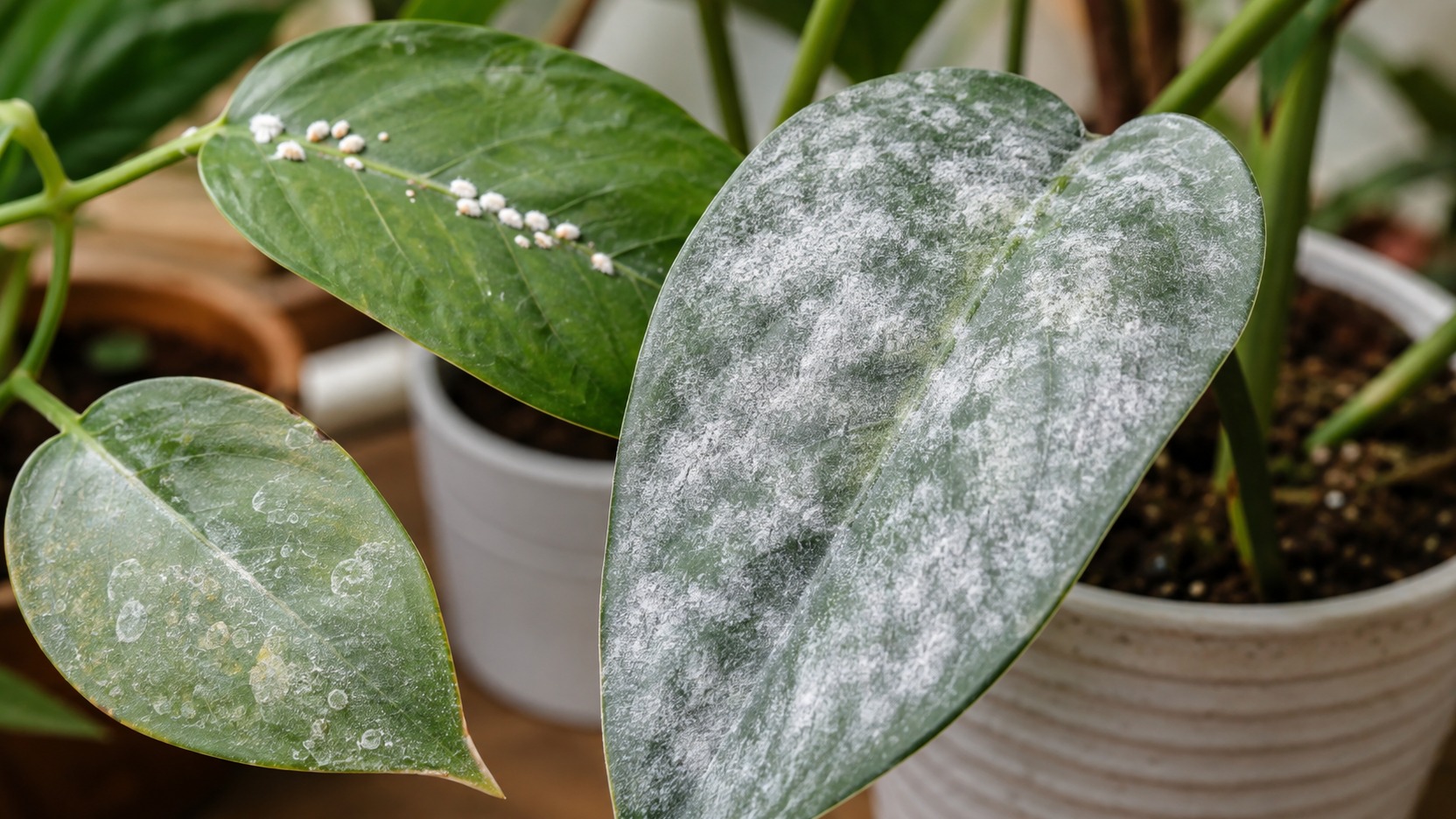
White powder on the leaves of a potted plant is consistent with powdery mildew, but color alone does not establish the diagnosis. The same “white” appearance can come from mealybugs covered in wax, residue left by water or sprays, and other problems. Before applying a fungicide or a homemade remedy, the best decision is to observe how the material is distributed, whether insect structures are present, and whether the pattern is spreading over living tissue.
Powdery mildew is the name given to a group of diseases caused by fungi that form white to grayish growth, usually superficial, on leaves and other green plant parts. UC IPM describes this growth as powdery and capable of forming patches that increase in size. University of Minnesota Extension uses a useful comparison: the plant may look as if it has been dusted with talcum powder or covered with a very fine web-like film. Embrapa also describes a whitish or powdery appearance as a typical sign in different crops.
What to look for first on the leaf
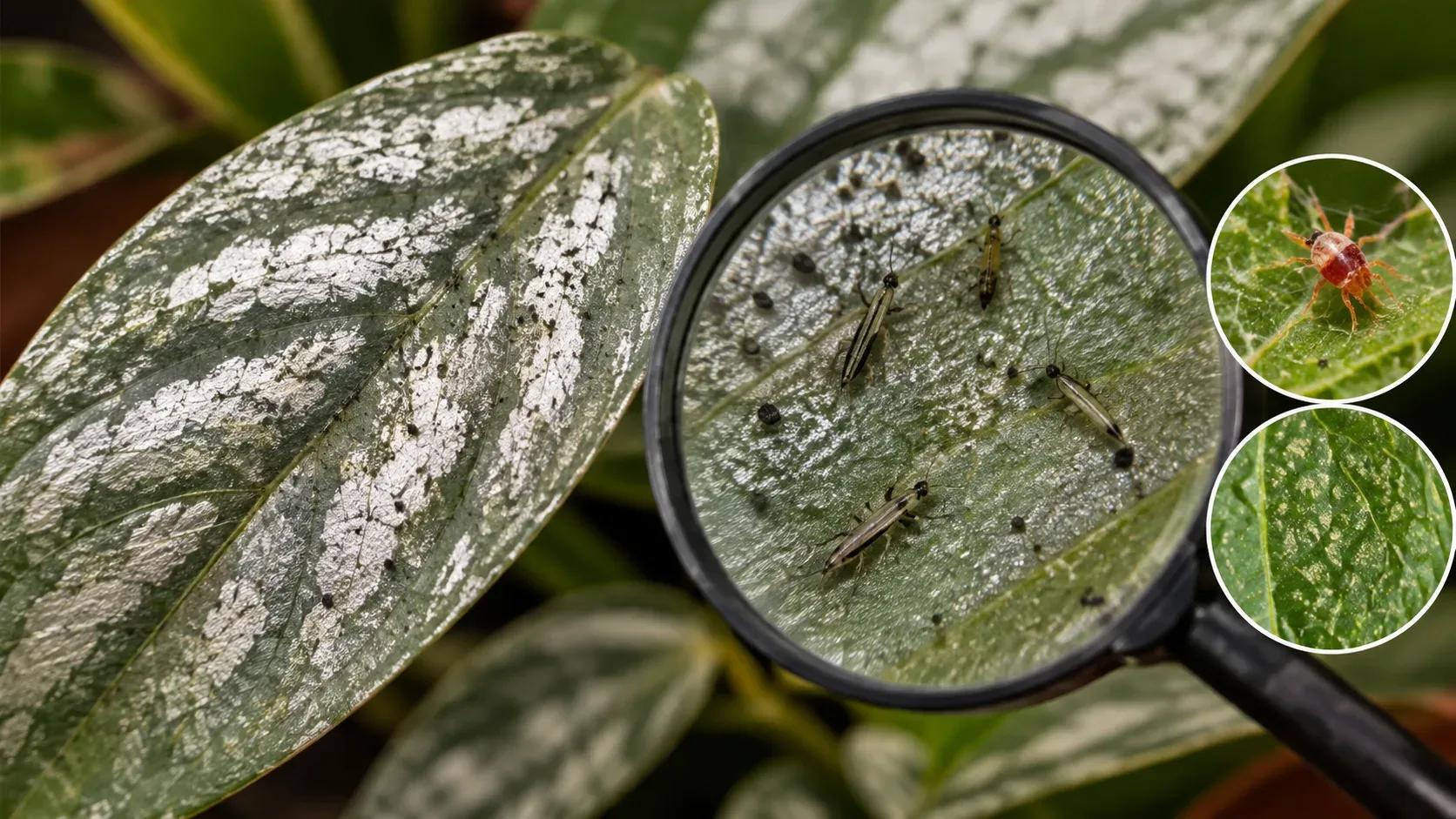
Start with distribution. With powdery mildew, the white material tends to appear as spots, patches, or diffuse areas that seem to form a film over the leaf surface. On some hosts it starts in small colonies and then covers larger areas. The pattern may appear on the upper surface, the lower surface, or both, depending on the plant and the fungus involved.
Also observe whether the white area looks like very fine powder or a shallow felt-like coating, without the appearance of individual bodies. As the disease progresses, some plants develop yellowing, deformed or twisted leaves, or premature leaf drop. These signs are not required early on, but they strengthen the suspicion when they accompany the powdery growth.
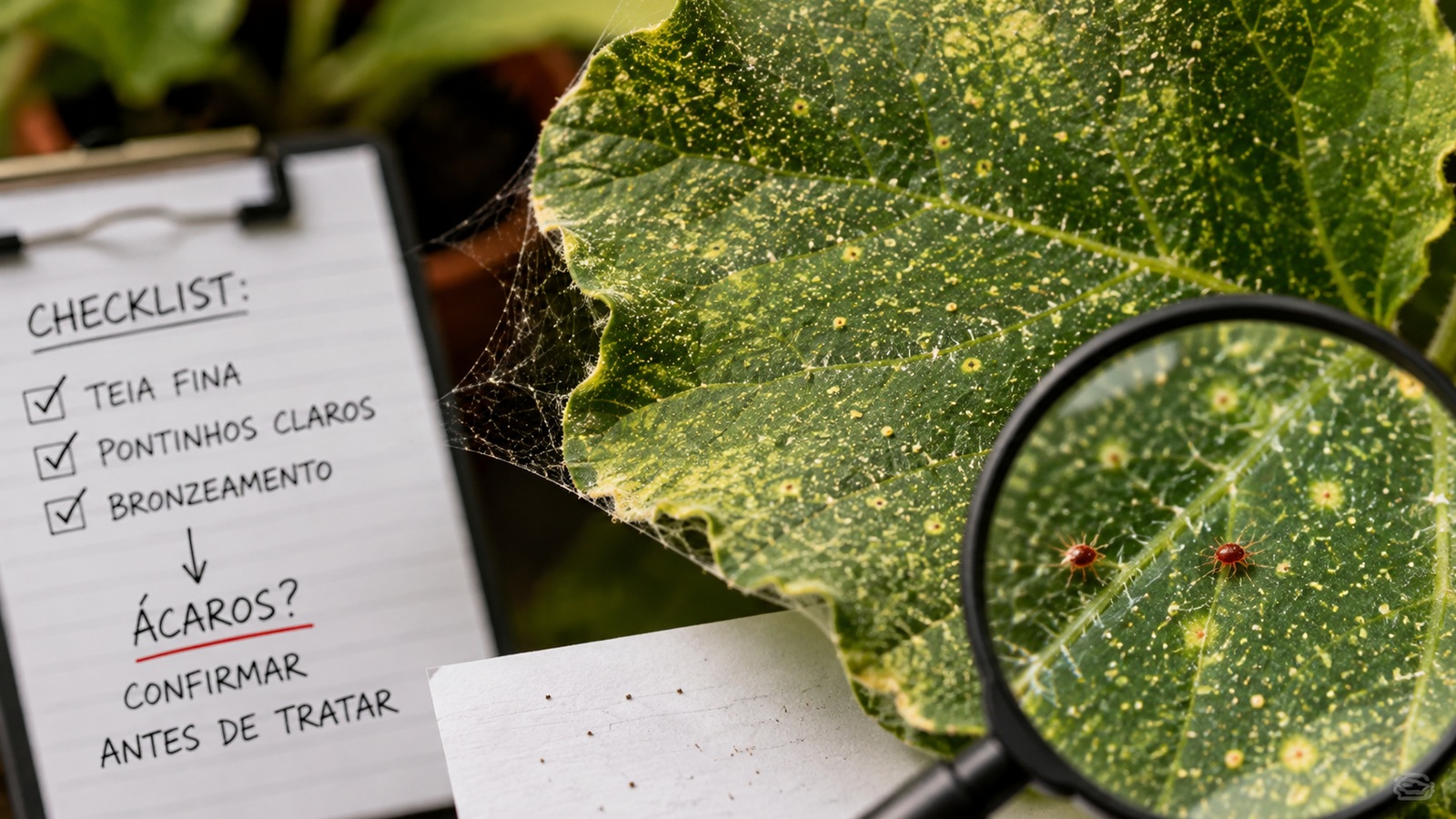
A simple magnifying glass helps. Powdery mildew fungi produce mycelium and spores on the tissue surface. You do not need to identify the species to make the first decision, but you should try to answer a simpler question: is there a diffuse layer of growth over the leaf, or are there small separate organisms grouped in specific spots?
The wipe test helps, but it does not prove the diagnosis by itself
Gently wiping a small area with a cloth or cotton swab can help you understand the texture, but it should not be used as the only test. Powdery mildew growth is superficial, and some of it may come off when touched. Water or spray residue can also come off. Therefore, “it came off when I wiped it” neither confirms nor rules out the disease.
After cleaning only a small area, keep track of that leaf and watch how it changes. If the white material returns or new spots appear on nearby tissue, the hypothesis of a biological problem becomes stronger. If the marks remain limited to droplet rings, splashes, or a film that does not expand, physical residue becomes more likely.
Avoid rubbing several leaves before you finish the inspection. Besides erasing visual clues, contact between leaves, hands, and tools can transfer pests or pathogen structures from one part of the plant to another.
How to tell powdery mildew from mealybugs
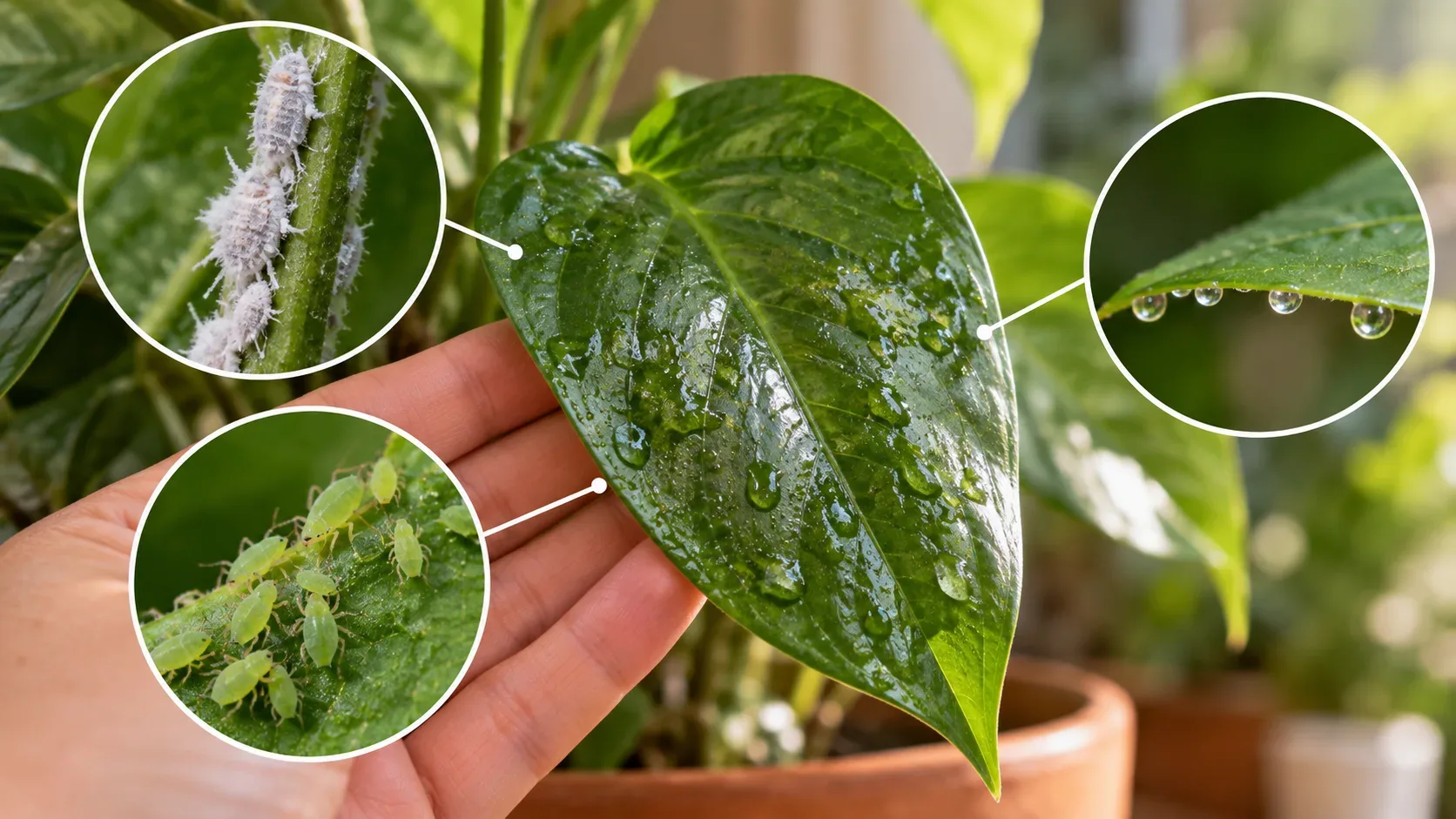
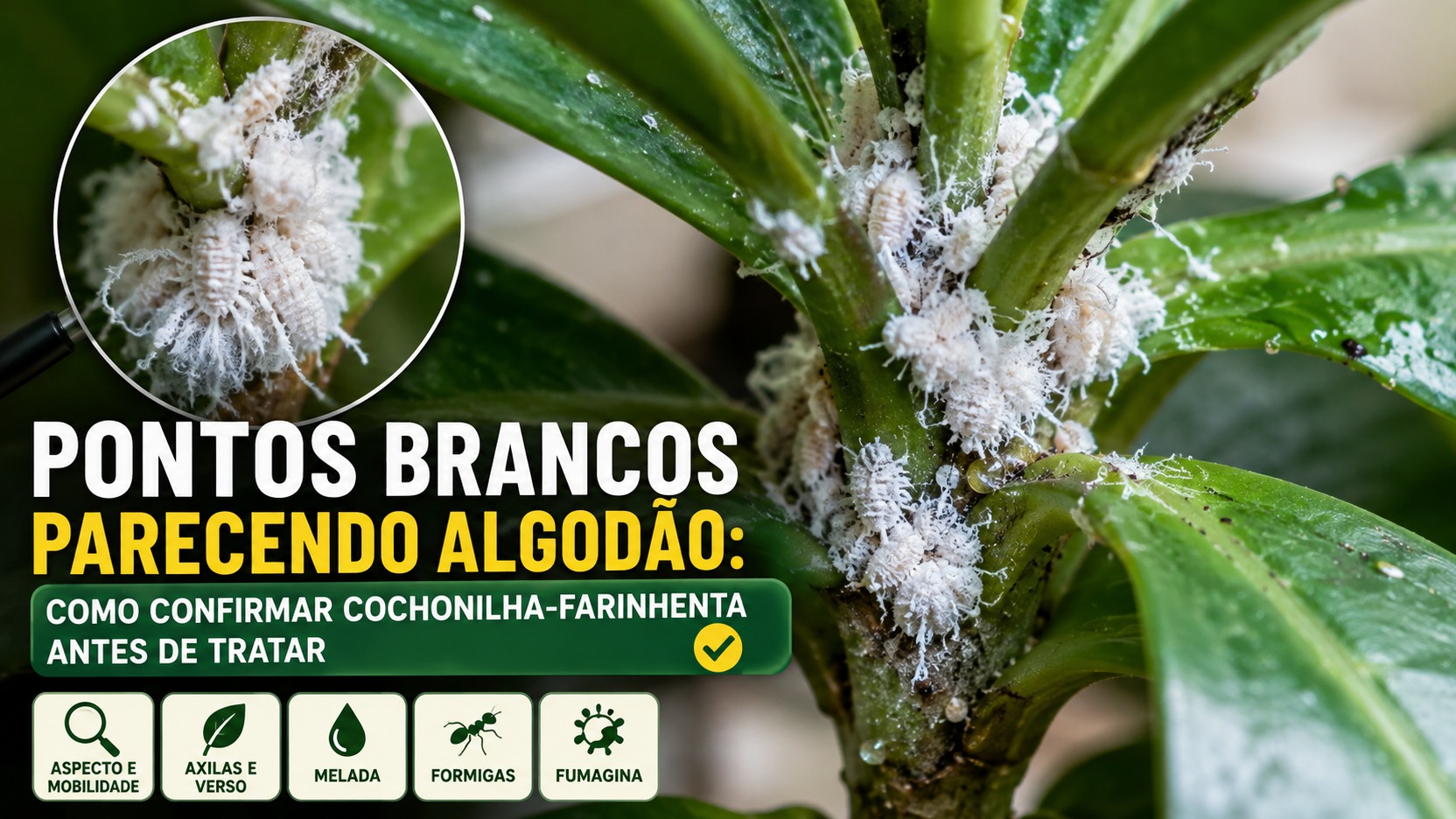
Mealybugs can be confusing because they also produce white material. The main difference is that a mealybug is an insect. Instead of a continuous film or powdery patches spread over the surface, look for small oval or segmented bodies covered with white wax, often in clusters.
UC IPM reports that mealybugs on houseplants often concentrate along veins, where the petiole meets the stem, in leaf axils, folds, and other protected crevices. These locations matter: a cottony cluster hidden where a leaf meets the stem is much more suggestive of mealybugs than powdery mildew.
Another clue is the presence of a sticky substance known as honeydew, along with ants or associated dark sooty mold. Not every infestation shows all of these signs, but they point toward sap-sucking insects. With powdery mildew, the white material is fungal growth; with mealybugs, you can find individual organisms and waxy material around them.
In practice, hold the leaf toward the light and inspect it with a magnifying glass. If the “powder” resolves visually into small oval structures, waxy filaments, or localized colonies, do not treat it as a fungus before confirming the pest.
How to tell powdery mildew from residue
Mineral residue, water marks, and remnants of products applied to leaves can leave pale areas. They often follow the path of a droplet that dried, form circles, edges, or splash-shaped marks, and may appear similarly on leaves, pot rims, or nearby surfaces.
This pattern differs from the irregular growth of a powdery mildew colony, which tends to occupy plant tissue in powdery patches and may enlarge over several days. Residue also should not produce insect bodies, sticky honeydew, progressive distortion of new growth, or expansion of a white felt-like layer over new areas of the leaf.
Cleaning a single leaf and then observing it is more useful here than cleaning the whole plant. If the marks disappear and do not return without another spray or renewed contact with the water that caused them, that supports the residue hypothesis. If new white colonies appear on living tissue, investigate powdery mildew or another biological cause.
What weakens the powdery mildew hypothesis
A powdery mildew suspicion becomes weaker when the white material appears only as localized tufts in axils and along veins and you can distinguish insects. It also becomes weaker when the marks are exclusively circular, follow dried droplets, and do not change over time.
Another reason not to force the diagnosis is white growth concentrated on the underside of the leaf accompanied by water-soaked, yellow, or necrotic-looking spots on the upper surface. Some diseases other than powdery mildew can produce pale or whitish structures. If the pattern does not match the typical superficial powdery growth, it is better to avoid a specific treatment until the problem is clearer.
It is also incorrect to conclude that “it cannot be powdery mildew” because the leaf was never wet. Unlike several other foliar fungi, many powdery mildew pathogens can germinate and infect without free water on the surface. Shade, moderate temperatures, and poor air circulation can favor the disease, depending on the host.
First step when the pattern really looks like powdery mildew
If the inspection points to powdery mildew, temporarily move the pot away from other plants to make monitoring easier and reduce contact while you decide on management. Examine new leaves, older leaves, stems, and nearby plants. The goal is to determine whether there are only a few localized patches or whether the disease is already widespread.
With a small infection, remove only heavily affected leaves when doing so will not excessively defoliate the plant, and discard the material. Clean tools after use. Then correct factors that may maintain a favorable microclimate: avoid crowding plants, improve air circulation, and, if the species allows, provide appropriate light without suddenly exposing it to sun that could scorch the leaves.
There is no need to turn the first suspicion into a sequence of sprays. University of Minnesota Extension notes that low levels of powdery mildew can be tolerated on many ornamentals when they are not reducing growth or flowering. The decision to use a fungicide depends on the species, the extent of the problem, the value of the plant, and its history of recurrence.
If treatment is necessary
When powdery mildew is advancing or affects a very susceptible plant, fungicide products may be part of management, but the choice should follow the label and the indication for the plant in question. Ornamental plants vary greatly in sensitivity, and a product tolerated by one species can cause phytotoxicity in another.
UC IPM mentions lower-impact options for some situations, such as horticultural oils, sulfur, and potassium bicarbonate, but it also warns about the risk of damage when products are used under inappropriate conditions or combined incorrectly. For that reason, improvising concentrations, mixing products, or applying a substance simply because it appears in a generic internet recipe is not a good idea.
Treatment also should not be judged only by the immediate appearance of a leaf that is already affected. The main goal is to limit progression and protect healthy tissue. Older areas may remain stained or may not fully recover their original appearance even when the disease stops advancing.
When a more precise identification is worthwhile
Seek technical help when the plant is valuable, when the problem keeps returning despite management adjustments, when the white material does not clearly match any of the patterns described, or when there are extensive lesions, rapid leaf drop, and shoot dieback.
Sharp photographs help a great deal. Photograph the whole plant, the upper and lower leaf surfaces, where leaves meet stems, and a close-up detail of the white material. If possible, take the photographs before cleaning or spraying. This preserves the clues needed to distinguish fungus, insect, and residue.
The practical rule for avoiding blind treatment
Think about the pattern first, not just the color. Powdery mildew tends to form a white or grayish powdery coating that spreads over living tissue. Mealybugs tend to reveal insects and waxy masses concentrated along veins, axils, and crevices. Residue tends to follow droplets, splashes, or films without progressive biological growth.
If your plant looks as if it has been “dusted” and the patches are getting larger, powdery mildew is a strong hypothesis. If there are small tufts with defined bodies and sticky signs, investigate mealybugs. If the marks repeat the shape of droplets and do not progress, investigate the water or the product that was applied. This initial confirmation avoids a common mistake: treating the wrong problem and losing the clues that would help identify it.