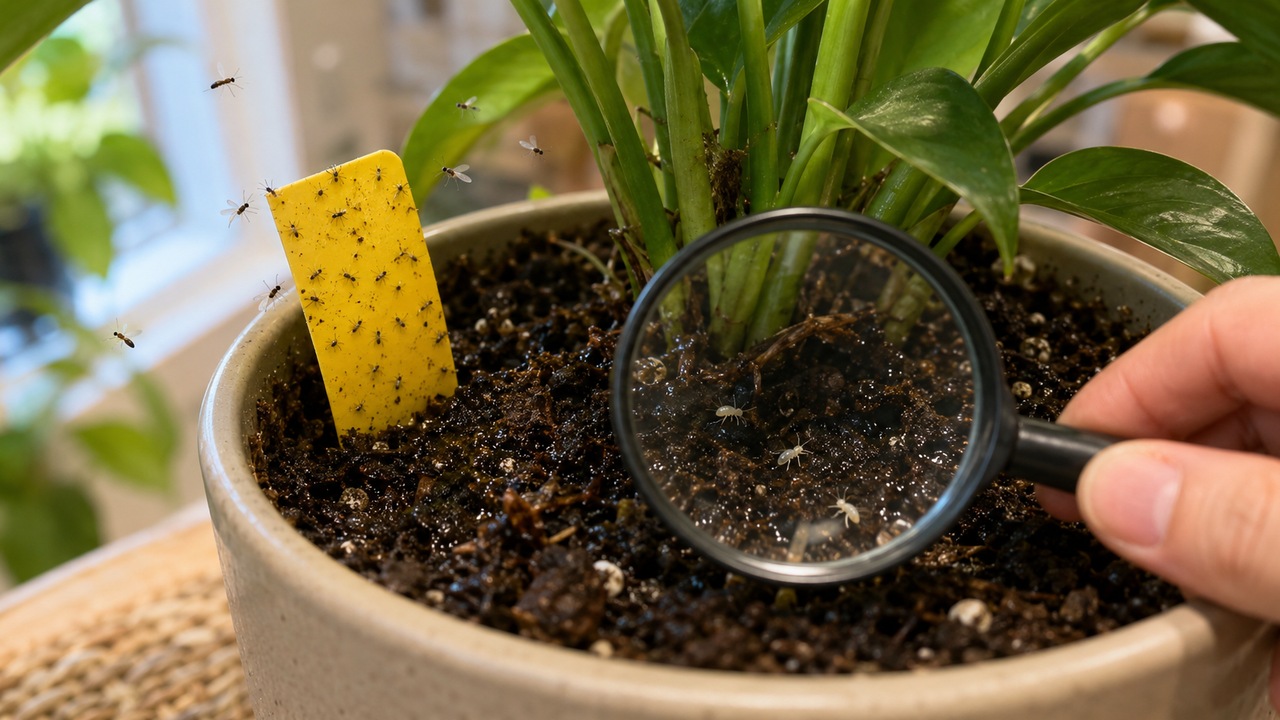
You touch the vase and little animals appear. Some take off on short trajectories; others look like specks of dust running or jumping across the earth. At first glance, everything could look like a “plant mosquito”, but the difference matters: fungus gnats have a larval phase in the substrate that can reach roots, while springtails are wingless soil organisms, generally associated with humidity and decomposing organic matter and rarely cause significant damage to the plant.
The most useful decision doesn't start with the product. It starts with the behavior of the organism, the place from which it arises and the phase of the cycle that is active. If you identify this first, it's easier to know when to use a trap just to monitor adults, when to tweak water and drainage management, and when controlling larvae makes sense.
First test: does it fly, jump or just run?
It flies and returns to the vase
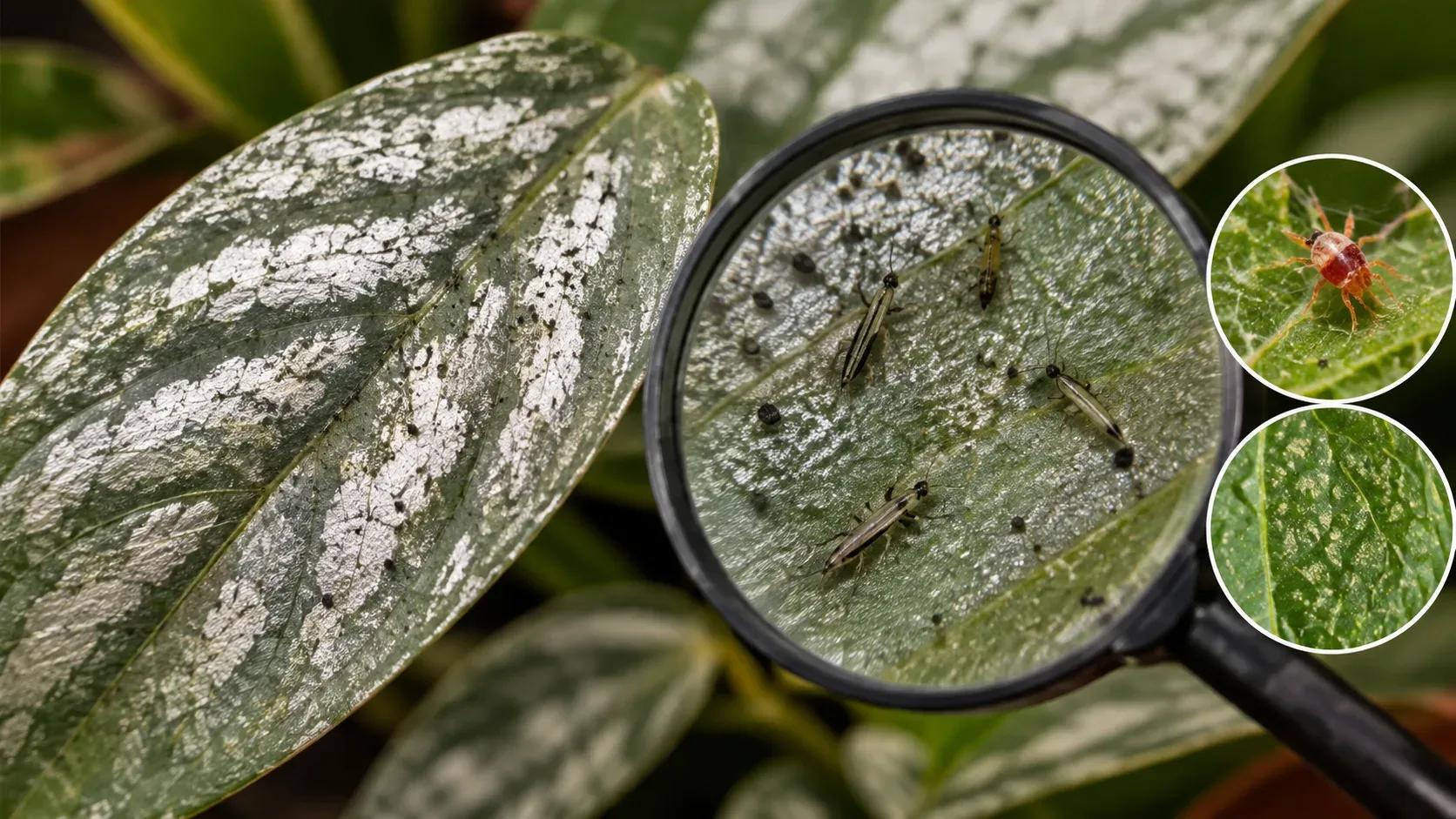
Fungus gnats are small, dark, delicate flies with relatively long legs and antennae. The appearance resembles a miniature mosquito. Adults are weak fliers: they tend to make short, erratic flights near the substrate, land on the edge of the pot, on lower leaves or nearby surfaces, and sometimes appear near windows due to attraction to light.
This pattern is a good indication, but should not be used in isolation. Seeing a fly near a plant does not prove that it is breeding in that pot. Confirmation improves when the adults appear repeatedly near the substrate and, especially, when you find the larvae in the growing medium.
If it doesn't fly and jump when disturbed
Collembolans do not have wings. They are very small and can be whitish, gray, brown or dark. Many species have a folded structure under the abdomen, the furcula,
which works like a spring and allows quick jumps when the animal is touched or when the surface is disturbed.
In the vase, they tend to remain in damp soil, in organic remains or close to microscopic fungi and algae. A visible population usually says more about the humid environment of the substrate than about direct aggression to the plant. In domestic conditions, the general rule is to observe first and correct excess moisture when it exists, rather than automatically assuming there is a pest that needs insecticide.
It looks like a fly, but is more robust
Another possible confusion are the so-called shore flies, small flies associated with damp surfaces, algae and organic matter. Compared to fungus gnats, they tend to have a more robust body and short antennae, with a more “compact” appearance. Fungus gnats, in turn, have long legs, longer segmented antennae and a more mosquito-like appearance.
For those who observe with the naked eye, this separation can be difficult. If the insect is clearly winged, but does not match well with the fungus gnat pattern, it is worth avoiding a closed diagnosis based on color alone. Behavior, origin in the pot and the presence or absence of typical larvae in the substrate help further.
How to confirm fungus gnats without treating in the dark
Notice where the adults actually come out
A vessel housing fungus gnats usually produces adults repeatedly. They appear close to the surface of the soil, especially when the pot is moved or watered.. A yellow sticky trap placed low near the edge of the container helps record this activity over several days.
The trap is useful because it turns a quick impression into evidence: you can tell if there are a few occasional adults or a continuous capture. But it alone does not show how many larvae there are and does not eliminate the immature stages that remain in the substrate.
Look for larvae in the substrate
Fungus gnats larvae are elongated, translucent to whitish and have a small dark and shiny head capsule. They live in moist growing medium, feeding mainly on fungi, algae and decomposing organic matter, but they can gnaw on roots and tissues in contact with the substrate when the population is high.
A simple test used in university extension is to place a small piece of raw potato with the cut side in contact with the substrate. After a few days, the underside can be examined for larvae attracted to the food. The test does not need to become a permanent routine; it serves as a diagnostic check when you want to know if the problem is also in the larval stage.
Do not confuse adult capture with cycle control
The sticky trap reduces part of the adults and can reduce the number of females that would lay eggs again. Still, adults stuck today doesn't mean the toilet is free of the infestation. The substrate may contain eggs, larvae and pupae that will continue the cycle.
This is why a vase can seem “settled” for a few days and then start producing mosquitoes again. Adult-only control acts at the most visible stage, not necessarily at the stage that keeps the population inside the vessel.
The cycle explains recurrence
Fungus gnats pass through egg, larva, pupa and adult. In a favorable indoor environment, with adequate temperature and continuously moist substrate, the cycle can be completed in a few weeks and several generations can overlap.
Most of life is spent as an immature phase in the substrate. This changes the management priority: when the infestation is confirmed and persistent, the focus must move away from the “flying mosquito” and onto the conditions of the growing medium and the larvae.
Adults, although uncomfortable, do not bite and are not the stage that chews roots. Direct damage, when it occurs, is linked to larvae and is more relevant in seedlings, young plants, rooting and high populations. In well-established adult plants, many cases are more a problem of nuisance and substrate management than of rapid destruction of the plant.
What to do when fungus gnats are confirmed
Start with excess humidity, which is actually correctable
Fungus gnats are favored by humid cultivation rich in decomposing organic matter. This does not mean turning “let it dry” into a universal order. The safe amount of drying depends on the species grown, the size of the pot, the type of substrate, the temperature and the drainage capacity.
For plants that tolerate a drier interval, allowing the surface of the substrate to lose moisture before the next watering reduces attractiveness for laying and impairs the survival of immature stages. For plants that require more constant humidity, the strategy needs to be more careful: eliminate standing water in the dish, improve drainage, review the watering frequency, ensure aeration of the substrate and prevent the surface layer from remaining wet for long periods.
An old, degraded substrate can also retain water for too long. If it has compacted, lost structure or remains saturated even with spaced watering, the problem may be less in the amount of water applied and more in the way the medium started to store it. In these cases, a well-planned replanting in a mixture suitable for the species may be more logical than simply increasing the interval between waterings.
Use adult traps as a monitoring and mitigation tool
Yellow sticky cards near the vase are useful for capturing adults and tracking whether the population is rising or falling. They help reduce the number of females available for new laying, but should not be treated as an isolated solution when larvae are established.
The most useful interpretation is to follow the trend. If catches fall while the substrate stops remaining excessively moist, management is interfering with the cycle. If they remain high for weeks, it is a sign that there is still an active source of reproduction in the vase or in a nearby container.
When it makes sense to target larvae
In persistent infestations, especially when there are many larvae, sensitive seedlings or repeated adult emergences, substrate-focused biological controls may be considered. Among the options described by university programs are Bacillus thuringiensis subsp. israelensis, known as Bti, and entomopathogenic nematodes of the species Steinernema feltiae.
These tools act on immature phases and need to be used according to the formulation and product label available locally. It is not safe to improvise concentrations, reuse any product “for mosquitoes” without checking the instructions or apply insecticides for external use indoors without specific guidance.
The central point is the target: if the problem maintaining the infestation is in the substrate, the chosen method needs to reach the substrate and be suitable for larvae. Spraying just air or foliage can kill some adults and still leave the cycle largely intact.
What if they are springtails?
When organisms are flightless, jump when disturbed, and remain on or in moist substrate, springtails become a strong hypothesis. They feed mainly on fungi, algae and decaying plant material. At home, they are usually harmless to people, animals and the plant itself, although some species can cause very limited damage in specific situations.
If the plant is healthy and the only observation is the presence of small springtails, the answer may simply be to monitor. An unusual abundance warrants reviewing moisture, drainage and the amount of decomposing organic matter, but does not require chemical treatment.
If the pot is waterlogged, correcting excess moisture can naturally reduce the population. Again, the correction must respect the blueprint. The objective is not to dry out a species that requires constant humidity, but rather to remove the excessively favorable condition that may have arisen due to poor drainage, a full dish, too frequent watering or compacted substrate.
A practical flowchart in the form of an observation
Start by lightly disturbing the surface of the vase. If the animals take flight and remain hovering around the substrate, observe whether they are small dark flies, with a delicate body and long legs. Place a low yellow trap and monitor the capture. If the pattern persists, look for translucent larvae with dark heads in the substrate or do the potato test.
If, on the contrary, the tiny dots do not fly and jump when touched, the springtail hypothesis gains strength. In this scenario, check the moisture condition of the pot and the health of the plant before thinking about control.
If there is a more robust fly, associated with algae or a very humid surface, but without the typical fungus gnat shape, keep the diagnosis open. Identification of tiny flies may require a clear macro photo or more specialized analysis.
What not to do
Do not treat all the organisms in the pot as if they were the same pest. Springtails and fungus gnats can appear in the same type of humid environment, but they have different biology and importance.
Do not drastically increase drying without considering the plant's water needs. Some species tolerate dry surfaces well between waterings; others suffer when the entire clod loses too much water. The goal is to correct excess, not produce water stress as a side effect.
Do not use the number of adults killed as the only indicator of success. If new flies continue to emerge after several days, the cycle is still active on some substrate.
Do not apply a product just because the label mentions “mosquitoes” or “insects”. For fungus gnats, the stage you want to reach, the application route and the indication for use on plants or indoor environments need to be compatible.
When the plant shows signs that the problem deserves more attention
A healthy adult plant can live with a few fungus gnats without noticeable damage. The scenario changes when the population is high, when there are seedlings or young plants, or when there is a loss of vigor, weak growth and wilting without a simple explanation.
Even so, these symptoms do not prove that fungus gnats are the cause. Overwatering, underwatering, root rot, poor aeration and other growing problems also cause wilting and loss of vigor. Therefore, finding larvae and evaluating the condition of the roots and substrate is more informative than attributing every symptom to flying adults.
The final decision depends on what you confirmed
If there are small dark flies near the pot and typical larvae in the substrate, treat the case like fungus gnats: reduce excessively humid conditions as are correctable, use traps to monitor the adults and, if the infestation persists, consider an appropriate strategy for the larvae.
If there are tiny wingless organisms that hop around on the land, and the plant is fine, springtails may just be part of the substrate fauna. In this case, observing and adjusting for excess moisture is often more proportionate than trying to eliminate everything that moves.
The diagnosis is safer when you separate three questions: does the organism fly or jump, is it reproducing on the substrate and which stage of the cycle really needs to be reached. This sequence avoids both unnecessary treatment and the frustration of killing adults while the larvae remain in the pot.