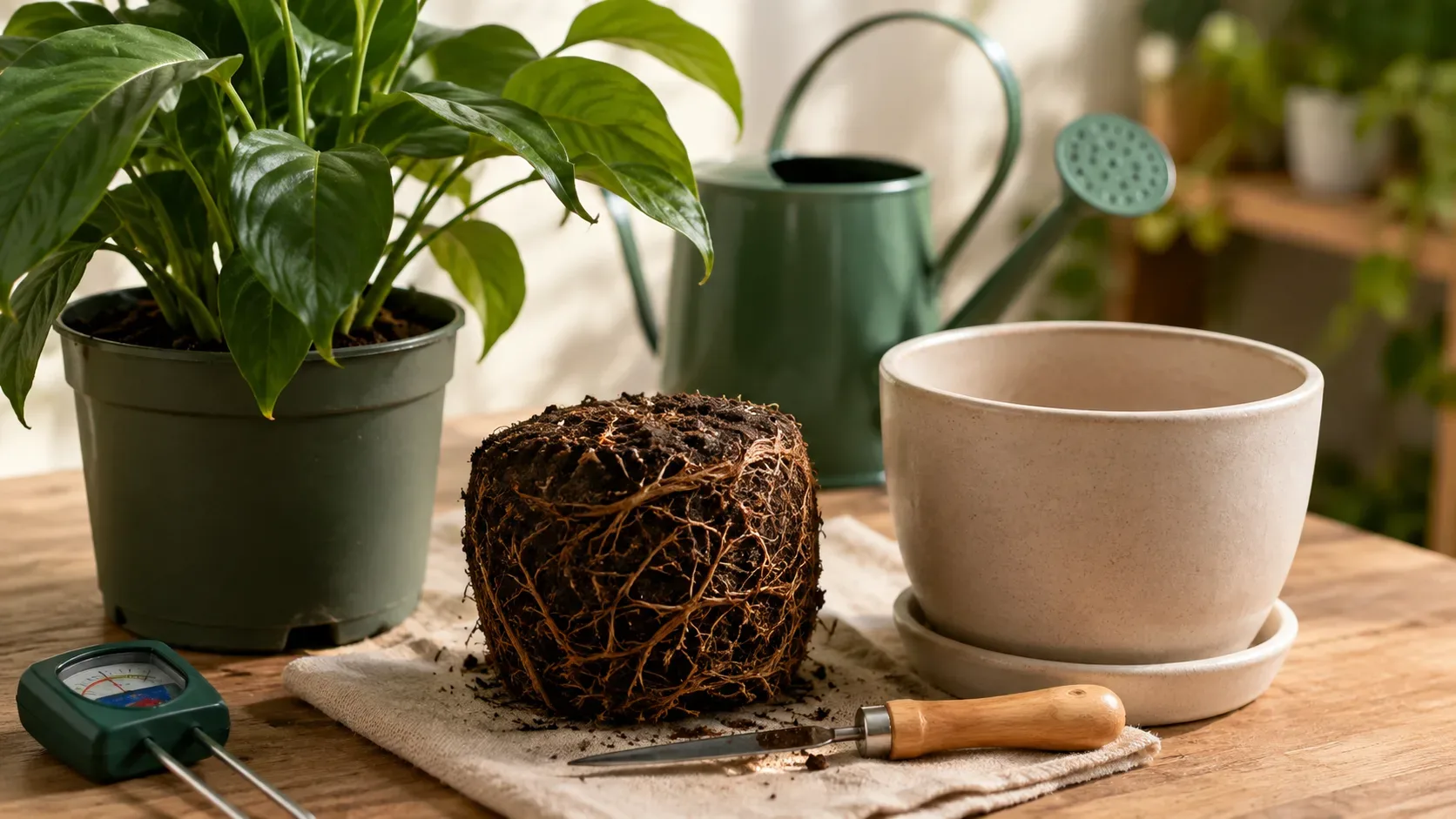
Replacing a potted plant is not always the first step to saving it. When the specimen is already weakened by lack or excess of water, change of environment, cold, heat, pests or a recent transplant, removing the root ball and manipulating the roots can add a new stress factor.
The decisive point is not just knowing if the plant looks sick, but identifying if the pot and substrate are part of the problem. Yellow leaves, wilting and leaf fall are non-specific symptoms: they can appear both when there is a lack of water and when the roots remain waterlogged and no longer function properly. Therefore, a haggard appearance alone does not justify replanting. The safest option is usually: stabilize conditions, observe the trend and only touch the roots when there is evidence that remaining in the current pot poses a greater risk than transplanting.
Quick answer: when is it better to wait
Postpone repotting when the plant is stable or showing improvement, the container has functional drainage, and there are no signs of rot. It is also prudent to wait when the problem started shortly after a change in lighting, temperature or location.
Consider replanting immediately when there is persistently soggy substrate, accumulated water that cannot drain, dark, soft roots, an odor of decay, or rot advancing along the base of the stem.
Between these two extremes, adopt a structured period of observation.
Why replanting can delay recovery
During removal from the pot, fine roots may be broken or dry out. The plant also needs to adjust to the composition, humidity and aeration of the new substrate. This combination can cause so-called transplant shock, characterized by wilting, yellowing, arrested growth or general decline. increases when several changes are made at the same time. A weakened plant can be transferred to another pot, placed in a brighter place, receive more water, intense pruning and fertilizer on the same day. If it gets worse, it becomes difficult to figure out which intervention caused the problem.
Recovery tends to be easier to assess when the environment remains stable and each change has a clear rationale.
Signs favorable to keeping the plant in the same pot
The plant is regaining its firmness
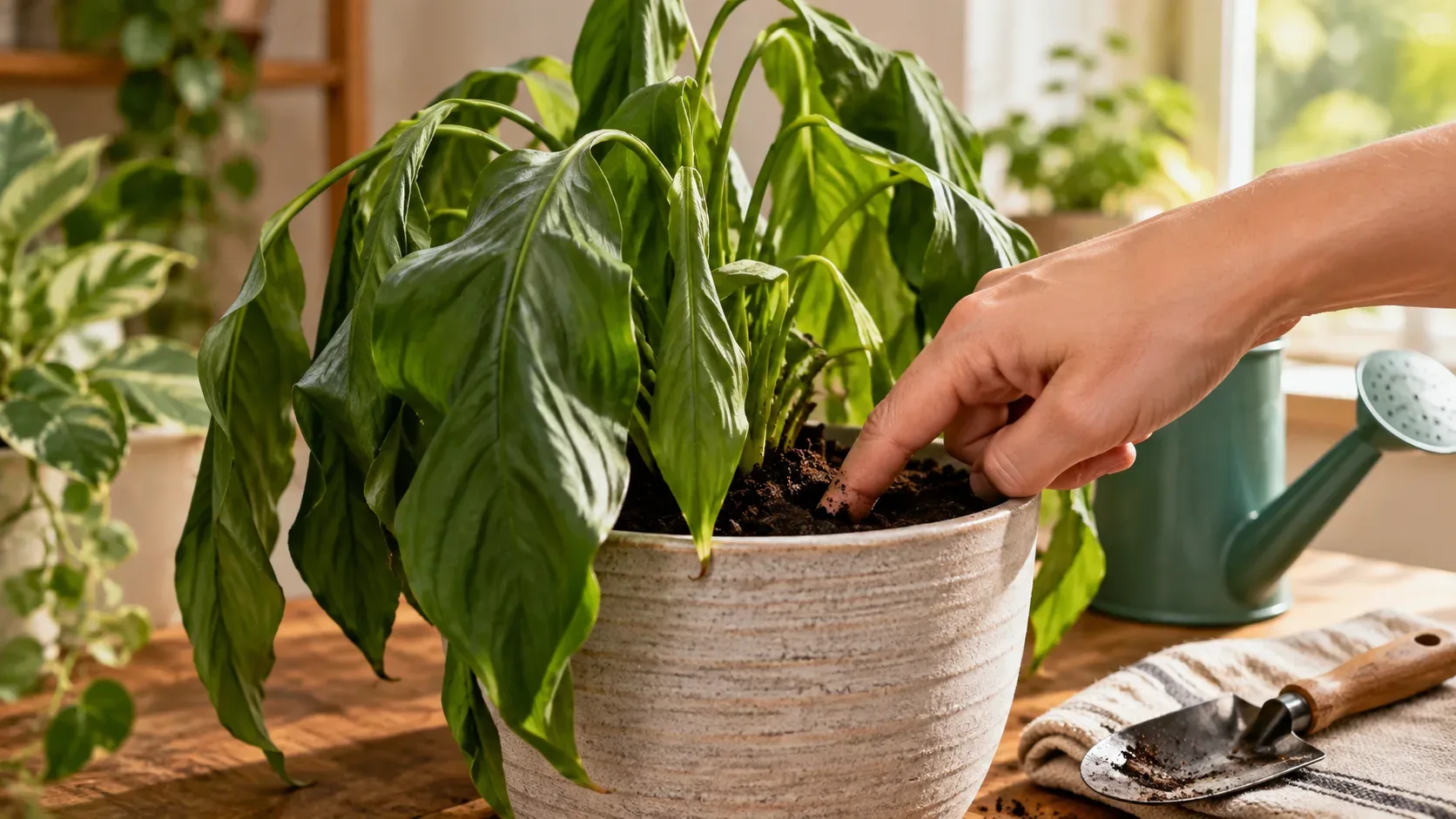
After mild dehydration, leaves and petioles may gradually return to their normal position after watering. If recovery is occurring and the substrate drains adequately, changing the pot at this time would add an intervention with no evidence of need.
Improvement need not be immediate or complete. The most important sign is the tendency: less fallen leaves, absence of new damage and stability of the stem.
Leaf fall has stopped
Already damaged leaves may continue to yellow even after the initial problem has been corrected. The lost tissue does not turn green again. What should be observed is whether new leaves continue to be affected.
When loss slows or stops, the stem remains firm and the buds are preserved, there is an argument for keeping the plant in the current container and continuing to monitor.
There are new shoots or roots
Expanding shoots, new leaves and active growth tips indicate that the plant is still able to direct resources towards development. The presence of new growth does not eliminate all problems, but it reduces the urgency to manipulate the roots without another concrete sign.
Fertilization should also not automatically be used as an emergency treatment. The University of Minnesota recommends associating fertilization with the period of active growth and warns that excess can cause accumulation of salts in the substrate. Abstract dries at a rate compatible with the plant
A substrate that goes from moist to moderately dry without remaining saturated for many days suggests that drainage and water consumption are still working.
The exact frequency depends on the species, the size of the vessel, the luminosity, the temperature and the composition of the substrate. Therefore, watering on fixed days is less reliable than checking the humidity before adding water. there are clear signs of confined roots
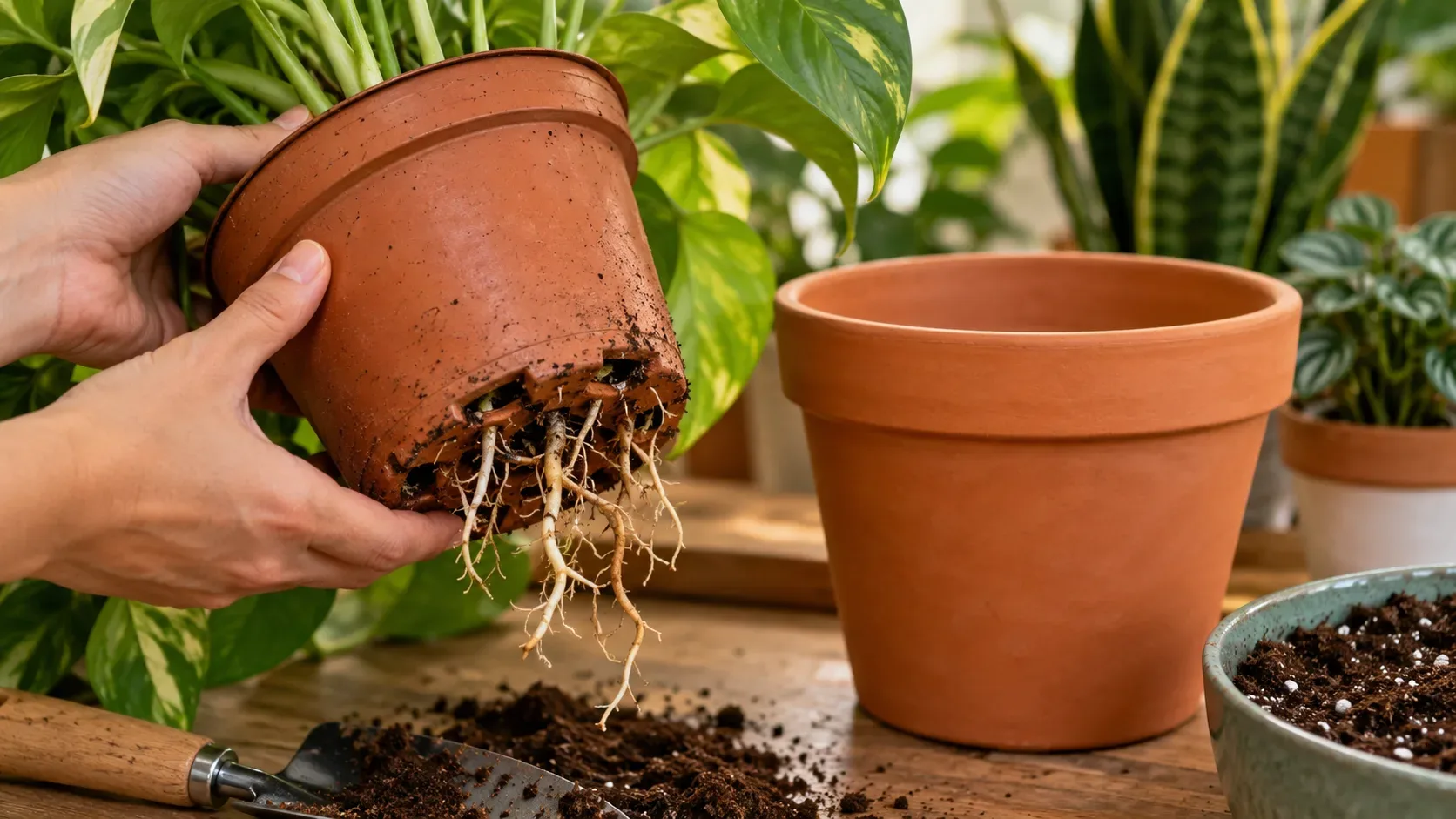
Roots visible in a single hole do not necessarily mean that the entire pot is filled. The most consistent signs of confinement are:
- roots densely surrounding the clod;
- little visible substrate between the roots;
- roots coming out through several holes;
- need for much more frequent watering because the pot dries out quickly;
- reduced growth during the active season despite adequate management.
Penn State and the University of Minnesota recommend confirming these signs before increasing the container. s contrary to waiting
| Situation observed | Most likely conduct |
|---|---|
| Stable plant, draining substrate and no abnormal odor | Keep the vase and observe |
| Old leaves turning yellow, but no new damage | Observe the trend |
| Withers with dry substrate | Correct watering before considering replanting |
| Withers with soggy substrate | Investigate drainage and roots |
| Dense, circular roots with almost no visible substrate | Program the vase change |
| Dark, soft or falling apart roots | Intervene without waiting the entire period |
| Soft or darkened stem base | Treat as possible rot |
| Vase without holes and accumulated water | Transfer to draining container |
| Plant recently placed in a much larger pot | Evaluate excess substrate and water retention |
Observation period: 7 to 14 days
The interval of 7 to 14 days proposed in this guide is an editorial follow-up protocol, not a universal botanical rule. Succulent plants, slow-growing species, dormant specimens and plants with severe damage may respond within different timeframes.
The purpose of the period is not to wait passively. It is gathering evidence that allows us to distinguish recovery, stability or deterioration.
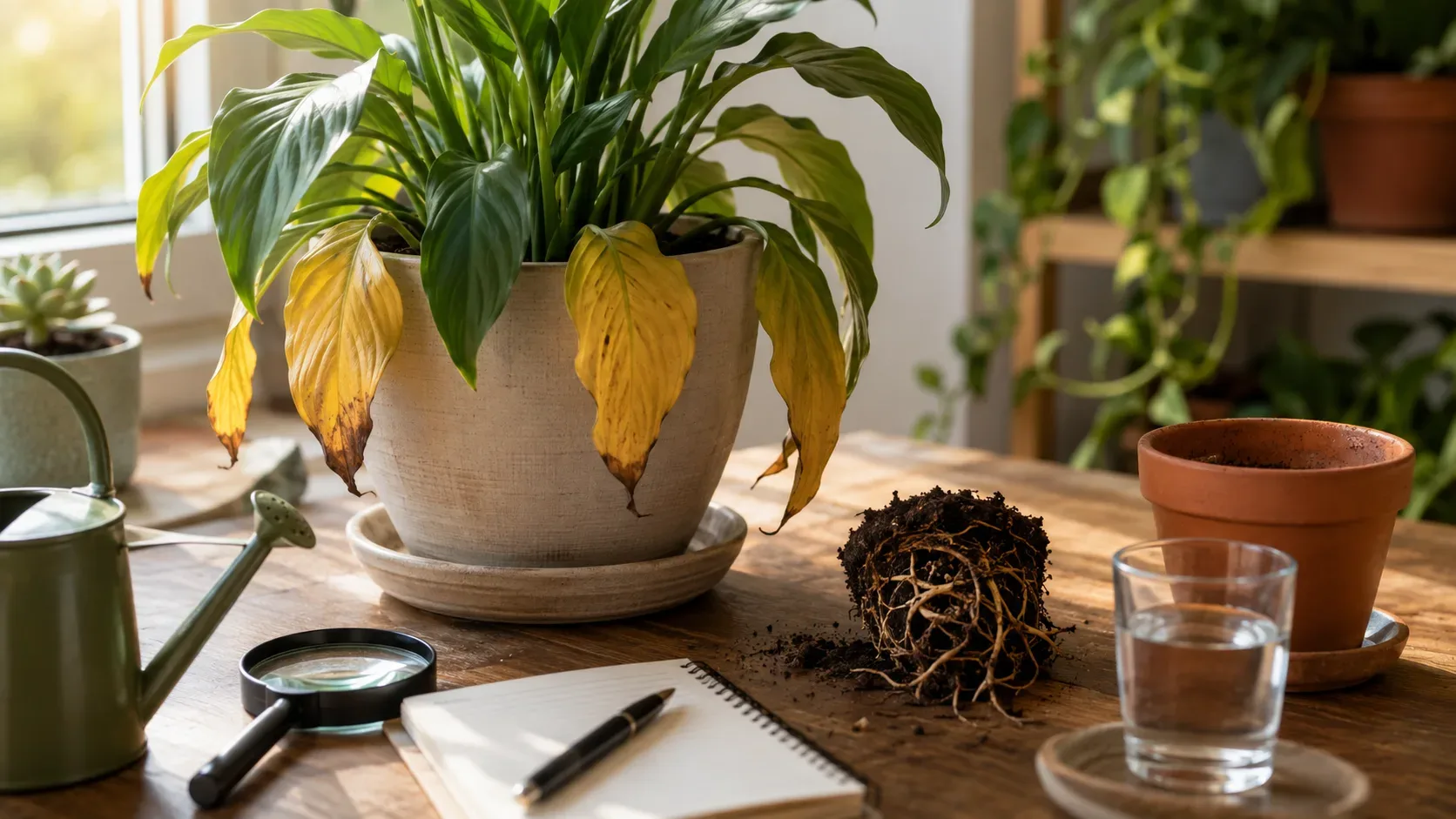
Day zero: record the initial condition
Photograph the plant from the same angle you intend to follow it. Observe and write down:
- approximate number of affected leaves;
- firmness of the stem and petioles;
- presence of sprouts;
- substrate moisture;
- approximate weight of the vase when lifting it;
- existence of drainage holes;
- still water in a small dish or cachepô;
- presence of insects, webs, sticky material or stains;
- last watering, fertilization or change of location.
This record avoids the subjective impression that “nothing has changed” or that the plant has gotten worse from one moment to the next.
Days 1 to 3: stabilize the environment
Keep the plant in conditions compatible with the species, avoiding sudden direct sun, cold drafts, intense heat or daily commuting.
Do not water just because the leaves are fallen. First check the moisture a few inches below the surface and confirm that there is water pooling in the outer container. Both lack and excess of water can cause wilting. extensive, corrective fertilization and simultaneous application of several products. Only remove completely dry fabrics, fallen leaves and parts with obvious rot.
Days 4 to 7: look for trends, not perfection
Compare the plan with the initial record. These are favorable signs:
- no new leaves affected;
- firm stem and base;
- leaves recovering part of their support;
- substrate gradually drying;
- preserved shoots;
- absence of unpleasant odor.
These are warning signs:
- yellowing advancing to previously healthy leaves;
- continuously cold and wet substrate;
- wilting worse even with high humidity;
- darkening or softening of the base;
- odor of fermentation or decomposition;
- rapid loss of leaves.
Days 8 to 14: make the decision
If the plant is improving, keep the pot and continue stable management. A pre-emptive exchange can be re-evaluated when it is actively growing.
If it is stable, without worsening or signs of rot, extend the observation according to the rhythm of the species.
If it is getting worse, examine the root system. It is not necessary to dismantle the entire lump immediately: carefully remove it just enough to assess the outside and bottom.
How to examine the roots without causing unnecessary damage
Hold the plant near the base, tilt the container and loosen the root ball with light pressure on the sides. Do not pull on the leaves.
Note four aspects:
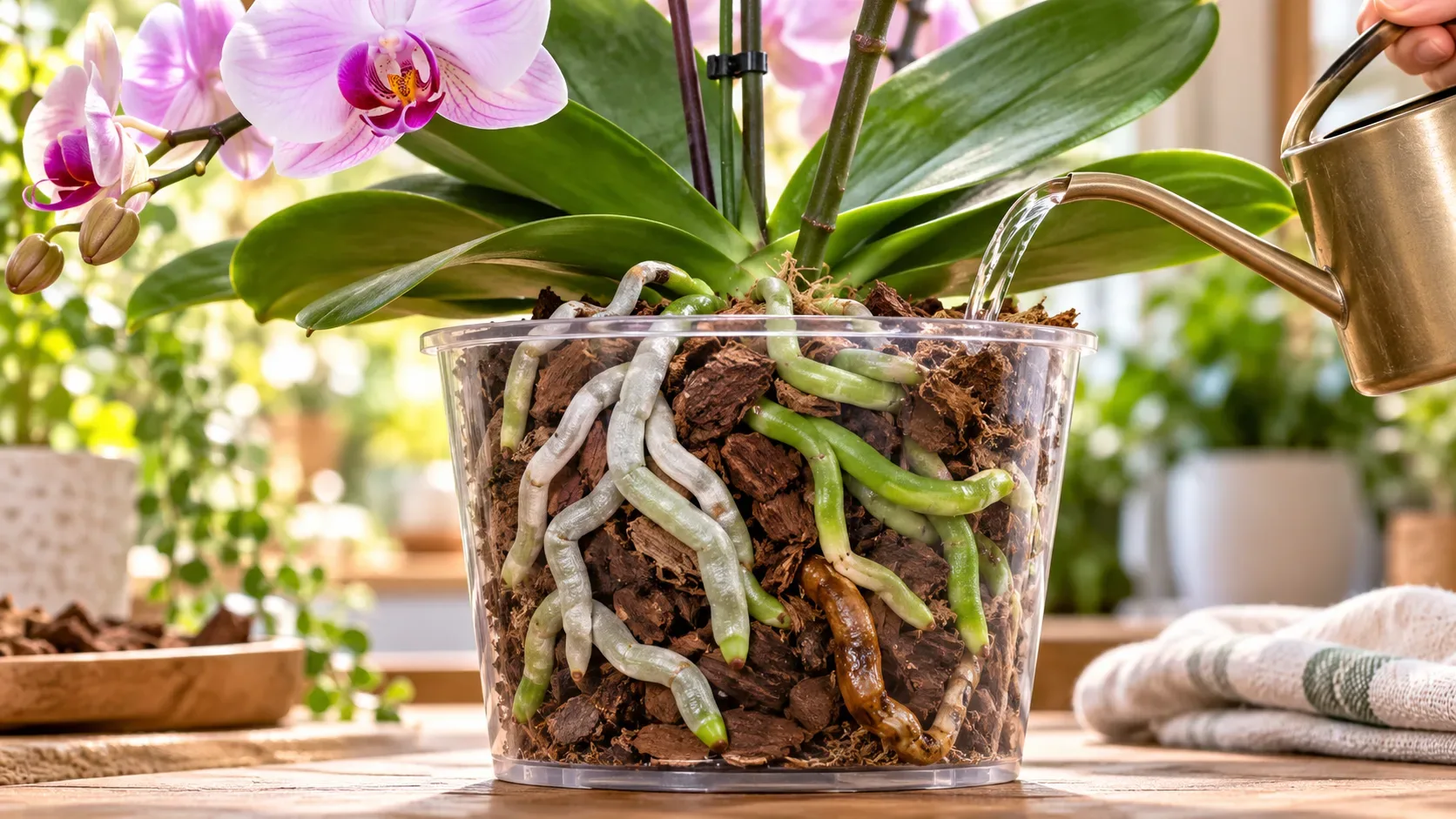
- Texture: functional roots are usually firm; rotted roots can become soft and break easily.
- Odor: intense smell of decomposition reinforces the suspicion of rot.
- Distribution: roots forming dense loops around the entire root ball indicate confinement.
- Moisture: saturated substrate for a long period and with little aeration can compromise the roots.
Color needs to be interpreted with caution, as it varies between species and depending on the substrate. Still, brown or black roots associated with soft texture and structural loss are important signs of deterioration. o replanting becomes necessary
There are rotten roots
Overwatering, poor drainage and disproportionately large pots are among the conditions associated with root rot in indoor plants. Confirmation requires examining the roots, as symptoms on foliage may be similar to those of other problems. nary, the change should not just be for a larger pot. It may be necessary:
- remove excessively moist substrate;
- cut clearly dead tissue with a clean tool;
- use a mixture suitable for the species and with good aeration;
- choose container with drainage;
- maintain or even reduce the size of the pot, depending on the volume of healthy roots remaining.
When the rot is very advanced, recovery of the entire specimen may not be possible. The Missouri Botanical Garden points out that still healthy shoots can, in some cases, be used for propagation. it just doesn't allow drainage
Decorative containers without holes can be used as pots, as long as the plant remains in an internal draining pot and the accumulated water is removed.
Planting directly in a closed container increases the risk of substrate saturation. Penn State recommends holes that allow excess water to escape and the water accumulated in the cachepô to be removed after watering. tapir was placed in a vase that was too big
More space does not automatically mean better conditions. When there is too much substrate for too few roots, the outside of the pot can remain wet for longer and with less oxygen.
The Royal Horticultural Society associates excessive pot size with yellowing, leaf drop, wilting, reduced growth and waterlogged substrate. The general recommendation is to increase only one size, usually a few centimeters in diameter. aizes actually occupied the container
If the roots surround the root ball densely, there is almost no substrate visible and water passes through or dries out too quickly, replanting can improve the available space.
Use just a slightly larger container. Excessive bounce increases water retention before new roots can occupy the substrate. replant a plant that is still weak
When intervention is necessary, try to reduce the number of attacks:
- prepare the new container and substrate before removing the plant;
- use a clean pot, with drainage holes;
- choose a mixture compatible with the species;
- preserve firm roots and only remove clearly dead parts;
- avoid aggressively breaking up a clod that has already become fragile;
- do not bury the stem deeper than it was;
- eliminate water that runs onto plates or cups;
- keep the plant protected from intense sun and sudden variations;
- resume fertilization only when there is active growth and according to the requirements of the species.
If the problem was oversize, rot, or root loss, the new container may need to be the same size or smaller. If it was root confinement with healthy roots, use a slightly larger pot.
Errors that can confuse the diagnosis
Replace the vase just because there is a yellow leaf
An isolated leaf may be old or reflect a stress that has already been corrected. Check to see if the problem is progressing before touching the roots.
Rewater a wilted plant in wet substrate
Damaged roots do not absorb water properly, even when there is excess water. Adding more can worsen the lack of oxygenation. get a much larger vase to avoid having to change it again
Excess substrate takes longer to dry and can create a soggy band around the rootball. eat during flowering unnecessarily
Flowering is not a universal prohibition, but some species are sensitive to intervention at this stage. Penn State, for example, recommends not replanting party cacti while they are actively blooming. The decision must consider the type and urgency of the problem. light, water, pot, prune and fertilize on the same day
The plant can suffer from the sum of changes, and the person responsible loses the ability to identify which factor produced improvement or worsening.
Decision flow
The plant is weakened, but the substrate drains, the stem is firm and there is no rotten odor?
Observe for 7 to 14 days, keeping the environment stable.
Is the substrate dry and the plant has wilted?
Correct the hydration according to the species before considering replanting.
The substrate is wet, but the plant continues to wilt?
Check drainage, accumulated water and condition of the roots.
Are there soft roots, a bad odor or the base of the stem rotting?
Intervene without waiting for the end of the period.
The roots are healthy, but densely curled and the pot dries out too quickly?
Schedule the switch to a slightly larger container.
Is the plant producing leaves or buds and there is no sign of emergence?
Keep the pot and reevaluate when recovery is consolidated.
Frequently asked questions
Does a root coming out of the hole mean I need to change the pot?
Not necessarily. An isolated root may have found the hole without the entire root ball being occupied. Confirm that there are many roots circulating, little visible substrate and excessively rapid drying.
Can I just change the substrate and keep the same pot?
Yes. This may be appropriate when the substrate is degraded, contaminated or unsuitable, but the plant has lost roots and does not need more space. The pot must be clean and have drainage.
How long does it take for a plant to show recovery?
There is no single deadline. The 7 to 14 day interval serves to detect an initial trend in many domestic situations, but the pace varies depending on species, season, temperature, light and severity of damage.
Should I publish or act like this for any species?
No. Orchids, bonsai, carnivorous plants, cacti, succulents, bulbs and dormant species may require specific substrates, times and techniques. For rare or valuable specimens, seek guidance from a professional with experience in the botanical group.
Before changing the pot, save the initial record and monitor the plant for a few days. A decision based on the evolution of signs tends to be safer than an intervention motivated only by the appearance of a leaf.