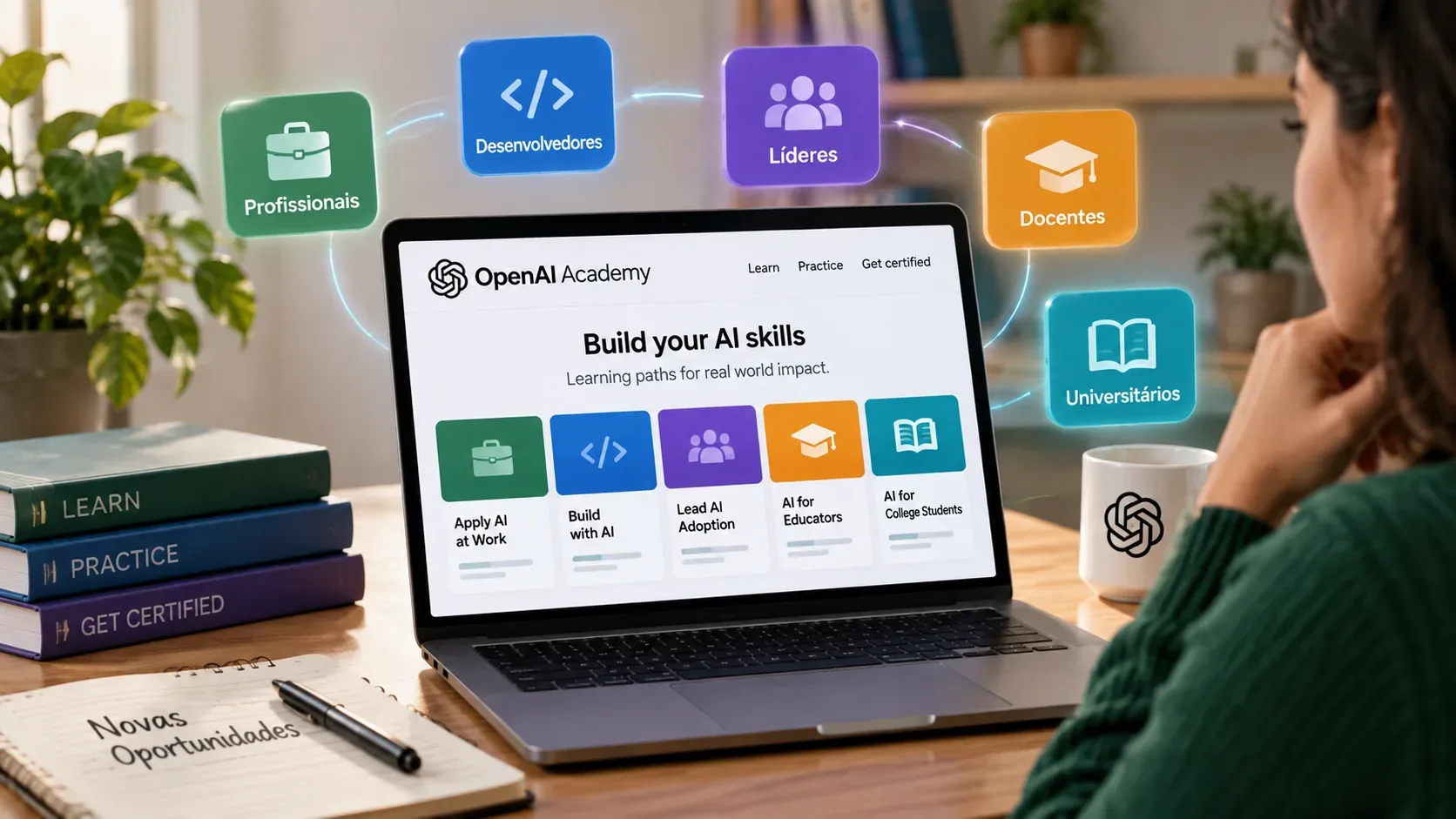
OpenAI expanded OpenAI Academy on September 21, 2026 with new learning options aimed at different roles. The portfolio is now organized around practical paths for professionals who use AI at work, developers, leaders, educators, and college students. The idea is straightforward: instead of everyone following the same curriculum, each learner can begin with the path that most closely matches the tasks they actually need to perform.
The official announcement also clarifies an important point about recognition: courses include assessments, and learners earn an OpenAI Academy course badge when they pass the corresponding assessment. The model therefore combines practice, a check of what was learned, and a completion signal that can be shared on social platforms.
What changed in OpenAI Academy
The expansion adds courses for developers, leaders, educators, and college students to a portfolio that already included Apply AI at Work. According to OpenAI, the paths are built around the idea that learners should use AI to learn AI, working on real tasks, giving instructions, adding context, and reviewing results.
In practice, the Academy now addresses five main needs: improving everyday use of AI at work, building technical solutions, leading organizational adoption, applying AI to teaching, and using AI responsibly for study and career preparation.
Which learning path should you choose?
| Path | Best fit | Main focus | Expected practical outcome |
|---|---|---|---|
| Apply AI at Work | Non-technical professionals and knowledge teams | Foundations, clear instructions, context, review, repeatable workflows, and agents | Turn recurring tasks into more structured ways of working while keeping human review |
| Build with AI | Developers and technical teams | Codex, software development lifecycle, OpenAI API, evaluations, agents, retrieval, and production operation | Plan, build, evaluate, and operate AI solutions with greater control over quality |
| Lead AI Adoption | Leaders responsible for strategy, transformation, and change | Business priorities, value, governance, ownership, roadmap, and adoption | Turn an AI initiative into a draft strategy and an initial implementation plan |
| AI for Educators | Teachers and other education professionals | Lesson planning, activities, assessments, and communication based on materials the educator is permitted to use | Create useful AI-assisted materials and review them against real learning goals and requirements |
| AI for College Students | College students | Study planning, group work, draft review, applications, and interviews | Use ChatGPT to support academic and career tasks while retaining responsibility for the final result |
Apply AI at Work: the broadest starting point for everyday use
For people who are not building software or leading a transformation program, Apply AI at Work is the broadest option. The path starts with fundamentals: giving clear instructions, providing relevant context, and checking whether a response actually satisfies the task. Learners then turn successful approaches into workflows they can reuse.
At more advanced stages, the path introduces directing larger portions of work with agents. The key idea is not simply to delegate more, but to decide what can be delegated, where checkpoints belong, and where human review remains necessary.
Build with AI: for people building with Codex or the API
Build with AI is the natural choice for developers and technical teams. It covers both using Codex across the software development lifecycle and building products with the OpenAI API. OpenAI highlights topics such as solution design, evaluations, agents, retrieval of relevant information, and operating AI systems in production.
This path is more appropriate when the goal is not only to use ChatGPT more effectively, but to create or maintain software that incorporates OpenAI models and tools.
Lead AI Adoption: turning intent into a plan
Lead AI Adoption is designed for people responsible for strategy, adoption, and change management. The path addresses questions that arise when an organization moves beyond experimentation: where AI can create value, what to prioritize, who owns the work, what governance is needed, and how progress will be measured.
The AI Leadership course within this path guides learners to connect an initiative to business priorities and develop a roadmap and an initial AI strategy draft. It is better suited to people who coordinate decisions and teams than to learners whose main goal is programming.
AI for Educators and AI for College Students
The two education options serve different needs. AI for Educators keeps the educator in control of the process. Learners use materials they are permitted to use to plan classes, create activities or assessments, and adapt communications. ChatGPT outputs should be reviewed against learning objectives, source materials, and requirements before they are used in teaching.
AI for College Students focuses on academic and career tasks. OpenAI examples include organizing readings and deadlines into a study plan, assigning roles in a group project, reviewing a draft against assignment requirements, and preparing for applications or interviews. Responsibility for the final submission remains with the student.
How assessments and badges work
The public rule announced by OpenAI is simple: each course includes an assessment, and a learner who passes the assessment earns the associated course badge. The Academy deployment guide adds that the badge can be shared on social platforms.
Completion and passing should not be treated as the same thing. The announcement makes passing the assessment the condition for receiving the badge. In the public pages reviewed, OpenAI does not state one universal passing score, number of questions, assessment duration, or retake policy for the entire portfolio. Those details may depend on the course and should be checked inside the Academy experience.
The Academy also has other badge types in specific programs, with their own criteria such as participation or reviewed work. That does not change the rule announced for the courses in this expansion: a course badge is tied to passing the corresponding assessment.
How to choose without taking unnecessary courses
- If your goal is to produce, research, analyze, plan, or collaborate more effectively at work: start with Apply AI at Work.
- If you code or build AI products: choose Build with AI.
- If you coordinate strategy, transformation, or adoption: choose Lead AI Adoption.
- If you teach: choose AI for Educators.
- If you are in college and want support for study and career tasks: choose AI for College Students.
The paths do not need to be treated as a mandatory sequence. The Academy deployment guide recommends a starting point for each audience and says that learners with relevant experience can begin with the learning that best fits their needs. For organizations, a common approach can be to use Apply AI at Work as a shared baseline and then add specialized paths for technical teams, leaders, and education audiences.
Where to find the official paths
The expansion announcement is available at Expanding OpenAI Academy with new learning paths. The current list of courses and paths is available on the OpenAI Academy courses page. Teams planning to deploy the courses internally can use the Academy deployment guide for guidance on choosing paths, communicating the program, supporting practice, and tracking progress.
Because OpenAI says the courses will continue to be updated as its models, products, and guidance change, it is worth checking the official page before beginning a path or setting an internal training program.