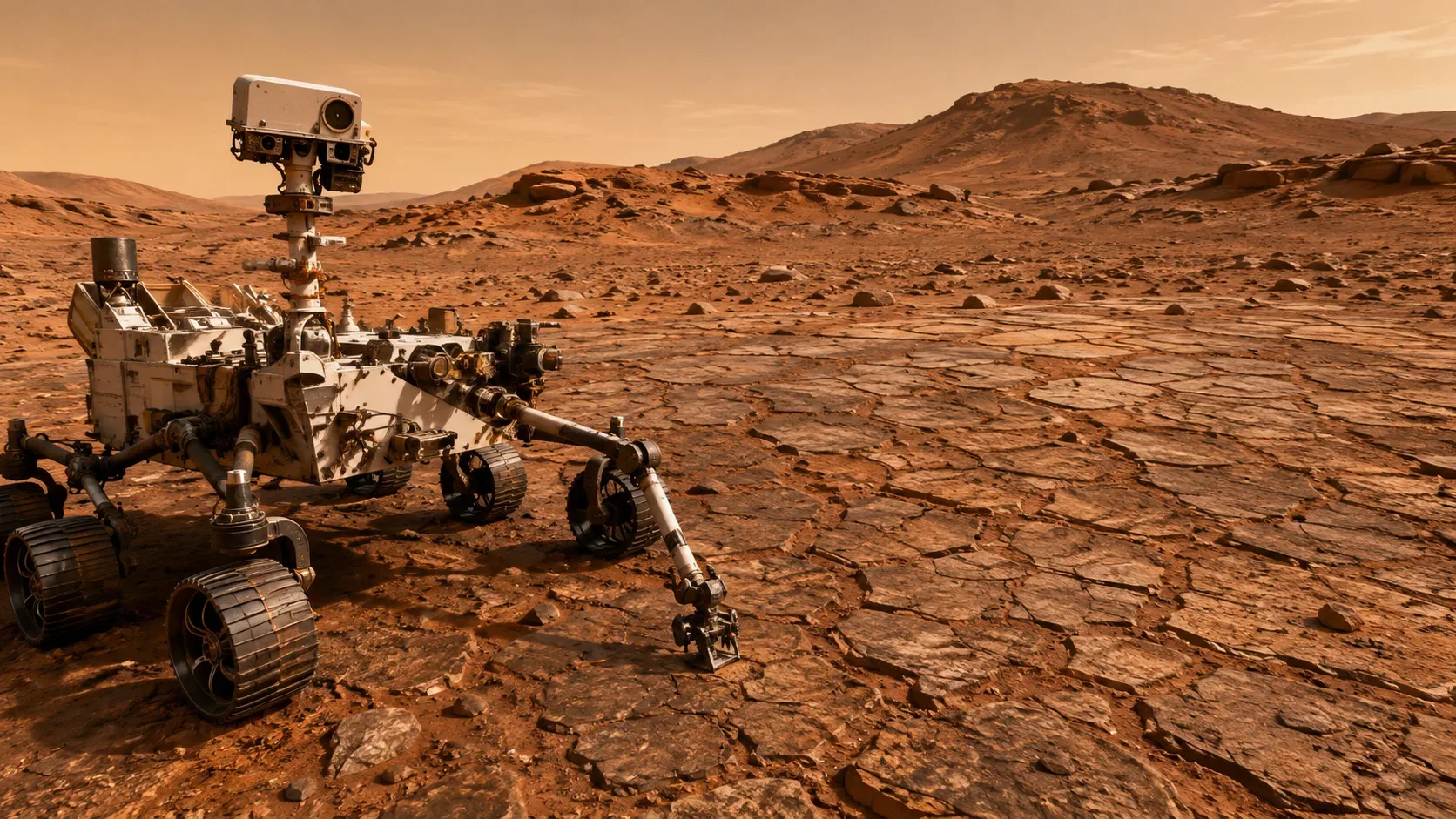
The terrain appears to be covered in a huge stone beehive. In Valle Grande, a region of Mars that the Curiosity rover is traveling through in Gale crater, small ridges form polygons just 4 to 8 centimeters wide and repeat as far as the cameras can see.
NASA released the finding on July 29, 2026. The 360-degree panorama that revealed the extent of the field was recorded on June 19 and 20, during sols 4,930 and 4,931 of the mission. Curiosity had already found polygonal fractures before, but, according to the agency, never so many in one place.
Geometry attracts attention. The explanation, however, is far from closed. Similar fractures can arise through different processes, and some of them tell very different stories about temperature, water and the transformation of Martian sediments.
What Curiosity found in Valle Grande
“Valle Grande” is the nickname given by the mission team to the area the rover is climbing on Mount Sharp, the roughly 5-kilometer-high mountain in the center of Gale Crater.
In the new field, the fractures form a mesh of small cells that resembles the structure of a honeycomb. They appear around the rover and also follow the sides of a nearby elevation nicknamed “Miraflores”, approximately 6 meters high.
Scale is important. This is not to say that this is the largest field of polygons on Mars, something that the available observations do not allow us to conclude. It is, according to NASA, the largest concentration of its kind found by Curiosity itself so far.
The mission's operational blog shows that the surprise began even before the public announcement. When the rover entered a unit that, from orbit, appeared relatively smooth, the team found the ground covered by the structures. Scientists then directed close-up observations at the ridges and interiors of the polygons, using different instruments to study texture and composition.
A similar form can be born from different processes
This is precisely where the discovery becomes more interesting. A polygonal pattern does not function as a fingerprint that alone identifies a single geological process.
NASA itself cites more than one possibility for structures of this type. Some fractures previously found by Curiosity were clearly interpreted as mud cracks. In other cases, similar patterns may be contributed by heating and cooling cycles or by processes that occurred when sediments were buried and compressed, expelling water from their pores.
These alternatives are not details. Each one points to a different story.
If the fractures are related to the drying of wet sediments, they may record conditions in which water was present near the surface. If thermal cycles played a dominant role, the geometry may reflect repeated stresses produced by temperature variations. If the structure is linked to compaction and fluid circulation during burial, part of the story may have happened after the sediment had already been deposited.
Therefore, seeing a “hive” is not enough to say when there was water, how long it was present or even if surface water was the mechanism responsible for the fractures observed now.
The case of Pontours shows why comparison requires care
Curiosity has already found an example on Mars where polygonal geometry provided much more specific evidence.
In an area called “Pontours”, observed in 2021 and described in a study published in Nature in 2023, researchers identified centimeter-long polygonal ridges enriched in sulfates and connected by Y-shaped junctions. The combination of shape, composition and geological context was interpreted as a record of repeated wetting and drying cycles on ancient Mars.
NASA explained at the time that mud cracks may initially have T-shaped abutments. After repeated exposure to water and further drying, these abutments may rearrange themselves to produce patterns closer to hexagons. At Pontours, this sequence supported the interpretation of prolonged wet-dry cycles.
It is tempting to look at Valle Grande and immediately apply the same explanation. There is no basis for this yet.
Pontours' lesson is precisely that form was only one part of the evidence. Fracture orientation, joint type, mineralogy, position in layers and chemical composition worked together. For the new field, the team is still trying to figure out which combination of these signals best explains what they see.
What geometry and chemistry can reveal
Curiosity project scientist Ashwin Vasavada said the team carefully measured both the shapes and chemistry of the structures and hopes to find clues about their formation in this data.
The observation plan helps you understand why. In late June, the rover separately examined polygon crests and centers with imaging and chemical analysis instruments including MAHLI, APXS and ChemCam.
Geometry can show how stresses are distributed throughout the material. The composition, in turn, can indicate whether the ridges preserved minerals different from those found in the center of the cells.
In principle, systematic chemical differences could point to transport or deposition of minerals along ancient fractures. A similar composition between ridges and interior would require considering other paths. This is an interpretation of the type of information the instruments can offer, not a result already announced for Valle Grande.
It is also necessary to take into account that the relief observed today has undergone erosion over a huge period of time. The ridges that stand out today may be stronger parts of older structures, and the visible pattern need not exactly match the original appearance of the cracks.
What the new field can tell about ancient Mars
The scientific value of Valle Grande does not depend on a spectacular explanation. Even purely geological processes can function as archives of the conditions that existed when sediments formed and were modified.
If the team can determine the dominant mechanism, the fractures could help constrain aspects such as the presence or circulation of water, drying episodes, sediment burial and stresses associated with environmental variations.
This matters because Curiosity is reading the story of Gale Crater layer by layer. The mission has already found abundant evidence of ancient lakes, waterways and environments that brought together water and chemical components capable of supporting microbial life. The presence of these conditions, however, does not mean that life existed.
The same caution applies to the new fractures: they are not fossils, they do not constitute a biosignature and, at the current stage of the investigation, they cannot even be presented as independent proof of wet-dry cycles.
Why the origin remains uncertain
Uncertainty does not arise from a lack of hypotheses, but from the opposite problem: there is more than one plausible process capable of producing similar patterns.
To differentiate between these possibilities, researchers need to match the scale and shape of the polygons with their chemistry, texture, relationship to neighboring layers, and possible subsequent changes. It is precisely this type of analysis that Curiosity began to do when comparing the ridges with the interior of the cells.
As of August 8, 2026, NASA's Valle Grande release still presents these explanations as hypotheses under investigation rather than a determined origin. The chemical results mentioned by the team have not yet been used by the agency to publicly choose a winning mechanism.
It is this difference between observing a form and reconstructing its history that makes the “sea of hives” scientifically interesting. The polygons already show that some repetitive process has left an extraordinarily extensive signature on the terrain. Discovering what this process was is what could transform a curious landscape into a new chapter in the environmental history of Mars.