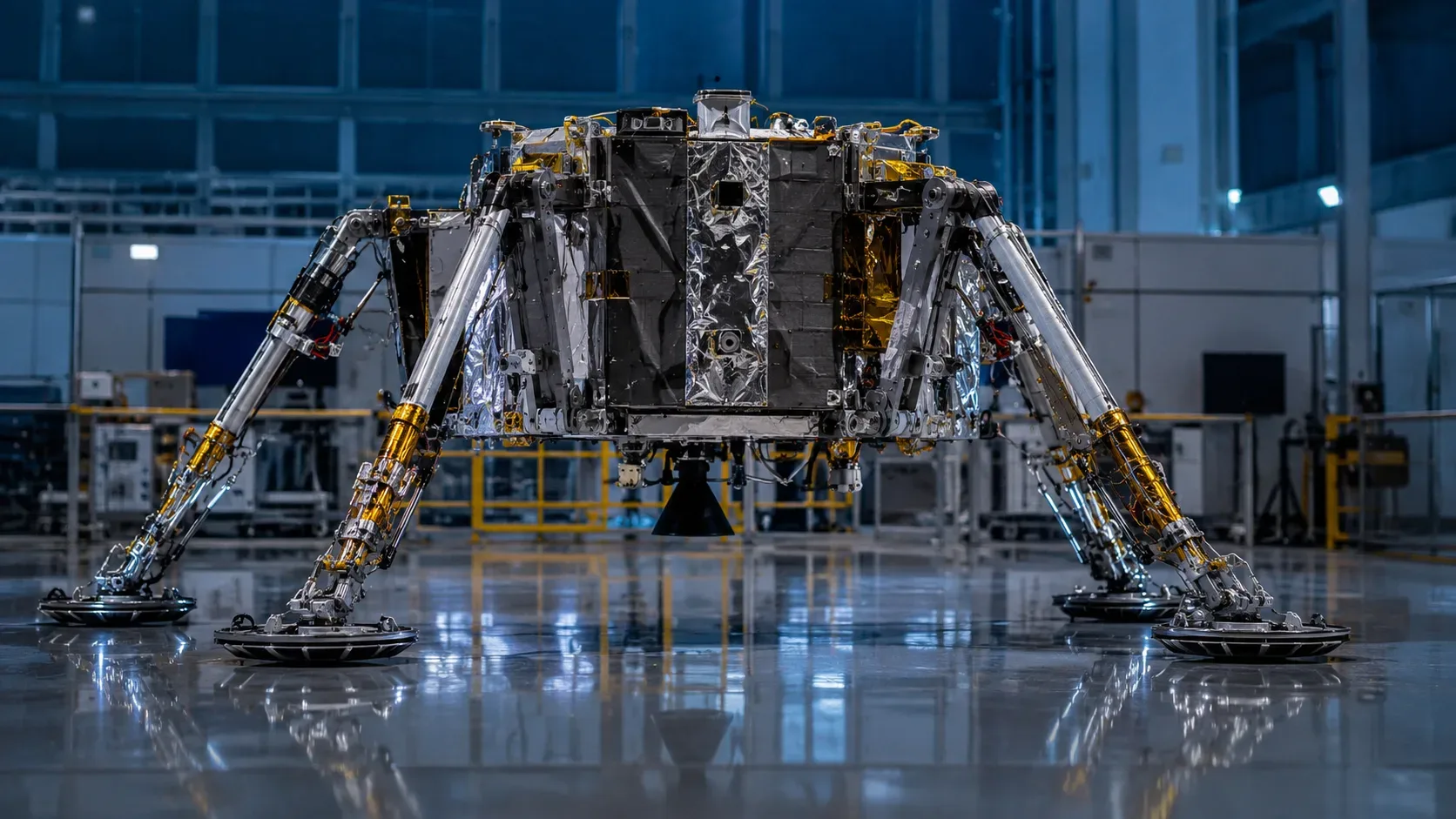
The European Space Agency (ESA) released on August 6, 2026 a new test of the platform that should take the Rosalind Franklin rover to the surface of Mars. This time, the focus was not on the collapse of the structure nor on its impact resistance, but on the deployment of the four landing legs.
The important detail is in the sequence: the four legs do not all open at exactly the same time. The system activates them in two successive pairs, with the two legs of each pair moving simultaneously. According to ESA, the automatic process takes place in less than a second, using non-explosive actuators.
It's a brief operation, but it prepares one of the components that will need to function correctly during the final minutes of the Martian descent.
What the August 6 test actually showed
The test was carried out with a full-scale model of the platform at the Thales Alenia Space facilities in Turin, Italy. The four legs reproduce the structure and dimensions planned for the units that will fly on the mission. Sener, from Spain, is responsible for the design and manufacture of this set, while Airbus provides the landing platform and Thales Alenia Space industrially leads the mission.
During the journey through space, the legs remain retracted. They should only be opened during the descent phase, right after the capsule's frontal shield is discarded. The landing sequence published by ESA places this event before the final stage of propulsive descent, when the engines take on a decisive part of the deceleration.
Therefore, the test released now answers a specific engineering question: can the mechanism quickly release and place the legs in the configuration required for landing?
It does not reproduce a complete landing on Mars on its own. Other tests are used to investigate impacts, tilts, sensors and stability.
The legs are not just for supporting the platform
At first glance, a landing gear appears to fulfill a simple function: prevent the structure from directly touching the ground. On ExoMars, however, the legs participate in different stages of contact with the surface.
They are light and retractable, have shock absorbers to absorb part of the impact energy and carry sensors associated with landing detection. In tests carried out in early 2026, teams from ESA, Thales Alenia Space and Airbus subjected a model of the platform to drops onto hard surfaces and granular material similar, in physical behavior, to the soil used in the mission's Mars tests.
The system also needs to deal with a very realistic possibility: the platform may not arrive perfectly level.
In another campaign released in May, a full-scale model was launched onto a structure inclined at up to 20 degrees, at speeds reaching 4 meters per second. According to ESA, the four legs absorbed the impact in the tests carried out. These trials provided data on the stability of the platform under deliberately unfavorable conditions.
This does not mean that the actual landing is guaranteed. It means that certain situations predicted by engineers were reproduced on the ground and provided measurements to evaluate and improve the system.
Contact with the ground also needs to turn off the engines
There is an even less visible function in the legs. All four have sensors that help detect contact with the surface and the command to turn off the descent engines.
This moment demands speed. If the engines continue to produce thrust for too long after the platform touches down, their jets can lift material from the surface and create unwanted loads on the vehicle. In tests presented in January, the ESA team worked with the aim of reducing this interval to a maximum of 200 milliseconds, and reported that the sensors were operating within the limits established for the campaign.
In the tilt landing trials released later in May, ESA again reported that the campaign had demonstrated the performance of this detection and shutdown function.
Thus, the set of legs unites three related tasks: receiving mechanical contact with the terrain, contributing to keeping the platform stable and providing information necessary for the transition between powered descent and the condition of a landed vehicle.
Why platform stability matters for the rover
The legs belong to the landing pad, not the Rosalind Franklin rover. This distinction helps to understand why the mechanism is so important.
The rover will travel on the platform. After a successful arrival, he must use one of the two ramps installed on opposite sides to reach Martian terrain. The platform, therefore, not only needs to survive the impact: it needs to finish the maneuver in a position that allows the following operations.
This is one of the reasons for testing with different terrain and inclined landings. An excessively tilted or unstable platform could complicate later steps, including exiting the rover.
ESA currently plans to launch the Rosalind Franklin mission at the end of 2028, arriving on Mars in 2030. The main scientific objective is to search for signs of past or present life and investigate the Martian subsoil. The rover will be able to drill up to two meters deep, reaching materials that are more protected from the radiation that reaches the surface.
The test reduces uncertainty, does not anticipate the outcome of the mission
It is useful to interpret the August 6 video within a larger sequence of validations. The test confirmed on the ground that leg deployment works on a representative model of the platform. Previous campaigns have separately evaluated impact absorption, sensors and stability in different conditions.
None of these results alone demonstrate that Rosalind Franklin will successfully land on Mars in 2030. The real environment brings together atmosphere, parachute, mechanical separations, navigation, propulsion, terrain and a chain of events that must work in an integrated manner.
The value of testing lies precisely in breaking down this complex problem into verifiable systems. In the case of legs, the question is no longer just whether they can support a platform. They need to remain collected during the trip, open quickly at the expected moment, absorb contact loads, help preserve stability and participate in landing detection.