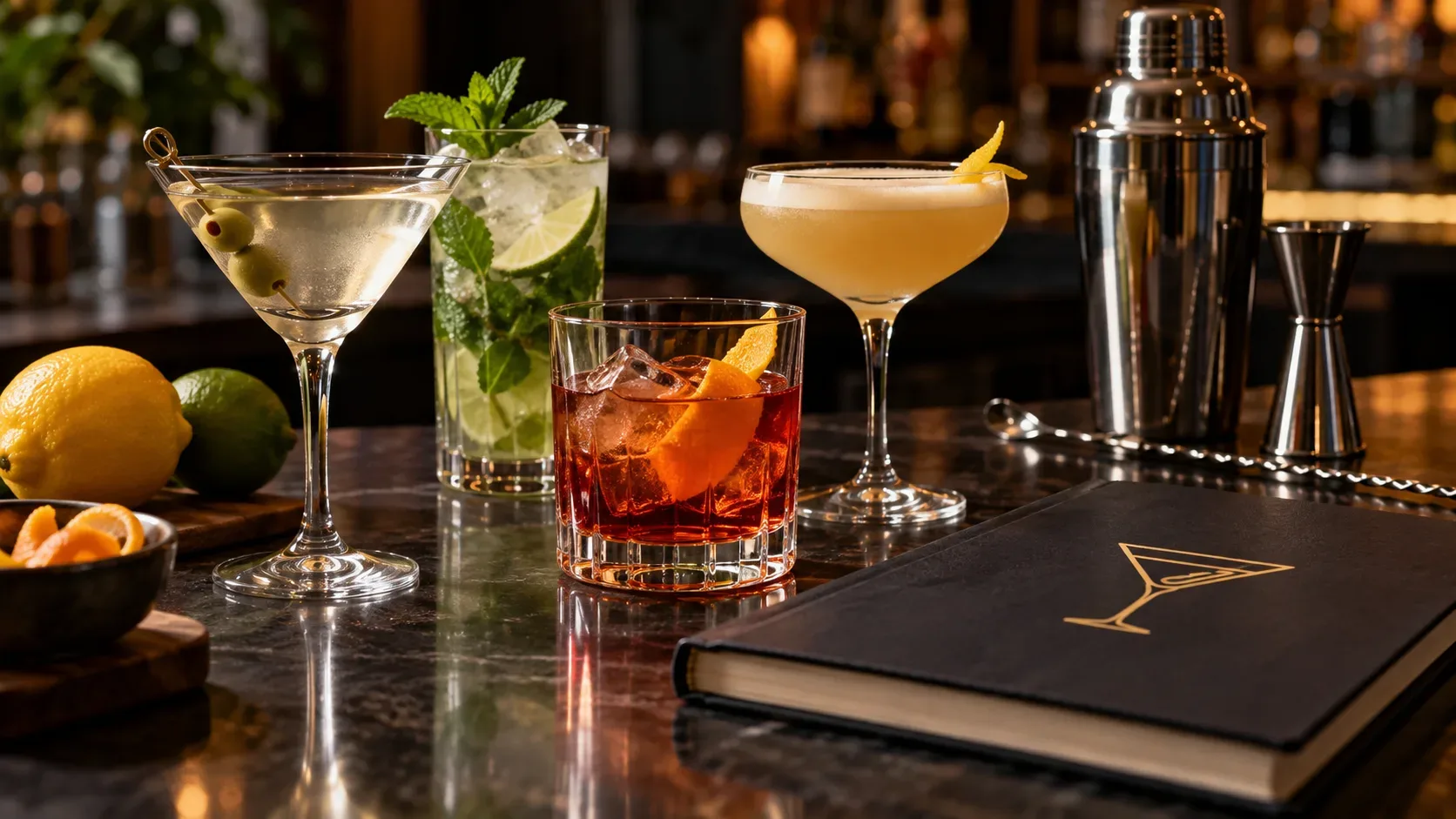
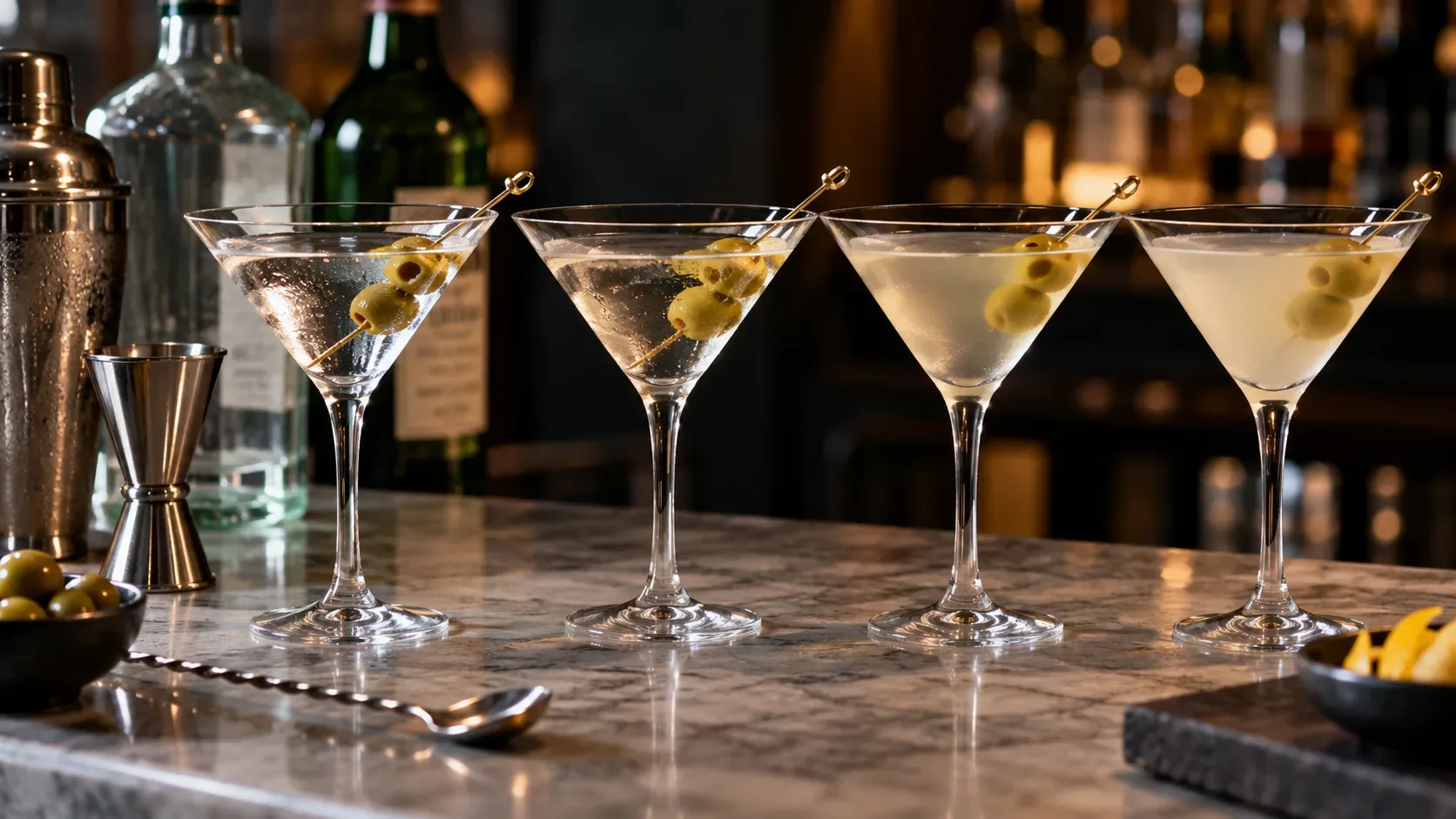
There is no single universal ratio for a Dry Martini. The current official reference from the International Bartenders Association (IBA) uses 60 ml gin to 10 ml dry vermouth, or 6:1, and instructs bartenders to stir the ingredients with ice before straining into a chilled glass. Outside that reference, terms such as wet, extra dry and 50/50 work as bar shorthand for how much vermouth goes into the drink — and that shorthand varies from one bar to another.
The useful rule is simple: more vermouth = a wetter Martini; less vermouth = a drier Martini. That changes aroma, texture, initial alcohol strength and how prominently the gin shows. Dilution is a separate variable: it mainly comes from the water added as ice melts during mixing and should not be confused with the amount of vermouth.
Dry, wet, extra dry and 50/50: quick comparison
| Style | Reference gin:vermouth ratio | What changes in the glass | How to order with less ambiguity |
|---|---|---|---|
| 50/50 | 1:1 | Vermouth and gin have equal weight; the profile is more wine-like, herbal and gentle, with a lower initial alcohol strength than drier versions. | “50/50 Martini, stirred, with a twist/olive.” |
| Wet | 2:1 is a common reference | More vermouth than in a modern Dry Martini; gin remains the base, but vermouth is clearly noticeable. | “Wet Martini, 2:1, stirred.” |
| Dry | IBA: 6:1 (60 ml + 10 ml); many bars work around 5:1 to 8:1 | Gin dominates, with vermouth acting as an aromatic and structural modifier. | “Dry Martini, 6:1” or state your preferred ratio. |
| Extra dry | No universal number; it means less vermouth than the bar's standard Dry Martini | More focus on gin and a stronger impression of alcohol; vermouth may become only an accent. | Instead of relying on the label, ask for a ratio, such as 10:1, if that is what you want. |
These numbers are service references, not a law. The Difford's Guide ratio guide shows how the Martini has historically appeared across a very wide range, from 1:1 to extremely dry versions. The bar vocabulary itself grew out of that flexibility.
What “dry” actually means
In a Martini, dry does not mean “no vermouth.” It generally means a higher proportion of spirit to vermouth. The official IBA recipe is a useful anchor because it specifies 60 ml gin and 10 ml dry vermouth, stirred with ice and strained into a chilled glass.
That 6:1 ratio does not end the discussion. Contemporary bar sources treat roughly 5:1 to 8:1 as a common range for a modern Dry Martini. As a result, two bars can serve noticeably different drinks even when both call the result “dry.”
It is also important to separate dry vermouth from Dry Martini: the first is the type of vermouth used; the second describes the cocktail and, in current usage, suggests a relatively low proportion of vermouth compared with gin.
Wet: more vermouth is not simply “more diluted”
A Wet Martini uses more vermouth than the bar's Dry Martini. A 2:1 reference is common: two parts gin to one part dry vermouth. The result tends to show more of the vermouth's wine, herbal and bitter notes while rounding the alcoholic impression of the gin.
Because vermouth is usually much lower in alcohol than gin, increasing its share lowers the average strength of the mixture before water from the ice is added. But that does not make a Wet Martini watery. “Wet” describes the gin-to-vermouth relationship, not the amount of water.
For someone who finds a modern Dry Martini aggressive or too gin-dominant, 2:1 is a useful entry point because it keeps the drink recognizably Martini while allowing the vermouth to be tasted.
50/50: when vermouth stops being a supporting ingredient
In a 50/50 Martini, gin and dry vermouth are used in equal parts. One advantage of the name is that it already states the ratio, making it one of the least ambiguous Martini orders.
Compared with a 6:1 Martini, the 50/50 is less centered on gin's alcohol and much more dependent on the quality, freshness and style of the vermouth. The profile can read more herbal, floral, saline, citrusy or wine-like depending on the brands used. The Liquor.com 50/50 recipe reinforces the equal-parts logic and notes that the style produces a lower-alcohol drink than drier versions.
This is a case where treating vermouth as a secondary ingredient hurts the result. In a 50/50, it is half the drink.
Extra dry: the name helps, but a ratio helps more
Extra dry generally asks for even less vermouth than that bar's standard Dry Martini. The problem is that there is no single international number attached to the request. At one bar, “extra dry” might mean reducing a 6:1 build to something like 10:1; at another, it might mean using only a minimal amount of vermouth.
To avoid the old confusion between “very dry” and “no vermouth,” the clearest strategy is to state the ratio. Saying “10:1” communicates more than simply saying “extra dry.” If you truly want no vermouth, say so explicitly; terms such as bone dry can also be interpreted differently from one bar to another.
The key point is that dry is not synonymous with zero vermouth. The Liquor.com Dry Martini guide makes the same distinction: dryness comes from a higher proportion of gin, not from a requirement to eliminate vermouth.
Dilution: the axis that the ratio does not settle
When gin and vermouth are stirred with ice, some of the ice melts. That water is desirable: it lowers alcohol concentration, integrates aromas and helps the Martini arrive cold and balanced. The IBA instructs bartenders to stir well with ice but does not set a universal percentage of water.
The final amount of dilution depends on factors such as the starting temperature of the ingredients, size and condition of the ice, mixing vessel, time and intensity of mixing. A “wet” Martini is therefore not automatically more diluted, and an “extra dry” Martini is not automatically less diluted.
What changes predictably with the ratio is the alcohol strength before water is added: more vermouth generally lowers it; more gin generally raises it. If two Martinis receive a similar amount of water, a 50/50 will still generally be lower in alcohol than a 6:1, while a 10:1 version will remain more spirit-forward.
In practice, this helps explain why a very dry Martini can taste “hot” or harsh when it is under-diluted. The problem is not necessarily the ratio; it may be the preparation.
Stirred or shaken: method also changes the experience
The IBA reference for the Dry Martini is stirred. Stirring preserves a clearer appearance and allows the bartender to control chilling and dilution without introducing as much aeration. Shaking is a possible preference, but it can change texture, appearance and how quickly the ice interacts with the drink.
That means comparing two ratios only makes sense when the method is also clear. A stirred 6:1 and a shaken 6:1 can taste different even with the same ingredients.
How to choose the style by what you want to taste
- Want vermouth clearly present and a gentler drink: try 50/50 or 2:1.
- Want a modern balance with gin in the lead: use the IBA's 6:1 reference or something close to 5:1.
- Want almost all gin but still a vermouth accent: ask for an explicit ratio, such as 10:1.
- Want to avoid ambiguity at the bar: state the base spirit, ratio, method and garnish — for example, “gin Martini, 6:1, stirred, with a lemon twist.”
The garnish also affects the profile: a lemon twist adds citrus oils, while an olive brings salinity and its own flavor. It does not change the ratio, but it can strongly change how the drink is perceived.
How to order a Martini without relying on vague labels
Instead of asking for the “correct ratio,” think of the Martini as a matrix of choices. First choose gin or vodka; then set the relationship with vermouth; next choose method and garnish. For the difference among dry, wet, extra dry and 50/50, the second step removes the most confusion.
A phrase such as “gin Martini, 2:1, stirred, with a twist” is more precise than “wet Martini.” Likewise, “gin Martini, 10:1, stirred, with an olive” is more precise than “extra dry.” The style name remains useful as orientation, but the ratio turns preference into an instruction.
Reference sources
- International Bartenders Association — Dry Martini: current official specification of 60 ml gin, 10 ml dry vermouth and a stirred preparation.
- Difford's Guide — Dry Martini Ratios: overview of historical and contemporary ratios, including 1:1, 2:1, 5:1, 10:1 and others.
- Liquor.com — Wet Martini: contemporary reference for 2:1 as a wet style.
- Liquor.com — 50/50 Martini: explanation of the equal-parts style.
- Liquor.com — How to Order a Martini: bar vocabulary and cautions about terms that vary from one establishment to another.