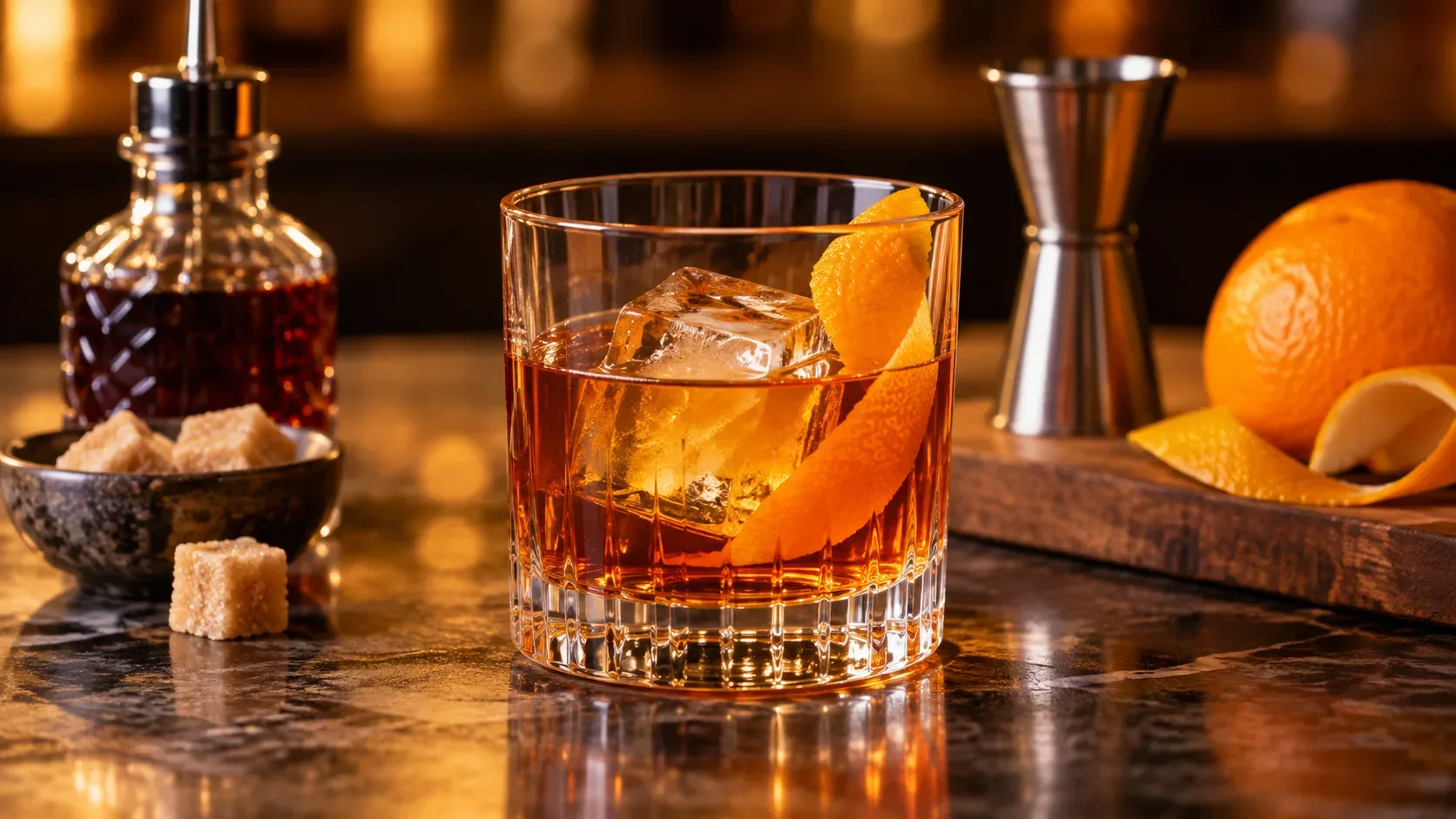
In an Old Fashioned, whiskey remains at the center of the drink, but bitters, sugar and water determine how it is perceived. Bitters contribute aromatic notes and a bitter counterpoint; sugar rounds out the mixture; the initial water dissolves the cube, while ice chills the drink and adds more water as it is stirred. Small differences in these steps change sweetness, aroma, texture and perceived intensity, even when the amount of whiskey stays the same.
The starting point: the official IBA recipe
The International Bartenders Association (IBA) lists the following ingredients for one Old Fashioned:
- 45 ml bourbon or rye whiskey;
- 1 sugar cube;
- a few dashes of Angostura bitters;
- a few dashes of plain water.
The official method calls for wetting the sugar with bitters and water, muddling until dissolved, adding ice and whiskey, and stirring gently. The specified garnish is an orange slice or zest and a cocktail cherry. The IBA does not set an exact number of bitters dashes, a stirring time or a total volume of dilution water. Those details should therefore not be presented as official measurements.
Why each ingredient changes the flavor
Bitters: aroma, spices and contrast
Angostura is an aromatic bitter used in small amounts. It brings spice and herbal aromas to the mixture and adds bitterness to the finish. Its job is not simply to make the drink bitter: in a moderate quantity, it contrasts with sweetness and brings other whiskey notes into focus. Extra dashes change the cocktail's profile and may cause the bitters to dominate the drink.
The IBA recipe specifies Angostura. Replacing it with another bitter is a sensory variation, not an interchangeable step: different products have different aromatic profiles and bitterness levels. Nor should 'a few dashes' be treated as a universal milliliter measure, since droppers and dasher tops do not dispense identical volumes.
Sugar: balance and integration
The sugar cube adds sweetness and body without turning the Old Fashioned into a drink dominated by sugar. Dissolving it is crucial: crystals left on the bottom make the first part of the drink less sweet and the last part sweeter, rather than producing a uniform mixture.
Simple syrup can make integration easier, as Difford’s Guide explains, but it is an alternative preparation method rather than the ingredient specified in the IBA formula. Sugar concentration and the amount of water already in the syrup vary, so replacing one cube with an arbitrary measure of syrup does not guarantee the same sweetness or dilution.
Water and ice: chilling and dilution are not flaws
Water enters at two stages with related functions. The initial dashes help dissolve the sugar. Later, contact with ice and stirring chill the cocktail and add meltwater. This dilution moderates the sensation of alcohol and changes how aromas and sweetness appear on the palate.
The aim is not to seek one fixed percentage of water for every glass. The whiskey's starting temperature, the ice's size and condition, the amount of liquid and the stirring time all affect the result. A large cube can help manage how the drink evolves during service, but it does not stop melting: stirring over ice still dilutes the mixture.
Bourbon or rye: the base matters too
Both are accepted by the IBA. Broadly speaking, bourbon tends toward a softer, sweeter profile, while rye often emphasizes spicier notes, a distinction described by Difford’s Guide. This is not a rule for every brand: the whiskey chosen shapes how the sugar and bitters are perceived.
How to make it using the IBA method
- Place one sugar cube in a short Old Fashioned glass.
- Moisten the cube with a few dashes of Angostura bitters and a few dashes of plain water.
- Muddle until the sugar dissolves; avoid leaving dry grains on the bottom.
- Fill the glass with ice cubes and add 45 ml of bourbon or rye whiskey.
- Stir gently to combine and chill. Finish with an orange slice or zest and a cocktail cherry, following the IBA garnish specification.
This order follows the official method, not a shaken version. The IBA does not prescribe a number of spoon rotations; use sugar integration, chilling and sensory balance as guides without turning a bar preference into a recipe requirement.
Why stir instead of shaking?
An Old Fashioned does not contain juice, egg white or another ingredient that calls for an aerated mixture. Stirring combines the dissolved sugar, bitters and whiskey while allowing control over chilling and the water added by the ice. Difford’s Guide identifies stirring as an essential part of achieving the intended dilution.
Shaking with ice changes agitation and texture and can introduce more aeration and small ice fragments. That produces a different experience, but it no longer follows the IBA method, which specifies gentle stirring. This does not mean stirring prevents over-dilution; the technique still requires attention.
Signs of imbalance and what to check
- Uneven sweetness: check whether the cube fully dissolved before adding the whiskey.
- Bitters overpowering the whiskey: review how many dashes went in and how intense the product is.
- Harsh alcohol sensation and a drink that is not cold enough: check whether there was sufficient contact and stirring with ice rather than trying to fix it with extra sugar alone.
- Watery results and muted aromas: examine the water added at the start and the dilution accumulated during preparation and service.
These signs are sensory reading guides, not laboratory measurements or automatic diagnoses. Change one variable at a time to understand the effect. If using syrup, record its concentration and volume before comparing it with a sugar-cube preparation.
Orange, cherry and the limits of variations
Orange zest can add citrus aroma when its oils are expressed over the glass; an orange slice offers a different presentation and interaction. The IBA allows a slice or zest and includes a cherry as garnish. This does not mean fruit must be muddled with the sugar: the official recipe instructs you to muddle the cube, not a fruit mixture.
Historical and regional styles may include muddled fruit or different base spirits, as documented in The Oxford Companion to Spirits & Cocktails. They help explain the diversity of drinks bearing the Old Fashioned name, but should not be confused with the specific bourbon-or-rye and Angostura formulation discussed here.
What this classic teaches
The contrast among sweetness, bitterness and whiskey works as a whole only when the sugar is integrated and water is managed deliberately. Bitters do not replace sugar; sugar alone does not correct inadequate chilling; and ice is not merely decoration. The IBA recipe gives the structure, while dissolving and stirring explain why two glasses with the same ingredients can produce different results.
This is a spirit-forward alcoholic cocktail. For those who choose to drink it, serving size and pace of consumption matter; the recipe should not be interpreted as an invitation to increase the pour.