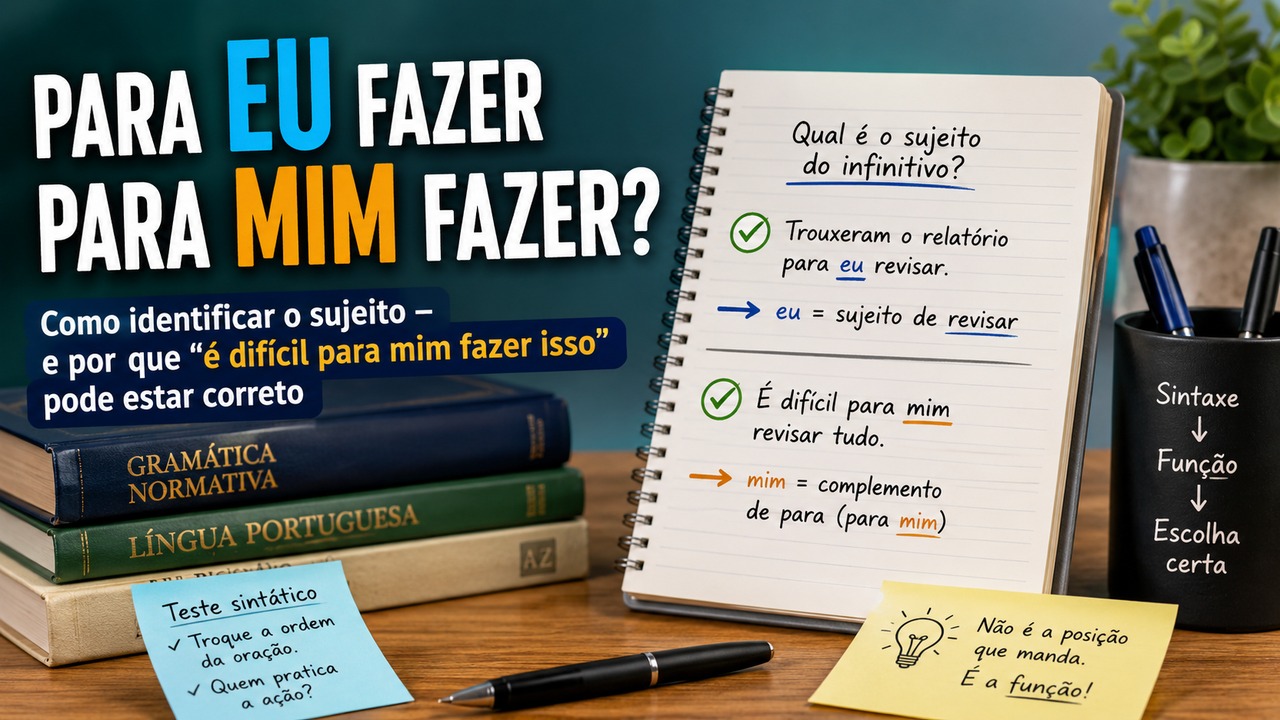
In the standard norm, the choice between I and me near an infinitive cannot be resolved just by looking at the word that comes after it. The decisive point is the syntactic function. If the pronoun is the one who carries out the action expressed by the infinitive, I use: “They brought the report for me to review”. If “for me” belongs to another part of the sentence, the pronoun me can appear immediately before an infinitive without being its subject: “It is difficult for me to review everything.”
This contrast explains why the school shortcut “I don’t do anything” helps in some cases, but fails as a general rule. Mim really does not function as the subject of the infinitive in the normative construction “for me to do”. But the graphic proximity between me and do does not prove that the two form the same syntactic block.
The right question: who is the subject of the infinitive?
In a text published by the Brazilian Academy of Letters, Evanildo Bechara summarizes the most frequent case: eu is used when the pronoun is the subject of the verb in the infinitive. The logic appears clearly in “This is for me to do”, “This book came for me to read” and “The message is for me to write down”. In all of these examples, I name the person who will do, read, or write it down.
The preposition para does not automatically require the use of me. In “for me to review”, the preposition introduces an entire infinitive clause: “I review”. Within this sentence, I plays the role of subject. Therefore, the straight form is appropriate even after a preposition.
Compare “They brought the report for me to review” with “They brought the report for me”. In the first sentence, there is a purpose that involves an action taken by me: I will review the report. In the second, there is no infinitive; for me it indicates the recipient. The structure changed, and the form of the pronoun changed with it.
Why “I don’t do anything” is an incomplete shortcut
The memorized sentence tries to prevent a real error: using me as the explicit subject of the infinitive in constructions such as “This is for me to do”, when the standard norm requires “This is for me to do”. The problem begins when the shortcut becomes a mechanical rule like “if there is an infinitive after it, it can never be me”. That's not true.
Ciberdúvidas records structures in which me appears before an infinitive without functioning as its subject. In “It is good for me to eat well”, for example, the sentence “eat well” can be understood as what is good, while “for me” is linked to the predicate “it is good”. Reordering makes the relationship more visible: “Eating well is good for me.”
The same reasoning helps to understand “It’s difficult for me to do this”. What is difficult? Do this. Who is it difficult for? For me. A more transparent command would be “Doing this is difficult for me.” In this analysis, I do not practice the action of doing; For me, the group indicates the person for whom that action is difficult. Therefore, the visual sequence “doing me” does not transform me into the subject of doing.
The reordering test shows the structure
Reordering the sentence is a good diagnosis because it separates terms that, in the original order, were side by side by chance. “It’s hard for me to review everything” can become “Reviewing everything is hard for me.” After the change, it becomes much more difficult to interpret me as the subject of review.
This test should not be used as an isolated trick, but as a way to confirm the analysis. First, ask who performs the action of the infinitive. Then, see what term the group with to connects to. Finally, try to reorder the sentence without changing the central meaning.
When the answer is me
In “They left the documents for me to check”, who will check? Me. In “There is a message for me to respond”, who responds? Me. In “She reserved the afternoon for me to present the project”, who presents? I. In these cases, the pronoun has a direct relationship with the infinitive as its expressed subject.
Another way to test is to develop the idea with a finite sentence. “They left the documents for me to check” is close to “They left the documents for me to check”. The presence of I remains natural because the pronoun is the subject of the action.
When the answer could be me
In “It's difficult for me to review everything today”, the central question is not “who reviews?”, because the structure presents “review everything today” as what is difficult and “for me” as the term that indicates the person affected by this difficulty. The reordering “Reviewing everything today is difficult for me” highlights this.
UOL Educação uses exactly this type of analysis when explaining “It's difficult for me to make friends”: the infinitive functions as the subject of the construction with difficult, while the person connects to the adjective through para. Ciberdúvidas presents similar reasoning in phrases such as “It’s good for me to eat well” and “It was easier for me to accept myself...”
Two similar sentences can have different analysis
“It’s not possible for me to do everything alone” and “It’s not possible for me to do everything alone” are a useful pair because changing the pronoun can accompany a change in structure and reading. Ciberdúvidas explains that, at first, I can be the subject of doing, with a meaning close to “it is not possible for me to do everything alone”. In the second, a possible reading is “Doing everything alone is not enough for me”, in which for me it is associated with giving in the sense of serving or being viable for someone.
This shows why it is not safe to correct a sentence just by the sequence of words. Before exchanging me for me, it is necessary to discover what the prayer is saying and which term each expression completes.
What does the preposition have to do with I and me
In common uses, mim is the expected tonic form after a preposition when the pronoun functions as a complement: “they spoke about me”, “they came to me”, “they kept that for me”. I, in turn, is the typical subject form: “I spoke”, “I came”, “I kept”.
The combination “para eu + infinitive” does not contradict this distribution. The para is not simply choosing the pronoun eu as its complement. He introduces a structure in which I is the subject of the infinitive. This is why “for me to do” can be correct at the same time as “for me” is also correct in another construction.
A more reliable procedure than memorizing a sentence
When in doubt, start by finding the infinitive and ask who carries out the action. If the answer is the expressed pronoun itself, the standard norm uses I: “for me to review”, “for me to decide”, “for me to send”.
If it appears to me, check whether this group completes an adjective, verb or other expression outside the infinitive clause. “Doing this is difficult for me” reveals that for me it is related to difficult. “Having you by my side is enough for me” shows the same type of separation between the infinitive clause and the complement with me.
Finally, reorder the sentence. If the infinitive can go forward and me remain linked to the rest of the sentence, you have gained a strong clue that me is not the subject of the infinitive. This is what happens in “Reviewing everything is difficult for me”.
The difference worth keeping
“For me to do” is the normative choice when I am the subject of doing it. “For me to do” should neither be automatically accepted nor automatically rejected just because me appears before an infinitive. In many familiar constructions of Brazilian Portuguese, mim is used as the subject of the infinitive, a use registered by grammars and descriptive studies, but not accepted by the standard norm in this role. In other sentences, however, such as “It's difficult for me to do this”, me is not the subject of the infinitive and the construction may also be correct in monitored writing.
The most useful rule, therefore, is not “I don’t do anything”. It's: find out who does it and find out which term for me it belongs to. When the syntactic function becomes clear, the choice between I and me no longer depends on the position of the words.