A senior dog that suddenly starts waking up, walking around the house, or struggling to settle at night should be observed methodically — and, if the change is new or worsening, should be evaluated by a veterinarian. Sleep-wake cycle changes and pacing can occur with canine cognitive dysfunction, but they are not specific to it. Pain, urinary or metabolic disease, neurologic problems, vision or hearing loss, anxiety, and other conditions can also cause nighttime restlessness.
In February 2026, the American Animal Hospital Association (AAHA) highlighted the publication of the first guidelines specifically for the diagnosis and monitoring of canine cognitive dysfunction syndrome. The document reinforces an important point for caregivers: no single sign or simple test can establish “dementia.” Clinical history, examination, and ruling out other causes remain central.
What to track before the veterinary appointment
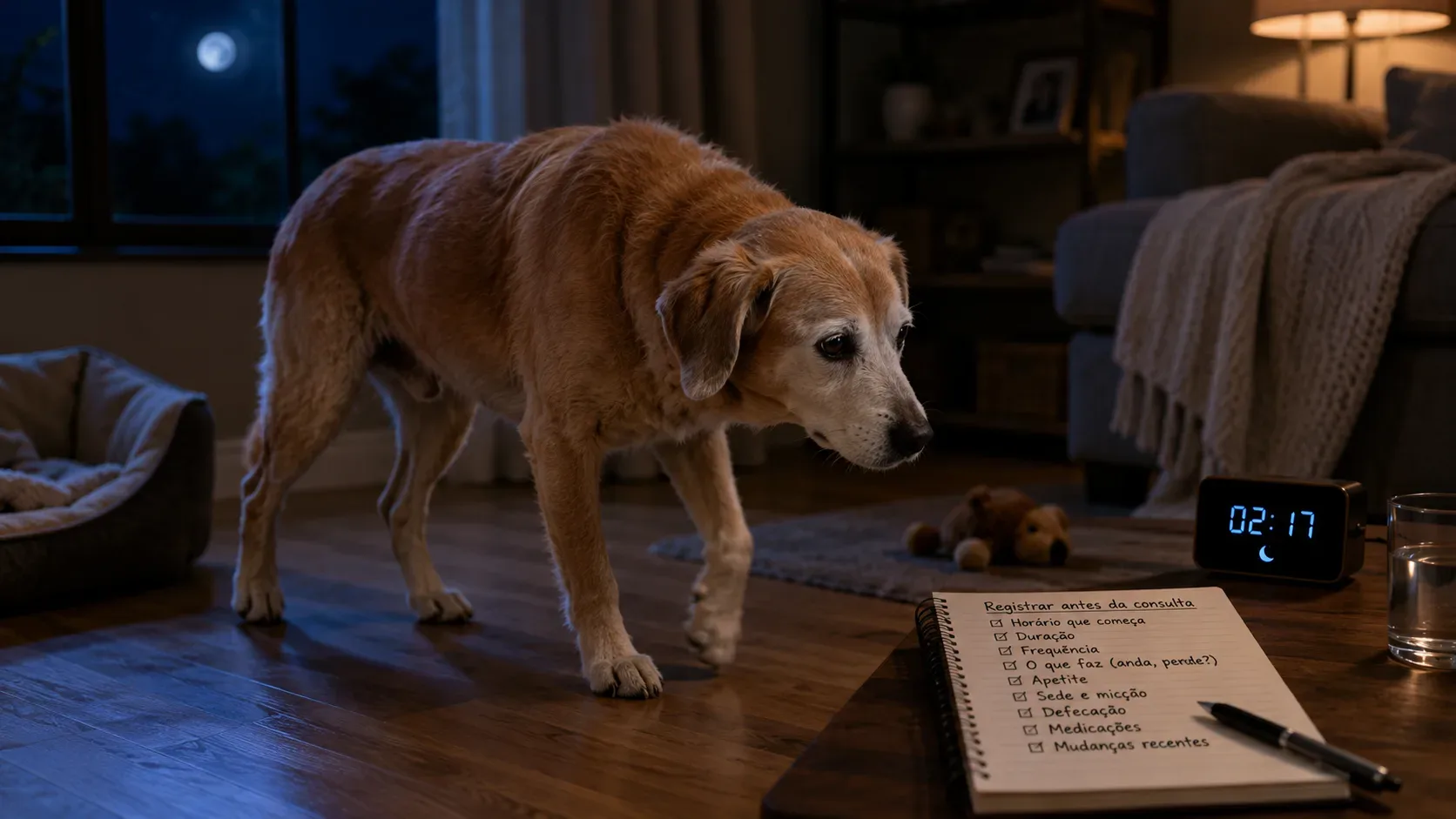
A three- to seven-night diary can turn a vague report such as “he doesn’t sleep” into useful clinical information. Record what happens without trying to trigger the behavior.
- Timing: when the restlessness starts, how long it lasts, and how many times it repeats during the same night.
- Movement pattern: whether the dog walks seemingly without purpose, follows the same route, circles, stops in corners, tries to pass through obstacles, or simply gets up to drink, urinate, or change position.
- Associated signs: panting, whining, barking, trembling, a vacant look, difficulty lying down, stumbling, head tilt, weakness, nausea, or repeated attempts to urinate.
- Daytime sleep: whether the dog is sleeping much more during the day or appears to have reversed the sleep cycle.
- Elimination and thirst: increased water intake, larger urine volume, house accidents, diarrhea, constipation, or straining to urinate/defecate.
- Appetite and weight: decreased or increased appetite and any noticeable weight loss.
- Mobility and pain: difficulty getting up, climbing steps, turning, lying down, getting back up, or finding a comfortable position.
- Orientation and interaction: whether the dog seems not to recognize a room, gets stuck behind furniture, goes to the wrong door, starts avoiding people, or becomes unusually dependent.
- Medications and recent changes: note medicines, supplements, dose changes, food changes, routine changes, a move, or changes in walk times.
- Video: record short clips when it is safe. The AAHA senior care guidelines recommend considering caregiver videos when assessing neurologic and mobility changes.
Why “walking at night” does not automatically mean cognitive dysfunction
The Cornell University College of Veterinary Medicine lists sleep-pattern changes, nighttime wandering, restlessness, and pacing among possible signs of cognitive dysfunction syndrome (CDS). The same source stresses that diagnosis requires ruling out conditions that can cause similar signs, including pain, arthritis, systemic illness, seizure disorders, and vision or hearing loss.
| What you observe | Why it matters |
|---|---|
| Walks around and cannot settle | It can occur with cognitive change, anxiety, or discomfort; chronic pain can also keep a dog from finding a comfortable sleeping position. |
| Gets up repeatedly to drink or urinate | This shifts attention toward urinary, kidney, endocrine, or medication-related causes in addition to behavioral causes. |
| Gets stuck in corners or seems lost | This is compatible with disorientation, one of the domains used to screen for cognitive dysfunction, but neurologic or sensory changes also need consideration. |
| Pants, whines, or avoids lying down | This may indicate pain, discomfort, or anxiety. In senior dogs, pain-related behavior changes can be subtle. |
| Stumbles, loses balance, or develops a head tilt | This calls for neurologic/vestibular assessment and should not be labeled simply as “old age.” |
| Sleeps during the day and wanders at night | Sleep-wake reversal is a classic sign to investigate in cognitive dysfunction. |
What DISHAA is and how it organizes the signs
Veterinarians often use the acronym DISHAA to group changes associated with cognitive dysfunction: Disorientation, changes in social Interactions, Sleep-wake changes, loss of House training and other learned behaviors, Activity changes, and Anxiety/fear. Both the AAHA and Cornell use this framework to help identify changes caregivers may not realize are related.
The 2026 guidelines also propose two levels of diagnostic evaluation and a three-stage severity scale. Their purpose is to standardize language and follow-up, not to turn a home questionnaire into a definitive diagnosis. Bring the record to the veterinarian; do not use a score alone to conclude that the dog does or does not have the syndrome.
Which signs call for a veterinary visit soon
Schedule an evaluation when the nighttime pattern is new, recurrent, progressive, or disruptive to sleep and routine, especially when it is accompanied by disorientation, urinary or fecal accidents, interaction changes, new anxiety, appetite loss, weight loss, increased thirst, reduced mobility, or signs of pain.
Even if the dog seems fine during the day, new nighttime pacing in a senior animal is clinically relevant. In a 2026 publication on sleep and behavior, the AAHA states that nighttime pacing, vocalizing, or reversed day-night patterns should prompt a trip to the veterinarian.
When to seek emergency care
Do not wait for a scheduled appointment if the restlessness comes with signs of a possible emergency. The Cornell University Hospital for Animals lists the following among emergent conditions:
- difficulty breathing;
- collapse, unconsciousness, or unresponsiveness;
- blue, purple, or very pale gums;
- active seizures or significant tremoring;
- major loss of balance;
- severe weakness;
- difficulty urinating;
- trauma, major bleeding, or ingestion of a toxic substance.
The Merck Veterinary Manual likewise classifies breathing difficulty, ongoing seizures, loss of consciousness, and blocked urine flow among problems requiring immediate treatment.
What the veterinarian may investigate
The workup depends on the full pattern of signs. In senior dogs with behavioral change, evaluation may include a physical and neurologic examination, pain and mobility assessment, medication review, blood pressure, blood and urine testing, and vision and hearing checks. If neurologic disease is suspected, imaging may be considered.
This matters because cognitive dysfunction can be a diagnosis of exclusion. The AAHA senior care guidelines list intracranial disease, pain, and organ dysfunction among differential diagnoses that can cause similar behavioral changes.
What to do at home until the appointment
- Keep nighttime pathways clear and use soft lighting if the dog seems to get lost.
- Avoid moving the bed, bowls, and furniture unnecessarily; a predictable routine may reduce confusion.
- Make water and a safe toilet area easy to reach, and do not leave the dog to manage stairs or slippery floors alone.
- Do not punish vocalizing, accidents, or pacing. If cognitive disease, pain, or another medical problem is present, punishment does not treat the cause.
- Do not start sedatives, melatonin, herbal products, or “sleep” supplements without discussing them with the veterinarian, especially if the dog already takes other medications.
- If the episode changes pattern or an emergency sign appears, raise the priority of care rather than waiting for the diary to feel “complete.”
A simple log that fits on your phone
For each episode, record: date and time → duration → what the dog did → associated signs → water/urine/stool → mobility → response to contact or a short walk → video, if available. Add one line about daytime sleep.
This log is not meant to diagnose dementia at home. It is meant to answer questions that improve the veterinary visit: did the problem start suddenly or gradually? does it happen every night or at specific times? are pain, thirst, urinary changes, disorientation, or balance deficits present too? From there, the veterinarian can decide which possibilities should be prioritized.