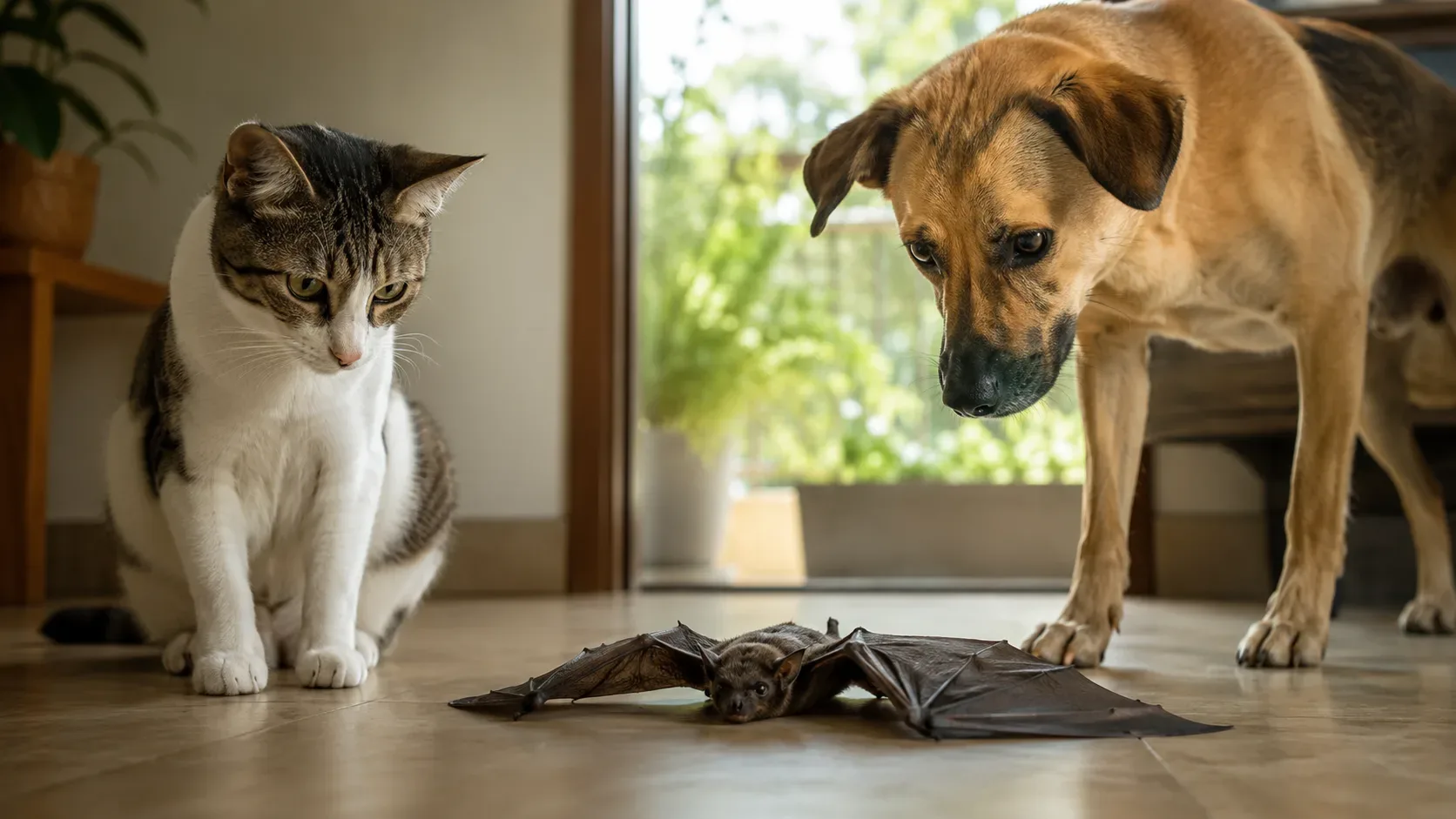
If a dog or cat has caught, bit, mouthed, scratched, or otherwise had direct contact with a bat, do not handle the bat, even if it appears dead. Keep people and other animals away, notify the zoonosis service or municipal surveillance and seek medical and veterinary advice. The pet's vaccination card must be presented, but an anti-rabies dose within the deadline does not make the episode a closed case.
This happens because vaccinated dogs and cats continue to be evaluated after a relevant exposure. The Ministry of Health reports that these animals can still become infected by wild variants of the rabies virus, especially those associated with bats.
If contact just happened, what to do
The priority is to prevent new contacts and preserve the possibility of investigating the bat without putting anyone at risk.
- Take the dog or cat away from the bat. Do not allow the bat to sniff, bite, lick or play with the animal again.
- Do not pick up the bat with your hands. The official guidance is not to handle it, dead or alive. If you are inside a room, keep people and animals away and, when it is possible to do so without direct contact, isolate the area. Surveillance services can also guide the placement of a container over an immobile bat until collection, without directly touching it.
- Activate the municipality's zoonosis surveillance. The name of the sector varies between cities: Zoonosis Surveillance Unit, Environmental Surveillance, Zoonosis Control Center or equivalent service. The bat can be collected for laboratory diagnosis, and this result influences the measures adopted for the pet. The Ministry of Health manual provides for sending the bat for analysis in situations of entry and exposure.
- Seek veterinary advice and inform your anti-rabies history. Bring, if available, your wallet or proof of previous doses. Inform when the contact occurred, how it happened and whether the bat remains available for collection.
- If someone has also had contact with the bat, the assessment is human and not just veterinary. In case of a bite, scratch or contact of saliva with the lesion or mucous membrane, wash the area with soap and water and quickly seek medical attention. Do not wait for the results of the pet's monitoring to report a human exposure. The prophylaxis scheme must be defined by the health service according to the type of contact.
If you did not witness the entire interaction and cannot determine whether there was a bite, scratch or contact with the pet's mouth, report this uncertainty to the zoonosis service instead of assuming on your own that there was no exposure.
Why the up-to-date rabies vaccine does not end the evaluation
Keeping dogs and cats vaccinated is one of the most important measures to prevent rabies. The point is different: prior vaccination reduces the risk and modifies behavior after exposure, but does not eliminate the need to investigate contact with a bat.
The Ministry of Health's Zoonosis Surveillance, Prevention and Control Manual establishes specific conduct for previously vaccinated dogs and cats that have had contact with bats. When the bat tests positive for rabies or when it is not possible to diagnose it, the document provides for veterinary follow-up, the possibility of isolation for 180 days, evaluation by serum neutralization and two doses of anti-rabies vaccine on days 0 and 30. If the bat's test results negative for rabies, the measures can be suspended and the case closed.
This protocol did not just remain in an old document without subsequent application. In a December 2025 newsletter, the Environmental Surveillance of Zoonoses of the Federal District advised that previously vaccinated dogs and cats that were in contact with positive or undiagnosed bats should receive two anti-rabies doses, on days 0 and 30, and remain in home isolation with veterinary monitoring for 180 days.
The concrete execution must be defined by the health authority responsible for the case. This is especially important because local protocols, epidemiological situation, possibility of testing the bat and the pet's vaccination history are part of the decision. It is not recommended to simply apply a booster on your own and consider the problem resolved.
For dogs and cats that have not previously had rabies vaccination, official measures are more stringent. This is another reason to report exposure immediately to surveillance rather than waiting to see if your pet displays any symptoms.
Why contact with bats gets so much attention
Urban rabies associated with classic dog variants has been strongly reduced in Brazil, but this does not mean the risk has disappeared. The epidemiological scenario began to give greater importance to variants originating from wild animals.
In the Ministry of Health update of June 11, 2026, dogs and cats continued to be described as susceptible to wild variants, especially those related to hematophagous and non-hematophagous bats. The agency also highlights that cats deserve attention due to their predatory behavior, which can increase interactions with bats.
For human health, the same epidemiological shift is visible. According to data from the Ministry of Health updated on June 11, 2026, Brazil registered 54 cases of human rabies between 2010 and 2026; 23 were attributed to bats. The Ministry itself currently classifies transmission by bats as the main source of human rabies infection in the country.
Therefore, it is not safe to try to decide from the appearance of the bat whether there is a risk or not. Surveillance includes hematophagous and non-hematophagous bats, and an animal that has fallen, is weakened, found in an unusual situation or has just had contact with a pet deserves communication to the responsible service.
Do not discard the bat after contact
After a dog, cat or person has been exposed, throwing the bat in the trash or releasing it without guidance can eliminate important information: the laboratory diagnosis.
The national manual clearly differentiates situations in which the bat has a negative result from situations in which it is positive or cannot be examined. A negative result may allow measures related to that contact to be terminated; the inability to test the animal may lead to a more cautious approach.
This does not mean that the guardian should capture it. The recommendation is precisely the opposite: avoid manipulation and ask qualified professionals for collection.
What if a person touched the bat?
The evaluation of the dog or cat does not replace the evaluation of those who had contact with the bat.
The Ministry of Health maintains specific guidance for human exposures. The official human rabies prophylaxis poster, whose page was updated on July 10, 2026, provides appropriate conduct for contacts involving bats. The decision about vaccines and immunobiologicals must be made by the health service after characterizing the exposure.
If there has been a bite, scratch or lick on the lesion or mucous membrane, the area must be washed thoroughly with soap and water and the person must seek care. It is also important to report exactly what happened, including when it cannot be reliably determined whether there was direct contact.
The simple fact that the dog or cat found a bat does not automatically allow us to conclude that a person in the house was exposed. Human assessment depends on the interaction that occurred with the person. Therefore, instead of assuming risk or lack thereof, describe the episode to the health service when in doubt.
What to inform the veterinarian and surveillance
When making contact with professionals, try to have at hand the approximate date and time of the episode, how the pet interacted with the bat, the current situation of the bat and proof of the dog or cat's anti-rabies doses. Also inform if anyone touched the bat or suffered a bite, scratch or other contact.
This information helps to separate three different issues: the diagnosis of the bat, the post-exposure management of the domestic animal and the possible need for prophylaxis for people.
The preventive measure continues to be to keep the rabies vaccination of dogs and cats up to date and reduce opportunities for hunting or contact with wild animals. But, when exposure has already occurred, “the vaccine is up to date” should be information taken into account, not a reason to dismiss it.