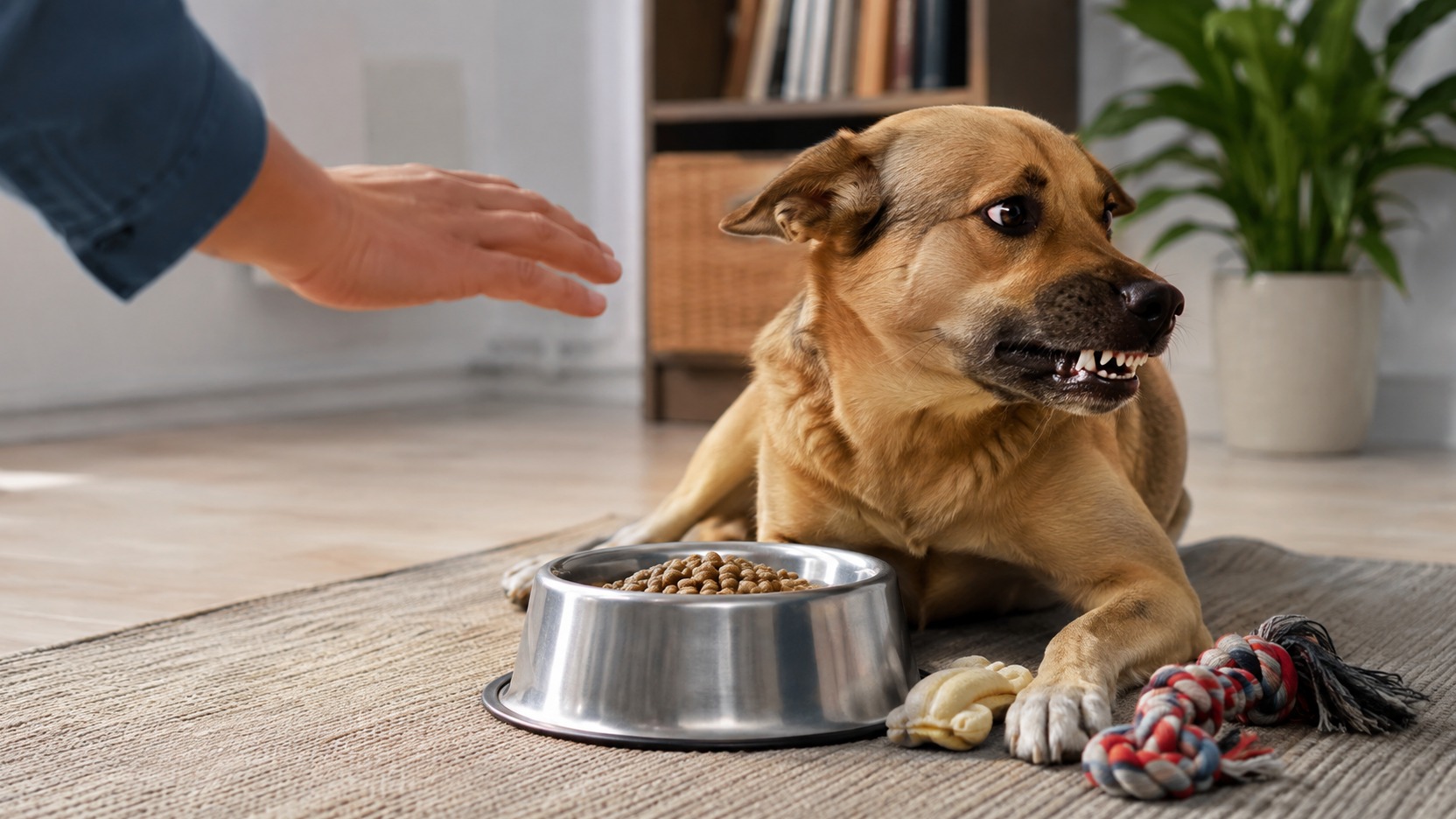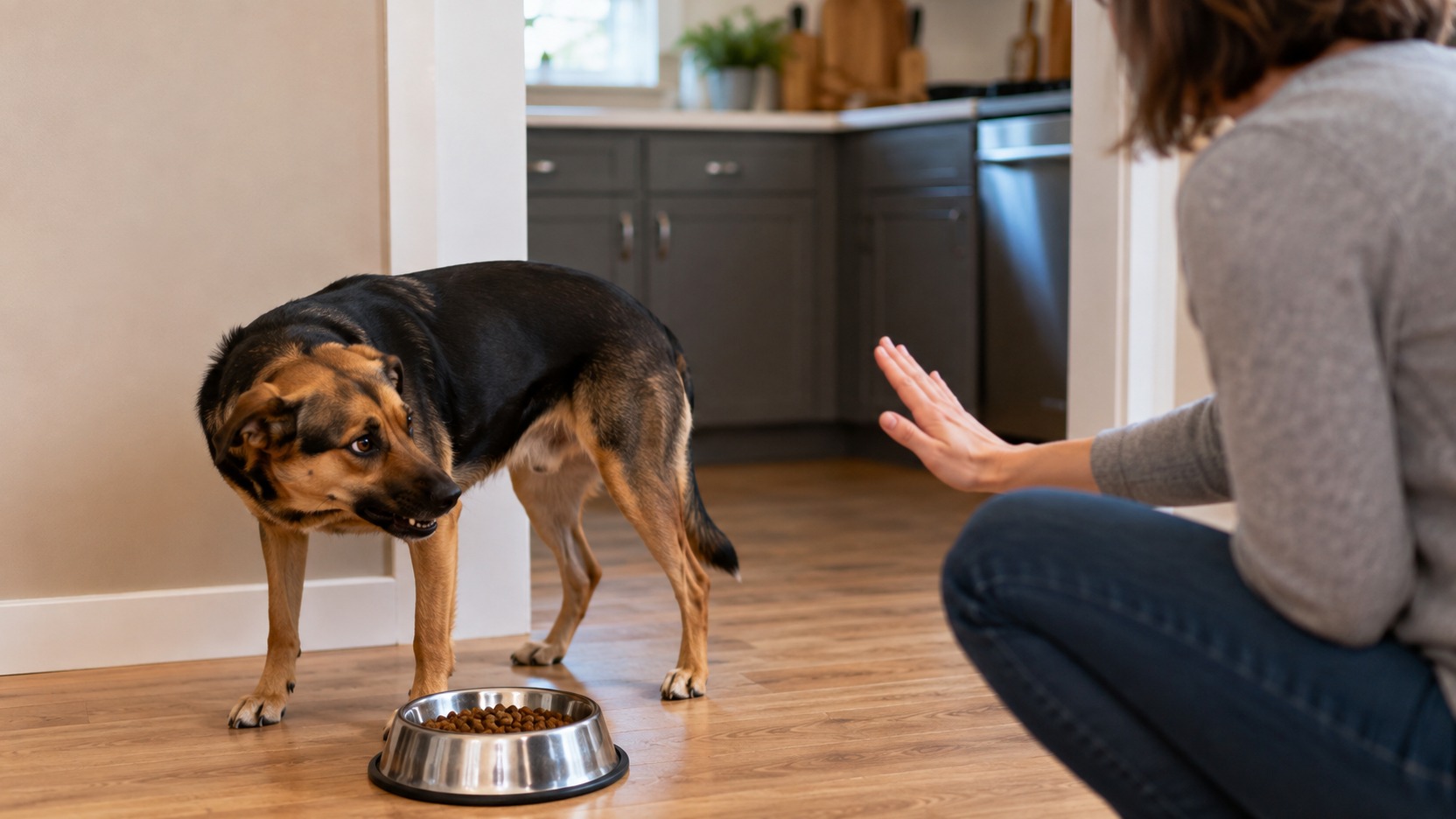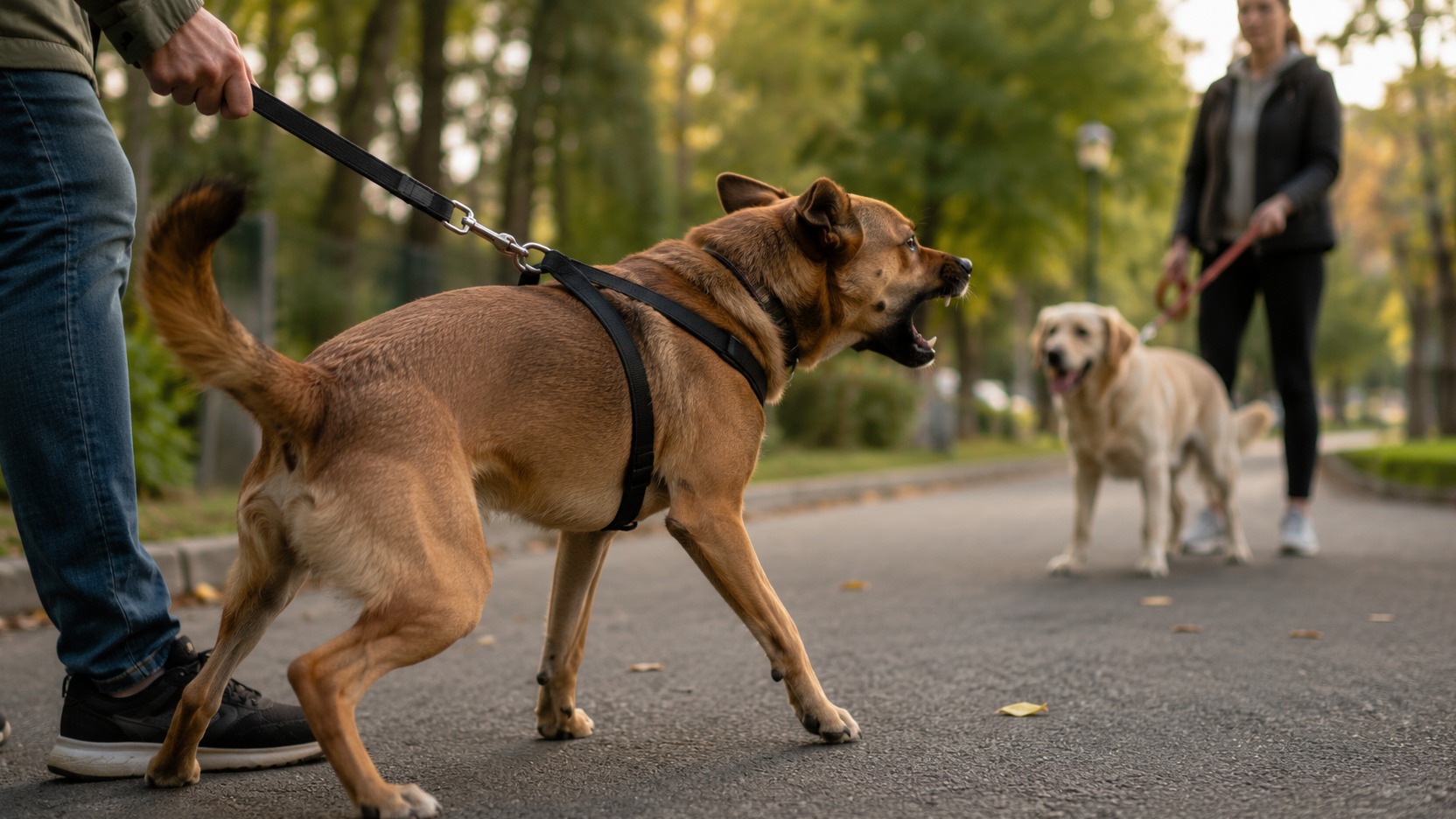
Barking, growling or advancing towards another dog during a walk is a behavior that demands attention, but does not allow you to conclude on your own whether the dog is scared, frustrated, trying to push the other animal away or reacting due to a combination of factors. For those holding the leash, the priority is not to discover motivation in the middle of the sidewalk. It's about preventing the situation from escalating, creating distance, and observing the pattern in enough detail to put together a safe plan.
The central idea is simple: management comes first, behavioral modification comes later. Management reduces the chance of new intense episodes while you learn which situations trigger the reaction. Behavioral modification is the gradual work to change the dog's response to the trigger. The two things complement each other. Avoiding a difficult approach today is not “running away from the problem”; is to prevent the dog from practicing a response that can become stronger with repetition.
1. Record what happens before calling everything “aggressiveness”
Start by describing observable facts. Note what the trigger was, where it occurred, whether the other dog was stationary or moving, whether it was coming from the front or from behind, whether there was room to avoid it, and the approximate distance at which your dog began to shift. This distance does not need to be measured precisely. This could be “across the street”, “half a block” or an estimate in meters.
Also observe the signs that appear before barking or lunging. Staring, going rigid, freezing for a moment, shifting his weight forward, speeding up his pace, or ceasing to respond to you can be helpful clues. Veterinary behaviorists point out that freezing and staring can appear before more intense responses. Noticing this initial moment is valuable because there is still room to increase the distance before the explosion.
Record the peak of the reaction and, mainly, the recovery. How long does it take for the dog to smell the ground again, release its body, walk without pulling and respond as it usually does on a regular walk? A recovery that takes a long time suggests that the encounter demanded too much from the animal and helps to compare situations over the weeks.
Registration prevents two common mistakes. The first is to believe that “he does that with any dog”, when in practice there may be a pattern of distance, environment, direction of approach or type of encounter. The second is to invent a cause based on a single scene. The same barking may appear in dogs that are scared, frustrated, overly excited, in pain or with a different learning history.
2. The right distance is the distance at which there is still learning
To modify behavior, the goal is not to get as close to the other dog as possible. It's about finding a distance where your dog perceives the trigger without going into such an intense reaction that he loses his ability to respond and recover.
Cornell University advises starting counterconditioning at a safe distance, associating the presence of the trigger with something positive, and increasing proximity only when the dog remains comfortable. If he starts to get more tense, the distance should increase again. This principle is more important than any fixed number in meters.
In practice, a functional distance is one in which the dog can still notice the other animal and continue with some degree of flexibility. He may look and then look away, follow you, accept food he normally values, or respond to a simple skill he already knows. If he gets stuck, can't disconnect from the other dog, bursts into barking or takes a long time to recover, the training has become too difficult at that point.
This also explains why “socializing by force” is often a bad strategy. Bringing dogs closer together until they “get used to it”, forcing a nose-to-nose greeting or remaining very close waiting for the dog to stop reacting can increase fear, frustration and risk. Approximation is not the goal. The goal is a safer and more regulated response.
3. Have a plan for inevitable encounters
The best time to act is when you see the other dog before your dog is at his limit. Use the available space. Cross the street, change sidewalks, make a wide turn, enter a side street, or use a visual barrier such as a parked car when this can be done safely. The most useful maneuver is the one that increases distance without turning the encounter into a physical contest on the leash.
If your dog is still able to eat and keep up with you, rewards can help when you go out. Food does not need to function as a “bribe to shut up”. In counterconditioning, the presence of the other dog starts to predict something good at a distance that your dog tolerates. With well-planned repetition, the goal is for him to notice the trigger and have a more stable alternative than moving forward.
If the reaction has already started, the priority changes. Exit the situation with as little confrontation as possible. Don't insist on difficult commands, don't try to prove that he “has to obey” just a few meters from the trigger and don't use the approach as a test of courage. Create distance and wait for recovery before thinking about training.
It's also worth planning the tour to reduce surprises while work is beginning. Less crowded times, routes with good visibility and space to divert are management methods. Avoiding dog parks, narrow corridors and short leash encounters may be necessary temporarily, especially if the dog reacts intensely or if a bite has already been attempted.
4. Management and behavioral modification are not the same thing
Management is what reduces risk now. Changing time, choosing a wider street, crossing before meeting, not allowing greetings on the curb and keeping your distance are examples. These measures do not in themselves teach a new emotional response, but they prevent the tour from becoming a sequence of explosions.
Behavioral modification is the process of teaching different responses and creating new associations. Counterconditioning seeks to change the meaning of the trigger: another dog appears and, at a safe distance, good things happen. Systematic desensitization works with very gradual exposure, avoiding throwing the animal into an intense situation all at once.
The American Veterinary Society of Animal Behavior, AVSAB, recommends reward-based methods for training and treating behavior problems. The organization also states that cases of fear, anxiety and aggression may require a combination of environmental management, behavioral modification and, in some cases, veterinary evaluation and medication. This is different from simply trying to “tire” the dog until he stops reacting.
Management may need to continue even when progress is made. A dog can learn to cross the street by seeing another dog and still not be a good candidate for tight greetings on a sidewalk. Success does not mean turning every dog into an animal that is sociable with strangers. It means reducing risk, intensity and recovery time, as well as increasing the ability to make safer choices.
5. How to start work without forcing approximations
Choose a scenario in which you can control the distance. Instead of looking for the toughest encounter in the neighborhood, use an open, predictable space, preferably with a calm assistance dog and a handler who respects the plan. Start far enough away for your dog to notice the other animal without quickly escalating.
When the other dog appears, offer the high-value reward and keep the session short. If your dog can look, turn his attention to you, and remain relatively loose, this distance may be suitable for repeating. On another day, and not necessarily in the same session, the distance may decrease a little. If stiffness, intense fixation, increasing vocalization, or attempts to move forward appear, increase again.
Progress does not have to be linear. Tolerated distance may vary depending on the location, the size and behavior of the other dog, the number of surrounding stimuli, recent experiences and the animal's physical condition. Therefore, comparing today's session with yesterday's using just “how many meters did you get close” is not very useful. Observe intensity, ease of getting out of focus and recovery.
Short, successful sessions are usually more productive than insisting until the dog makes a mistake. Terminating after a few calm repetitions preserves learning capacity and reduces the chance of the dog moving past the point where he can still handle the situation.
6. What to avoid when your dog barks, growls or lunges
Sharp leash pulls, chokes, prong collars, shocks, intimidation, yelling, and other aversive corrections are not the direction recommended by AVSAB. The entity's current position is that reward-based methods should be used even for behavior problems and that aversive techniques should not be used to treat fear, anxiety or aggression.
In addition to the well-being problem, punishing visible behavior does not necessarily resolve the emotion or motivation that underpins it. A dog may momentarily stop vocalizing and remain uncomfortable. There is also a risk that he will associate the presence of other dogs with additional discomfort, the opposite of what is sought in counterconditioning.
Also avoid “testing” the dog by loosening the leash, removing a barrier or approaching him to find out if he would actually bite. On-leash reactivity alone does not reveal what would happen without the leash, and this type of testing can put people and animals at risk.
7. Reactivity describes the pattern, does not close the diagnosis
The term “on-leash reactivity” is useful to describe a dog that displays an intense response to certain stimuli during a walk. It does not automatically identify motivation. Fear is a possibility. Frustration at not being able to get closer is another. Territoriality, prior learning, pain or more than one factor at the same time can also participate.
This distinction matters because the plan changes depending on the cause. A dog that reacts in pain needs medical investigation. A dog that panics at great distances may need a more structured clinical plan. A dog that becomes frustrated when unable to greet other dogs may require different work than a dog that tries to chase them away.
A sudden change in behavior deserves veterinary evaluation, especially if it is accompanied by sensitivity to touch, difficulty in moving around, changes in sleep, appetite or disposition. Health assessment is part of behavioral care because medical conditions can contribute to aggressive or irritable responses.
8. When to stop domestic attempts and seek help
Seek a veterinarian and a qualified behavior professional when there is a bite, an attempted bite, aggression redirected towards the owner, a reaction so intense that you cannot maintain a safe distance, progressive worsening or a very slow recovery after encounters. It is also wise to seek help if your dog reacts to other dogs even at great distances or if the environment in which you live makes it practically impossible to avoid risky situations.
Redirected aggression deserves special attention. An overly excited or frustrated dog may turn on the person holding the leash or another nearby animal. In this situation, do not turn the episode into training. Reduce exposure and ask for professional advice. In cases with a bite risk, a well-fitting basket muzzle can be part of a safety plan, but it should not be used to allow approaches that the dog would not tolerate without the equipment. The animal's space still needs to be respected.
If pain, neurological changes, sudden behavioral changes or a history of severe episodes are suspected, veterinary consultation should come before increasing exposure to the trigger. Behavior professionals working with reward-based methods can supplement the plan after clinical evaluation.
9. How to know if the management is working
The first sign of progress doesn’t have to be “walking past another dog without barking”. Useful results appear before then. The dog begins to notice the other animal without freezing immediately, accepts increasing distance with you, recovers faster after a surprise and is able to complete more walks without reaching peak reaction.
Your record helps you see these changes. If before he started looking at 40 meters and needed ten minutes to reorganize himself, and after a few weeks he manages to look at a similar distance, turn with you and recover in a short time, there is concrete information to continue the plan. If the opposite happens, the strategy needs to be revised.
The ultimate goal is predictability and security, not proximity at any cost. A better walk is one in which the owner identifies the trigger early, knows how to create space and offers the dog opportunities to respond before climbing. With consistent management, gradual work, and reward-based methods, many dogs are able to reduce the intensity of reactivity. When the risk is high or progress is lacking, asking for help early is part of treatment, not a failure of training.