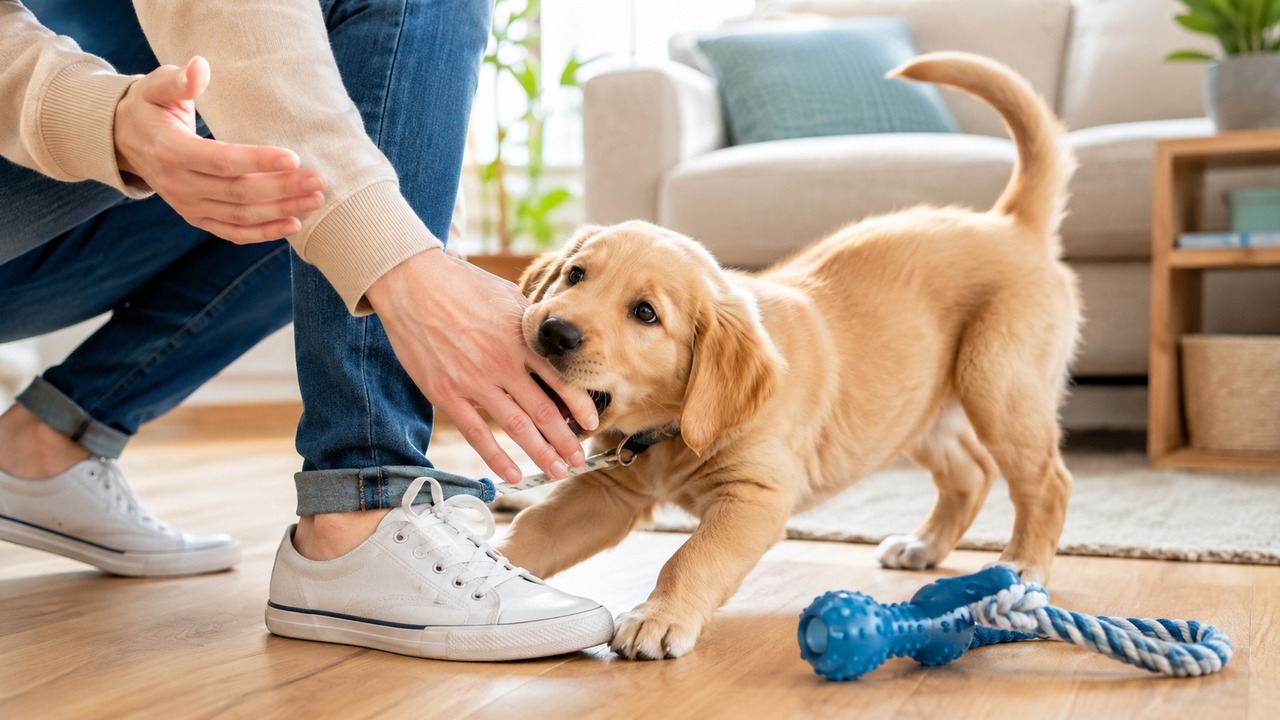
Scratched hands, ankles targeted when someone walks through the house, and pant legs pulled by little teeth are very common scenes with puppies. The behavior can hurt a lot, but teeth touching skin does not, by itself, mean the dog is becoming aggressive. For puppies, the mouth is a tool for exploration, play and communication, and the transition from baby teeth to adult teeth also increases the urge to chew.
The more useful question, therefore, is not simply "does the puppy bite?", but "what was happening just before it, what did the puppy's body look like, and what did the puppy seem to be trying to achieve?" Reading the context this way helps separate three situations that can even overlap on the same day: play biting, chewing linked to teething, and defensive biting associated with fear, discomfort or pain.
Play, teething and a warning sign are not the same thing
VCA Animal Hospitals makes a useful distinction: nipping, mouthing and biting people in puppies commonly appear as part of social play, while teething tends to increase the need to gnaw and chew objects. In another resource on teething, VCA also notes that puppies may chew on people during this stage. The two ideas do not contradict each other. The same puppy may play with a hand while also having a more sensitive mouth because of tooth replacement.
That is why the target alone is not enough to decide what is happening. Biting a hand may be play, excitement or a defensive response. Chewing a toy may be exploration or relief from teething. The combination of posture, context and the ability to stop the interaction is more informative than any single behavior.
When it looks like play
With play biting, the puppy usually has a loose body, bouncy movement and a clear interest in continuing the interaction. The puppy may run, come back, jump, chase moving feet, grab shoelaces or try to catch sleeves and pant legs. The mouth works as part of the game, much as it would during play between puppies. Intensity can increase when the person moves their hands quickly, runs, pushes the dog away or tries to pull clothing out of the mouth in the opposite direction. For some puppies, that human reaction makes the situation even more interesting as a game. The fact that it hurts does not automatically make the motivation aggressive; puppy teeth are very sharp, and clumsy play can cause scratches or small punctures.
Another clue is quick recovery. When the interaction stops, the puppy tends to look for another toy, go back to loose play or simply move away. That is different from a dog that remains stiff, stares fixedly or keeps trying to make a person move away from a particular situation.
When teething is a bigger factor
The replacement of baby teeth begins at around 12 weeks, and permanent teeth are normally in place by about six months, according to VCA. During this period, chewing may relieve discomfort in the mouth. It is common for the puppy to seek objects frequently, persist in gnawing different textures and seem satisfied when given something appropriate to chew. The most useful sign here is that the activity does not depend as much on social interaction. Instead of chasing a hand to keep a game going, the puppy may settle down and chew an object for a while. That does not rule out biting people: hands, sleeves and furniture can also end up in the category of "interesting things for the mouth."
The practical response is to provide safe, supervised alternatives. VCA warns that no chew toy is one hundred percent safe and recommends attention to size, material and hardness. Very hard objects can damage teeth, while items that break apart or are swallowed can cause other problems. The choice should take the puppy's size into account and, when in doubt, be discussed with a veterinarian.
When the bite deserves more attention
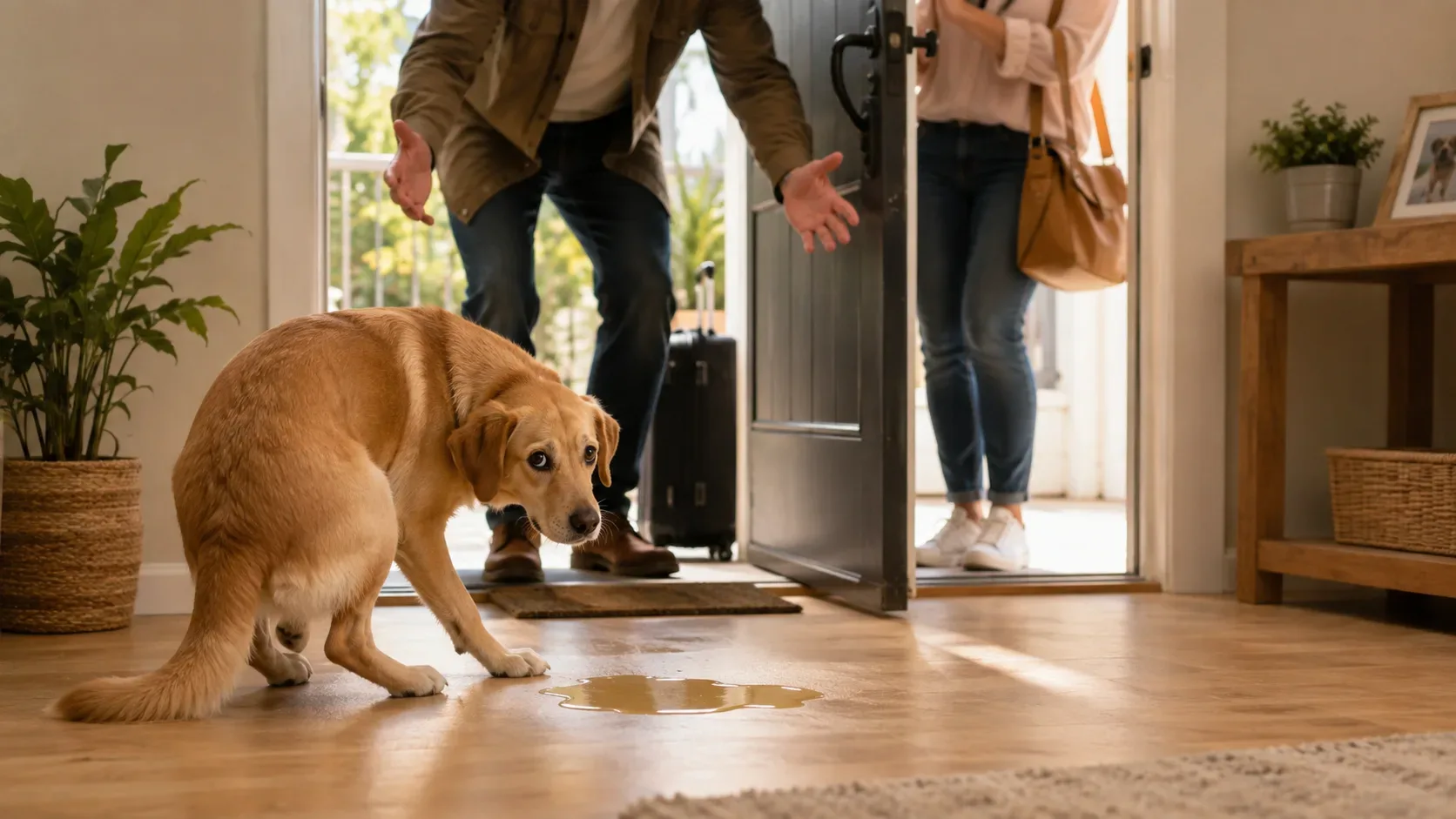
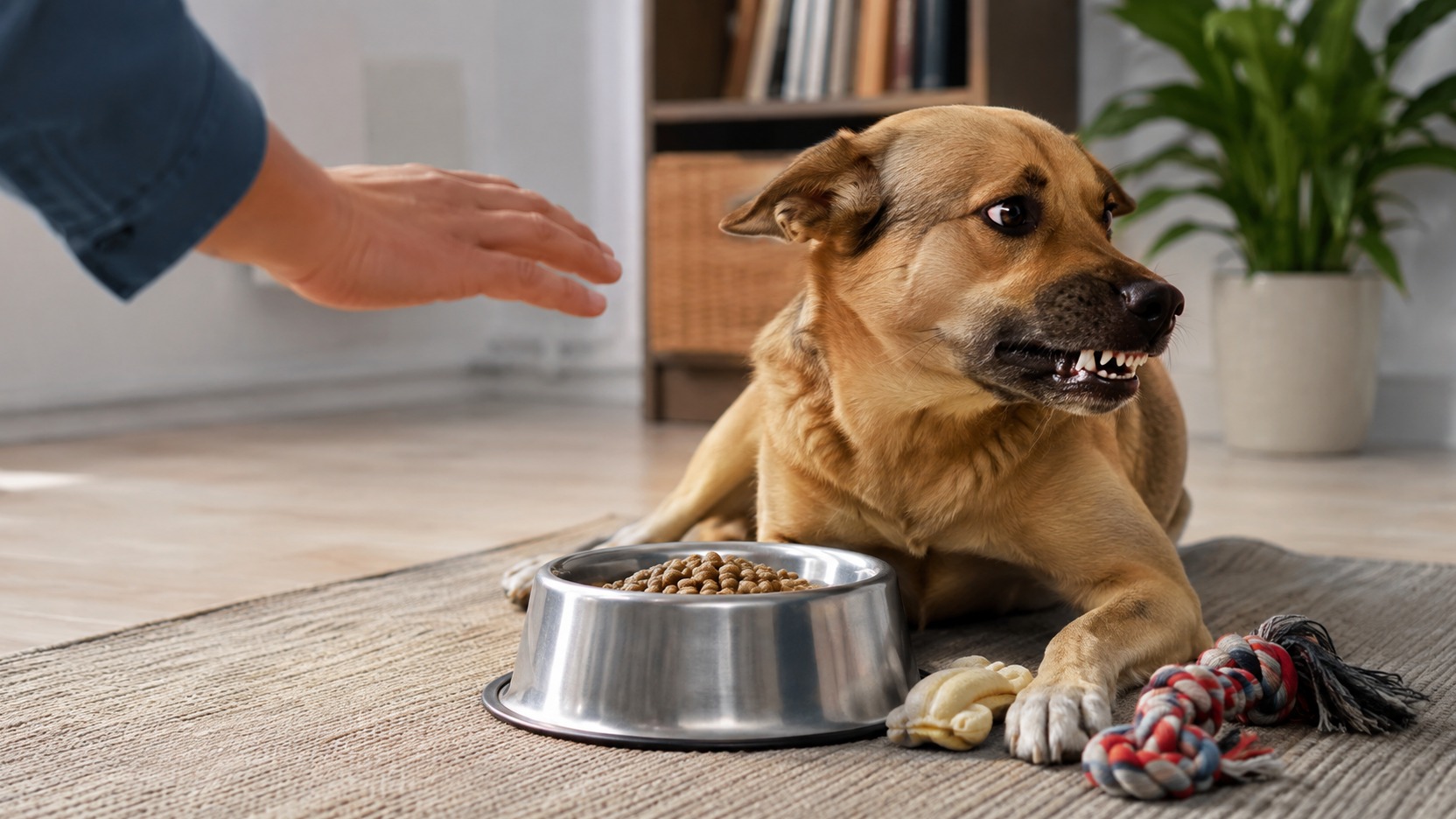
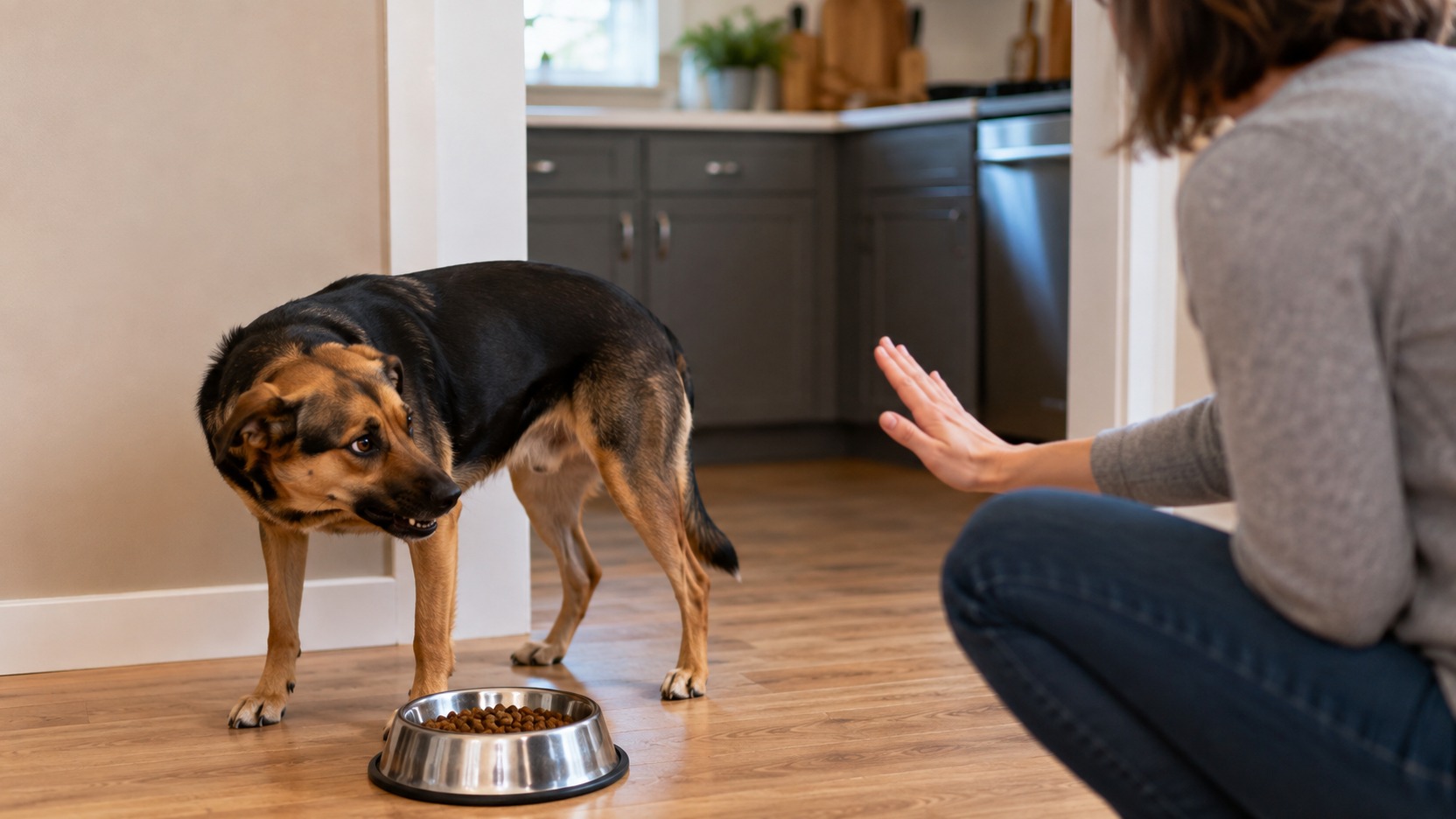
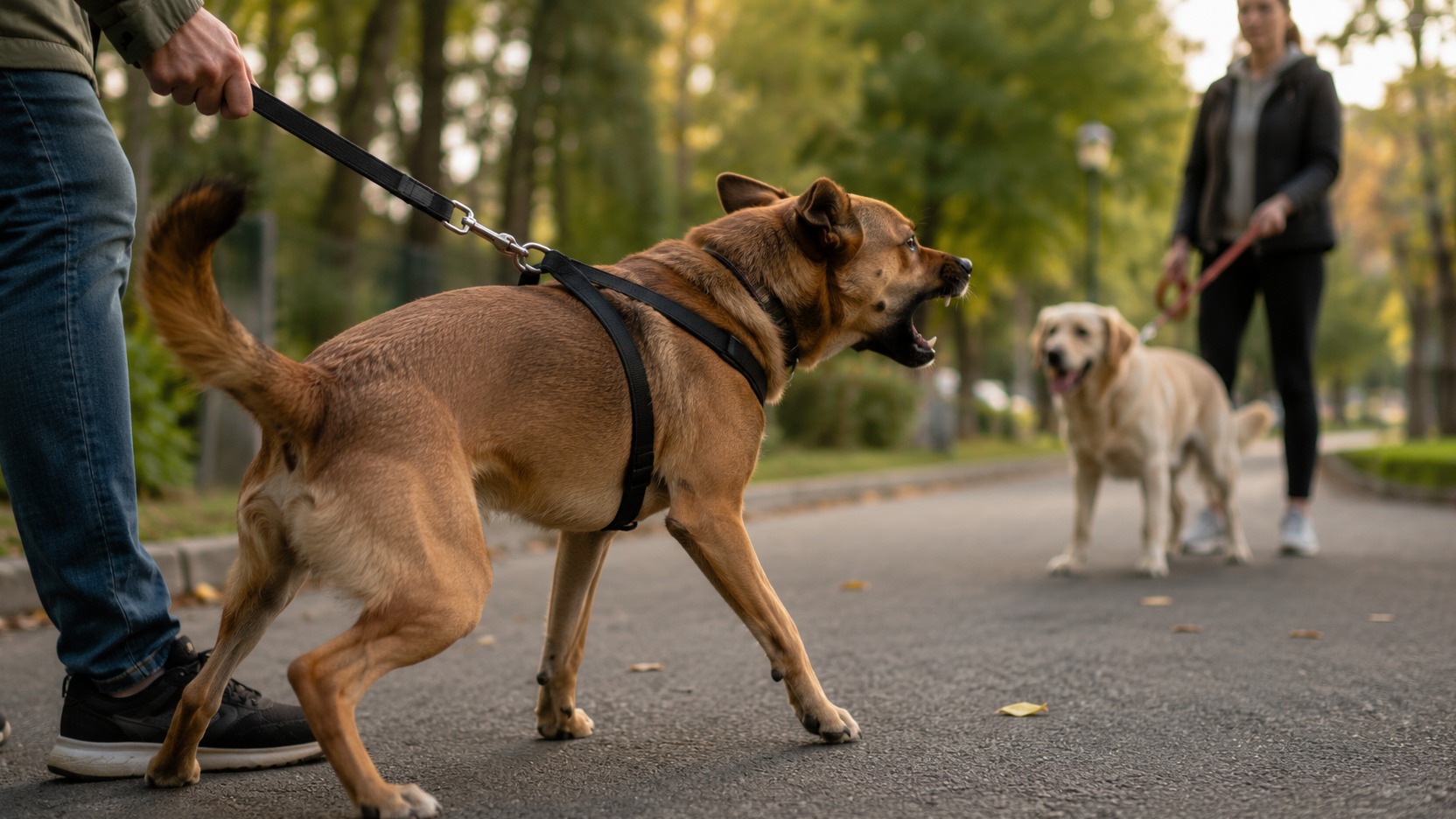
The warning sign is not simply "the puppy bites hard." Watch for the behavior occurring together with body stiffness, freezing, a fixed stare, growling, showing teeth, attempts to move away, or a defensive reaction when someone touches a body part, approaches food, handles an object or insists on an interaction the puppy wants to end.
The American Veterinary Society of Animal Behavior points out that rigid posture and immobility can communicate discomfort. VCA also notes that fear, anxiety, frustration and pain can reduce a dog's tolerance and increase the chance of growling, lunging or biting. A sudden behavior change in a puppy that previously accepted touch or play deserves special attention because pain and physical problems can also appear as irritability or unusual aggression. In these situations, do not test the puppy by repeating the situation to "see whether the puppy bites again." Reduce exposure to the trigger and seek veterinary evaluation, especially if there is pain when touched, limping, loss of appetite, lethargy, vocalization, reluctance to play or another physical change. If medical causes are ruled out and there are consistent signs of fear or aggression, a veterinary behaviorist or another qualified professional who works with reward-based methods can help.
What to do exactly when teeth catch skin or clothing
For play biting, the rule needs to be simple and predictable: teeth on a person make the interesting interaction stop. There is no need to scare, hit, restrain or argue with the puppy. Stop moving, calmly withdraw attention and give the puppy a chance to choose something else.
If the biting started during play, stop for a few seconds and move away. If the puppy comes back calmer, the interaction can restart. If the puppy keeps chasing hands, feet or clothing, increase distance by using a door, gate or pen for a short period, without turning the separation into a scolding. The goal is to make the consequence predictable: biting people ends access to play; keeping the mouth on a toy or settling down keeps good things available.
When the puppy targets ankles while someone is walking inside the house, continuing to pull the leg away often fuels the chase. Stop walking, protect the skin and redirect the puppy to a toy that can be carried or tugged. When the puppy accepts the alternative, start moving again. With repetition, the person's movement stops being the only interesting trigger.
The same logic applies to clothing. Do not turn a pant leg into a tug-of-war toy. Stay as still as possible, offer an appropriate alternative and reinforce the puppy when it lets go of the clothing and chooses the toy. If the puppy is too excited to make the switch, the best response may be to end the interaction for a
moment and help the puppy lower its arousal.
Teaching without punishment means showing what works
AVSAB recommends reward-based methods for training and behavior modification and rejects aversive techniques that depend on pain, intimidation or fear. For a puppy that bites, this changes the focus: instead of trying to make use of the mouth "wrong" through fright or punishment, you teach an alternative that produces a better consequence.
In practice, keep suitable toys within reach in the parts of the house where episodes happen most often. Before petting or playing, have an alternative available. Spontaneously reward moments when the puppy approaches without using teeth, sits, keeps all four paws on the floor, picks up its own toy or relaxes near people. Learning does not happen only when there is a problem; it is built mainly through repetitions in which the desired behavior works. It also helps to anticipate patterns. If the biting appears every day late in the afternoon, after a very intense session or when the puppy has been awake for a long time, do not wait for the outburst before acting. Lower the excitement before that point, offer sniffing or chewing activity and make sure there is a rest period. Tired or overstimulated puppies can lose self-control and become more "mouthy," and a routine with play, enrichment and predictable breaks usually makes training easier.
What tends to make the problem worse
Wrestling with the puppy using your hands teaches exactly the opposite rule from the one the guardian wants to build. If some people let the puppy grab fingers and others end the interaction, the animal receives inconsistent messages. To the puppy, a hand is sometimes a toy and sometimes it is not.
Physical punishment has an additional problem: besides the risk of fear and damage to the relationship with the guardian, a sudden reaction may excite a puppy even more when it was already playing. Slapping the muzzle, holding the mouth shut, rolling the dog onto its back, shouting close to the face or using aversive equipment do not clearly teach which behavior should replace the biting. Growling should not be "corrected" as if it were disobedience either. A growl is information about discomfort. Punishing that warning may not resolve the emotion that caused the problem and may also make the dog less predictable, because the dog learns that warning is dangerous. The safer approach is to understand why the puppy was uncomfortable and work on the cause.
With children, management needs to be stricter
Children move quickly, vocalize loudly and may pull their hand away the moment the puppy's teeth touch them. For a dog in play mode, all of this can increase chasing. VCA identifies children as particularly vulnerable in play-biting episodes because their reactions can unintentionally intensify the game.
The rule is active adult supervision and separation whenever no one can closely monitor the interaction. A child should not be responsible for "teaching the puppy a lesson." Avoid wrestling games, chasing indoors and bringing the child's face close to the dog's muzzle. If the puppy gets into a cycle of running, jumping and grabbing clothes, end the interaction before the child has to defend themselves with their hands.
How to tell whether training is working
Progress usually appears first in quality, not in the immediate disappearance of biting. The puppy begins to stop more quickly, accepts the toy with less persistence, bites with less force, seeks alternatives on its own and can return to a calm state in less time.
It is normal to have better and worse days during development. What should not be ignored is a pattern of increasing intensity, frequent injuries, growing difficulty stopping the behavior, signs of fear or stiffness, biting in specific contexts involving handling or resource guarding, or an abrupt change from previous behavior.
If the family is managing the situation consistently and the behavior remains dangerous or very intense, seeking help early is better than waiting for the puppy to "grow out of it." Professional assessment is useful
precisely because it can identify the function of the biting and adjust the plan to the individual without relying on punishment.
The goal is not to make the puppy never use its mouth again
Chewing, carrying objects and exploring with the mouth are part of normal canine behavior. Training does not need to make those behaviors forbidden; it needs to create clear limits about where and with whom they are appropriate. When the puppy learns that teeth on skin and clothing end the fun, while toys, calm behavior and alternative behaviors keep access to attention and rewards, the rule becomes understandable. At the same time, watching posture and context helps avoid two common errors: treating every normal puppy bite as "aggression" or, at the other extreme, calling a behavior play when it is actually communicating fear, pain or a need for distance.